When evaluating language access services healthcare leaders must treat linguistic accommodations as a fundamental clinical safety standard rather than an administrative convenience. With nearly 30 million individuals in the United States living with limited English proficiency, communication gaps during triage or informed consent pose an immediate threat to patient outcomes. A single linguistic error can distort a diagnosis, compromise treatment, and trigger severe regulatory penalties under federal law.
You already feel the operational strain. Clinical teams face frustrating bottlenecks when attempting to secure qualified medical interpreters during critical encounters, while administrators worry about Section 1557 enforcement and HIPAA compliance across remote communication tools. Protecting patient rights shouldn’t require compromising clinical efficiency or institutional security.
This guide equips you to master federal compliance mandates, navigate modern interpretation modalities, and deploy effective language access strategies across every department. Ahead, you’ll discover how to streamline on-demand workflows, eliminate diagnostic friction, and build a dependable communication infrastructure that upholds patient safety at every touchpoint.
Key Takeaways
- Identify how modern language access services healthcare systems rely on integrate qualified spoken interpretation, American Sign Language, and certified document translation across clinical workflows.
- Align institutional policies with current federal non-discrimination mandates, including Section 1557 rules and Joint Commission performance standards, to mitigate legal risk.
- Determine when to deploy on-demand video, phone, or scheduled on-site medical interpreters based on diagnostic acuity, clinical setting, and patient needs.
- Build a repeatable language access plan driven by community demographic assessments to eliminate intake bottlenecks and improve informed consent.
- Evaluate qualified language service partners using rigorous criteria for interpreter credentialing, rapid connection benchmarks, and robust HIPAA safeguards.
What Are Language Access Services in Healthcare?
In acute clinical environments, language access services healthcare teams depend on function as vital risk-mitigation measures designed to protect patient autonomy, ensure valid informed consent, and prevent diagnostic failure. These services encompass a structured ecosystem of spoken-language interpretation, American Sign Language support, and certified document translation across every stage of the care continuum.
Clear communication directly reduces hospital readmission rates, shortens lengths of stay, and prevents adverse drug events that frequently stem from misunderstood discharge protocols. Comprehensive language interpretation in healthcare allows clinicians to elicit subtle symptom chronologies, assess cognitive baselines accurately, and build necessary therapeutic trust. Reliable access ensures that clinical precision remains uncompromised by linguistic barriers.
The Scope of Limited English Proficiency (LEP) in Healthcare
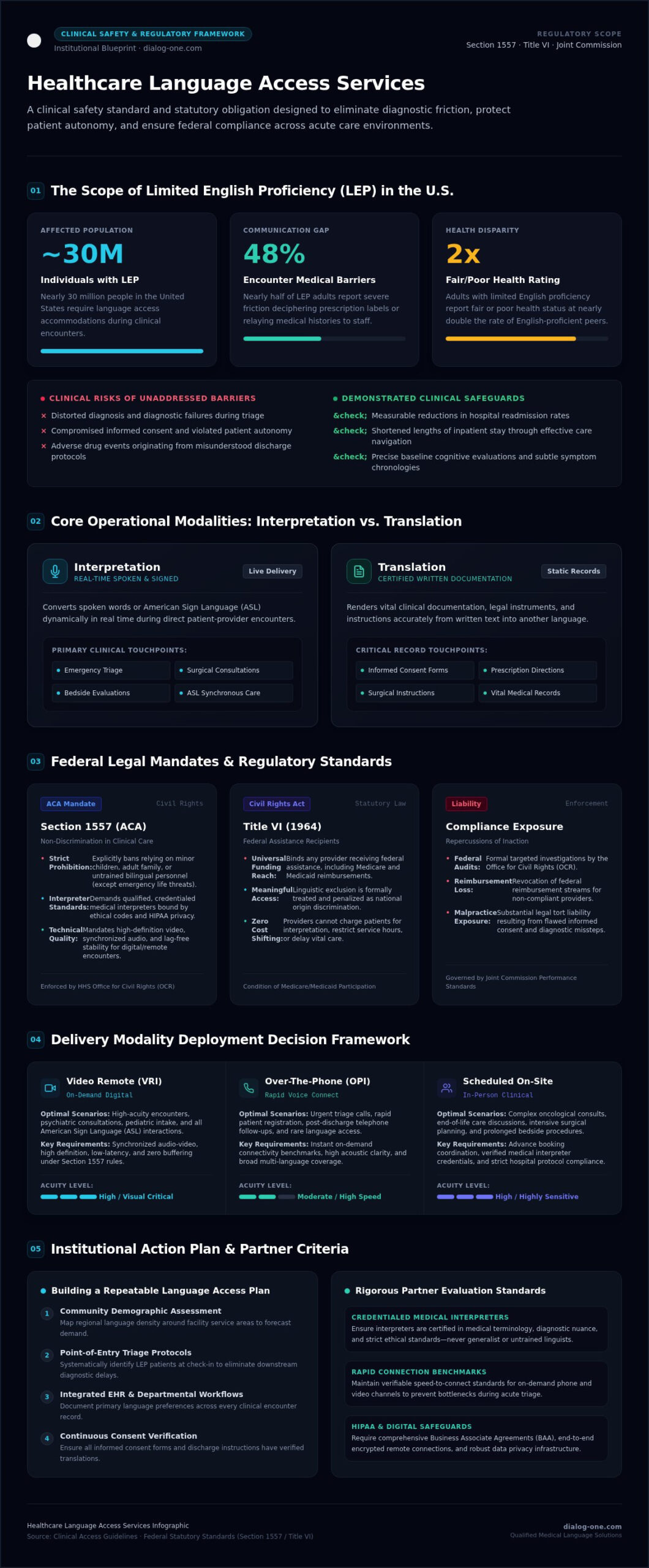
Nearly 30 million individuals across the United States live with limited English proficiency. Research indicates that 48 percent of LEP adults encounter communication barriers during medical visits, from deciphering prescription labels to communicating critical medical histories to intake staff. These friction points compound systemic health disparities. Adults with limited English proficiency are significantly less likely to maintain a consistent primary care home and report fair or poor health status at nearly twice the rate of English-proficient individuals.
Key Distinctions Between Interpretation and Translation
Clinical administrators must distinguish between real-time vocal communication and written documentation to configure their workflows effectively:
- Interpretation: Converts spoken or signed communication in real time during live encounters. This modality addresses dynamic exchanges during triage, surgical consultations, and bedside evaluations.
- Translation: Renders written text into another language, focusing on informed consent forms, surgical instructions, prescription directions, and vital medical records.
Both disciplines demand specialized competence in clinical terminology, diagnostic nuance, and ethical standards. When building comprehensive language access services healthcare providers must approach both areas as interdependent safety protocols requiring qualified human precision.
Federal Legal Mandates and Compliance Standards for Healthcare Providers
Regulatory enforcement requires treating language access as an unyielding statutory mandate rather than an optional bedside courtesy. In federally funded healthcare settings, failing to provide competent linguistic support constitutes unlawful discrimination. The Office for Civil Rights enforces these requirements aggressively; non-compliance invites formal federal audits, loss of federal reimbursements, and severe malpractice liability. To maintain continuous compliance across language access services healthcare administrators must operationalize three foundational legal frameworks.
Section 1557 of the Affordable Care Act
Section 1557 codifies rigorous protections against national origin discrimination. The regulation explicitly prohibits clinical staff from relying on minor children, adult family members, or untrained bilingual personnel to interpret, except in life-threatening emergencies when no qualified interpreter is immediately available. Facilities must utilize qualified, credentialed medical interpreters who adhere to established codes of ethics and patient confidentiality. For digital encounters, Section 1557 mandates strict technical standards: video remote interpreting systems must deliver high-definition video, synchronized audio, and stable connections that prevent communication lag during diagnostic conversations.
Title VI of the Civil Rights Act of 1964
As established by federal law on language access, Title VI obligates any healthcare organization receiving federal assistance, including Medicare and Medicaid reimbursements, to provide meaningful communication for LEP patients at no charge. Regulatory bodies treat linguistic exclusion as national origin discrimination. Providers cannot shift interpretation costs to patients, restrict service hours, or delay critical care while attempting to locate ad-hoc support.
The National CLAS Standards Framework
The National Standards for Culturally and Linguistically Appropriate Services (CLAS) translate federal statutes into concrete operational expectations. Standardized protocols mandate ongoing clinical workforce training, routine audits of community language demographics, and conspicuous public notices detailing language rights. Embedding these benchmarks directly into electronic health record workflows ensures clinicians request language support at intake rather than scrambling during an acute crisis. Partnering with a dedicated language specialist like Dialog One allows health systems to embed qualified interpretation directly into their daily compliance workflows while mitigating institutional risk.
Healthcare Language Modalities: Comparing Interpretation Delivery Methods
Clinical efficacy hinges on matching interpretation delivery to the specific demands of each medical encounter. No single communication channel fits every clinical scenario. High-volume emergency rooms require near-instantaneous connections, whereas complex pediatric oncology consults demand nuanced interpersonal rapport. To optimize language access services healthcare leaders must establish a balanced delivery framework that balances visual fidelity, technical bandwidth, and clinical urgency.
On-Demand Video Remote Interpreting (VRI)
Video remote interpreting bridges immediate access with visual interaction. It provides essential non-verbal cues for psychiatric evaluations, stroke assessments, and pediatric consultations, while serving as the primary delivery vehicle for American Sign Language. Effective VRI deployment demands robust enterprise infrastructure. Clinical units need dedicated high-bandwidth Wi-Fi, specialized mobile carts with rolling stability, and high-definition cameras that function seamlessly without visual distortion or packet loss during vital procedures.
Over-the-Phone Interpretation (OPI)
Over-the-phone interpretation remains the most resilient modality for rapid telephone triage and low-acuity touchpoints. Dial-in audio connects care teams to linguists in seconds, offering critical access across hundreds of spoken languages and uncommon indigenous dialects. Beyond handling routine intake scheduling or billing clarifications, phone lines serve as an indispensable redundant system when local broadband fails or mobile video hardware is in use elsewhere on the floor.
Scheduled On-Site Interpretation
Physical bedside presence remains the gold standard for high-stakes, emotionally sensitive clinical encounters. In-person interpreters excel in complex diagnostic settings, including palliative care discussions, complex surgical planning, and long-term rehabilitation therapies. Their physical presence allows them to observe subtle body language, navigate crowded operating theaters, and manage multiple family members effectively. This modality requires clear operational lead times and standardized arrival protocols to prevent schedule delays.
Selecting the appropriate channel requires evaluating both technical capabilities and diagnostic risks:
- Urgent Triage & Intake: Deploy on-demand phone interpreters to establish rapid linguistic connection and complete initial registration without delay.
- Bedside Diagnosis & Deaf/Hard of Hearing Care: Utilize on-demand video to evaluate non-verbal physical signs and maintain direct visual communication.
- Critical Prognosis & Multi-Party Consultations: Schedule certified on-site professionals to navigate emotional nuance and multi-provider treatment discussions.
Implementing a clear decision matrix ensures bedside clinicians select the right language access services healthcare delivery option instantly, eliminating delays when seconds matter.
How to Implement a Comprehensive Healthcare Language Access Plan
Establishing effective language access services healthcare systems rely on demands an actionable operational framework, not merely a collection of administrative guidelines. A successful plan integrates compliance requirements directly into clinical workflows, establishing repeatable protocols that remove friction at admission and ensure continuity of care across all clinical units.
Linguistic Community Needs Assessment
Implementation begins with empirical data. Healthcare administrators must evaluate demographic reports from their electronic health record (EHR) systems alongside regional census figures to uncover primary and emerging linguistic populations. While Spanish accounts for the majority of non-English encounters nationally, shifts in immigrant or refugee resettlement frequently introduce unexpected requirements for languages such as Dari, Pashto, or Karen. Conducting annual reviews of departmental language requests prevents resource deficits and ensures staffing models align with shifting patient volume.
Clinical Workflow Integration and Staff Protocols
Communication protocols fail when bedside teams lack straightforward activation pathways. Systems must embed language identification directly into patient registration:
- Point-of-Care Identification: Equip intake desks and patient kiosks with digital language identification cards, allowing patients to self-identify their preferred language and specific dialect instantly.
- EHR Standardization: Configure mandatory fields within the EHR that automatically flag linguistic needs and display preferred communication modalities across nursing dashboards.
- Hardware Deployment: Position mobile tablet stands and dual-handset phones within triage bays, procedure suites, and recovery floors to eliminate delays during handoffs.
Every clinical and administrative team member must complete structured onboarding covering interpreter activation, proper positioning during encounters, and legal documentation rules.
Document Translation and Vital Materials Management
Federal standards require organizations to translate vital clinical documents. These include informed consent forms, patient rights notices, advanced directives, discharge instructions, and intake paperwork. Machine translation engines alone are insufficient for these mission-critical documents because clinical nuances require human oversight. Facilities must deploy qualified human translators to preserve clinical accuracy, verify health literacy levels, and adhere to strict version-control protocols whenever clinical policies update.
To audit your current clinical workflows and design a compliant operational infrastructure, consult with the language access specialists at Dialog One.
Selecting a Qualified Healthcare Language Service Provider
Choosing an external language partner directly influences clinical outcomes and enterprise compliance posture. An unqualified interpreter introduces severe legal liability and medical error into the examination room. When vetting vendors for language access services healthcare administrators must evaluate prospective partners through rigorous standards covering clinical credentialing, network architecture, and patient confidentiality protocols.
Medical Interpreter Qualifications and Ethics
General bilingual capability is entirely insufficient for clinical environments. Health systems must verify that linguists possess specialized medical credentials through recognized credentialing bodies. Interpreters must demonstrate complete mastery of anatomical terminology, pharmaceutical classifications, and diagnostic phrasing. Professional partners enforce strict adherence to the National Council on Interpreting in Health Care (NCIHC) Code of Ethics, ensuring neutral, accurate message delivery while maintaining continuous professional boundaries during emotionally intense patient encounters.
HIPAA Compliance and Technical Safeguards
Digital interpretation channels represent protected health information (PHI) touchpoints that require stringent data security measures. Vendors must execute binding Business Associate Agreements (BAAs) across all interpretation delivery streams. Technical infrastructure must feature end-to-end encryption protocols conforming to modern cybersecurity benchmarks. Remote communication systems must enforce a strict zero-recording architecture; video feeds, spoken audio streams, and real-time transcription data must never be cached, recorded, or stored on external servers.
Scalability and 24/7 Responsiveness
Clinical emergencies unfold without warning across day and night shifts. Organizations require language partners equipped to scale instantly across diverse linguistic needs:
- Breadth of Coverage: Secure on-demand access to linguists covering more than 200 languages, ensuring rapid support for low-diffusion and indigenous languages alongside common regional tongues.
- Connection Velocity: Prioritize vendors maintaining sub-minute average connection times for video remote interpretation and phone access during acute emergency room intakes.
- Infrastructure Stability: Partner with established organizations with proven operational history, such as Dialog One, bringing over 25 years of specialized language access experience to deliver 24/7 on-demand access backed by rigorous HIPAA protocols.
Selecting a partner capable of combining rapid digital connectivity with certified human accuracy transforms language access services healthcare programs into dependable, risk-mitigating safeguards across every clinical department.
Strengthening Patient Safety Through Dependable Compliance
Achieving statutory compliance across the language access services healthcare systems deploy protects both institutional integrity and patient well-being. Eliminating communication barriers isn’t merely an administrative obligation; it’s a critical clinical safeguard that prevents diagnostic errors, guarantees informed consent, and honors patient autonomy across every encounter.
Executing an effective strategy requires the right operational partner. With over 25 years of specialized experience, Dialog One delivers 24/7 on-demand phone and video interpreters alongside scheduled on-site support in more than 200 languages. Every encounter is anchored in rigorous HIPAA compliance protocols and certified human linguistic accuracy, shielding your facility from regulatory risk while empowering your clinical teams. Partner with Dialog One for secure, 24/7 healthcare language access and build an equitable care environment where every patient is heard, understood, and safely treated.
Frequently Asked Questions
What is required for a medical interpreter to be considered qualified under federal law?
Under federal standards, a qualified medical interpreter must demonstrate bilingual proficiency, mastery of specialized clinical terminology, and adherence to interpreter ethics. Federal rules differentiate qualified personnel from simple bilingual speakers. Interpreters must understand complex medical concepts, maintain strict impartiality, and accurately convey diagnoses without altering clinical meaning. While national credentialing validates this mastery, compliance centers on proven competency, ethical adherence, and unyielding patient confidentiality during clinical communication.
Can bilingual hospital staff members or nurses act as medical interpreters during procedures?
Bilingual clinical staff may only interpret if the hospital has officially assessed and documented their medical interpreting competency. Conversational fluency isn’t enough for clinical care. Unassessed staff members often misunderstand nuanced pharmacological terms or surgical risks. If a nurse or technician lacks documented qualification as a dual-role interpreter, pulling them into interpretations disrupts their primary clinical duties and creates severe compliance vulnerabilities under federal regulations.
Are healthcare facilities legally permitted to use a patient’s adult family member to interpret?
Healthcare facilities cannot require or routinely allow adult family members to interpret clinical discussions. Section 1557 explicitly bars reliance on adult companions except during immediate life-threatening emergencies where no qualified interpreter is accessible. A patient may specifically request a companion after staff explains that professional interpreters are provided free of charge. Even then, clinicians should keep a qualified interpreter present to verify diagnostic accuracy and protect informed consent.
How does Section 1557 of the ACA regulate video remote interpreting in clinical settings?
Section 1557 establishes mandatory technical and visual performance standards for video remote interpreting across all language access services healthcare facilities provide. Digital platforms must deliver real-time, high-definition video and audio streams over dedicated high-speed connections without lag, buffering, or dropped frames. Displays must be large enough to clearly convey facial expressions and manual signs for American Sign Language. Staff must also receive operational training to connect these remote systems quickly.
What specific clinical documents are classified as vital documents requiring certified translation?
Vital documents include any written materials that directly affect patient rights, legal consent, or clinical safety. Hospitals must provide certified translations of surgical and procedural informed consent forms, discharge instructions, prescription labels, intake questionnaires, and advanced directives. Notices of non-discrimination and financial assistance policies also fall into this category. Translating these critical records requires professional human linguists to ensure medical accuracy, legal enforceability, and clear patient comprehension.
How does a healthcare organization maintain HIPAA compliance when using remote interpreters?
Organizations preserve HIPAA compliance by executing Business Associate Agreements with language partners and deploying encrypted, zero-retention communication channels. Remote phone and video sessions must utilize end-to-end encryption to protect patient privacy during live interactions. Technical systems must forbid saving audio feeds, video streams, or chat transcripts on external servers. Language partners must also verify that remote linguists operate from secure environments that prevent unauthorized observation.
What steps should a hospital take if an LEP patient arrives speaking an uncommon dialect?
When an uncommon dialect presents at triage, staff should immediately leverage on-demand phone interpretation networks to identify and connect with specialized linguists. Point-of-care language identification cards help patients point to their native tongue. Because rare indigenous or regional dialects often lack local in-person interpreters, enterprise language access services healthcare organizations depend on provide 24/7 telephonic access to global linguist networks covering hundreds of rare dialects, preventing delays in emergency stabilization.