A patient arrives in pain, but the clinician and patient don’t share a language. A qualified LEP patient interpreter can help them communicate accurately. Choosing the right format also makes it easier to address the needs of the moment and the care involved.
Healthcare teams may know language support matters and still need to decide how to arrange it during a busy or urgent encounter. Clear communication helps patients ask questions, share information, and participate in decisions. Professional interpretation supports that exchange and helps reduce the risk of misunderstandings.
This guide explains how interpreters support patients with limited English proficiency and how to choose among phone, video, and in-person options. It also covers how to build a consistent workflow for planned appointments and unplanned conversations. On-demand and scheduled interpreting in different formats can help teams match language support to patient needs, clinical context, and timing.
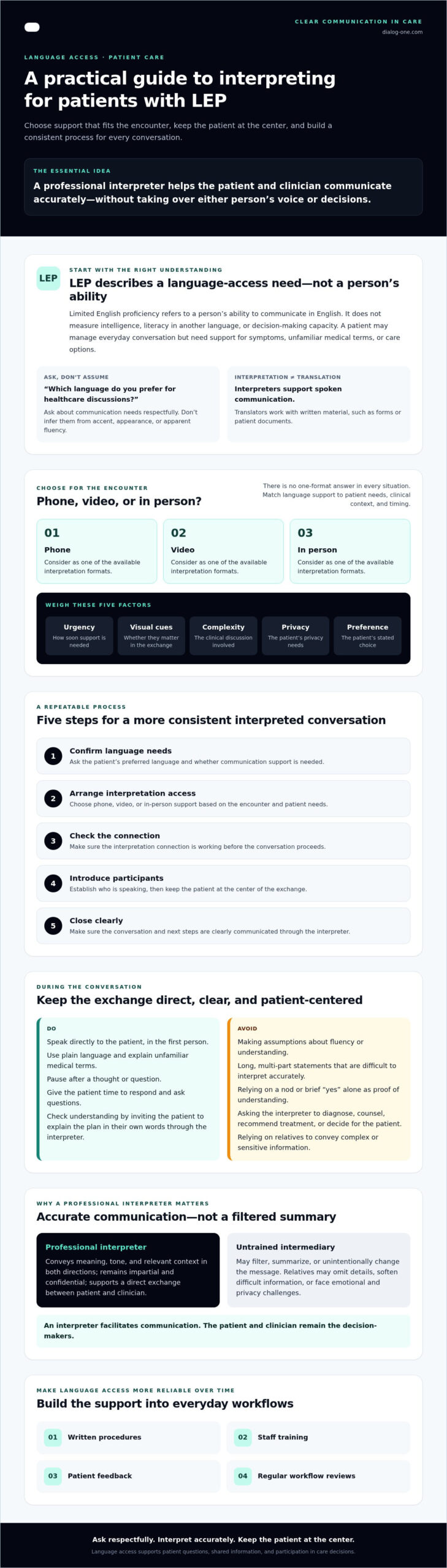
Key Takeaways
- Ask about a patient’s preferred language and communication needs. Don’t make assumptions about their understanding or decision-making ability.
- Use an LEP patient interpreter to convey meaning accurately, and speak directly to the patient throughout the conversation.
- Choose phone, video, or in-person interpretation based on urgency, visual cues, clinical complexity, privacy, and patient preference.
- Follow a repeatable process: confirm language needs, arrange access, check the connection, introduce participants, and close the conversation clearly.
- Improve language access over time with written procedures, staff training, patient feedback, and regular workflow reviews.
What Is an LEP Patient Interpreter, and Why Does Language Access Matter?
A patient may speak some English yet find it difficult to describe symptoms, understand unfamiliar medical terms, or weigh care options in English. Limited English proficiency refers to a person’s ability to communicate in English, not their intelligence, literacy in another language, or capacity to make decisions. Limited English Proficiency (LEP) describes a language-access need, not a measure of a person’s capability.
A qualified healthcare interpreter is a trained professional who accurately conveys spoken communication between a patient and clinician, including meaning, tone, and relevant context, while maintaining impartiality and confidentiality. An interpreter supports spoken communication during an encounter. A translator works with written material, such as a form or patient document.
What does LEP mean in a healthcare setting?
English proficiency can vary by situation. A patient may be comfortable with everyday conversations but need language support to discuss a diagnosis, describe complex symptoms, or understand treatment instructions. Don’t infer a patient’s needs from their accent, appearance, or apparent fluency. Ask respectfully which language they prefer for healthcare discussions and whether they need communication support.
Asking gives patients a clear opportunity to identify what will help them participate. Their preference can also guide the choice of interpretation format for the encounter.
How can language access support patient participation?
With an interpreter, patients can explain what they’re experiencing, raise concerns, and ask follow-up questions in a language they understand well. Clinicians can hear the patient’s account and discuss care options directly, rather than relying on gestures, guesses, or a family member to relay complex information.
Clearer communication supports a more informed discussion, but it can’t guarantee a particular clinical outcome. Clinicians should address the patient directly, use first-person language, and pause regularly so the interpreter can convey each person’s meaning accurately. For broader guidance on planning healthcare language access services, organizations can also consult a comprehensive language-access guide.
What Does a Professional LEP Patient Interpreter Do During Care?
A professional interpreter helps the patient and clinician communicate accurately. The interpreter conveys each speaker’s meaning, tone, and relevant context in both directions, without adding personal opinions or making decisions on either person’s behalf. The aim is a direct exchange between clinician and patient, supported by a neutral communication partner.
A professional interpreter conveys what each person says. An untrained intermediary may filter, summarize, or unintentionally change the message. Interpreters facilitate communication. They don’t diagnose, counsel, recommend treatment, or make choices for the patient. For information about applicable federal language-access responsibilities, healthcare organizations can consult the U.S. Department of Health and Human Services’ Language assistance obligations guidance.
How should clinicians work with a medical interpreter?
Keep the patient at the center of the exchange. Speak to them directly in the first person, such as, “Where does it hurt?” rather than, “Ask them where it hurts.” Use plain language, explain unfamiliar medical terms, and pause after a thought or question so the interpreter can convey it fully. Avoid long, multi-part statements that may be difficult to interpret accurately.
Give the patient time to respond and ask questions. Check understanding with respectful follow-up, such as asking the patient to explain the plan in their own words through the interpreter. A nod or brief “yes” alone may not show that the information was understood.
Why use a professional interpreter instead of relying on family?
Relatives may want to help, but they may omit details, soften difficult information, or interpret selectively without intending to. They may also be balancing emotional concerns with the task of conveying complex medical language. A patient might hesitate to discuss sensitive symptoms or personal circumstances in front of someone they know.
A neutral professional can support a more complete exchange and help protect the patient’s privacy. Respect the patient’s preferences, but don’t assume a family member is able or willing to interpret accurately. A qualified LEP patient interpreter can help keep communication focused on the patient and clinician, particularly when the discussion involves complex or sensitive information.
For planned appointments, teams can arrange scheduled on-site or remote interpreters. On-demand phone and video interpreting can support conversations that arise without advance planning. Dialog One provides professional healthcare interpreting through phone, video, and scheduled interpreter services.
Phone, Video, or In-Person: Which Interpreter Format Fits the Encounter?
No single format suits every appointment. Match the interpreter to the conversation’s urgency, complexity, visual needs, privacy considerations, and the patient’s preference. A short follow-up may work well by phone, while a discussion involving visual information may call for video or an on-site interpreter. Check what’s available and what the patient can use comfortably.
Use this practical comparison as a starting point, not a fixed rule:
- Phone: Useful for time-sensitive or straightforward conversations when video or in-person interpretation isn’t available. It requires reliable audio and may be less suitable when gestures, facial expressions, or visual materials matter.
- Video: Adds visual cues that can help participants follow the exchange and may be useful when the clinician needs to show or discuss something on screen. The connection, device, and setting must work for the patient.
- In person: Allows the interpreter to be physically present and observe the care environment. It may suit complex discussions or encounters where physical context matters, but scheduling and interpreter availability affect whether it’s practical.
When may phone interpretation be appropriate?
Phone interpretation can help teams start a conversation without waiting for a video connection or an on-site appointment. It may fit a focused question or a time-sensitive exchange, provided the patient can hear clearly and speak comfortably. Before proceeding, check the audio, reduce background noise, and ask whether the patient can follow the conversation. If visual information becomes important, reassess the format.
When may video or in-person interpretation be preferable?
Choose video when seeing facial expressions, gestures, or shared visual materials could help the interaction. Consider an on-site interpreter when the encounter’s complexity or physical setting makes an in-person presence useful. Neither option is automatically better. Technology, scheduling, availability, privacy, and patient preference all matter. Protect the conversation from being overheard, and ask the patient which option works best when there’s a choice.
These decisions are part of responding thoughtfully to language barriers in healthcare. The article The Language Barrier in Healthcare: 2026 Trends and Impact Analysis offers broader context. For practical guidance on clinician-interpreter communication, see UCSF’s Interpreter Best Practices.
A qualified LEP patient interpreter can support care by phone, video, or in person. Select the mode that allows the patient and clinician to communicate clearly in the encounter at hand, and be prepared to adjust if the conversation’s needs change.
How Can Care Teams Build an LEP Patient Interpreter Workflow?
A reliable workflow makes language support part of the encounter, not an improvised extra. Assign clear responsibility for identifying a patient’s language needs, arranging an interpreter, preparing the setting, and recording the interaction according to organizational policy. A consistent sequence also helps staff respond when communication needs arise unexpectedly.
What should staff do before the encounter?
Ask the patient which language they prefer for healthcare conversations, then record that preference using the organization’s established process. Confirm any communication needs that could affect the format. Select phone, video, or on-site interpretation based on the encounter, patient preference, urgency, and available access.
Before participants join, check that the space supports privacy and that equipment is ready. For remote interpretation, test the connection, sound, and camera as applicable. Make sure the patient can hear and communicate comfortably before beginning.
How should staff conduct and close the interpreted conversation?
Introduce everyone and briefly explain the interpreter’s role. Speak directly to the patient in clear, complete statements, pausing regularly so each message can be conveyed. Avoid side conversations with the interpreter. At the end, invite questions, clarify next steps, and ask whether the patient needs further communication support.
Document language needs, interpreter use, and follow-up according to workplace procedures. For remote sessions, consult your organization’s privacy or compliance lead about appropriate safeguards. The article “How to Ensure HIPAA Compliance During Remote Interpretation in 2026” may provide additional context, but confirm any guidance against current authoritative sources and your organization’s policies before treating it as a compliance requirement.
A practical encounter sequence can be kept simple:
- Identify: Ask and record the patient’s preferred spoken language and relevant communication needs.
- Arrange: Request an interpreter in the format that fits the encounter and the patient.
- Prepare: Check privacy, access, and audio or video connections before starting.
- Communicate: Introduce participants, address the patient directly, and pause for interpretation.
- Close: Invite final questions, confirm next steps, and document the interaction as policy requires.
For planned appointments, scheduled remote or on-site interpreters can be arranged. On-demand phone and video interpretation can support unplanned conversations. Review professional healthcare interpreting options when shaping a workflow around your team’s needs.
How Can Healthcare Organizations Make LEP Patient Support More Reliable?
Reliable language access depends on a process staff can follow, not on improvising each time a communication need arises. Create written guidance that explains how to identify a patient’s preferred language, request an interpreter, respond when access is delayed or unavailable, and record the encounter according to organizational policy. Identify whom staff should contact when a request can’t be fulfilled through the usual process.
Then review whether the process works in practice. Train staff to request and work with interpreters, invite patient feedback about access and communication, and periodically examine workflows for recurring gaps. Service availability is one measure of operational coverage, not proof by itself of interpreter quality or improved clinical outcomes. Assess those questions separately, using clear criteria and appropriate evidence.
What should an organization evaluate in an interpreting partner?
Before implementation, confirm which languages and access methods are currently available, how scheduled requests are handled, and what support coverage applies. Ask how interpreter qualifications, confidentiality practices, and quality processes are described and monitored. Clarify how staff request help, what happens when access is interrupted, and who is responsible for documenting interpreter use. Verify service details directly and revisit them as organizational needs change.
Technology can make remote access practical, while qualified human interpreters provide professional judgment during communication. These resources can work together. Neither technology nor a service-availability claim should be treated as a guarantee of accuracy or a particular care outcome. Keep human oversight and a clear escalation path in the workflow.
How can interpretation support adapt to different care needs?
On-demand phone or video interpretation can support encounters that arise without advance scheduling. Scheduled remote or on-site interpreters may suit planned, complex conversations where preparation or physical presence is useful. A dependable program makes these options part of one coordinated process, with staff able to select the format that fits the patient and encounter.
Dialog One provides professional healthcare interpreting through on-demand phone and video services and scheduled remote or on-site interpreters. The company reports more than 25 years of language-services experience and services in over 200 languages. Verify current language availability and service details before publication or implementation. A consistent process, supported by appropriate technology and human expertise, helps teams make a LEP patient interpreter part of reliable patient communication.
Make Clear Communication Part of Every Encounter
Reliable language access starts with a simple commitment: identify the patient’s communication needs, bring in a qualified interpreter, and choose a format that fits the conversation. A professional LEP patient interpreter helps patients and clinicians communicate directly, while a consistent workflow makes support easier to arrange for planned and unplanned care.
Phone, video, and in-person interpretation each serve different needs. Train staff to use them effectively, invite patient feedback, and review procedures regularly so language access remains practical and responsive.
Dialog One offers on-demand phone and video interpreting in over 200 languages, with 24/7 service availability, as well as scheduled remote and on-site interpreting. Verify current language availability and service details when assessing your organization’s needs. With a clear process and appropriate human support, healthcare teams can help patients participate more fully in conversations about their care.
Explore Dialog One’s professional healthcare interpreting services to discuss options for your care team.
Frequently Asked Questions
What is an LEP patient interpreter?
An LEP patient interpreter is a qualified professional who conveys spoken communication between a patient with limited English proficiency and a healthcare provider. The interpreter communicates each person’s meaning accurately and impartially, helping the patient and clinician speak directly with one another. LEP describes a person’s English communication needs in a particular setting, not their intelligence, literacy in another language, or ability to make decisions.
When should a healthcare provider use an interpreter for an LEP patient?
Use a qualified interpreter when a patient needs language support to communicate comfortably and understand a healthcare discussion. This may include describing symptoms, discussing treatment options, asking questions, or reviewing follow-up instructions. Ask the patient about their preferred language and communication needs rather than judging fluency by appearance or casual conversation. Arrange support for planned appointments, and follow your organization’s process when an unexpected need arises.
Can a family member interpret for an LEP patient?
A family member may want to help, but shouldn’t be assumed to have the language skills, neutrality, or medical vocabulary needed to interpret accurately. Important details can be missed or changed, and a patient may feel uncomfortable discussing sensitive information with someone they know. Respect the patient’s preferences and follow organizational procedures, while offering a qualified professional interpreter for healthcare communication, especially for complex or private discussions.
Is phone or video interpretation better for LEP patients?
Neither format is best for every encounter. Phone interpretation can be useful for time-sensitive conversations when visual information isn’t needed, provided the patient can hear clearly. Video adds visual cues and may help when participants need to see one another or shared materials. Consider the encounter’s complexity, privacy, technology, availability, and the patient’s preference. If the format isn’t working, pause and assess another available option.
How do clinicians work effectively with a medical interpreter?
Address the patient directly, speak in clear first-person statements, and pause often so the interpreter can convey each thought accurately. Use plain language and explain unfamiliar medical terms. Give the patient time to ask questions, then check understanding with respectful follow-up rather than relying on a nod or brief “yes.” The interpreter supports communication but doesn’t diagnose, advise, or make decisions for the patient.
What happens if an interpreter is not immediately available?
Follow your organization’s language-access process: contact the appropriate staff member, explain the access problem, and ask about another available qualified interpreter or format, such as phone or video. Consider the urgency and complexity of the conversation, and avoid relying on gestures or an untrained person to interpret complex information. For urgent care, follow clinical escalation procedures while seeking appropriate language support as promptly as possible.
Do medical interpreters translate written documents?
Medical interpreters convey spoken communication during conversations; translators work with written material. A patient who needs a form, instruction sheet, or other document in another language may need a qualified translation service rather than an interpreter. Identify whether the information is spoken or written, then use the appropriate language service. For important documents, follow your organization’s process for obtaining and reviewing translated materials.