What does a USCIS certified translation need to include? USCIS doesn’t maintain a list of approved translators. The translation must be complete, and the translator must certify their competence in both languages and the accuracy of the English translation.
A missing stamp, handwritten note, or page can raise questions about whether a translation is complete. It’s also common to wonder whether you need notarization or a translator with specific credentials. The requirements are manageable once you know what to check. This checklist explains what the translator must certify and how to prepare the original-language document and English translation as a complete submission.
You’ll learn what a compliant certification should contain, why every page detail matters, and when notarization generally isn’t required. You’ll also find questions to ask a professional provider about document format, certification, and delivery. Requirements can vary by filing context, so check current USCIS instructions for your application.
Key Takeaways
- Check the current USCIS instructions for your filing and document type before preparing your submission.
- For each uscis certified translation, verify that the certification identifies the translator, is signed and dated, and addresses language competence and accuracy.
- Compare the translation against every source page, including reverse sides with content. Check names, dates, stamps, seals, and handwritten entries.
- Ask a provider who will translate and review the document, how corrections are handled, and what format and certification will be delivered.
- Dialog One offers certified translation for personal documents. Confirm language availability and order details before proceeding.
What USCIS Certified Translation Means for Your Immigration Documents
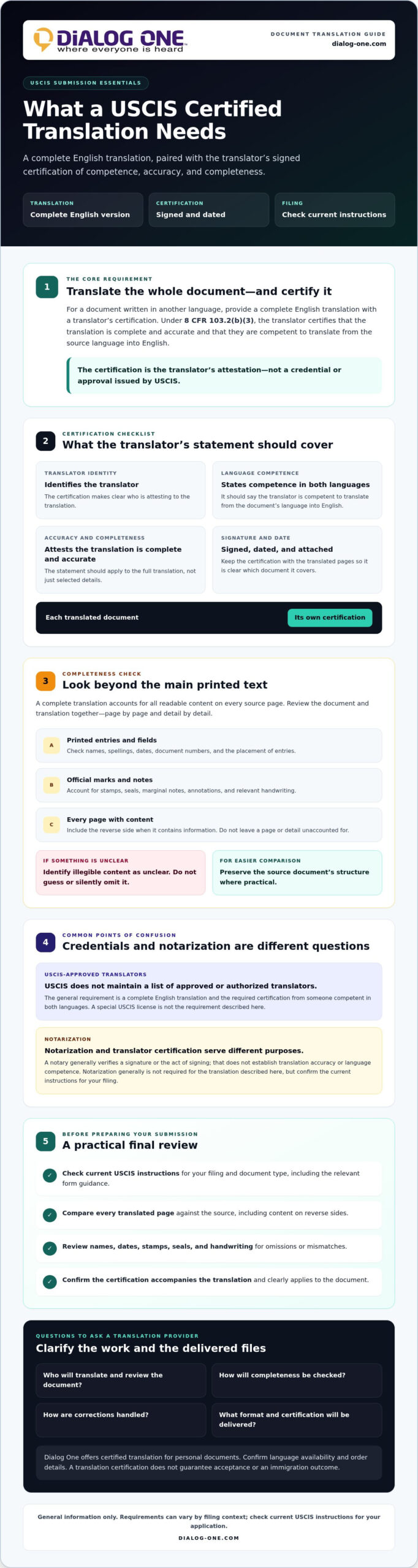
For a birth certificate or another document written in a language other than English, a USCIS certified translation is a complete English translation accompanied by the translator’s signed certification. Under 8 CFR 103.2(b)(3), the translator must certify that the translation is complete and accurate and that they’re competent to translate from the source language into English. The requirement concerns the translation and the person attesting to it, not the outcome of your case.
Completeness means translating more than the main printed text. A certificate may also include stamps, seals, marginal notes, and handwritten entries. These details can help convey what appears on the source document, so check that the translation accounts for them. For a broader overview of what is a certified translation, see the general distinction between a translated document and a translator’s certification.
What does a translator certification usually state?
The certification should identify the translator and state that the translation is complete and accurate to the translator’s knowledge. It should also say that the translator is competent to translate from the document’s language into English. Check that the statement is signed and dated, and that it accompanies the translation it certifies. A certification is an accountable declaration, not simply a cover page or a claim that the document was translated.
For example, if a birth certificate includes a handwritten correction or an official stamp, the English version should account for that content, and the certification should apply to the full translation. Review the certification with the translated pages so it’s clear which document it covers.
Does USCIS certify or approve individual translators?
A common misconception is that applicants must hire a translator with a special USCIS license. USCIS does not maintain a list of approved or authorized translators. The general requirement is a complete English translation with the required certification from someone competent in both languages. A USCIS certified translation is a translator’s attestation, not a credential issued by USCIS.
That distinction doesn’t remove your responsibility to check the paperwork. Requirements can depend on the filing context, so review current USCIS instructions and guidance for the relevant form before submitting a birth certificate. This section offers general information, not legal advice. If you use a professional provider, ask who translates the document, how completeness is checked, and what the certification will state. A careful review can help you spot omissions, but no translation certification guarantees acceptance or an immigration outcome.
USCIS Certified Translation Requirements: What Must Be Included
For a document in another language, USCIS requires a complete English translation with a translator’s certification. The governing rule, 8 CFR 103.2(b)(3), says the translator must certify that the translation is complete and accurate and that they’re competent to translate from the foreign language into English. The certification should accompany the translation, and each translated document should have its own certification.
In short: submit a complete English translation of the document, plus the translator’s signed statement of competence, accuracy, and completeness. Treat this as a practical starting point, then confirm current USCIS instructions and the relevant form’s filing guidance. Requirements can be specific to the application.
What does complete and accurate mean in practice?
Translate all readable content, not just the fields that seem important. For a birth certificate, that may include printed entries, stamps, seals, annotations, and relevant handwriting. Include every source page with content, including the reverse side if it contains information. A partial translation can leave out context USCIS needs to understand the record.
Review the translation against the source line by line. Check names and spellings, dates, document numbers, and the placement of entries. If part of the original is illegible, the translator should identify it as unclear rather than guess or silently leave it out. Preserve the document’s structure where practical so details can be matched to the original.
Do you need notarization or a translator credential?
Notarization and translator certification serve different purposes. A notary generally verifies a signature or the act of signing; that does not establish translation accuracy or language competence. USCIS generally doesn’t require notarization of a certified translation, but check the current instructions for your form and filing before submitting. A special USCIS translator license is not generally required either. The certification and the translator’s stated competence are central.
Use this checklist before filing:
- Confirm the latest USCIS and form-specific instructions.
- Check that every page and visible detail has been translated.
- Compare names, dates, numbers, stamps, and handwriting with the source.
- Make sure the translator’s signed certification accompanies the translation and covers the document.
This information is general, not legal advice. For a case-specific concern, consult a qualified immigration attorney. If you’re arranging a uscis certified translation, ask the provider how it handles unclear text, completeness checks, and certification details. Dialog One offers certified translation for personal documents. Confirm language availability and delivery details for your document before ordering.
How to Choose a USCIS Certified Translation Provider
A provider’s claims matter less than the process behind the finished document. Compare how each service handles language capability, certification, completeness, communication, and corrections. The USCIS translation regulation sets the core certification standard. A provider should also be able to explain how it applies that standard to your birth certificate and its source details.
Use this checklist when comparing options:
- Language and document type: Can the provider handle the source language and a birth certificate in the format and condition of yours?
- Certification: Will the completed translation include the translator’s signed statement of competence, accuracy, and completeness?
- Completeness review: Does the process account for every page and check names, dates, stamps, seals, annotations, and handwriting?
- Communication: Will someone contact you if a name, mark, or passage is unclear instead of guessing?
- Corrections and handling: How can you report an error? What file formats, legibility, and document-handling practices should you expect?
Questions to ask before ordering
Get practical details before sending personal records. Ask who translates the document and whether another person reviews it. Confirm what the certification contains and whether it arrives with the completed translation. Find out which file formats are accepted, what image quality is needed, and how the provider will raise questions about unclear text. Clear answers help you identify gaps before work begins.
Signs of a careful, accountable translation process
Look for a provider that can explain its checks, including how it verifies spellings, dates, document numbers, page coverage, and visible marks. A responsible process also explains how corrections work and flags source text that cannot be read. Be wary of claims that a translation guarantees USCIS approval or that a company has special government endorsement. No provider can promise a case outcome.
Dialog One provides certified translation for personal documents. If you’re considering its service for a birth certificate, ask about current language availability, accepted document formats, certification contents, delivery, and how questions or corrections are handled. These details help you assess whether the process fits your needs without relying on unsupported promises.
USCIS Certified Translation Checklist Before You Submit
A careful final review checks more than the English wording. Treat the source document, translation, and certification as one filing package, then confirm how your application requires them to be submitted. Use this checklist for a birth certificate before sending your materials.
Prepare the source document for translation
- Gather every page. Include the front and any reverse side with writing, stamps, or other content. Don’t assume a blank-looking back can be left out if it contains a mark.
- Make clear, complete scans or images. Check that all text and edges are visible, including seals, stamps, marginal notes, and handwritten entries. If a section is hard to read, tell the provider rather than relying on a guess.
- Share spelling guidance. If supporting records establish a preferred spelling for a name, provide that information to the translator. Flag differences between records for clarification instead of silently changing the source.
- Confirm file requirements. Ask the provider which formats it accepts and whether the document is legible enough to translate. Resolve questions before the translation is prepared.
Review the finished translation and filing package
- Compare each page with its source. Check page order and match names, dates, numbers, and translated entries against the original. Include reverse sides when they contain content.
- Check details beyond the main text. Confirm that visible stamps, seals, annotations, and relevant handwriting are represented, and that unclear text is identified rather than invented or omitted without explanation.
- Verify the certification. Make sure the translator’s signed certification accompanies the translation and states the required competence, accuracy, and completeness. Confirm no translated page is missing.
- Follow your filing instructions. Before sending anything, check current USCIS instructions and the relevant form guidance for whether to submit copies or originals and which submission method to use. Don’t assume the process is identical for every filing.
Final check: match every translated page to its source, confirm the certification is attached, and follow the filing instructions for your form. A complete, carefully reviewed uscis certified translation helps you prepare the document package, but it can’t guarantee application approval.
Dialog One offers professional help with personal-document translation. Before ordering, confirm language availability, accepted file formats, certification details, and delivery.
Get USCIS Certified Translation Support from Dialog One
Before submitting a birth certificate or other personal record, make three checks: review current USCIS instructions for your filing, prepare every page and any content-bearing reverse side, and verify that the translator’s certification accompanies the complete English translation. A careful process can help you catch missing details, but no translation provider can guarantee USCIS acceptance or an immigration case outcome.
Dialog One provides certified translation for personal documents and brings more than 25 years of company experience to its language services. Its focus on human expertise, accuracy, and accountability is relevant when names, dates, stamps, and handwritten entries must be handled with care. Dialog One is not USCIS-approved or endorsed, and its service shouldn’t be treated as a promise of application approval.
What to confirm with a translation provider
Before placing an order, confirm that the provider handles your specific document type and source language. Ask what the certification includes, whether it will be delivered with the completed translation, and which file formats are accepted. Share concerns about hard-to-read text or name spellings, then ask how questions will be resolved. Verify delivery options, turnaround, and correction arrangements directly with the provider, since these details can vary.
These questions help you understand the process before sharing a sensitive personal document. They also give you a clear basis for checking the completed translation against your source and filing instructions. Keep the original document available for review, and don’t assume a translation service determines which version, copy, or submission method your application requires. Confirm those details through current USCIS and form-specific guidance.
How to take the next step with Dialog One
If you’re considering Dialog One for a uscis certified translation, be ready to identify the document type and the language it’s written in. Ask about current language availability, document requirements, certification contents, and how the finished files will be delivered. Settle these practical details before ordering, especially if the source includes unclear marks or several pages.
Professional support can give you a clear point of contact for questions about the translation process. It doesn’t replace your own final review or the need to follow current USCIS filing instructions. Details on the service are available through Dialog One’s certified document translation page.
Prepare Your Translation with Confidence
A sound USCIS certified translation submission starts with a few checks: confirm current instructions for your form, include every page and relevant document detail, and ensure the translator’s certification accompanies the complete English translation. These steps help you prepare a thorough package, though no translation can guarantee acceptance or an immigration case outcome.
Dialog One offers certified translation for personal documents. The company reports more than 25 years of experience and emphasizes human expertise, accuracy, ethics, and accountability. Before ordering, confirm that your source language and document can be handled, and ask about the certification, file format, and delivery details.
Review service details at Dialog One’s certified document translation page before deciding what support you need.
Frequently Asked Questions
Does USCIS require a certified translation of every foreign-language document?
Generally, any foreign-language document submitted to USCIS must include a complete English translation and the translator’s certification. This applies to supporting records such as birth certificates when they’re filed in another language. Check current instructions for your application and form before submitting, since they explain which documents to provide and how to file them. Translate the entire document, not only the fields you expect USCIS to review.
What must a USCIS certified translation include?
A USCIS certified translation must include the complete English translation and a translator’s certification stating that the translation is complete and accurate and that the translator is competent to translate from the source language into English. The certification should identify the translator and include a signature and date. Check that it accompanies the translation it covers. Translate details such as stamps, seals, annotations, and relevant handwriting, not just the main printed text.
Does USCIS require a translator to be certified or licensed?
USCIS generally requires a qualifying translation and certification, not a special government translator license or membership in a professional association. The translator must be competent in both the source language and English and certify the translation’s completeness and accuracy. Applicants remain responsible for providing compliant documents, so review current USCIS and form-specific instructions. A provider’s professional credentials may inform your choice, but they don’t replace the required certification.
Does a USCIS certified translation need to be notarized?
USCIS generally doesn’t require notarization of a certified translation. Notarization typically verifies a signature or the act of signing, while the translator’s certification addresses competence, completeness, and accuracy. They serve different purposes. Before filing, check current USCIS instructions for your application and form in case they specify an additional requirement. Notarization doesn’t make an incomplete translation acceptable or guarantee that USCIS will accept your submission.
Can I translate my own documents for USCIS?
No. Applicants shouldn’t translate their own documents for USCIS. The translation must be certified by someone competent to translate from the source language into English, and the translator must attest to its completeness and accuracy. If you prepare your own version, it won’t meet the requirement for an independent translator’s certification. Consider a qualified person or professional provider, and confirm that the certification will accompany the complete translation before filing.
Do I submit the original document with the English translation?
Submit the source-language document along with its complete English translation and certification, but check your current form instructions to determine whether USCIS requires an original or a copy and which filing method applies. Don’t mail an original unless the instructions call for it. Keep a copy of the documents you submit for your records, and make sure every source page corresponds to the translation, including any reverse side with content.
What happens if a USCIS translation is incomplete or contains an error?
An omission or translation error may prompt USCIS to question whether the document supports your application, request additional evidence, or cause processing delays. The outcome depends on the case, so no specific consequence is guaranteed. Before filing, compare each translated page with the source and check names, dates, numbers, stamps, and handwriting. If you find a problem after submission, review USCIS guidance or seek qualified immigration legal advice about your next step.
For certified translation of personal documents, contact Dialog One to confirm language availability, certification details, accepted formats, and delivery for your document.