What if the translation is accurate, but your application is delayed because a required document or certification is missing? To translate and certify documents successfully, you need more than a word-for-word rendering. A certified translation usually includes the translator’s signed statement about its accuracy and completeness. Notarization or an apostille serves a different purpose and may not be required.
Before submitting personal records to an agency, school, court, or other organization, get its current written instructions. The receiving organization sets the requirements. This guide explains how to prepare your documents, what to expect in a certified translation, and how to distinguish certification from notarization and an apostille. It also covers how to check recipient-specific rules and review names, dates, and other details before submission. Starting with complete documents and clear instructions can help you avoid preventable delays.
Key Takeaways
- Before you translate and certify documents, gather the receiving organization’s written instructions so the translation is prepared for its submission process.
- Translation certification, notarization, and document authentication serve different purposes. Confirm which steps the recipient requires.
- Use the exact agency or institution’s current guidance, since requirements can vary by organization, case, state, and document type.
- Before submitting, confirm that the translated pages, certification statement, supporting documents, and required format are all included.
- Compare names, dates, page order, and visible details against the original to catch inconsistencies before they delay review.
What Does It Mean to Translate and Certify Documents?
To translate and certify documents means to provide a translation with a certification statement, subject to the receiving organization’s requirements. The statement attests that the translation is complete and accurate and that the translator is competent to translate between the languages. It does not amend, authenticate, or otherwise change the original document.
Certification tells the recipient who is responsible for the translation and provides an attestation about its accuracy. It does not guarantee that every agency, school, court, or other institution will accept the same format. Requirements depend on who receives the translation and how the document will be used. The broader meaning of certified translation varies internationally, so use the U.S. submission instructions that apply to your case.
What information does a translation certification usually contain?
A certification is generally a signed statement that identifies the translated document and attests to the translator’s competence and the translation’s accuracy and completeness. The recipient may specify the wording, format, signature, or other details it expects. Use those instructions rather than assuming one template will suit every submission.
Keep the certification with the translated document so the recipient can review them together. For a multi-page document, check that the translated pages stay in the same order as the source and that the certification accompanies the complete translation.
Which documents commonly need certified translation?
People may be asked to provide certified translations of birth or marriage certificates, academic records, and immigration-related documents. These are examples, not a universal list of documents that always require certification. The receiving organization determines whether a translation is needed and what supporting statement or format it requires.
Before ordering, identify the exact document and its intended use, then review the recipient’s current instructions. Note any requirements for the language, certification statement, and submission format so you can share them when requesting the translation. Dialog One provides certified document translation for personal records.
How to Prepare Documents for Translation and Certification
Prepare the source document and submission instructions before requesting a translation. Clear, complete pages give the translator the context needed to represent the document accurately. The receiving organization’s written guidance clarifies the certification format and submission method. Let the recipient’s instructions guide the requested certification format.
Gather the complete source document and recipient instructions
Collect the recipient’s current written instructions first. Check whether it specifies a translator statement, file type, or submission method. For immigration filings, compare the instructions for your specific process with the relevant official U.S. translation requirements. Include every source page, along with relevant stamps, seals, annotations, and reverse sides when applicable. Make sure text and details are readable. Don’t guess at blurred or unclear wording. A legible source helps the translator interpret the document correctly.
Check names, dates, and document details before submission
Compare names and dates with the source and with any identity records the recipient requests. Keep spellings, numbering, headings, and page order consistent throughout the translation. If the source contains a discrepancy, flag it for careful handling rather than silently changing the information. The translation should accurately represent the document as presented, not resolve differences by assumption.
Use this sequence to prepare and check your submission:
- 1. Identify the recipient. Confirm which agency or institution will receive the document and what it will be used for.
- 2. Gather instructions. Save the recipient’s written requirements, including directions about certification, file format, or submission method.
- 3. Assemble the complete source. Include all pages and visible document details, and provide readable copies.
- 4. Request the translation and certification. Share the source and recipient instructions so the translation can be prepared with the requested details in mind.
- 5. Review the finished package. Check that the translated pages and certification are together, details match the source, and the submission follows the recipient’s directions.
Careful preparation reduces the chance that missing pages, obscured seals, or inconsistent details will complicate review. Dialog One provides certified translation for personal documents, combining human expertise with language technology to support accurate, accountable communication.
Certified, Notarized, Sworn, or Apostilled: What Is the Difference?
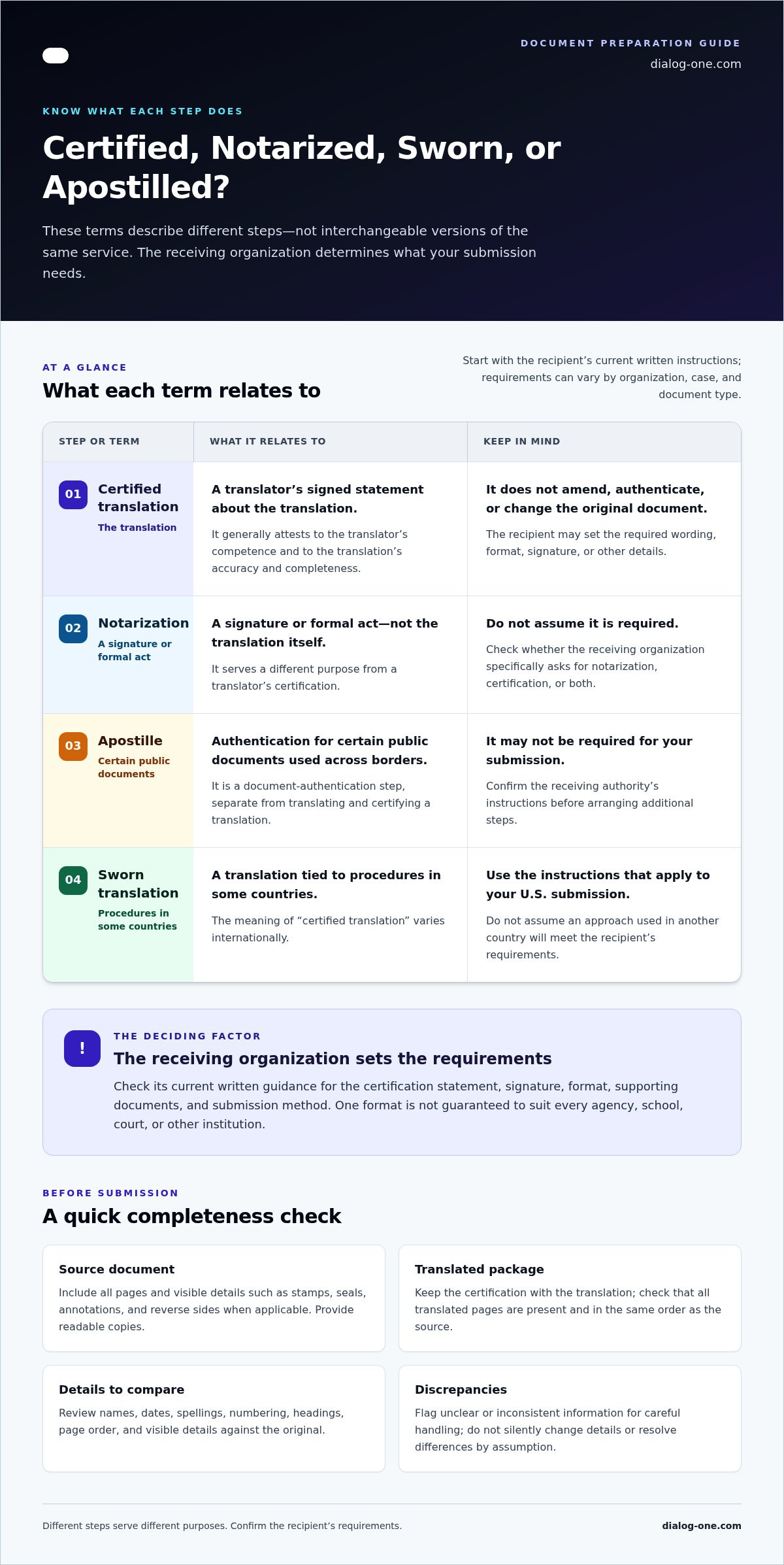
These terms describe different steps, not interchangeable versions of the same service. A certified translation addresses the translation and the translator’s attestation. Notarization concerns a signature or formal act. An apostille authenticates certain public documents for use across borders, while a sworn translation is tied to procedures in some countries. To translate and certify documents, first identify which step the receiving authority requires.
| Term | What it relates to | What it does not establish by itself |
|---|---|---|
| Certified translation | A translator’s statement attesting to the translation’s accuracy and the translator’s competence. | It doesn’t automatically provide notarization, an apostille, or acceptance by every recipient. |
| Notarization | A notary’s verification of a signature or act, according to the applicable procedure. | A notary generally doesn’t assess the translation’s linguistic accuracy. |
| Apostille | Authentication of certain public documents for qualifying international use. | It doesn’t certify that a translation is accurate. |
| Sworn translation | A translation prepared under a country’s sworn-translator system, where applicable. | It isn’t a universal U.S. certification category. |
Certified translation practices differ across countries. The key distinction is that translation certification addresses the translator’s attestation, while notarization or authentication addresses a separate formal requirement. A certified translation is not automatically notarized or apostilled.
Does a certified translation need to be notarized?
Not automatically. Certification and notarization are separate. The translator attests to the translation, while a notary generally verifies the signer’s identity or signature rather than the translation’s content. A receiving agency, court, school, or other institution may separately request notarization or another formality. Follow the instructions for the specific document and submission rather than assuming one rule applies everywhere.
When might an apostille or sworn translation be relevant?
An apostille may be relevant when a public document is intended for use in another country and the destination’s rules call for authentication. It concerns the document’s official status, not the accuracy of its translation. Whether it applies depends on the document, destination, and authority involved.
Some countries also require translations by sworn translators under their own systems. The meaning and procedure vary by country, so a U.S.-style certification may not meet a foreign authority’s requirements. Check the destination authority’s current instructions before arranging extra steps. This helps you focus on the formalities that address the recipient’s actual requirements.
How to Check the Receiving Organization’s Requirements
Start with the organization that will review your documents, not a general checklist found elsewhere. The recipient’s published instructions control the requested format. General U.S. guidance can establish a baseline, but requirements may differ by agency, state, case, and document type. Before you translate and certify documents, locate the instructions for your exact submission and save a copy for reference.
What should you verify in the recipient’s instructions?
Use the receiving agency or institution’s official website, application materials, or written directions. Check the current instructions for the specific document and purpose. Record the page or document you consulted and the date you reviewed it, especially if you’re preparing a time-sensitive filing.
- Does the recipient request a complete English translation and a signed certification statement?
- Does it specify whether to submit a copy, an original, or both?
- Are there directions for page order, file format, delivery method, or file naming?
- Does it request notarization, authentication, or another supporting document?
Separate explicit requirements from assumptions. If the instructions address only the translation and certification, don’t infer an additional formality from another organization’s process.
How should immigration applicants approach document requirements?
For immigration matters, use current USCIS guidance and the instructions for your specific application as your starting point. The federal regulation at 8 CFR 103.2 addresses translations submitted to USCIS, including the requirement for a full English translation accompanied by the translator’s certification of completeness, accuracy, and competence. Review the applicable instructions before preparing your submission, since a general example may not address your document or case.
Keep a short record of what you checked: the application or process, the document type, the source of the instructions, and the review date. Revisit the official guidance if the filing instructions change before submission. For personal documents, Dialog One provides certified translation. Learn more about certified document translation.
Final Review: Submit a Complete Certified Translation
Before sending your packet, review it as one complete submission. Confirm that the translation includes every required page, the certification statement is attached and signed as requested, and any supporting documents are included. A careful final check can catch missing pages or inconsistent details before the recipient reviews the file.
What should you review before sending the documents?
Compare the translation with the source document. Check that all text, stamps, seals, annotations, and other visible details have been represented where relevant. Then verify names, dates, numbers, and headings against the original. If a detail appears unclear or inconsistent, don’t silently correct it. Resolve how it should be handled before submission.
- Translated pages: Confirm the translation is complete and follows the source document’s page order.
- Certification statement: Make sure it accompanies the translation and has the signature or other details the recipient requests.
- Supporting documents: Include any copies or related materials required by the organization.
- File and format: Check legibility, file names, page order, and the recipient’s specified format.
- Submission method: Follow the stated instructions for uploading, mailing, or delivering the documents.
Keep your final version organized so the receiving office can identify the source document, translation, certification, and supporting materials without confusion. Certification documents the translator’s attestation. It can’t guarantee how an agency or institution will assess the application or what decision it will make.
How can professional translation support the process?
Personal documents often contain details that must remain consistent across names, dates, seals, and formal fields. Language professionals give these details focused attention and prepare clear documentation for review. Human oversight matters because a fluent translation still needs careful comparison with the source to preserve its meaning and context.
Dialog One provides certified document translation for personal records, drawing on more than 25 years of language-services experience and combining language technology with human expertise. The service supports careful, accountable communication when you’re preparing documents for submission. Explore certified document translation services.
Prepare Your Translation With Confidence
To translate and certify documents for submission, start with the receiving organization’s current instructions. They determine the certification format and whether additional steps are needed. Then provide complete, legible source documents and review the finished translation for consistent names, dates, page order, and visible details.
Certification documents the translator’s attestation. It doesn’t guarantee that an agency or institution will accept a submission or determine its outcome. A careful final review helps you send a complete package that follows the recipient’s stated requirements.
Dialog One provides certified translation for personal documents, backed by more than 25 years of language-services experience. Its services are available nationwide across the United States, with human expertise supporting clear, accountable communication.
With the right instructions and a consistent, complete translation, you can take the next step with greater confidence.
Frequently Asked Questions
What does it mean to translate and certify a document?
It means providing the translated content with a signed statement attesting to the translation’s accuracy and the translator’s competence. The statement’s wording and supporting details can vary based on the receiving organization’s instructions. Certification doesn’t automatically mean the translation is notarized or apostilled, and it doesn’t mean a government agency has approved it. Check the requirements for the specific document and submission before requesting a translation.
Do all translated documents need to be certified?
No. Whether certification is required depends on the receiving organization and how you’ll use the document. One institution may accept a translation without a certification statement, while another may require a signed attestation or additional formalities. Check the current instructions for the specific application, school, court, or agency. Don’t assume that requirements for one organization or document apply to another.
Can I translate and certify my own documents?
It depends on the recipient, but applicants can’t translate their own documents for USCIS submissions, according to the current guidance reflected in the applicable rules. Other organizations may set different limits or specify particular declarations or qualifications. Read the written instructions for your exact submission before preparing a translation yourself. For important documents, a professional translation service can prepare the translation and certification statement for review against those instructions.
How do I get a birth certificate translated for immigration?
Start with the current instructions for your specific immigration application and confirm what the receiving authority requires. Prepare a complete, legible copy, including relevant text and markings, then arrange an English translation with the required certification. Compare names and dates with the source before filing. Requirements can depend on the application and may change, so use current USCIS guidance rather than relying only on a general checklist.
What happens if a certified translation is rejected?
First, identify the reason the receiving organization gives. The issue may involve missing pages, legibility, formatting, certification wording, or another instruction. Compare the notice with the organization’s current requirements, then correct the specific issue rather than assuming notarization or an apostille will resolve it. Keep the original source document, translation, certification, and any correspondence together as you prepare a complete response or resubmission.
How long does it take to translate and certify a document?
There’s no universal turnaround time. Timing can depend on the document’s length and complexity, language pair, legibility, and required format. To help avoid preventable delays, gather every page and the recipient’s instructions before starting, and flag unclear source text. Leave time to review names, dates, and page order before submission. For timing details specific to a translation project, refer to Dialog One’s service information.
When you’re ready to prepare personal documents for submission, explore Dialog One’s certified document translation services.