What if a translation that looks official still fails to meet the receiving organization’s requirements? Choosing a certified translation agency means looking beyond the label. The right partner should understand how the document will be used, explain what the certification covers, and make responsibilities clear.
If you’re unsure how certified, notarized, and standard translations differ, you’re not alone. In the United States, USCIS requires a full English translation of a foreign-language document with a translator’s certification of competence, completeness, and accuracy. Notarization generally isn’t required unless specifically requested. Other organizations may set their own requirements, so review the recipient’s instructions before ordering.
This guide explains how to compare agencies on acceptance requirements, quality, confidentiality, workflow, and timing. You’ll also find practical steps for preparing documents. With more than 25 years of experience, Dialog One provides certified translation for personal documents and larger projects, combining technology with human expertise where accuracy and accountability matter.
Key Takeaways
- Match the translation service to the document’s purpose and the receiving organization’s instructions.
- Compare a certified translation agency by relevant experience, accountability, confidentiality, and communication.
- Consider language-pair and subject-matter fit to help preserve names, terminology, and document context.
- Prepare for a smoother project by identifying the recipient, languages, purpose, instructions, and clear document files.
- Choose a partner equipped for both personal documents and larger projects, with experienced human oversight.
What is a Certified Translation Agency & When to Use One
A certified translation includes the translated document and a signed statement addressing its completeness and accuracy. A certified translation agency coordinates the translation and provides the accompanying certification statement. That statement helps the recipient assess what is being submitted, but it doesn’t guarantee acceptance. Requirements depend on the organization and the document’s intended use.
Use document translation when written records need to be understood in another language. Examples include a birth or marriage certificate for an application, academic records for an educational review, legal documents for an official matter, healthcare records for care coordination, or organizational materials for administrative use. Interpretation serves a different need: it supports spoken communication during a conversation or appointment.
What makes a translation certified in the United States?
In plain language, certification is a signed declaration that the translation is complete and accurate. It may also state that the person signing is competent to translate between the relevant languages. The statement accompanies the translated document so the recipient can assess the declaration as part of its review.
Certification doesn’t automatically mean the document has been notarized or approved by a government authority. The United States doesn’t have one universal certification authority for every document and recipient. Practices also vary across countries; What is a Certified Translation? offers a broader overview of how the term is used internationally. For a specific submission, the receiving organization’s instructions are the practical reference point.
Which documents may require certified translation?
Personal and institutional records are common examples. A recipient may request a certified translation of:
- Birth, marriage, or other personal records
- Academic transcripts, diplomas, or enrollment documents
- Legal records or documents submitted for review
- Healthcare records used to support communication about care
- Organizational documents for administrative or official purposes
Certification isn’t required in every situation. One organization may request a signed certification statement, while another may give different instructions about the translation or supporting documents. Read the current requirements for the specific submission and share them with the translation team. For immigration or specialized legal submissions, use guidance written for that process rather than relying on general examples.
Certified, Notarized, or Standard Translation: Which Service Fits?
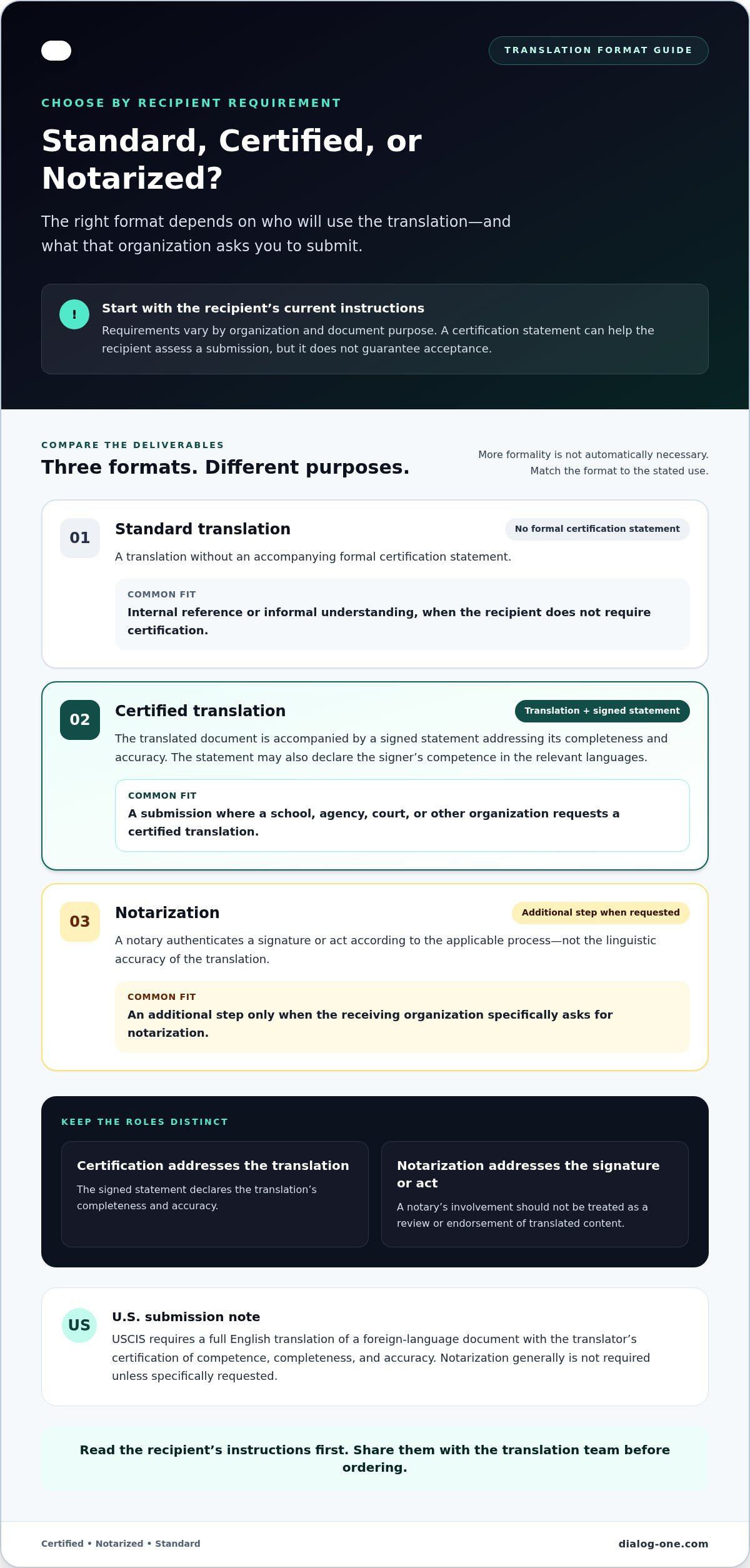
The right format depends on who will use the translation and what that recipient asks you to submit. Certification and notarization serve different purposes, and a more formal document isn’t automatically necessary. Use this comparison to understand the distinctions, then follow the receiving organization’s current instructions.
| Service | What it provides | Common fit |
|---|---|---|
| Standard translation | A translation without a formal certification statement. | Internal reference or informal understanding, when the recipient doesn’t require certification. |
| Certified translation | A translation accompanied by a signed statement addressing completeness and accuracy. | Submissions where an institution or organization requests a certified translation. |
| Notarization | A notary authenticates a signature or act, according to the applicable process. | An additional step when the receiving organization specifically requests notarization. |
How is certified translation different from notarized translation?
Certification addresses the translation: the signed statement records the translator’s declaration about its completeness and accuracy. Notarization addresses the signature or act, not the translation’s linguistic accuracy. A notary’s involvement shouldn’t be treated as a review or endorsement of the translated content.
Recipients determine which format, certification wording, or additional steps they require. Requirements can differ between organizations and countries. For example, the UK’s government requirements for certified documents reflect guidance for that jurisdiction, not a universal US rule. Match the deliverable to the stated instructions instead of adding formalities by assumption.
When is standard translation enough?
A standard translation may suit internal reference materials, such as a document translated so a team can understand its contents. A document submitted to a school, agency, court, or other institution may have different requirements. Don’t assume that internal-use expectations apply to official submissions, or that every institution asks for the same level of formality.
For example, a translated note used only to help a colleague understand a message may not need a certification statement. If the same document is submitted as part of an institutional process, it could be subject to specific format or certification instructions. Check the recipient’s current requirements before ordering.
A certified translation agency can prepare a translation and its accompanying statement for the intended use. Share the recipient’s instructions so the requested format is clear from the outset. For personal documents or larger translation needs, explore Dialog One’s certified translation support.
How to Compare Certified Translation Agencies on Quality and Accountability
A polished website or a fast quote doesn’t show how well an agency fits your document. Compare the substance behind its claims: relevant experience, clear responsibility, careful handling of sensitive information, and communication that sets expectations without promising outcomes outside its control.
What signals a dependable certified translation agency?
Start with responsibility. The agency should explain who is accountable for the translated document and its accompanying certification statement. Relevant experience matters, too. A team familiar with your document type and intended use is better positioned to recognize how context affects names, terminology, dates, and formal wording.
Language-pair and subject-matter fit are practical quality considerations. A birth record, academic transcript, and healthcare document each contain details that need to be rendered faithfully in context. Look for a process explained in plain language, including what information the agency needs and how it communicates project expectations. For immigration submissions, use current official guidance such as USCIS Certified Translation Requirements alongside the receiving organization’s instructions.
Separate useful process information from promises. Clear explanations of scope, responsibility, and communication are meaningful. Claims of guaranteed acceptance, perfect accuracy, or speed without context don’t establish that a translation meets a recipient’s requirements.
How should agencies address confidentiality and technology?
Personal, legal, and healthcare documents can contain sensitive information. Look for clear explanations of how the agency handles documents and addresses confidentiality. A broad phrase such as “secure process” doesn’t explain specific protections; useful details should be stated plainly and accurately.
Technology can support translation work, but it doesn’t remove the need for human judgment and accountability. Names, specialized terms, and document context call for careful attention. Dialog One combines AI technology with human expertise, keeping accuracy, ethics, and accountability central to its approach. The company’s more than 25 years of experience informs its work on individual documents and larger translation projects.
Use these criteria together rather than treating one claim as proof of quality. Relevant experience, a clear statement of responsibility, thoughtful communication, and transparent information about document handling give you a more grounded basis for evaluating a translation partner.
How to Prepare Your Documents and Compare Translation Workflows
A clear project brief helps a certified translation agency understand what you need and how the document will be used. Before submitting files, gather the recipient’s current instructions and provide enough context to define the scope. Doing so can reduce avoidable questions and help set realistic expectations.
What should you prepare before requesting certified translation?
Work through these steps before sending your documents:
- Identify the recipient. Note the organization that will receive the translation and collect its current instructions about certification, format, or other requirements.
- Confirm the language pair. State the source language and the target language. If you’re unsure about the source language, say so rather than guessing.
- Describe the document and its purpose. Identify the document type and explain how it will be used, such as for an academic review or an organizational process.
- Share relevant requirements and timing. Include the recipient’s instructions and any deadline you’re working toward. A requested date helps clarify the project, while timing depends on the document and scope.
- Submit complete, legible files. Check that pages aren’t missing, cut off, blurred, or obscured. Flag handwriting, stamps, or sections that are difficult to read so they can be considered during intake.
Providing these details together gives the translation team a stronger starting point. Don’t omit a page because it appears repetitive or contains little text. The receiving organization’s instructions determine what should be included.
What happens during a document translation project?
A typical workflow begins with intake, when the documents and project details are received. Next, the scope is clarified, including the language pair, document volume, intended use, recipient instructions, and timing considerations. The translation work follows, and the completed materials are delivered according to the agreed project scope.
Each project has its own requirements. Source-file condition and legibility, document volume, and requested format can affect scope and timing. Share uncertainties early, especially if a page is difficult to read or the recipient has specific instructions. Clear communication helps align the work with the information available, without implying a fixed turnaround or guaranteed acceptance.
Dialog One provides certified translation for personal documents and larger projects, with project details tailored to the document and scope. To begin, start a certified document translation project by preparing your files, language pair, purpose, recipient instructions, and relevant deadline.
Why Work with Dialog One for Certified Translation?
Document translation needs can range from one personal record to a substantial set of materials for an organization. Dialog One supports certified translation for personal documents and large document projects, with an approach grounded in human expertise, ethics, and accountability. More than 25 years of experience informs the company’s work across language services and provides perspective for projects where details and context matter.
How does Dialog One support different translation needs?
An individual may need a certified translation of a personal document for an institutional submission. An organization may need a larger volume of documents connected to legal, healthcare, education, government, or administrative work. The scope differs, but both types of projects call for careful attention to the source material and the translation’s purpose.
Dialog One combines AI technology with human expertise. Technology can support language work, while people bring contextual judgment and accountability to communication where accuracy matters. Translation and interpretation also have distinct roles: certified translation addresses written documents, while interpretation supports spoken communication. Dialog One provides both, but interpretation services are not a substitute for a certified written translation.
Choosing a certified translation agency is ultimately about finding a partner whose work aligns with the document and its intended use. Dialog One’s experience with individual and larger project needs offers people and organizations a path to written language support without treating every project as though it has the same scope.
What is the next step for a certified translation project?
Start with the receiving organization. Gather its current instructions, then prepare a complete, legible copy of the document. Include the source and target languages, explain the document’s intended use, and share any recipient requirements or relevant deadline. These details help establish the project’s scope and provide a practical starting point for the translation.
For a personal record or a larger set of documents, provide the purpose and instructions alongside the files. Dialog One tailors project details to the document and scope, grounding the work in the information and requirements you share.
Start your certified translation project with Dialog One by bringing together your document, its intended use, and the receiving organization’s instructions.
Choose Your Translation Partner with Confidence
The right translation starts with the document’s purpose and the receiving organization’s current instructions. Match the requested format to those requirements: certification addresses the translation, while notarization authenticates a signature or act. Then compare each certified translation agency on relevant experience, clear accountability, careful communication, and its approach to sensitive material.
Dialog One brings more than 25 years of language-services experience to certified translation for personal documents and larger document projects. Its approach combines human expertise with technology, guided by ethics and accountability. Whether you’re preparing an individual record or coordinating a broader project, sharing the recipient’s instructions and explaining how the translation will be used helps establish a clear starting point.
Gather your document, source and target languages, intended use, and any recipient guidance. When you’re ready, start your certified translation project with Dialog One. With the right information and a responsible partner, you can take the next step with greater clarity.
Frequently Asked Questions
What is a certified translation agency?
A certified translation agency provides translated documents accompanied by a signed statement addressing completeness and accuracy. The statement may identify the translator’s competence in the languages involved. The agency coordinates the document translation and its certification, but the receiving organization decides whether the submission meets its requirements. Before requesting service, identify the document’s intended use and review the recipient’s current instructions.
Is a certified translation the same as a notarized translation?
No. Certification addresses the translation through a signed statement about its completeness and accuracy. Notarization generally authenticates a signature or act rather than verifying the translation’s linguistic accuracy. A recipient may ask for certification, notarization, both, or neither. Follow the instructions for the specific submission instead of assuming that notarization will make a translation more acceptable.
Does the United States have one universal certified translation requirement?
No single certification format applies to every document and recipient in the United States. Requirements can vary by organization and intended use. USCIS, for example, publishes requirements for translations submitted as part of its processes, while other institutions may provide their own instructions. Review current guidance from the organization receiving your document, including any required statement, format, or additional steps.
Can a certified translation agency translate personal documents?
Yes. Dialog One provides certified translation for personal documents, as well as translation for large document projects. Personal records may include birth or marriage certificates and academic documents, depending on the recipient’s requirements. Share the document’s purpose and the organization’s instructions when preparing your request. This context helps define the project, but acceptance remains the receiving organization’s decision.
How do I choose a certified translation agency?
Compare a certified translation agency by its experience with your document type and language pair, clear responsibility for the translation and certification statement, communication, and its explanation of confidentiality and document handling. Look for practical details about the project rather than promises of guaranteed acceptance or perfect accuracy. Share the recipient’s instructions and assess whether the agency’s explanation aligns with your submission’s requirements.
How much does certified document translation cost?
Certified document translation costs depend on project details, including the document’s length and condition, language pair, and required format. A single personal record and a larger document project may have different scopes. To define the project, provide a legible copy, identify the source and target languages, and explain the intended use and recipient requirements. Dialog One tailors project details to the documents and scope.
Can AI produce a certified translation?
AI can support translation work, but certification requires an accountable signed statement addressing the translation’s completeness and accuracy. Automated output alone doesn’t provide that human declaration. For documents where names, specialized terminology, or context matter, human expertise remains important. Dialog One combines AI technology with human expertise, ethics, and accountability in its translation services.