What if a translated financial statement reads smoothly but changes the meaning of a figure, note, or accounting term? That’s why certified translation for financial statements requires more than fluent wording. Certification relates to the translation; it doesn’t verify the underlying figures or replace an accounting review.
If you’re unsure what certification means, which supporting documents to provide, or how to keep terminology consistent across a set of statements, start by clarifying the recipient’s requirements and gathering the complete source files. Financial documents can contain dense tables, specialized terms, and notes that depend on the surrounding context. Clear expectations help keep the project organized and reduce avoidable revisions.
This guide explains what certification does and does not establish, what to prepare, and how to move the work forward. You’ll learn how to organize statements and supporting material, flag terminology or formatting needs, and review translated files. Dialog One provides certified document translation and large document project translation, combining human expertise with AI technology. The goal is a translation that preserves meaning, structure, and traceability to the source.
Key Takeaways
- Learn what certified translation for financial statements attests to, and where its scope ends.
- See why figures, labels, notes, and cross-references need to remain traceable across translated statements.
- Understand how the recipient and intended use determine whether certification is needed, and how it differs from notarization or an audit.
- Use a practical sequence to gather complete statements, supporting pages, and readable files before submission.
- Explore how Dialog One’s certified document translation and large document project services can support your translation needs.
What Certified Translation for Financial Statements Means
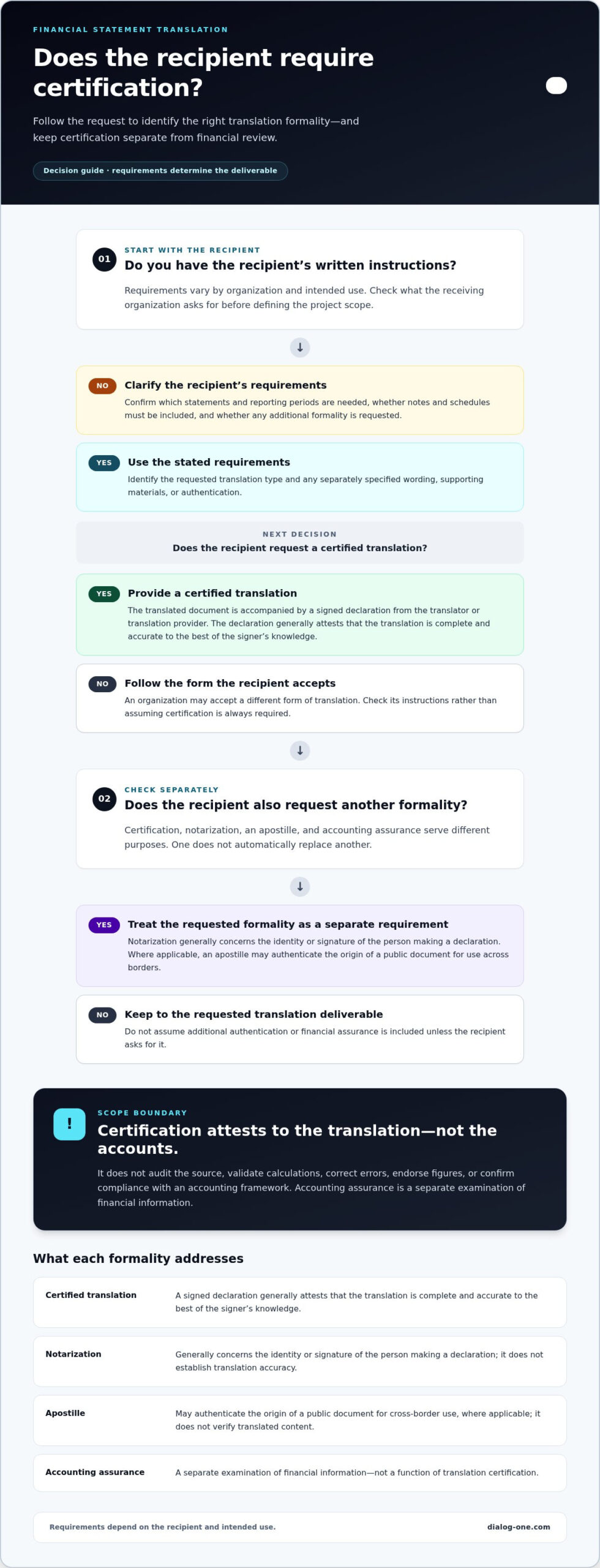
A certified translation is a translated document accompanied by a signed declaration from the translator or translation provider. The declaration generally attests that the translation is complete and accurate to the best of the signer’s knowledge. For certified translation for financial statements, that statement concerns the translation, not the financial performance or reliability of the organization that prepared the original.
Financial statements include more than narrative text. They may contain balance sheets, income statements, cash flow statements, notes, and supporting schedules. The Financial Statements Wikipedia overview provides background on their purpose and common components. Certification doesn’t independently audit the source, validate calculations, or endorse the figures. If a source statement contains an error, certification doesn’t correct or approve it.
What does certification establish for a translated financial statement?
The certification statement typically identifies the translated document and declares that it is a complete and accurate rendering of the source. Its wording and accompanying details can vary according to the recipient’s instructions and the applicable process. Certification is not an audit opinion, assurance report, or confirmation that the source figures comply with a particular accounting framework.
Other formalities have different purposes. Notarization generally concerns the identity or signature of the person making a declaration; it doesn’t establish the translation’s accuracy. An apostille may authenticate the origin of a public document for use across borders, where applicable, but it doesn’t verify translated content. Accounting assurance, by contrast, involves a separate examination of financial information.
When might a recipient request a certified translation?
A recipient may request certification for an institutional submission, business transaction, legal proceeding, or another formal purpose. Requirements vary: an organization may ask for a certified translation, specify particular wording or supporting materials, or accept a different form of translation.
Before defining the project scope, review the recipient’s written instructions. Confirm which statements and reporting periods are needed, whether notes and schedules must be included, and whether notarization or another formality is separately requested. This helps distinguish the translation deliverable from any additional review or authentication the recipient may require.
How Financial Statement Translation Preserves Meaning and Structure
Financial statement translation needs to keep each detail connected to its original meaning and location. A figure separated from its currency symbol, a negative value rendered as positive, or a footnote detached from the line it explains can change how readers interpret the report. Dates, labels, headings, and cross-references also need to remain clear and traceable in the translated file.
Financial translation accuracy means preserving both the data as presented and the meaning of the words, relationships, and structure around it. The aim is not to reinterpret the accounts, but to let readers follow the translated document as they would the source.
Which parts of a financial statement need careful handling?
Review the full document set, not just the main statements. Balance sheets, income statements, cash flow statements, notes, and accompanying schedules may refer to one another. A line item explained in a note should remain identifiable through the same label or a clear equivalent.
Formatting conventions matter, too. Decimal and thousands separators, parentheses or minus signs for negative values, currency symbols, and date formats can differ across source documents and languages. Preserve the underlying value and make its presentation unambiguous. Accounting terminology should reflect the project’s context, including any relevant GAAP or IFRS framework, without assuming either applies automatically. The U.S. Department of the Treasury Financial Report offers an example of formal financial reporting presented as a connected document.
How can translators maintain consistency across financial documents?
Recurring terms should be handled consistently across accounts, entities, reporting periods, and line items. If the same account label appears in multiple statements, translating it differently without a reason can make comparison harder. A glossary or terminology reference can help align choices, especially across a larger document set.
Treat statements and their notes as connected material. References such as “see Note 4” or a schedule identifier need to point to the corresponding translated section. Tables should retain their headings, row relationships, and attachment context as far as the file format allows, so readers can trace each value rather than guess where it belongs.
Human review helps check language, context, and document relationships, particularly where a small change could affect interpretation. Dialog One combines human expertise with AI technology across its translation services, including large document projects. For a complex set of statements, large document translation support can help keep the project organized.
Does Every Financial Statement Need Certified Translation?
No. Whether you need certified translation for financial statements depends on the receiving organization and the document’s intended use. Certification is one feature of a translation deliverable, not a universal requirement for every financial report. A standard translation still needs careful handling of figures and accounting terminology; certification doesn’t turn the translation into an audit.
Certified versus standard financial translation
Use the comparison below as a general guide. The recipient’s instructions determine the requirements for a specific submission.
| Document or process | What it generally involves | Possible purpose |
|---|---|---|
| Certified translation | A translation accompanied by a statement attesting to its completeness and accuracy. | Formal submissions or other uses where the recipient requests certification. |
| Standard translation | A translated document without a certification statement. | Internal analysis or business communication, when the recipient doesn’t request certification. |
| Notarization | Authentication of a signature or declaration by a notary, where required. It doesn’t verify the financial figures. | An additional formality if specifically requested. |
| Audit or assurance | A separate accounting examination or assurance process concerning financial information. | Review of financial reporting, not translation certification. |
Both certified and standard translations require accurate language and careful treatment of the source. The difference is the accompanying certification statement and whether it meets the recipient’s expectations. Certification doesn’t confirm that the original calculations, disclosures, or accounting records are correct.
Examples: A formal submission may call for a certified translation if the receiving organization says so. A team translating statements for internal analysis may need a standard translation instead. A business sharing translated reports with a partner should follow the partner’s stated requirements and intended use. These are examples, not universal rules.
How should you determine the recipient’s requirements?
Start with the receiving organization’s current written instructions and submission checklist. Requirements may differ by organization, proceeding, and purpose, so don’t assume that a previous recipient’s decision applies.
- Check whether certification is requested and whether specific wording is provided.
- Confirm the required file format and whether notes, schedules, or supporting pages must be included.
- Look for any separate request for notarization or other formalities, distinguishing them from translation or accounting review.
Once you understand the requirements, define the project scope around the complete set of documents the recipient expects. This gives the translation team clear direction and helps reduce avoidable revisions.
How to Prepare Financial Statements for Certified Translation
A well-prepared file set gives the translation project a clear starting point. For certified translation for financial statements, the recipient, language pair, reporting period, file format, and intended use can all affect the scope. Use this sequence to organize the request and reduce avoidable follow-up.
- Identify the recipient. Review its current written instructions, submission checklist, and requirements for certification or file format.
- Gather the complete files. Include final statements, notes, appendices, referenced schedules, and any supporting pages the recipient expects.
- Define the scope. Specify the source and target languages, reporting period, intended use, required deliverables, and preferred output format.
- Submit readable source files. Provide complete documents and flag scans, handwritten entries, or unclear text so they can be addressed early.
- Review the deliverables. Compare the translated files with the source for completeness, key details, and document sequence.
What documents and details should you gather?
Start with the final version of each statement, then add every note, appendix, and schedule referenced in it. Missing pages or supporting material can interrupt the work or leave a translated set that doesn’t match the intended submission. Send legible, complete files whenever possible. If a page is scanned, handwritten, or difficult to read, flag it rather than leaving the issue unexplained.
Along with the files, provide the target language, recipient, submission purpose, reporting period, and preferred output format. A request for a particular file type or layout may affect how the translated document is prepared. Project fees depend on factors such as document volume, language pair, and requirements, so a complete scope helps clarify the work.
How should you review the translated deliverables?
Compare the translated set with the source, checking entity names, reporting periods, headings, figures, currencies, and page sequence. Confirm that every in-scope note, table, schedule, and attachment is present. If a discrepancy or unclear source item needs attention, identify the exact page and section to make follow-up precise.
A final completeness check should compare both the structure and content of the translated files against the source. This helps confirm that the deliverable is organized as expected and that no requested material has been overlooked.
Dialog One provides certified document translation and large document project translation, drawing on more than 25 years of language-service experience. Start your financial statement translation project with the recipient’s instructions and complete source files ready.
Start a Certified Financial Statement Translation Project with Dialog One
With the recipient’s requirements clear and your source files assembled, define the work. A certified financial statement translation may involve a single statement or a larger set of reports and supporting documents. A clear scope establishes what needs translation, what certification is requested, and how the translated files should be prepared.
What information helps define the project scope?
Gather the key details before discussing the project. A complete overview helps shape the translation scope and approach around the documents and their intended use.
- Languages: Identify the source language and the language required by the recipient.
- Document volume: Describe the statements, notes, schedules, appendices, and other supporting material included.
- Reporting periods: List the fiscal years or other periods covered, especially if terminology needs to remain consistent across reports.
- File format: Note the source file types and any preferred format for translated deliverables.
- Intended use: Explain who will receive the translation and whether written instructions specify certification or other document requirements.
Include any relevant submission checklist or formatting instructions with the project details. Fees depend on document volume, language pair, and project requirements, so these details help establish the scope and project terms.
What can you expect from Dialog One’s translation services?
Dialog One provides certified document translation and large document project translation for individuals and organizations. These services support both individual documents and broader sets of files. Dialog One combines human expertise with AI technology across its language services. The project scope and approach are shaped by the documents and intended use. Certification remains distinct from an accounting audit or validation of source figures.
To move forward, bring together the recipient’s instructions, complete source files, language pair, reporting periods, and intended use. These details give the project a clear foundation and make it easier to define what the translation needs to include.
Discuss your financial statement translation project
Move Forward with a Clear Translation Plan
A dependable financial statement translation starts with clear recipient requirements and complete source files. Certification attests to the translation, not the accuracy of the underlying figures, and the right deliverable depends on the document’s intended use. Preserving figures, notes, and structure helps readers follow the translated material.
For certified translation for financial statements, define the language pair, reporting periods, document scope, and requested format before starting. Dialog One provides certified document translation and large document project translation, combining human expertise with AI technology across its language services.
Ready to discuss your documents and scope? Discuss your financial statement translation project with Dialog One and take the next step with a clear plan.
Frequently Asked Questions
What is a certified translation of financial statements?
A certified translation of financial statements is a translated document accompanied by a signed statement attesting to the translation’s completeness and accuracy. The certification relates to how the source text has been translated, not whether the original statements are financially correct. The recipient may provide instructions about certification wording, file format, or supporting pages, so review them before defining the project scope.
Do financial statements always need certified translation?
No. Whether certification is needed depends on the receiving organization and the document’s intended use. A formal submission may call for a certified translation, while internal analysis or business communication may have different requirements. These are examples, not universal rules. Review the recipient’s current instructions for certification, particular wording, or additional documentation before submitting translated statements.
Can a certified translation verify that financial statements are accurate?
No. Certification attests to the translation, not the accuracy of the source figures, calculations, or accounting records. It isn’t an audit opinion or accounting assurance. If a statement contains an error, certification doesn’t validate or correct it. Translation communicates the source content in another language; financial verification requires a separate review of the underlying information.
What documents should I submit with financial statements for translation?
Submit the complete final statements, including relevant notes, appendices, schedules, and referenced supporting pages. Also provide the target language, reporting period, intended recipient, purpose, and preferred output format. Complete files help establish the scope and preserve connections between statements and their notes. If a source page is scanned, handwritten, incomplete, or difficult to read, flag it at the outset.
How are figures and accounting terms handled in financial statement translation?
Figures, currency symbols, dates, labels, tables, footnotes, and cross-references should remain traceable to the source. Translators also consider how number and date formats appear in the target language, taking care not to change the value or meaning. Accounting terms should remain consistent across statements and related notes. Relevant terminology may depend on the project’s context, including whether GAAP or IFRS applies; neither should be assumed automatically.
Can financial statements be translated from scanned documents?
Scanned statements can be used as source files when the text, figures, and page details are legible. Faint print, skewed pages, handwritten entries, or cut-off table columns can make content difficult to interpret. Provide complete scans in page order and identify unclear sections. If you have a readable digital source file, include it so the content can be reviewed alongside the scan.
How long does certified financial statement translation take?
Timing depends on the project scope, including document volume, language pair, file condition, and deliverable requirements. A short, clear document set differs from a larger package with extensive notes, schedules, or hard-to-read scans. Share the complete files, reporting periods, target language, and recipient instructions so the project details and timing can be discussed based on the actual scope.