What if an informed consent form is accurate on paper but still difficult for a participant to understand? Effective informed consent document translation preserves the source’s meaning while making essential information clear and usable for the people who need it.
Research teams have important responsibilities when preparing these materials. Complex terminology, translation errors, and outdated versions can confuse participants and disrupt document workflows. A careful process protects clarity at every stage, from preparing the source text to reviewing translated files and tracking updates.
This guide explains how to translate informed consent documents with participant understanding in mind. You’ll learn how to compare quality safeguards, organize translation and review, and keep language versions aligned as study documents change. It also explains how human expertise and technology can work together in high-stakes written communication.
The focus is practical: a transparent workflow that supports clear communication, responsible oversight, and informed participation.
Key Takeaways
- Participant comprehension matters more than word-for-word matching alone.
- A structured workflow helps carry meaning and required details from source review through final version checks.
- Compare translation approaches by their accuracy controls, human review, terminology consistency, formatting, and revision practices.
- Prepare source files, target languages, terminology, and study context to make informed consent document translation easier to manage.
- Set document ownership and a clear process for resolving questions so translated versions stay aligned as source materials change.
What informed consent document translation means for research participants
Informed consent document translation transfers written consent information from its source language into another language while preserving its meaning. It gives prospective participants access to the same study information in language they can understand, so they can consider whether to take part and make a voluntary choice.
Consent involves more than receiving a form. Participants need to understand what the study involves, what may happen if they join, and what choices are available to them. Clear communication supports that understanding, and accurate translation helps ensure the translated document does not change the source’s meaning. The ethical principles behind informed consent center on giving people information they can use to decide for themselves.
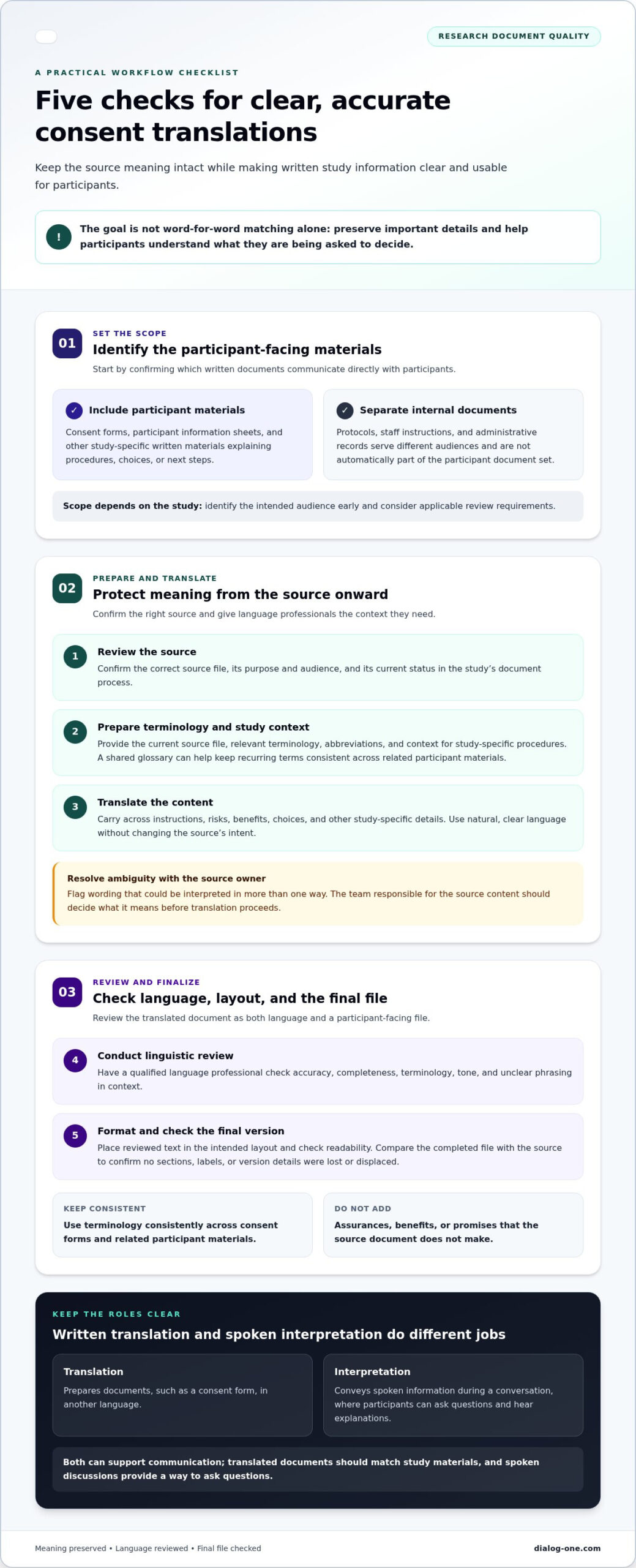
Written translation and interpretation serve different purposes. Translation prepares documents, such as a consent form, in another language. Interpretation conveys spoken information during a conversation, such as a consent discussion with a study team member. Both can support communication, but neither replaces the other: translated documents need to match the study materials, while spoken discussions let participants ask questions and hear explanations.
A translated form can be technically faithful yet difficult to use if it carries over long sentences, unexplained abbreviations, or unfamiliar terms without considering the reader. For example, a technical description of a study procedure may need careful wording so participants can understand what will happen without losing a meaningful detail.
Which materials may require translation for a study?
Participant-facing materials can include consent forms, participant information sheets, and other study-specific written materials that explain procedures, choices, or next steps. The set depends on the study and applicable review requirements. Distinguish these documents from internal protocols, staff instructions, and administrative records, which serve different audiences and purposes.
Make that distinction early. A participant-facing document communicates directly with the person considering or taking part in the study. Internal materials may guide study operations, but they are not automatically part of the participant document set. Identifying the intended audience helps teams organize translation requests and record which materials are meant for participants.
Why participant understanding matters beyond word-for-word accuracy
Meaning depends on more than individual words. Sentence structure, unfamiliar terminology, and cultural context can affect how easily a participant follows the information. Translators should preserve the source’s intent and important details while using natural language that is clear to the intended readers. A translation must not introduce assurances, benefits, or promises that the source document does not make.
Clear consent language helps participants make informed decisions without changing what the study is asking of them. That balance is central to responsible informed consent document translation: protect accuracy, respect the participant’s ability to choose, and make the written information genuinely usable.
How informed consent document translation preserves meaning and clarity
A reliable workflow treats translation as a sequence of connected checks, not a word-substitution task. Each stage should protect the source document’s intent, preserve important study details, and make the translated material usable for participants. Clear ownership also helps the research team resolve questions before they become errors in the final document.
Use a defined process:
- Review the source. Confirm the correct source file, its purpose and audience, and its current status in the study’s document process.
- Translate the content. Carry the source meaning into the target language, including instructions, risks, benefits, choices, and other study-specific details.
- Conduct linguistic review. Have a qualified language professional examine accuracy, completeness, terminology, tone, and unclear phrasing in context.
- Format the document. Place the reviewed text into the intended layout and check that it remains readable and associated with the right content.
- Check the final version. Compare the completed file with the source and confirm that no sections, labels, or version details were lost or displaced.
These stages work best when questions have a clear route back to the responsible study team. A translator can identify ambiguity, but the team that owns the source content should decide what an unclear instruction or phrase is intended to mean. This keeps the translation from silently changing the study’s meaning.
Prepare the source document and study terminology
Provide the current source file used for the study, along with relevant terminology, abbreviations, and context for study-specific procedures. If the source contains wording that could be interpreted in more than one way, flag it for the responsible study team to resolve before translation. A shared glossary can keep recurring terms consistent across consent forms and related participant materials, reducing the risk that the same concept is described differently in separate documents.
Review the translation and protect document usability
Linguistic review should check that all source content is present, the meaning is accurate, and the phrasing suits participants rather than merely being grammatically correct. Review the file as a document, too: check headings, tables, signature fields, footnotes, page references, and instructions tied to a specific location. A sound review process supports quality, but no single method guarantees regulatory acceptance.
Formatting needs its own verification. A translated paragraph may take more or less space than the original, shifting a signature line or separating a heading from the text it introduces. Check the rendered file, not only the text, and confirm that page references and cross-references still point to the right sections. Record the language, source version, and translated version together so the team can trace which materials belong together when the source changes.
For research teams managing high-stakes written materials, Dialog One’s professional translation services can support a careful, accountable workflow.
How to evaluate informed consent translation quality and workflow options
Compare the process, not just the translated file. For informed consent document translation, research teams need to understand how a workflow handles specialized language, participant-facing clarity, document layout, and later changes. A polished document alone does not show whether key details were checked or how questions about the source were resolved.
Translation quality means accuracy, clarity, completeness, and document usability working together. The approach can vary, but accountability for these elements should be visible.
| Quality safeguard | Automated-only handling | Human-led review supported by technology |
|---|---|---|
| Accuracy controls | May produce translated text without contextual review. | Human review can assess meaning and context against the source. |
| Human review | No language professional reviews the output. | A reviewer can flag unclear wording, omissions, or unintended changes. |
| Terminology consistency | Terms may vary across files or sections. | Glossaries and reviewer feedback can help maintain consistent terms. |
| Formatting | Text may need separate checks in the final layout. | Review can include headings, fields, tables, and page references. |
| Revisions | Changes may require manual comparison and tracking. | Version records and review steps can help identify affected content. |
This comparison does not mean one method is right for every study. Technology may assist with language work and document handling, while human expertise supports contextual judgment. The research team should be able to identify who addresses terminology, reviewer comments, and questions about source meaning, and how the final file is checked.
What should a research team assess in a translation workflow?
Assess whether the people and steps involved suit the material’s subject matter and participant audience. A single credential does not establish that a workflow fits every study. Look for a defined method for resolving source questions, applying terminology consistently, and incorporating reviewer feedback. Confirm that formatting and version tracking are considered alongside the translated text, so the delivered document remains usable and traceable.
Certified translation for personal documents serves a different purpose from study-specific review. Certification may document a translation of a personal record, but it does not by itself show that participant-facing research language, study terminology, or document layout received the review a particular study requires.
When does a consent translation need revision?
When the source document changes, assess whether translated versions need corresponding updates. Correcting a typo may have a different impact from revising a procedure, risk description, eligibility detail, or participant instruction. The study team should determine the significance of the change and follow applicable sponsor, IRB, and institutional review processes before using updated materials.
Keep a record linking each translated file to its source version and review status. This makes it easier to identify which language versions may be affected by a change and helps prevent outdated materials from remaining in circulation.
How to prepare consent documents for translation and manage versions
A clear handoff gives translators the context to work consistently and gives research teams a practical way to track each language version. Before starting informed consent document translation, assemble the source materials, identify who can answer content questions, and agree how updates will be recorded. These steps help prevent confusion about which file is current or which change needs attention.
Use this checklist to prepare a translation request:
- Source files: Provide the final source document and note its version or date. Include related participant-facing materials that need consistent wording.
- Target languages: Identify the languages required for the study and the specific materials needed in each.
- Terminology: Share approved terms, acronyms, definitions, and any existing glossary or reference translation.
- Study context: Explain relevant procedures and concepts, who the intended readers are, and any established plain-language preferences.
- Document ownership: Name the person or team responsible for source content and designate a route for questions that need a study-team decision.
What information helps translators work consistently?
Reference materials help translators understand how a term is used in the study, not just what it means in isolation. For example, an acronym may refer to a procedure, assessment, or study group, so its context matters. Providing approved terminology and identifying the intended audience helps maintain consistent wording across a consent form and related materials. Plain-language preferences can guide readability without changing the source’s meaning.
Set a clear process for resolving uncertainty. Translators can flag ambiguous source wording, while the designated content owner clarifies the intended meaning. This keeps decisions about study content with the responsible team rather than leaving them to inference. For broader planning around communication with patients who use other languages, teams may also find healthcare language access services relevant.
How should teams handle updates across language versions?
A simple version log can connect each translated file to its source and responsible owner. Record the source date or version, target language, translation revision status, and the person accountable for tracking the file. The log can also note whether a change is under review or ready for the study’s next approval step. Keep it somewhere relevant team members can access.
When the source changes, compare each translated version against the revised text. Do not assume a small edit affects only one language or one section; check whether related wording, references, or layout also need attention. Distinguish editorial corrections from changes that could alter participant understanding, such as updated instructions or descriptions of study activities. The appropriate study and review stakeholders should decide what action is needed under applicable sponsor, IRB, and institutional processes.
For a structured approach to preparing and managing translated study materials, Dialog One’s translation services support document translation projects.
How Dialog One supports informed consent document translation
Research teams need translated consent materials that preserve the source’s meaning and communicate clearly to participants. Dialog One provides professional document translation for high-stakes written communication, combining human expertise with AI technology. The process gives attention to the context and terminology that shape how a document is understood.
For informed consent document translation, technology can support translation work, while human expertise brings judgment to meaning, tone, and context. A phrase that appears straightforward in isolation may carry a specific meaning in a study or read awkwardly to a participant. Human review can help identify those issues and distinguish a faithful, clear expression from wording that could unintentionally alter the source.
A human-centered approach to high-stakes written communication
Participant-facing healthcare documents require care because readers use them to understand study information and consider their choices. Translation should treat clarity and linguistic accuracy as connected priorities, rather than assume automated output alone is sufficient. Dialog One brings more than 25 years of language-services experience to complex communication, without promising a particular study outcome or review decision.
Human expertise also helps preserve nuance. Reviewers can consider whether specialized terms are used consistently, whether sentences communicate the intended information naturally, and whether any wording could add a promise or change the source’s meaning. These are practical quality considerations, not a substitute for the study team’s decisions or applicable review processes.
Bring the translation project into focus
Each project is shaped by its documents and communication needs. Source files, target languages, study terminology, related participant materials, formatting requirements, and anticipated revisions all affect how teams organize the work. A clear project brief aligns the translation with its intended use and gives the language team useful context for consistent terminology and participant-friendly communication.
Before work begins, research teams can gather current source documents, identify the languages and materials involved, share relevant reference terms, and name the person responsible for answering source-content questions. As source documents change, teams can track versions and determine which translated files need review. Project details can be tailored to the documents and communication needs involved.
Some study interactions also require spoken language support. For conversations where participants and study staff need to communicate remotely, on-demand video remote interpreting serves a different purpose from written document translation.
With a clear understanding of your documents, languages, and project context, Dialog One can support your document translation project.
Make your next consent update easier to manage
Before the next study document changes, assign an owner for the source text and decide how each language version will be reviewed and tracked. That operational step helps your team respond thoughtfully when a revision affects participant-facing information, instead of treating translation as a one-time task. It also gives translators and reviewers a clear point of reference as project needs evolve.
Effective informed consent document translation supports more than document delivery. It helps research teams make study information accessible while keeping participant understanding at the center of their communication decisions. A consistent process gives your team a stronger foundation for preparing clear materials and managing future updates with care.
Dialog One provides professional translation for organizations working in high-stakes sectors, combining AI technology with human expertise. Discuss your informed consent document translation needs with Dialog One and take the next step toward a workflow shaped around your documents and communication needs.
Clearer materials begin with a deliberate process, and your team can put that process in motion.
Frequently Asked Questions
Does an informed consent document translation need to be certified?
Not necessarily. Certification expectations can depend on the study, institution, sponsor, and review process. Some review boards may request documentation describing who completed the translation or how it was reviewed, while others may specify a different process. Certification alone does not show that study terminology is appropriate or that the translated document is easy for participants to use. Follow the applicable study instructions when deciding what records to include.
Can AI translate an informed consent form accurately on its own?
AI can assist with translation, but automated output alone cannot reliably resolve every ambiguity in specialized research language or judge how a phrase may be understood by participants. For example, an acronym may have a study-specific meaning that is not clear from the sentence alone. A human language professional can review terminology and context, while the study team remains responsible for clarifying source content and following its review process.
Who approves a translated informed consent document?
Approval depends on the study’s established review pathway, so no single role should be assumed to approve every version. A translator or reviewer can address language quality, but decisions about study content and permission to use a document belong to the appropriate study and review stakeholders. For example, a sponsor, institutional team, or IRB may have defined responsibilities. Identify who owns each decision before distributing translated materials.
What happens when the original consent form changes after translation?
Compare the revised source with the version used for each language, then identify whether the change affects participant-facing meaning. A corrected spelling error may call for a different response than a new description of a procedure or risk. The team should document its decision, update translations as appropriate, and follow applicable sponsor, IRB, and institutional review processes before replacing materials in use.
Should consent forms be translated word for word?
No. A translation should preserve the source’s meaning, not reproduce its structure so literally that the result becomes unnatural or confusing. Translators may need to rearrange a sentence to make it clear in the target language while keeping the same conditions, choices, and details. For instance, sentence structure can be simplified without omitting a limitation or making a study benefit sound more certain than the source states.
Is informed consent translation the same as interpreter services?
No. Translation creates written materials in another language; interpretation conveys spoken communication between people. A participant may read a translated form and then discuss questions with study staff through an interpreter. These supports serve different moments in the consent process. Plan written and spoken communication separately so a translated document is not treated as a substitute for explaining information or responding to a participant’s questions.
How can teams keep translated consent documents consistent across a study?
Use a shared terminology reference and record which source version each language version follows. When a term changes, identify every related document where it appears, rather than updating only the main consent form. Assign a person to coordinate questions and version records, and ensure reviewers work from the same reference files. This reduces avoidable variation across sites, participant materials, and later revisions.