What if language access were planned as carefully as the agenda, rather than added after the details are set? Conference organizers need to give attendees a clear way to follow sessions and participate, but choosing an approach can feel complicated when a program includes multiple languages, formats, and audience needs. Choosing live event interpretation for conferences starts with matching the delivery format to the event, whether sessions are in person, remote, or hybrid. Coordination matters just as much as the format itself.
This guide offers a practical framework for arranging conference language access. Learn how scheduled on-site and remote interpreters can fit different agendas, what materials to prepare for speakers and interpreters, and how to coordinate sessions for a smoother attendee experience. You’ll also see where AI live transcription and captioning can support access, while professional interpretation helps people communicate across languages. A clear plan for format, preparation, and coordination makes language access part of the conference from the start.
Key Takeaways
- Map audience languages, session types, and participation needs to identify where interpretation will have the greatest impact.
- Compare on-site and remote delivery by venue, audience access, session interaction, and coordination requirements rather than assuming one format suits every event.
- Brief speakers and interpreters, plan for schedule changes, and review how language access worked after sessions.
- Plan live event interpretation for conferences around the agenda, with scheduled on-site or remote interpreters matched to each session’s needs.
Why live event interpretation for conferences belongs in the event plan
Conference interpretation helps participants follow live sessions in a language they understand. The distinction is straightforward: interpretation conveys spoken meaning between languages; translation conveys written content between languages. An interpreter works with what speakers say as it happens, while translated materials are prepared as text. One does not replace the other.
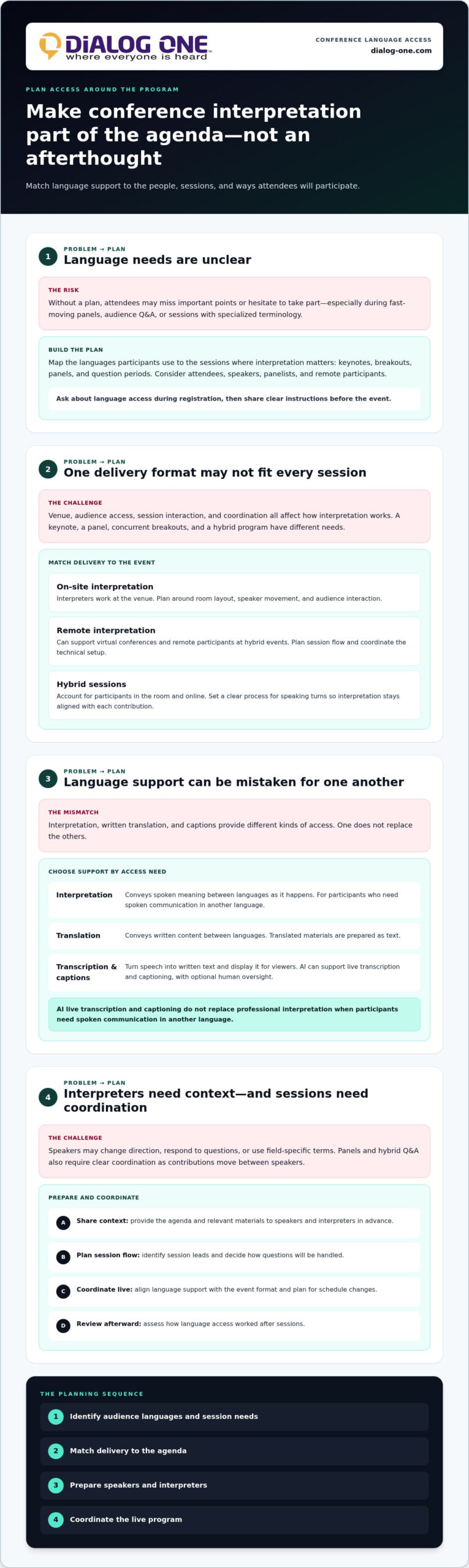
Language access affects more than whether attendees can follow a presentation. Participants who understand the discussion can track its context, contribute to conversations, and ask questions. Without a plan, they may miss important points or hesitate to take part, especially during fast-moving panels, audience Q&A, or sessions with specialized terminology.
Build interpretation into agenda design and attendee communications, not just the final production checklist. Session length, panel format, audience interaction, and language needs all shape the arrangements. Planning early also gives organizers time to explain how participants can access support and coordinate language needs across parallel sessions. For live event interpretation for conferences, access is part of the attendee experience, not an afterthought once registration closes.
Which conference audiences may need language support?
Consider everyone taking part, not only the people seated in the room. Attendees, speakers, panelists, and remote participants may use different languages or need access during different parts of the program. Map the languages participants use to the sessions where interpretation matters, such as keynotes, breakouts, panels, and question periods.
Include language access questions in registration and share clear instructions before the event. This helps organizers plan around attendees’ needs and lets participants know what to expect.
What does an interpreter contribute to a live session?
An interpreter listens to speech and conveys its meaning in another language, using professional judgment to preserve context, intent, and relevant nuance. That requires active attention as speakers change direction, respond to questions, or use field-specific terms. Organizers can support accurate interpretation by sharing context and relevant materials in advance.
Written translation serves documents, while automated captions display spoken words as text. AI live transcription and captioning can support access in a different way, but they don’t replace professional interpretation for participants who need spoken communication in another language.
How conference interpretation works across on-site, remote, and hybrid events
Start with the event, then choose a delivery format. For live event interpretation for conferences, use a practical sequence: identify audience languages and session needs, match delivery to the agenda, prepare speakers and interpreters, and coordinate the live program. Scheduled interpreters can work on-site or remotely, depending on the venue, audience access, and session design.
Agenda pace matters. A keynote with one speaker flows differently from a panel with rapid exchanges and audience questions. Breakouts may run at the same time, while a hybrid program must account for participants in the room and those joining remotely. Map these details early so interpretation arrangements fit the program instead of forcing changes to it.
What changes between on-site and remote interpretation?
On-site interpretation places interpreters at the venue, where room layout, speaker movement, and audience interaction shape coordination. Remote interpretation supports virtual conferences and can also serve remote participants at a hybrid event. It connects interpreters and audiences remotely, but organizers still need to plan session flow and coordinate the event’s technical setup. The right fit depends on how the conference is delivered and how participants will take part.
For example, a hybrid panel with questions from both the room and an online audience needs a clear process for managing speaking turns and keeping interpretation aligned with each contribution. Plan this interaction before the session. For a closer look at remote service arrangements, explore this guide to on-demand video remote interpreting.
Where do live transcription and captions fit?
Interpretation and captions serve different purposes. An interpreter conveys spoken meaning from one language into another. Transcription turns speech into written text, and captions display that text for viewers. AI can support live transcription and captioning, with optional human oversight. Neither should be treated as a substitute for professional interpretation when participants need spoken communication in another language.
Choose support based on the access need. A participant who needs to follow spoken content in another language needs interpretation; someone who benefits from reading speech may use captions. The AI live transcription services overview explores the technology’s role in event communication. Preparation and expertise also matter: the Conference of Interpreter Trainers advances excellence in interpreter education.
Make coordination specific: share the agenda, identify session leads, decide how questions will be handled, and align language support with the event format. Dialog One provides scheduled on-site and remote interpreters to help organizers plan conference access around their program. Details are available in this conference interpretation planning resource.
On-site vs. remote conference interpretation: compare the right fit
Neither on-site nor remote interpretation suits every conference. Compare the venue, who needs access, how sessions run, and what organizers must coordinate. A format that fits a single-room meeting may not work as well for a hybrid program with simultaneous sessions and questions from both in-person and remote participants.
| Planning factor | On-site interpretation | Remote interpretation |
|---|---|---|
| Venue | Fits programs centered on a physical venue and shared in-room sessions. | Fits virtual events or conferences that need language support for remote participation. |
| Remote access | Primarily serves people attending in person unless remote access is also planned. | Can support attendees joining virtually, including remote participants in a hybrid event. |
| Session interaction | Room layout, speaker movement, and in-person questions shape coordination. | Session transitions and the flow of contributions from remote participants need clear coordination. |
| Coordination needs | Organizers plan around the venue, schedule, and how people will take part in each session. | Organizers align remote interpretation with the event’s sessions and participation flow. |
Use the comparison as a planning tool, not a ranking. For a hybrid event, focus on how in-room and remote audiences will participate in the same session. If a panel takes questions from both groups, decide how contributions will be recognized and how interpretation will stay aligned as speakers change. Mapping the flow in advance helps prevent either audience from being overlooked.
When may on-site interpretation suit a conference?
On-site delivery may suit a conference built around shared physical sessions, direct interaction, and a consistent venue. Consider the room arrangement, schedule, movement of speakers and attendees, and how questions will be handled. Dialog One provides scheduled on-site interpreters for organizers planning language access around an in-person program. Use the session structure to guide coordination.
When may remote interpretation support conference access?
Remote delivery may fit a virtual conference or an event where participants need language support from a distance. It can also support the remote audience at a hybrid event. Plan for transitions between sessions, identify how attendees will participate, and make the expected flow clear to speakers and interpreters. Dialog One provides scheduled remote interpreters for conference planning.
Takeaway: Let the event format, audience participation, and session flow determine whether on-site, remote, or a combination best supports access. For live event interpretation for conferences, Dialog One can arrange scheduled interpretation around those needs. Explore conference interpretation options.
How to prepare speakers, sessions, and attendees for interpretation
Preparation makes interpretation a coordinated part of event delivery rather than a service booked in isolation. For live event interpretation for conferences, consider audience needs, program structure, and the people who will speak and participate. After the event, review what worked so future planning can build on practical experience.
- Map language needs. Use registration information and event communications to identify the languages attendees use. Consider speakers, panelists, in-person participants, and remote attendees, then note which sessions each group needs to access.
- Review the program. Identify session formats, overlapping breakouts, panel discussions, presentations, and audience questions. Note where speakers may use specialized terminology or where fast pacing and turn-taking could make interpretation more demanding.
- Share context with interpreters. Provide the agenda, speaker names, relevant terminology, and background on each session. Explain the audience, subject matter, and likely discussion flow so interpreters have useful context before the event.
- Brief speakers and session leads. Explain how interpreted sessions will run. Ask speakers to use clear pacing, explain specialized terms, and allow orderly turn-taking so interpreters can convey complete contributions.
- Coordinate changes and review. Set a process for communicating updates to timing, speakers, or session content. After the conference, gather feedback from attendees and session leads to identify what worked and what to improve next time.
What should organizers share before conference sessions?
Useful preparation goes beyond sending a calendar invitation. Share current agendas, presentation materials when available, speaker names, key terminology, and enough context to clarify each session’s subject and purpose. Include session timing and format, such as planned audience questions or panel discussion. If a session changes, communicate the update through a clear process so interpreters and relevant participants have the same information.
How can attendees and speakers support interpreted sessions?
Brief speakers to articulate clearly, maintain a measured pace, and explain unfamiliar terms rather than relying on unexplained acronyms. Session leads can help ensure complete interpretation by recognizing speakers in turn and avoiding overlapping contributions. Tell attendees how to access interpretation and ask questions or join the discussion. Clear instructions before the event help participants take part without disrupting the session flow.
A consistent preparation process helps organizers coordinate language access across sessions while leaving room for program changes. This conference language access resource from Dialog One covers planning around audience, agenda, and session needs.
Arrange live event interpretation for conferences with Dialog One
Start planning with four practical questions: Which languages do participants use? Will the event be on-site, remote, or hybrid? What sessions and interactions are on the agenda? What context can organizers share to prepare interpreters? Clear answers help align language support with the program instead of treating each session as a last-minute decision.
Dialog One provides scheduled on-site and remote interpreters for conference planning. AI live transcription and captioning can support attendees who benefit from written access to spoken content, with optional human oversight. These services have different roles: transcription and captions present speech as text, while interpreters convey meaning between spoken languages.
Dialog One brings more than 25 years of language-services experience to its work. On-demand phone and video interpretation in more than 200 languages is a separate service capability from scheduled conference arrangements.
What Dialog One brings to conference language access
Scheduled interpretation can be planned around an event’s format, agenda, and session requirements. On-site and remote options give organizers different ways to arrange language access for in-person programs, virtual participation, or events with both. Dialog One’s scheduled interpretation services help organizers account for session structure and how participants will take part. AI transcription and captioning, with optional human oversight, can provide an additional form of written access without replacing professional interpretation.
What to include in an event interpretation request
Give the planning conversation a clear foundation. Share the event’s structure and access needs, including:
- Event dates and the session schedule, including overlapping sessions or planned changes.
- Venue details or the event’s remote or hybrid delivery format.
- Languages participants use and the sessions where interpretation is needed.
- Participation patterns, such as panel discussions, audience questions, or remote contributions.
- Whether the event needs interpretation, transcription, captioning, or a combination of supports.
These details connect the requested support to the attendee experience. A program with parallel sessions, for example, needs a different plan from a single-track event. Audience questions also affect how session participation is coordinated. Share updates as the schedule or speaker lineup changes so arrangements reflect current requirements.
For a considered plan for live event interpretation for conferences, discuss conference interpretation with Dialog One.
Make language access part of your next event plan
At your next planning meeting, assign clear ownership for language access. Decide who will track attendee needs, share program updates, brief speakers, and gather feedback after sessions. A named point person helps keep these details connected as the agenda evolves, instead of scattering them across registration, production, and speaker communications.
This approach makes live event interpretation for conferences more than a one-time arrangement. It gives organizers a practical way to learn from each event and make future programs more responsive to attendees. Start with the sessions where understanding and participation matter most, then build a plan that can grow with the conference.
Discuss conference interpretation with Dialog One and plan language access around your event.
Frequently Asked Questions
What is live event interpretation for conferences?
Live event interpretation for conferences helps participants follow spoken presentations and discussions in another language as the event unfolds. Organizers can plan it for specific sessions rather than assume every attendee needs the same support throughout the program. For example, a conference might prioritize interpretation for its opening session and audience Q&A, then plan different access options for smaller breakout discussions.
Is conference interpretation available for virtual and hybrid events?
Yes. Conference interpretation can be arranged for virtual events and hybrid programs with in-person and remote participants. The plan should account for how people in each audience will follow the discussion and take part. For a hybrid panel, organizers can decide how questions from the room and online will be included, then give attendees clear participation instructions before the session.
How far in advance should conference interpretation be arranged?
Start planning as soon as the event’s language needs and program begin to take shape. There isn’t one lead time that fits every conference, since the number of languages, session schedule, and format affect the planning involved. Early coordination leaves time to share context, prepare speakers, and communicate access instructions. Pass along agenda changes promptly.
Can AI captions replace a conference interpreter?
No. AI captions display speech as text, while a conference interpreter conveys spoken meaning between languages. Captions may help attendees who benefit from reading the spoken content, but they don’t provide interpretation for someone who needs to communicate in another language. Use each support for its intended purpose. AI live transcription and captioning can include human oversight.
What information should I provide when arranging conference interpretation?
Share the event dates, current agenda, delivery format, languages needed, and sessions requiring support. Include speaker names, subject matter, relevant terminology, and details about panels or audience questions. Identify priority sessions and name the person responsible for communicating schedule or speaker changes, so updates reach the right people as plans evolve.
Can interpretation be arranged for several languages at one conference?
Yes. Organizers can plan language support across multiple sessions and languages by mapping each language to the sessions where participants need access. A main-stage program may need a different language plan from simultaneous breakout tracks. Share the session schedule and audience language needs together, rather than as separate lists, to shape arrangements around the program and its participation patterns.
What is the difference between simultaneous and consecutive interpretation?
With simultaneous interpretation, the interpreter conveys the speaker’s message while the speaker continues talking, so the session can proceed without pausing after each statement. With consecutive interpretation, the speaker pauses at intervals while the interpreter relays the message. Consecutive delivery can affect session timing and turn-taking, while simultaneous delivery may suit presentations with a continuous flow. The session format and interaction style help determine which approach fits.