Patient safety and language access depend on recognizing a patient’s preferred language early and making communication support part of care. For healthcare organizations receiving federal funding, Title VI of the Civil Rights Act of 1964 requires meaningful access to services for people with limited English proficiency, according to the U.S. Department of Health and Human Services. Identifying language needs, using appropriate language assistance, and checking understanding can help reduce communication risks.
That responsibility matters whenever patients and care teams exchange important information. Patients may need to describe symptoms, understand a diagnosis, give informed consent, or follow medication and discharge instructions. If communication is unclear, critical details can be missed.
This article explains how healthcare organizations can identify language needs, recognize communication barriers, and support safer care while meeting key language-access obligations. It also covers staff training and professional interpretation, showing how practical safeguards fit into everyday healthcare.
Key Takeaways
- Record each patient’s preferred language and communication needs early so support can be arranged before important care discussions.
- Use qualified language assistance for complex conversations, and confirm understanding with clear, direct questions.
- Review safety reports and language-service barriers to identify recurring gaps, such as unavailable interpretation or unclear translated materials.
- Build staff communication skills through role-relevant practice, while assessing language proficiency for employees who communicate directly with patients.
- Support compliance with a language-access plan that addresses patient needs, language services, notices, staff training, and ongoing evaluation.
How can language training support safer healthcare communication?
Role-specific language training helps healthcare professionals practice clear communication before high-stakes conversations. Pair that preparation with appropriate language assistance and deliberate checks of understanding.
Checking Patient Understanding
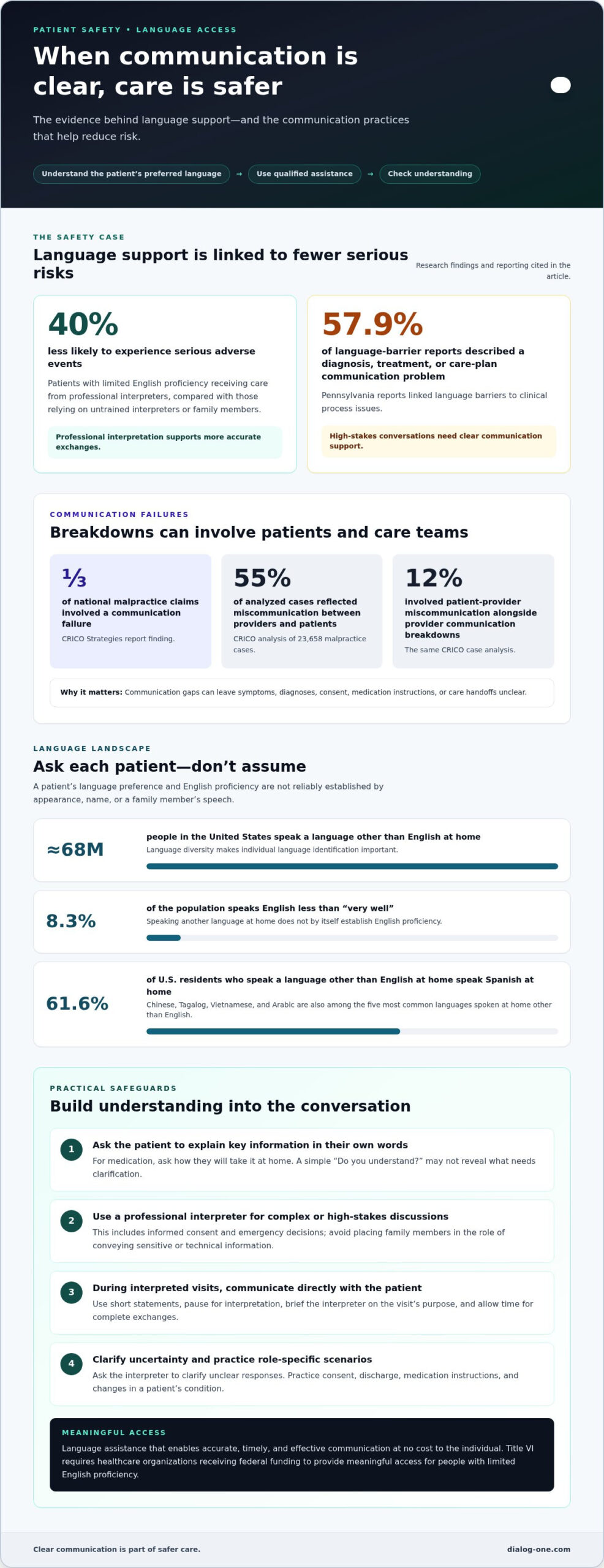
To check understanding, ask patients to explain key information in their own words. This can reveal confusion before it affects a decision or care task. After discussing medication, for example, ask how the patient will take it at home. Don’t rely on “Do you understand?” alone: a polite yes may not reveal which instruction needs clarification.
During interpreted visits, speak directly to the patient, use short statements, and pause for interpretation. Brief the interpreter on the visit’s purpose and allow time for complete exchanges. If a response is unclear, ask the interpreter to clarify rather than guessing. This keeps the patient involved and supports accurate communication.
Communicating Diagnosis and Treatment
Diagnosis and treatment communication explains what clinicians believe is happening and what care they recommend. In Pennsylvania reports linking language barriers to clinical process issues, 57.9% described providers unable to communicate the diagnosis, treatment, or care plan. Training can help staff practice asking about symptoms, explaining options in plain language, and inviting questions. These skills matter when patients must make informed choices.
Use a professional interpreter for complex discussions, informed consent, or emergency decisions, rather than relying on a family member. A qualified interpreter supports accurate communication without putting relatives in the position of conveying sensitive or technical information.
Communication Failures and Malpractice Claims
Communication failures occur when important information is misunderstood, incomplete, or not shared with the right person. CRICO Strategies’ 2015 report found that one-third of national malpractice claims involved a communication failure. In a CRICO analysis of 23,658 malpractice cases filed from 2009 through 2013, 55 percent reflected miscommunication between providers and patients.
The same CRICO analysis found that 12 percent involved patient-provider miscommunication alongside communication breakdowns among healthcare providers. These findings show why teams need shared practices for documenting concerns and handing off care.
Role-specific training can use scenarios involving informed consent, discharge, medication instructions, and sudden changes in a patient’s condition. The Joint Commission says patients need information in a language they understand, particularly for consent, discharge, care planning, and medication instructions. Practicing these exchanges helps staff communicate clearly and respond appropriately when time is limited.
Why do language barriers pose a patient safety risk?
Language barriers can make symptoms, diagnoses, and care instructions unclear, increasing the risk of harmful misunderstandings. The Joint Commission expects hospitals to demonstrate the competence of multilingual staff, especially those who interact directly with patients, and to provide information in languages patients understand.
Adverse Outcomes Linked to Limited English Proficiency
Limited English proficiency can make it harder for patients to describe symptoms, understand diagnoses, and follow treatment instructions. These communication gaps can affect clinical decisions and care outcomes. The U.S. Department of Health and Human Services reports that patients with limited English proficiency face higher risks of adverse health outcomes linked to misunderstandings about diagnoses, medications, or follow-up care.
Professional interpreters help patients and clinicians exchange information more accurately. The article’s research findings report that patients with limited English proficiency receiving care from professional interpreters are 40% less likely to experience serious adverse events than those relying on untrained interpreters or family members. That difference underscores why language support matters during clinical care.
Language Diversity and English Proficiency
Language diversity means patients may prefer to communicate in a language other than English, while English proficiency describes their ability to use English effectively. Approximately 68 million people in the United States speak a language other than English at home, and 8.3% of the population speaks English less than “very well.” A patient’s ability to speak another language doesn’t establish their English proficiency.
Among U.S. residents who speak a language other than English at home, Spanish is spoken at home by 61.6%. Chinese, Tagalog, Vietnamese, and Arabic are also among the five most common languages spoken at home other than English. Hospitals need to identify each patient’s preferred language rather than assume it from appearance, name, or family members’ speech.
Meaningful Access for Limited English Proficiency
Meaningful access is language assistance that enables accurate, timely, and effective communication at no cost to the individual, as defined by the U.S. Department of Justice. Title VI of the Civil Rights Act of 1964 requires healthcare organizations receiving federal funding to provide meaningful access to services for people with limited English proficiency, according to the U.S. Department of Health and Human Services.
In practice, assess the language needed for each interaction, then arrange appropriate support for decisions, medication instructions, and follow-up care. The Joint Commission emphasizes information patients can understand, while its expectations also include demonstrating multilingual staff competence. For an encounter requiring language support, professional interpretation support can help patients and clinicians communicate directly and clearly.
Assessment of languages spoken and barriers to language assistance
Reviewing language needs alongside safety reports helps hospitals identify where communication support breaks down. Pennsylvania’s patient safety reports offer concrete examples of how communication gaps can affect care.
Patient Safety Events Involving Language Barriers
These events are reported care incidents where language barriers contribute to communication or care-process problems. A Pennsylvania review analyzed 336 patient safety reports involving language barriers and identified interpretation challenges in 277 reports, or 82.4%.
The reports named patients’ native languages in 223 cases, identifying 46 different languages; 113 reports did not mention the patient’s native language. Spanish and Nepali together accounted for 52.5% of reports that identified a language. These details show why incident records should capture language needs, not only the event’s clinical outcome.
Cultural and Linguistic Barriers to Safety
Cultural and linguistic barriers arise when a care team’s communication does not account for a patient’s language or communication needs. In Pennsylvania, language barriers were associated with clinical process issues in 57 patient safety reports. A patient who cannot describe an allergy clearly, for example, may leave staff without information needed for a safe decision.
Review each event to identify where information became unclear, such as symptom reporting, care planning, or follow-up. Recording the patient’s preferred language and the support used can help teams spot recurring patterns, including missed or delayed care. The reports show that language needs are relevant to safety analysis, not merely demographic details.
Barriers to Providing Language Services
Barriers to language services include gaps in interpreter access and problems with translated materials. In Pennsylvania reports describing interpretation challenges, 57.0% said interpretation was not used because a certified interpreter was unavailable. That finding makes service access a practical safety concern, especially when teams need to communicate care instructions or time-sensitive information.
Translation-material issues appeared in 6.5% of the 336 reports reviewed. Among reports describing those issues, 31.8% identified unavailable materials, and another 31.8% described incorrect or incomplete translation. Hospitals can examine these categories separately: interpreter access requires a different response from reviewing the accuracy and availability of written materials.
Risks of Untrained Interpreters and Bilingual Staff
Using an untrained interpreter, or relying on bilingual staff whose language skills have not been assessed, can leave clinical meaning incomplete or inaccurate. In healthcare, untrained interpretation can result in patient harm, particularly when key details about symptoms, medication, or treatment are missed.
Speaking another language does not, by itself, establish proficiency for healthcare communication. Staff who serve multilingual patients should demonstrate proficiency in speaking, listening, reading, and writing. Hospitals should assess the skills of employees who communicate directly with patients, then distinguish qualified bilingual communication from situations requiring an interpreter. This supports clear accountability when language services are needed.
Language-access obligations of HHS funding recipients
Federal funding brings language-access responsibilities for healthcare organizations serving patients with limited English proficiency. They must provide meaningful access, meaning language assistance that enables accurate, timely, and effective communication at no cost to the individual, according to the U.S. Department of Justice.
Legal Duties to Provide Language Access
Language-access duties require covered organizations to address communication barriers so patients can access services. Title VI of the Civil Rights Act of 1964 applies to healthcare organizations receiving federal funding and requires meaningful access for people with limited English proficiency, according to the U.S. Department of Health and Human Services.
For hospital teams, this means assessing where patients may need language assistance and making appropriate support available. A patient who cannot understand a care plan needs support that enables accurate communication, not simply a translated form. The obligation applies to access to the services themselves.
The U.S. Department of Health and Human Services also identifies Section 1557 of the Affordable Care Act in AHRQ’s language access plan, which calls for evaluating whether its program complies. Organizations can use a similar review process to examine policies, staff practices, and patient communication across care settings.
Title VI Language-Access Obligations
Title VI requires meaningful access for people with limited English proficiency at federally funded healthcare organizations. The U.S. Department of Health and Human Services describes this requirement as applying to organizations that receive federal funding. It matters in direct care and in the steps patients must take to use health services.
Meaningful access means communication is accurate, timely, and effective. According to the U.S. Department of Justice, language assistance must enable these conditions at no cost to the individual. A patient, for example, must be able to understand information needed to participate in care, rather than receive material in a language they cannot use.
Interpretation can address spoken communication needs, while translated materials can support written communication. AHRQ says interpretation language assistance services should be provided free of charge to address identified needs. Organizations should match the support to the communication task and the patient’s needs.
Federal Requirements for Hospital Language Services
Federal requirements call for meaningful access, not one identical language-service arrangement for every hospital encounter. Hospitals should identify patients’ language needs and determine which assistance will support effective communication. The U.S. Department of Justice’s definition puts accuracy, timeliness, effectiveness, and no cost to the individual at the center.
The Centers for Medicare & Medicaid Services released its Guide to Developing a Language Access Plan in August 2023. The guide identifies needs assessment, language services, patient notices, staff training, and ongoing program evaluation as essential components. These elements help organizations address access systematically instead of relying on staff to improvise during a visit.
Hospitals can apply these principles by reviewing how language needs are identified, how interpreters are accessed, and whether notices explain the available assistance. Staff training supports consistent procedures, while program evaluation can reveal service gaps. AHRQ’s guidance also ties interpretation support to identified needs and requires that it be free to the individual.
Hospital identification of patients needing language services
Hospitals can reduce communication gaps by identifying language needs before clinical decisions depend on patient understanding. A consistent intake process makes patient safety and language access a shared operational responsibility, helping each department arrange support and record the patient’s preferred language.
Make Language Needs Visible at Each Point of Care
Ask every patient which language they prefer for healthcare discussions, then record the answer where registration, nursing, and clinical teams can see it. Don’t infer a preference from a patient’s name, appearance, or companion. Someone may speak conversational English yet prefer another language for discussing a diagnosis or treatment choice.
Revisit recorded language needs when circumstances change. A patient who arrives alone may later be joined by a family member, but that person’s presence doesn’t replace asking the patient directly. At admission, transfer, and discharge, staff can confirm the preferred language and whether communication support is needed for that interaction.
Connect Identification to Department Workflows
A hospital’s identification process works only if each department can act on the information. Registration can record language preference, while nursing and clinical teams use it to plan conversations about symptoms, care, and follow-up. Effective handoffs keep a language need visible when a patient moves between departments or units.
Use a clear workflow for urgent situations, scheduled appointments, and written materials. Staff can identify a language need during appointment scheduling, for example, and make it visible to the receiving care team. The CMS language access plan guide identifies needs assessment, language services, patient notices, staff training, and ongoing evaluation as essential components. Together, these elements link identification to an operational response.
Use Safety Data to Improve Identification
Reviewing safety events can show whether the hospital’s identification process misses patients or breaks down during handoffs. The Agency for Healthcare Research and Quality identifies its guide on patient safety systems for patients with limited English proficiency as a resource for healthcare organizations. Teams can look for missing language information, delayed support, or unclear documentation in incident reports.
The Joint Commission’s National Performance Goals for the Hospital Program take effect in January 2026. Goal #4 prioritizes excellent health outcomes for all, and the program requires hospitals to stratify outcomes by patients’ preferred language. This makes accurate language identification relevant to organization-wide quality review. Hospitals can use patient safety and language access reviews to improve intake questions, department workflows, and follow-up. For patient conversations requiring language support, strengthen language access in care with a process that connects identified needs to communication assistance.
Dialog One: On-Demand Phone & Video Interpreters
Dialog One helps healthcare teams address language needs through On-Demand Phone & Video Interpreters in over 200 languages. Use phone or video interpretation when a patient needs support during an unplanned conversation, or arrange Scheduled On-Site & Remote Interpreters for a planned visit. Matching the format to the encounter helps staff communicate with patients during care discussions without relying on family members to interpret. For hospitals also managing written communication, Dialog One offers Certified Translation for Personal Documents and Large Document Project Translation. Choose the service that fits the communication task and the timing of care. To discuss language support for your organization, visit Dialog One.
Make clear communication part of every care decision
Build language support into how your hospital plans patient communication, rather than treating it as an exception. A clear process helps teams recognize when to arrange interpretation, who coordinates it, and how communication needs follow the patient across departments. Practical workflows and staff accountability make patient safety and language access a shared responsibility.
Match the support to the task. Dialog One provides On-Demand Phone & Video Interpreters for conversations requiring language support, Scheduled On-Site & Remote Interpreters for planned encounters, and Certified Translation for Personal Documents when written communication needs translation. These services can support a broader approach, while clinical teams remain responsible for patient care and decisions.
Set a clear next step for your organization: identify where language needs enter the care process, then align support with those moments. Contact Dialog One about language access to discuss interpretation or document translation needs. Thoughtful preparation can help make every patient conversation clearer and more inclusive.
Frequently Asked Questions
How can healthcare organizations overcome language barriers?
Build language support into the patient journey, from appointment scheduling through follow-up. Registration can record a preferred language, scheduling staff can flag visits involving complex discussions, and clinical teams can confirm support before consent or treatment planning. Assign responsibility for each handoff so language needs aren’t lost during transfers. Review patient feedback and incident reports to find where the process breaks down.
How does multilingual communication improve patient care?
Clear communication gives patients and care teams a better way to exchange information and make decisions together. Patients can describe changing symptoms, ask about treatment concerns, and explain practical needs that could affect care. Clinicians can respond to those details rather than making assumptions. Asking a patient to describe a concern in their preferred language, for example, may surface information they struggled to express in English.
What are the most common communication risks in multilingual healthcare?
Important details can be omitted, misunderstood, or conveyed inaccurately. A patient might mishear a medication instruction, misunderstand fasting directions before a procedure, or miss a follow-up appointment because its purpose was unclear. During a handoff, the care team might also lack a clear record of what the patient understood. Treat each exchange as a potential safety checkpoint, especially when instructions change.
Who are Medical Interpreters?
Medical interpreters are language professionals who convey spoken communication between patients and healthcare staff. They interpret what each person says without making clinical decisions or replacing the clinician’s explanation. During a visit, the clinician should address the patient directly, speak in manageable segments, and pause for interpretation. This gives the patient space to respond and keeps the conversation focused on their care.
Why are language skills important for healthcare professionals?
Language skills help staff communicate clearly, but general fluency doesn’t automatically prepare someone to interpret clinical conversations. Healthcare professionals need to explain unfamiliar terms, listen carefully, and recognize when a patient hasn’t understood. Organizations can assess staff language ability for the duties involved and provide role-specific practice. A clinician speaking directly with a patient, for example, needs different language skills from someone translating written discharge material.
How does limited English proficiency affect patient safety and health outcomes?
Limited English proficiency can make it harder to share symptoms, understand care options, and follow instructions. The U.S. Department of Health and Human Services reports higher risks of adverse health outcomes linked to misunderstandings about diagnoses, medication instructions, or follow-up care. A practical safeguard is to identify the language needed for each important interaction and ensure the patient can ask questions before leaving.
Does Title VI require free interpreter services in healthcare settings?
Healthcare organizations receiving federal funding must provide meaningful access under Title VI of the Civil Rights Act of 1964, according to the U.S. Department of Health and Human Services. The U.S. Department of Justice defines meaningful access as accurate, timely, effective language assistance provided at no cost to the individual. The support needed depends on the communication task, such as discussing treatment or explaining care instructions.
What are best practices for translated consent forms, discharge instructions, and medication information?
Use professionally translated materials that match current clinical instructions, and remove outdated versions from circulation. Organize each document with clear headings, plain wording, and consistent terms for medications and next steps. Before using a translated consent form, give the patient time to ask questions and discuss the decision. In discharge materials, highlight whom to contact and what action the patient needs to take.