A communication failure can place patient safety and legal accountability at risk at the same time. Avoiding malpractice with certified medical interpreters means using qualified language support, making care meaningfully accessible, and documenting interpreted communication. According to the U.S. Department of Health and Human Services, Title VI requires healthcare organizations receiving federal funding to provide meaningful access to care for patients with limited English proficiency.
It’s reasonable to ask who is responsible when an interpreted conversation goes wrong. The interpreter’s role matters, as do the healthcare team’s language-access decisions, how interpretation is used, and the organization’s policies. Liability depends on the facts of the case, not on an assumption about who spoke the words.
This article explains how qualified medical interpreters help reduce communication risks, why family members or untrained staff may not be appropriate substitutes, and what hospital language-access programs should address. It also explains how Title VI obligations relate to accountability, helping healthcare leaders and clinicians make informed decisions about communication during care.
Key Takeaways
- Understand how Title VI obligations shape meaningful language access for patients with limited English proficiency.
- Recognize why relying on family members or untrained staff can increase communication and accountability risks.
- Build language-access policies around clear interpreter-request procedures, defined qualifications, and staff training.
- Look for core interpreter practices such as accuracy, impartiality, confidentiality, and appropriate medical terminology skills.
- Use clear documentation and patient-understanding checks to support safer, more accountable interpreted care.
Meaningful access for patients with limited English proficiency
Meaningful access enables patients with limited English proficiency to understand their care and communicate with their healthcare team. The U.S. Department of Health and Human Services states that healthcare organizations receiving federal funding must provide meaningful access.
Patient Language Assistance Rights
Patients have the right to receive healthcare information in a language they understand, including diagnoses, treatment options, procedure risks and benefits, and consent discussions. Understanding this information helps patients make informed decisions and follow care instructions. Professional medical interpretation is provided at no cost to patients and their family members, so patients should not have to rely on relatives to explain critical information.
Title VI and Language Rights
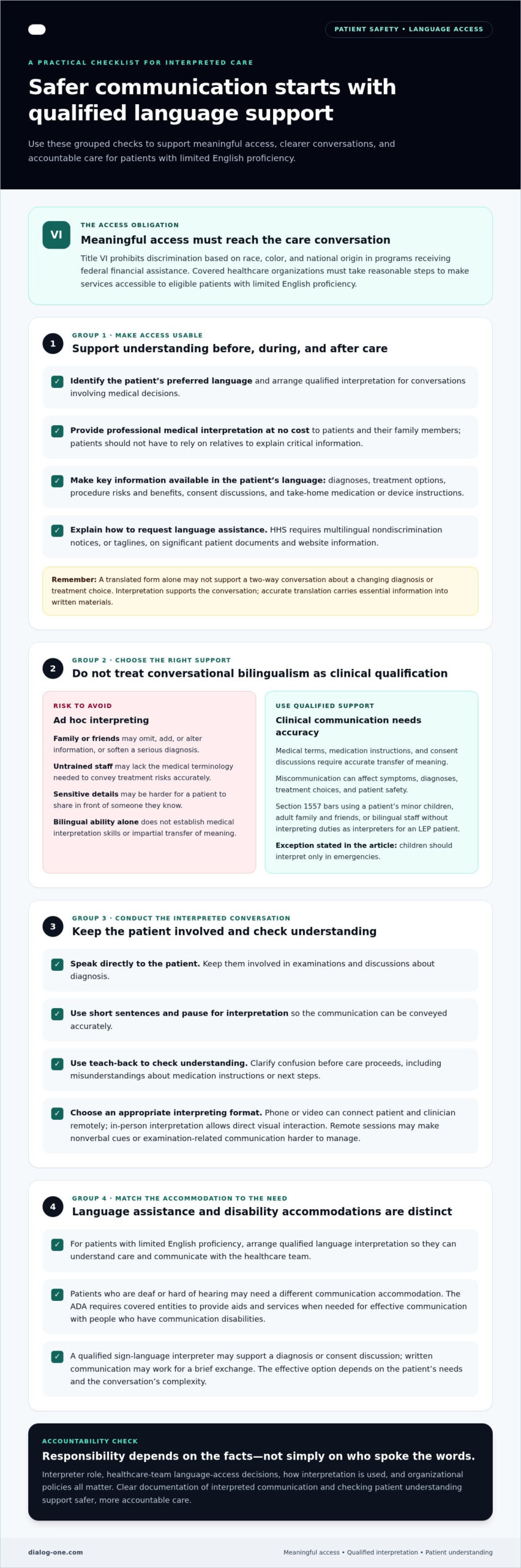
Title VI of the Civil Rights Act of 1964 prohibits discrimination based on race, color, and national origin in programs receiving federal financial assistance. For covered healthcare organizations, meaningful access includes taking reasonable steps to make services accessible to eligible patients with limited English proficiency. This obligation matters at every point where language affects care, from discussing symptoms to reviewing consent. A translated form alone may not support a two-way conversation about a changing diagnosis or treatment choice.
Patients who are deaf or hard of hearing may need a different communication accommodation. The Americans with Disabilities Act requires covered entities to provide aids and services when needed for effective communication with people who have communication disabilities. A qualified sign-language interpreter may support a discussion about diagnosis or consent, while written communication may work for a brief exchange. The effective option depends on the patient’s communication needs and the complexity of the conversation. Language assistance and disability accommodations address different barriers, so one should not replace the other.
Patients may not know what assistance is available or how to request it. HHS requires hospitals to include multilingual nondiscrimination notices, or taglines, on significant patient documents and website information explaining how to access language assistance. These notices show patients how to request help before a visit or during care. Staff can reinforce this information by identifying the patient’s preferred language and arranging qualified interpretation for conversations involving medical decisions.
Meaningful access extends beyond the examination room. Translated consent forms let patients revisit procedure details, while translated take-home medication or medical-device instructions can reduce confusion after discharge. Health education materials in a patient’s primary language allow them to review information at home and participate more actively in care. For example, a patient who cannot confidently discuss a medication in English still needs a clear way to ask questions and understand instructions. Qualified interpretation supports the conversation; accurate translation carries essential information into written materials.
Risks of ad hoc interpreters
An ad hoc interpreter may understand everyday English but lack the training required for clinical communication. Errors can affect treatment decisions, patient safety, and an organization’s accountability.
Clinical Communication Risks
Limited English proficiency can make it harder to communicate symptoms, diagnoses, and treatment instructions accurately. A patient’s description of pain may lose meaning when interpreted casually, or they may misunderstand medication instructions before discharge. Clinicians should speak directly to the patient, use short sentences, pause for interpretation, and use teach-back to check understanding. This keeps the patient involved in examinations and diagnosis discussions and helps identify confusion before care proceeds.
Risks of Untrained and Family Interpreters
Family members, friends, and untrained staff may unintentionally omit, add, or alter information. A relative might soften a serious diagnosis to protect the patient, while an employee may not know the medical terminology needed to convey treatment risks. Patients may also hesitate to share sensitive details in front of someone they know. Section 1557 bars using a patient’s minor children, adult family and friends, or bilingual staff without interpreting duties as interpreters for an LEP patient; children should only interpret in emergencies.
Limits of Bilingual Skills
Conversational bilingual ability does not establish medical interpretation skills. Clinical terms, medication instructions, and consent discussions require accurate transfer of meaning, not just familiarity with English and another language. A bilingual employee may understand the general subject but miss a distinction between similar terms or fail to interpret every statement impartially. That gap matters: the patient and clinician may leave the same conversation with different understandings of symptoms, risks, or next steps.
Interpreting Modality Risks
Phone or video interpretation can connect a patient and clinician without an interpreter physically present, while in-person interpretation allows direct visual interaction. Remote sessions may make nonverbal cues or examination-related communication harder to manage; in-person sessions still require clear turn-taking and accurate interpretation. Choose the format that supports the clinical setting, the patient’s communication needs, and the discussion’s complexity. For remote appointments, on-demand phone and video interpreting can support interpreted conversations when that format fits the encounter.
Document the interpreter’s name and certification credentials, the language, and the session’s date and time. Record the purpose, such as explaining a diagnosis, reviewing treatment options, or obtaining informed consent. This creates a clear record of the communication support used and what the patient discussed with the care team.
Ad hoc interpretation has figured in serious malpractice cases. In one case, a misinterpreted word preceded a missed intracerebral hemorrhage and a $71 million malpractice award. The case illustrates why clinicians should not treat apparent fluency as proof of accurate medical interpretation, especially when a misunderstanding could affect diagnosis or urgent treatment.
Hospital language-access programs and staff training
A hospital language-access program explains how staff identify communication needs and arrange qualified interpretation. State rules and hospital systems can differ in their procedures, interpreter directories, and staff qualification standards. Each organization should make its applicable requirements, request process, and escalation route clear to staff.
Language-Access Policies and Directories
A language-access policy explains who requests interpretation, how staff arrange it, and which interpreters qualify. A current directory helps the care team find the right resource for routine visits and urgent situations. It should list available languages and explain how to access phone, video, or on-site interpretation. Staff training should cover recognizing limited English proficiency, recording the patient’s preferred language, and documenting each session. Clear procedures reduce delays and help prevent staff from defaulting to informal language assistance.
Liability for Inadequate Language Access
Inadequate language access can expose healthcare professionals to civil liability when a communication failure contributes to a tort claim. Examples include lack of informed consent, breach of a duty to warn, or improper medical care. Hospital policies and staff training matter because they shape how teams respond when a patient needs language assistance. Documentation can show whether staff recognized the need, arranged qualified interpretation, and communicated essential information.
Section 1557 is the civil rights provision of the Affordable Care Act of 2010 and prohibits discrimination on specified grounds in certain health programs and activities, according to the U.S. Department of Health and Human Services. Hospitals should translate that obligation into operational practice. For example, staff need a defined process for identifying an interpreter need and a clear way to reach qualified language support. HHS guidance does not require hospital staff who serve as interpreters to hold national certification, but hospitals must assess competencies before designating individuals as qualified interpreters.
Training should prepare staff to use the system, not simply point them to a policy. In a practical exercise, a team member can locate the interpreter directory, request the appropriate language, and record session details. Supervisors can reinforce when bilingual skills are insufficient and qualified interpretation is needed. Hospital language-access policies should define qualification standards and the process for requesting interpretation, so the response does not depend on which staff member is present.
Eligible small businesses may qualify for a disability-access tax credit under the stated criteria: 30 or fewer full-time employees or annual revenues under $1,000,000. Eligible access expenditures above the first $250 may qualify for a 50% tax credit, up to a maximum eligible expenditure of $10,250; the maximum credit is $5,000 for the tax year. These figures concern eligible access expenditures, not interpreter service prices. Organizations should distinguish tax-credit eligibility from their separate duties to provide meaningful language access.
Qualified medical interpreter competencies
A qualified medical interpreter combines language ability with specialized skills, ethical practice, and accurate message transfer. These competencies help clinicians address language barriers while keeping clinical decisions with the care team. Avoiding malpractice with certified medical interpreters starts with matching an interpreter’s demonstrated abilities to the demands of the encounter.
Medical Interpreter Qualifications
Medical interpreters need more than conversational fluency: they must understand medical terminology, interpret accurately and impartially, and follow ethical standards. They preserve each speaker’s meaning without adding, omitting, or changing information. Confidentiality also matters when patients discuss sensitive symptoms or treatment. The National Council on Interpreting in Health Care’s National Standards of Practice for Interpreters in Health Care, published in September 2005, provide a professional reference for interpreting conduct.
A qualified interpreter supports communication but does not advise the patient or make clinical decisions. If a term is unclear, the interpreter can ask the speaker to repeat it, slow down, or use shorter sentences. Interpreters should promptly correct any omission or misinterpretation. These steps help clinicians and patients resolve confusion during the conversation.
Selecting and Verifying Interpreters
Providers should match an interpreter’s language skills and medical knowledge to the encounter, then assess competence before designating that person as qualified. HHS guidance does not require hospital staff serving as interpreters to hold national certification, so a certificate alone is not a substitute for assessment. Verify relevant credentials and evaluate accuracy, ethics, impartiality, and terminology knowledge. An interpreter who lacks confidence or subject knowledge for an assignment should not accept it.
Selection also requires attention to role conflicts. NCIHC standards state that interpreters with another clinical role must follow interpreting standards during the session, disclose conflicts that could hinder care, and withdraw when necessary. Family members may offer support, but should not be treated as substitutes for assessed interpreter competence. A clear qualification process supports patient rights and keeps clinical judgment with the healthcare professional. This is one practical safeguard for avoiding malpractice with certified medical interpreters.
Informed Consent Through an Interpreter
Informed consent through an interpreter requires a clear discussion of the proposed procedure, its risks and benefits, and available treatment options. The clinician should speak directly to the patient, pause for sentence-by-sentence interpretation, and avoid jargon, acronyms, idioms, and humor. This gives the patient room to ask questions and supports a complete discussion before consent.
Use teach-back to check understanding: ask the patient to explain the procedure or next steps in their own words. The interpreter conveys the patient’s response without summarizing or filtering it. If the response reveals confusion, clarify the point and check again before proceeding. Record the interpreter’s name and credentials, language, session date and time, and purpose, such as obtaining informed consent.
Competence also means knowing the assignment’s limits. Medical interpretation may involve pediatrics, emergency medicine, trauma, outpatient care, or a specialty, each with its own terminology. A professional interpreter should recognize when a conversation exceeds their knowledge and request clarification or withdraw rather than guess. Clear boundaries help teams assess communication accurately and support accountable care.
Title VI language-access obligations for federally funded hospitals
Federal language-access duties depend on the organization’s funding and the patient’s communication needs. Title VI, Section 1557, and the Americans with Disabilities Act address distinct protections in healthcare.
Title VI Interpreter-Service Requirements
Title VI of the Civil Rights Act of 1964 prohibits discrimination based on race, color, and national origin in programs receiving federal financial assistance. According to the U.S. Department of Health and Human Services, recipients must take reasonable steps to provide meaningful access for patients with limited English proficiency. For a federally funded hospital, this includes qualified interpreters across aspects of care. The obligation concerns qualification and effective communication, not simply the presence of someone bilingual.
What federal laws require qualified medical interpreters in U.S. healthcare? Title VI applies to recipients of federal financial assistance serving patients with limited English proficiency. Section 1557 also applies to specified health programs and activities, while the ADA requires covered entities to provide effective communication aids and services for people with communication disabilities.
Title VI and Meaningful Access to Care
Meaningful access means patients can understand and communicate about the healthcare services they receive. It matters in discussions with a physician about symptoms, diagnosis, treatment choices, procedure risks, and consent. A translated document can convey written information but may not let patients ask questions during a live consultation. Hospitals should match language support to the encounter, using qualified interpretation for spoken exchanges and appropriate translation for written materials.
Title VI does not prescribe one national format for every hospital’s interpreter system. State requirements, funding arrangements, hospital policies, and available resources can shape the process. However, hospitals receiving federal assistance still need to take reasonable steps to provide meaningful access. Staff should know how to identify a patient’s language needs, request qualified interpretation, and document the support used during care.
When Qualified Interpreters Are Needed
Providers should use a qualified interpreter when a patient with limited English proficiency needs language assistance for healthcare communication. Under Section 1557, minor children, adult family members and friends, or bilingual staff without interpreting duties shouldn’t be used as interpreters. HHS guidance permits an ad hoc interpreter when an imminent threat to patient safety or welfare exists and no qualified interpreter is immediately available.
Does federal law always require a nationally certified interpreter instead of bilingual staff? HHS guidance does not require hospital staff serving as interpreters to hold national certification, but hospitals must assess their competence before designating them as qualified. The standard is demonstrated ability, including specialized terminology, interpreter ethics, and accurate, effective, impartial interpretation.
For a patient who needs spoken language support, a hospital can use qualified phone or video interpretation when appropriate to the encounter. Arrange phone or video interpretation for a care conversation that requires language support.
Dialog One: On-Demand Phone & Video Interpreters
Dialog One provides on-demand phone and video interpreters in over 200 languages, giving care teams a way to connect with language support during patient conversations. Use these options when an interpreted discussion is needed remotely; schedule on-site or remote interpreters for planned appointments where the encounter calls for advance coordination. Human interpretation supports the exchange, while clinicians remain responsible for explaining care and confirming patient understanding.
Certified translation for personal documents and large document project translation can help patients who need health information in another language. Choose the format based on the immediate need: a live conversation, a scheduled visit, or translated documents. Clear language-access processes help teams arrange appropriate support and document interpreted care.
Contact Dialog One to discuss language support for your healthcare setting.
Make Clear Communication Part of Every Care Decision
Reducing communication risk takes more than responding well during a single appointment. Make language access part of routine clinical operations: assign responsibility for interpreter requests, keep staff procedures clear, and review how communication needs are recorded. This makes avoiding malpractice with certified medical interpreters an ongoing practice grounded in accountability, not a last-minute fix.
Dialog One supports healthcare communication with on-demand phone and video interpreting, scheduled on-site and remote interpreting, and certified translation for personal documents. These services help teams address live conversations and written information in ways suited to the care setting. Human judgment remains central: clinicians lead medical discussions, confirm understanding, and document key decisions.
Build a process your team can use consistently, from a planned consultation to an unexpected communication need. Contact Dialog One about interpreter services to discuss language support for your healthcare setting. Clear communication is a practical foundation for patient understanding and responsible care.
Frequently Asked Questions
Legal Accountability: Who Is Liable for Interpreter Errors?
Accountability depends on each party’s role in arranging and using interpretation and on how the communication affected care. Healthcare organizations are responsible for language-access systems, while clinicians remain responsible for clinical decisions and ensuring patients can participate in care. The interpreter’s accuracy and conduct also matter when reviewing an alleged error. Records showing who interpreted, what was discussed, and how understanding was assessed can help clarify responsibilities.
Who Are LEP Patients?
LEP patients are people with limited English proficiency who may not communicate effectively in English during healthcare interactions. A patient might manage a brief greeting but struggle to describe symptoms, compare treatment options, or understand discharge instructions in English. The relevant issue is the communication task, not the patient’s accent, nationality, or general intelligence. Clinicians should identify the patient’s preferred language and whether language assistance is needed for the specific conversation.
What Are the Differences Between Certified, Qualified, and Trained Medical Interpreters?
“Certified” refers to a credential, “qualified” describes demonstrated ability for an assignment, and “trained” means the interpreter has received relevant instruction. These terms are not interchangeable. HHS guidance does not require hospital staff serving as interpreters to hold national certification, but hospitals must assess competence before designating them as qualified. A credential alone, for example, does not show whether an interpreter can accurately handle terminology in a particular specialty or follow interpreting ethics.
What Malpractice Cases or Liability Risks Involve Inadequate Medical Interpretation?
Inadequate interpretation can contribute to claims involving missed diagnoses, medication misunderstandings, or compromised consent. In a Miami case, a patient misunderstood pre-surgery fasting instructions and took medication that interfered with anesthesia. The surgery was delayed, complications occurred, and the case settled for over $2 million. This example shows how a communication failure around preparation instructions can affect care and lead to a liability dispute.