A single mistranslated term can change more than a sentence; it can affect a case, an agreement, or a business decision. The consequences of inaccurate legal translation can include rejected documents, court delays, disputes over contractual duties, and financial losses.
It’s easy to assume a document remains reliable as long as its main idea comes through. But legal meaning can hinge on precise wording, consistent terminology, and each party’s understanding of its obligations. A small error can create a much larger problem when a court, agency, or business relies on the translated text.
This article explains how translation inaccuracies can affect legal proceedings, agreements, deadlines, and finances in the United States. You’ll learn why legal terminology and review matter, what can happen when a translation is challenged, and how professional translation supports clear, dependable communication when the stakes are high.
Key Takeaways
- Assess whether translated wording preserves each party’s duties, rights, and intended legal effect, not just the document’s general meaning.
- Before filing, review the document for missing information and determine whether the receiving court or agency requires a certified or notarized translation.
- Keep key legal and technical terms consistent across related documents so differing versions don’t create ambiguity or weaken an agreement.
- Account for indirect consequences of errors, including rework, disrupted operations, missed opportunities, and disputes over responsibility.
- For high-stakes documents, use qualified human review to identify terminology and context issues that automated translation may miss.
Understanding the Stakes: What is Legal Translation Accuracy?
Legal translation accuracy means preserving the source document’s legal effect, not merely its general message. In a contract, changing “may” to “must” can turn permission into an obligation. Replacing “reasonable” with “prompt” can also change how parties understand performance. These distinctions matter across agreements, technical schedules, and remedies. The consequences of inaccurate legal translation can include disputes over which party must act, when performance is due, and what happens after a breach.
Technical legal material shows why exact terminology matters. The European Union cites Council Directive 70/220/EEC as dated 20th March, 1970. The European Union cites Directive 2001/95/EC on general product safety as dated 3 December 2001. When legal or technical language crosses languages, a translator must preserve the meaning of defined terms, conditions, exceptions, and obligations. If a translated clause uses a broad term where the original uses a narrow one, parties may apply the text differently.
That difference can trigger a contract dispute. For example, a translated equipment agreement might describe maintenance as optional, even though the source text makes it a party’s duty. One side may rely on the translated wording while the other insists the original controls. Conflicting language versions can leave a court to decide which text governs, and the outcome may not favor either party. In some jurisdictions, a party may challenge an agreement if a flawed translation prevented full understanding of its duties.
Enforceability can also depend on whether essential terms are clear. If a machine lease translation obscures payment obligations, maintenance duties, or termination rights, a court may limit enforcement or disregard those provisions. A party that unknowingly breaches a contract because of a mistranslated clause may face unfavorable consequences or a lawsuit. The risk is especially serious when signatories review only one language version. Before signing, compare both versions clause by clause, focusing on duties, deadlines, exceptions, and remedies.
Back-translation and structured quality control can help reveal shifts in meaning before signing. For a high-value international contract, translate critical clauses back into the original language, then compare the result with the source. Treat differences as points for review, not automatic proof of error. A quality process should include a legal translator familiar with the document’s purpose, along with independent editing and proofreading. Check defined terms against a shared glossary, confirm names and figures, and review the final layout. These steps can catch inconsistencies before parties rely on the translated agreement.
Court delays, rejected documents, and missed deadlines
An inaccurate court interpretation can impair a defendant’s ability to understand testimony or communicate, raising due-process concerns. Any challenge or correction must fit the court’s schedule. Time and expense depend on deadlines, document length, urgency, and the work needed to correct the issue.
Court Delays and Case Restarts
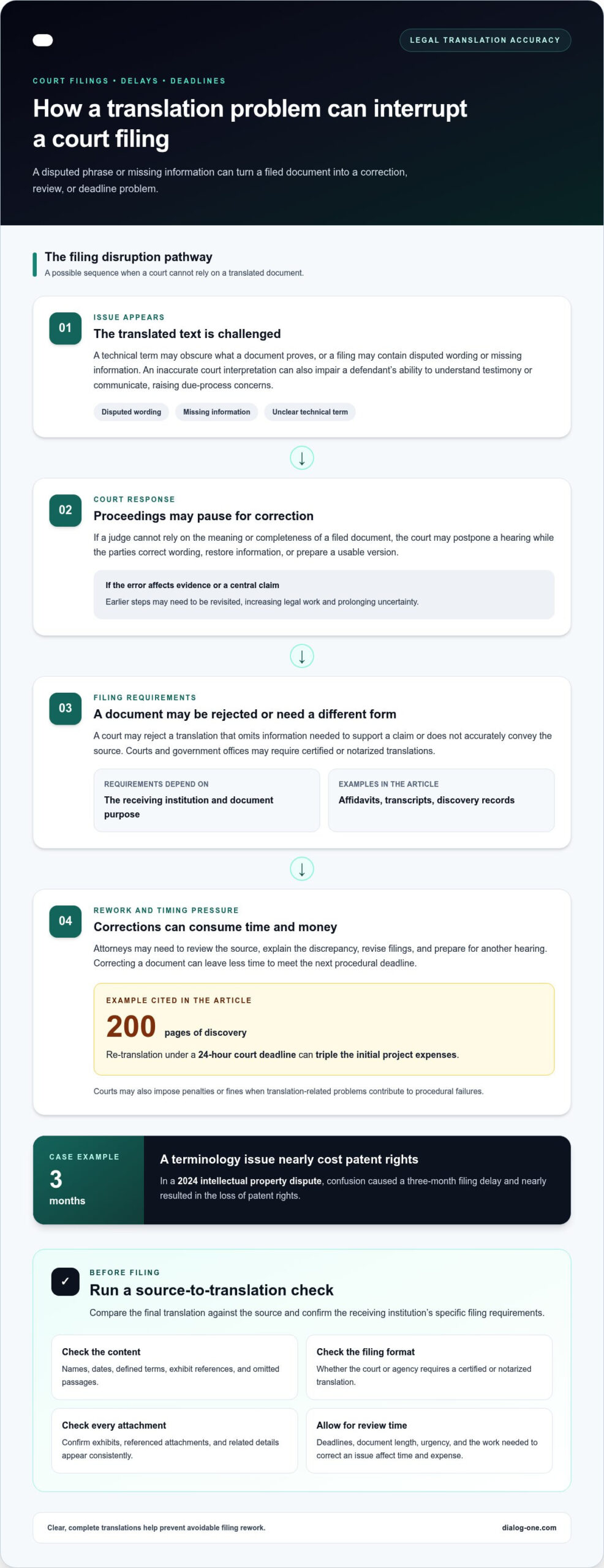
A translation problem can interrupt proceedings if a judge cannot rely on the meaning or completeness of a filed document. The court may postpone a hearing while the parties correct disputed wording, restore missing information, or prepare a usable version. If the error affects evidence or a central claim, earlier steps may need to be revisited. That can increase legal work and prolong uncertainty for everyone involved.
A 2024 intellectual property dispute illustrates how terminology can affect timing: confusion caused a three-month filing delay and nearly resulted in the loss of patent rights. In court, a mistranslated technical term can similarly obscure what a document proves. Lawyers may need to compare the source and translated texts, explain the discrepancy, and submit corrected material before the case can move forward.
Rejected Documents and Missed Deadlines
A court may reject a translated legal document if it omits information needed to support a claim or fails to convey the source accurately. Rejection matters because the filing may not serve its intended purpose, even if it reached the court on time. Correcting the document can require renewed review, preparation, and submission, leaving less time to meet the next procedural deadline.
Courts and government offices may require certified or notarized translations to establish completeness and accuracy. Requirements depend on the receiving institution and the document’s purpose. An affidavit, transcript, or discovery record may need different handling than correspondence. Confirm the specific filing requirements and ensure every exhibit, name, date, and referenced attachment appears consistently in the translated document.
Translation errors can also add costs beyond the initial translation. Attorneys may need to review the source, explain the discrepancy, revise filings, and prepare for another hearing. A 200-page discovery file that must be re-translated under a 24-hour court deadline can triple the initial project expenses. Courts may also impose penalties or fines when translation-related problems contribute to procedural failures.
To reduce avoidable rework, compare the final translation against the source before filing. Check names, dates, defined terms, exhibit references, and omitted passages. For personal records that need translation, certified translation for personal documents can support clear document preparation, though court acceptance depends on the filing requirements.
Mistranslated legal documents and agreements
A mistranslated document can change meaning, weaken evidence, or create compliance problems. The risk extends from contracts to immigration records, where names, dates, and personal statements must remain consistent.
Compliance and Document Rejection
Compliance can fail when translated wording omits a required detail or changes a document’s meaning. For example, a technical manual submitted with a regulated product may misstate a safety instruction. An authority reviewing the paperwork could reject it or question whether the documentation meets applicable requirements. The result may be further review, corrections, and disruption to the process.
Courts and government offices often require certified or notarized translations to confirm accuracy and completeness. Exact submission requirements depend on the receiving institution and the document. Before filing, compare the translation against the source and check names, dates, stamps, signatures, and attachments. Machine translation alone may miss context or legal nuance, so human review can help identify mistakes that affect compliance.
Inadmissible and Challenged Translations
A translated document may be challenged if a party disputes its accuracy, completeness, or interpretation. If important facts are missing, the document may be ruled inadmissible or given less weight in court. A judge may also dismiss complaint sections that rely on unclear wording, leaving the party with weaker evidence and additional work to correct the record.
Disputes can focus on a single phrase. In Corocraft v. Pan American Airways Inc., decided in 1969, the judge said the commissioned English translation of the Warsaw Convention was not exact. That example shows why a party should compare contested phrases with the source text, identify the precise discrepancy, and explain how it changes the document’s meaning. A complete record helps address a challenge directly.
Immigration Applications and Hearings
Inaccurate translations in immigration applications or hearings can distort dates, family relationships, prior statements, or reasons for travel. For example, a mistranslated birth record might conflict with a form, while an altered phrase in a personal statement could appear inconsistent at a hearing. Those discrepancies can prompt questions, delay review, or lead officials to challenge the reliability of the documents.
Before submission, compare each translated record with its source and supporting paperwork. Check spellings, dates, places, and repeated details across applications, affidavits, and identity documents. A certified translation can help present a complete, accurate record when an agency requires one. Machine translation may help with informal understanding, but automated wording should not replace careful human review of documents used in legal proceedings.
Professional legal translation and terminology consistency
Legal translation requires more than fluency in two languages. A translator must understand legal terminology, the document’s purpose, and the legal systems involved. This matters because a word can have different effects across borders, even when its everyday meaning appears similar. In a contract, translating “shall” as a suggestion rather than an obligation can change how readers understand a party’s duties.
Legal concepts rarely align perfectly across jurisdictions. A term used in a U.S. agreement may have no direct equivalent in another country’s legal system. A translator must identify the concept in context, then choose wording that preserves its role without suggesting a different legal effect. For example, a court, remedy, or business entity may function differently under each system. Literal substitution can sound precise while changing what the document communicates.
Terminology consistency is especially important in lengthy contracts and technical records. If a defined term appears as “warranty” in one clause and “guarantee” elsewhere, readers may interpret the provisions as distinct. A shared glossary helps translators and reviewers keep repeated terms consistent across schedules, exhibits, and related documents. Reviewers should also compare cross-references and defined terms against the source, so a correction in one section doesn’t create a mismatch elsewhere.
A German directive example shows how one technical word can affect interpretation. An expert group requested that “Benzin” be replaced with “Kraftstoff” in the German version of Directive 70/220/EEC, because the existing wording caused misinterpretations. The proposed correction concerned Section 5.1.3. The example illustrates why translators need subject knowledge and careful terminology research, especially when a legal document includes technical language.
Legal translators should understand the writing styles of both languages and research the concepts in the source. A bilingual speaker without legal expertise may miss how a term functions in a clause. Nearly 20% of translation errors in legal documents stem from misunderstanding or misapplying precise legal terminology. For high-value agreements, review critical terms against the source and maintain a record of chosen equivalents. That record supports consistent updates when multiple documents share the same terms.
For legal translators and court interpreters in the United States, qualifications depend on the court, jurisdiction, language, and assignment. No single credential applies to every legal translation or court-interpreting role. Relevant legal experience and any certification required for the specific work matter. Ask which qualification applies to the assignment, then match the professional’s expertise to the document or proceeding.
Financial translation errors and monetary losses
A mistranslated figure, condition, or payment term can shift financial responsibility between parties. The impact may include incorrect calculations, disputes over liability, litigation, and disrupted operations. In high-stakes agreements, a small wording error can affect what a party pays, receives, or must deliver.
International arbitration shows the scale financial disputes can reach, though awards aren’t necessarily caused by translation errors. These examples show why translated obligations and financial terms require close scrutiny.
Financial translation errors can distort amounts, payment schedules, interest terms, or accounting assumptions. A misplaced decimal or mistranslated condition might change an invoice’s meaning or how a party calculates its obligation. For financial records, compare every amount, currency, date, and condition with the source before relying on the translation.
Warranty clauses create a distinct risk. A mistranslated exclusion may appear to remove coverage, while an altered repair obligation may seem broader than the original. In an equipment agreement, confusion about who pays for replacement parts can leave machinery idle and delay production. Review the warranty period, covered components, claim process, exclusions, and responsible party together. Don’t assess a term in isolation from the rest of the clause.
Healthcare errors can carry personal as well as financial consequences. Incorrectly translated medical records or instructions can also contribute to serious complications for patients. In a high-stakes clinical setting, review medication names, dosage directions, allergies, and patient history against the original record. Legal translation involving healthcare or financial material requires attention to context, not just word choice.
For a large arbitration file, organize documents by type and use consistent terminology throughout. Then compare key figures, defined terms, and payment or warranty clauses with the source. Independent editing can help catch inconsistencies that remain after an initial review. This is especially useful when multiple agreements, exhibits, and financial schedules refer to the same obligations.
For extensive legal or financial records, request large document project translation to support consistent handling across a document set.
Dialog One: On-Demand Phone & Video Interpreters
Dialog One helps reduce communication barriers when people need to understand spoken exchanges or translated documents. On-Demand Phone & Video Interpreters support conversations where participants need language access, while Scheduled On-Site & Remote Interpreters can support planned meetings. Interpreting addresses spoken communication; it doesn’t replace a written translation for a contract, court filing, or other legal document.
For written materials, Dialog One offers Certified Translation for Personal Documents and Large Document Project Translation. These services support different document needs, from personal records to extensive files. Choose based on whether the immediate need is spoken communication, a personal document, or a larger translation project.
For language support that fits your communication or document needs, contact Dialog One or visit dialog-one.com.
Make the Next Translation Decision Deliberately
The best time to reduce translation risk is before anyone relies on a document or conversation. Identify what must be understood, who will use it, and whether the need is written or spoken. Then allow time for a focused review of names, obligations, figures, and terminology. These practical steps can help keep the consequences of inaccurate legal translation from shaping an agreement or proceeding.
Dialog One offers Certified Translation for Personal Documents when personal records need translation, along with On-Demand Phone & Video Interpreters and Scheduled On-Site & Remote Interpreters for spoken communication. Match the service to the task: an interpreter for a conversation, or a translation for a document. Clear communication helps people participate with greater understanding and confidence.
Contact Dialog One about legal translation to discuss the support your documents or conversations require. Take the next step with care, and give every party a clearer basis for informed decisions.
Frequently Asked Questions
What are the legal consequences of an inaccurate translation in a U.S. court?
An inaccurate translation can weaken evidence, delay a proceeding, or contribute to a document being ruled inadmissible. If an omission affects a claim or defense, the court may give the document less weight or dismiss the affected material. For example, an altered date in a translated record could conflict with testimony and prompt further scrutiny. The practical impact depends on how the error affects the case and the court’s ability to assess the evidence.
Can a mistranslated contract be voided or lead to a breach-of-contract claim?
A mistranslated contract isn’t automatically void, but a party may challenge an agreement if the translation prevented full understanding of its duties. A breach claim may arise when someone acts on inaccurate wording and fails to meet an obligation in the governing contract. For example, a party might rely on a translated delivery condition that differs from the signed source. The terms, the parties’ understanding, and evidence of reliance can shape the dispute.
Who is liable for errors in legal translation: the translator, law firm, or client?
Responsibility depends on who undertook the translation, what each party agreed to do, and how the error caused harm. A translator may face a client claim alleging professional negligence, while a law firm may face questions about its review or use of the work. A client’s reliance on a translation can also affect the dispute. Contracts, instructions, review records, and the chain of decisions help establish each party’s role.
How do courts handle discrepancies between translated and original legal documents?
Courts assess discrepancies in context, including the source text, the translation, and each version’s role in the proceeding. If documents conflict, parties can identify the disputed passage and present evidence explaining the difference. A contract’s governing-language clause may also matter, alongside how the parties used each version. For evidence, the court may examine whether the translation communicates the relevant facts clearly and completely.
What remedies are available after a legal translation error causes harm?
Possible responses include preparing a corrected translation, asking the court to accept a revised filing, or seeking relief from a procedural consequence. A party may also pursue a contractual or professional-negligence claim if the error caused provable harm. Preserve the original, every translation version, instructions, review notes, and communications. These records help show what changed, when the discrepancy was identified, and how it affected a decision or obligation.
How can parties prevent and correct errors in legal translations?
Before relying on a translation, compare key clauses and facts with the source, then have an independent reviewer check terminology and completeness. Use a shared glossary for recurring terms across related files. If an error surfaces, mark the exact passage, document the intended meaning, and issue a corrected version through the proper filing or approval process. Keep earlier versions and a record of corrections so reviewers can trace changes.