Clear remote interpreting depends on preparation, not just a stable connection. The best practices for working with a remote interpreter are to share the session’s purpose and relevant materials in advance, identify the participants and subject at the start, speak clearly in short turns, and protect privacy with a quiet, secure setting. Choose an interpreter with relevant training and experience for the subject matter.
It’s understandable to focus on the technology, but sound and video alone can’t prevent confusion when people talk over one another or key context is missing. A brief, well-managed session gives everyone more room to understand and respond.
This article explains how to brief interpreters, communicate clearly, protect confidential information, and assess qualifications for remote sessions. It also covers practical ways to reduce interruptions and handle technical problems, so you can prepare carefully and keep the conversation focused.
Key Takeaways
- Before an on-demand session, be ready to explain who is participating and what the conversation is about.
- Use short, clear turns and pause so each message can be interpreted without interruption.
- Protect sensitive conversations by choosing a private setting and limiting who can hear or see the session.
- Match interpreter qualifications to the subject matter, and choose phone or video based on the participants’ needs.
1. Briefing interpreters for on-demand sessions
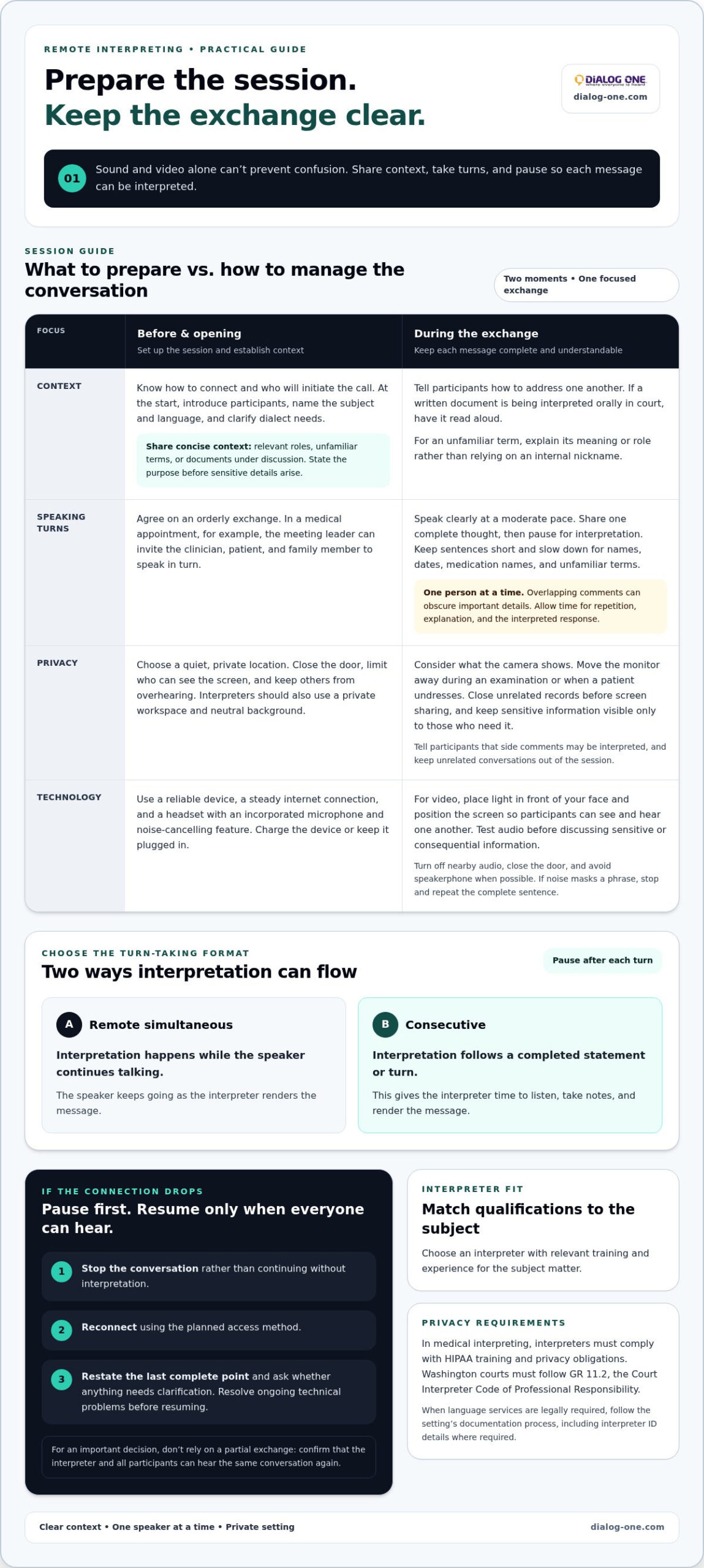
Before an on-demand call, know how to connect and who will initiate it. At the start, introduce each participant, identify the subject, and state the language needed. If dialect matters, clarify it early so everyone can confirm that the interpreter and participant understand one another. In a medical appointment, for example, explain that the discussion concerns a follow-up visit and identify the patient and clinician.
Give the interpreter concise context that will help clarify the exchange, such as a relevant role, unfamiliar term, or document under discussion. Avoid lengthy background that distracts from the immediate conversation. If a court session includes a written document for oral interpretation, have it read aloud so the interpreter can interpret its content. State the session’s purpose before sensitive details arise, and tell participants how to address one another.
Remote simultaneous interpreting happens while the speaker continues talking. Consecutive interpreting follows a completed statement or turn, giving the interpreter time to listen, take notes, and render the message. Participants should pause after each turn for the interpretation.
For remote interpreting, use a reliable device, a headset with an incorporated microphone and noise-cancelling feature, and a steady internet connection. Charge the device or keep it plugged in. For video, place light in front of your face and position the screen so participants can see and hear one another. Test the audio before discussing sensitive or consequential information.
If the interpreter or connection drops, pause the conversation rather than continuing without interpretation. Reconnect using the planned access method, briefly restate the last complete point, and ask whether anything needs clarification. If audio or video still fails, resolve the technical problem before resuming. For an important decision, don’t rely on a partial exchange: make sure the interpreter and all participants can hear the same conversation again.
2. Clear speech, patience, and minimizing interruptions
Speak clearly and at a moderate pace so the interpreter can follow each phrase. In a remote medical appointment, share one complete thought, then pause for interpretation. Short sentences help the interpreter retain details and convey the intended meaning. Slow down for names, dates, medication names, and unfamiliar terms. If asked, spell a word or explain its meaning rather than guessing. These are practical best practices for working with a remote interpreter in high-stakes conversations.
Keep the discussion orderly. During remote medical interpretation, allow only one person to speak at a time. When a clinician, patient, and family member talk together, overlapping comments can obscure important details. The meeting leader can invite each participant to speak in turn, then pause for interpretation. In a court hearing, this approach gives each statement room before the next speaker begins.
Reduce competing sounds before the call. Turn off nearby audio, close the door, and ask others in the room not to interrupt. Avoid speakerphone when possible because it may create echo. Speak close to the phone or video monitor and articulate each word. If noise masks a phrase, stop and repeat the complete sentence. Continuing from the middle can leave the interpreter without essential context.
Choose plain language over shorthand. Replace “let’s touch base” with “let’s speak again,” and avoid slang, jokes, or unexplained abbreviations. If a technical term matters, say it slowly and explain its role. For example, describe what a form is used for rather than relying on an internal nickname. Clear wording is another best practice for working with a remote interpreter because it reduces ambiguity.
Allow time for clarification. An interpreter may request repetition, slower speech, or an explanation when accents, regional vocabulary, or cultural nuance affect meaning. Respond calmly, then let the interpreted message and the other participant’s response finish before changing topics. These requests support accuracy, not delay. Patience keeps the exchange focused on the people communicating and the decision at hand.
3. Confidentiality, privacy, and ethical compliance
In the United States, privacy and language-access requirements depend on the setting. In medical interpreting, interpreters must comply with HIPAA training and privacy obligations; Washington courts must follow GR 11.2, the Court Interpreter Code of Professional Responsibility.
Before a remote session, choose a quiet, private location where others cannot overhear. Interpreters should also use a private workspace and neutral background, especially during attorney-client consultations or sensitive clinical discussions. Close the room door, limit who can see the screen, and avoid sharing confidential details in public spaces. A private setting protects the conversation from unintended listeners, whether the interpreter joins by phone or video.
Consider what the camera reveals throughout the appointment. During a physical examination or when a patient undresses, move the monitor away to protect the patient’s privacy. Before sharing a screen, close unrelated records and documents. Keep relevant materials visible only to participants who need them, and avoid displaying sensitive information while discussing another subject.
Build accountability into the session. When language services are legally required, documentation may need to include the interpreter’s ID number and other required information. Follow the documentation process for the setting, and record identifying details accurately. In a court proceeding, preserve the distinction between an interpreted conversation and a private attorney-client consultation. Courts should ensure that counsel and litigants can communicate confidentially.
Privacy also depends on how participants behave. Tell everyone that side comments may be interpreted, and keep unrelated conversations out of the session. Don’t ask an interpreter to handle sensitive information beyond the interpreting role. If a participant needs a private consultation, pause the shared discussion and arrange a confidential exchange. For healthcare teams, reviewing HIPAA privacy obligations before the call can clarify how to handle patient information during the remote encounter.
4. Interpreter qualifications and training
Match interpreter qualifications to the setting, subject, and communication demands. Professional interpreters should have formal education or proven technical knowledge in interpreting, specialized training, and familiarity with relevant protocols and professional standards. For a medical appointment, experience with clinical terminology and healthcare interpreting protocols matters. A court proceeding calls for knowledge of courtroom procedures and the specific requirements for court interpreters.
Assess competence through both language ability and professional practice. Ask whether the interpreter has training relevant to the subject, understands the applicable interpreting mode, and follows standards for accuracy, impartiality, and confidentiality. Strong conversational command of two languages alone doesn’t establish interpreting competence. Interpreters must convey the full message without substituting their own advice or omitting difficult details.
For Washington courts, RCW 2.43 governs court interpreter qualifications. Under RCW 2.43.030, courts must appoint a certified or registered court interpreter, or make a good-cause finding on the record to use a non-credentialed interpreter. These requirements apply to court appointments, not as a universal credential rule for every remote session. Identify the session’s setting before applying a qualification standard.
Before the session, clarify the language and dialect, subject matter, and participants’ communication needs. For a specialized discussion, share relevant terminology or documents in advance when appropriate. At the start, confirm that the interpreter and participant understand one another. During the conversation, notice whether the interpreter requests clarification when a term or phrase is ambiguous. Careful clarification supports accuracy; it should not be treated as a sign of poor performance.
For planned appointments requiring subject-specific preparation, prepare a scheduled remote interpreting session around the topic and relevant terminology. A clear match between qualifications, setting, and communication needs supports informed participation without confusing general language fluency with professional interpreting skill.
Dialog One: On-Demand Phone & Video Interpreters
Dialog One provides On-Demand Phone & Video Interpreters for conversations where people need language support without a scheduled appointment. Phone or video interpreting can support communication during healthcare, education, legal, and other important discussions. Choose the format according to participants’ needs and whether visual cues matter.
For planned meetings that need preparation around the setting or subject matter, Dialog One also offers Scheduled On-Site & Remote Interpreters. The right option depends on the conversation, its timing, and how participants will communicate. Brief the interpreter with relevant context, then use clear turns and protect the session’s privacy.
For language support with an upcoming conversation, contact Dialog One to discuss your interpreting needs.
Build a stronger communication practice
Make remote interpreting part of your preparation for important conversations, not an adjustment made at the last moment. Best practices for working with a remote interpreter are more effective when meeting hosts, clinicians, administrators, and other participants understand their roles before the session begins. A shared process helps everyone enter the conversation with clear expectations and respect for each participant’s voice.
Consider what support each upcoming interaction requires. Dialog One offers interpreting for live conversations and certified translation for personal documents, supporting communication needs beyond a single meeting. Choose the service that fits the task, whether you need an interpreter for a discussion or a translated personal document.
When you’re ready to plan language support for an upcoming conversation, contact Dialog One to discuss interpreting. Thoughtful preparation starts with one clear next step, and your next conversation can begin with a stronger foundation.
Frequently Asked Questions
What Can I Do as a Language Service User to Improve the Interpreting Experience?
Speak to the other participant, not through the interpreter, and use first-person language. For example, say, “What concerns do you have?” rather than asking the interpreter to put that question to someone. This keeps the conversation direct and helps participants respond to each other. During a clinical visit, maintain your attention on the patient while the interpreter conveys each person’s words.
What Should Clients Be Aware of During Interpreting Sessions?
Assume the interpreter will interpret everything said during the session, including side comments and remarks made while others speak. Avoid private conversations in the room, even if you think they’re unrelated. Don’t ask the interpreter to offer personal opinions or make decisions for participants. Their role is to convey communication, so address concerns or choices to the person responsible for them.
What is Required on the Part of the Interpreter?
A professional interpreter needs interpreting knowledge or education, relevant specialized training, and familiarity with the protocols and standards for the setting. The interpreter should convey participants’ messages faithfully and request clarification when wording is unclear. For example, they may ask someone to spell a name or explain a regional term. This supports accuracy; it doesn’t make the interpreter responsible for participants’ decisions.
What should you do before a remote interpreting session to prepare the interpreter?
Prepare a concise session note with participants’ roles, the meeting’s purpose, and any context that could clarify the discussion. For an appointment about a new treatment plan, identify the topic without sharing unnecessary personal details. Tell participants how they’ll join the call, and have relevant materials ready to share. This gives the interpreter useful context before the exchange begins.
How should participants speak and take turns when working with a remote interpreter?
Use first-person statements and pause after each complete thought. Let the other participant hear the interpreted message before adding a follow-up or changing topics. In a group meeting, the facilitator can invite one person to speak, then offer the floor to the next participant. This prevents overlapping contributions and keeps the conversation focused on the people involved.
How do you brief a remote interpreter on terminology, documents, and context?
Share relevant session materials in advance, such as a presentation, glossary, or document that will be discussed. Expand acronyms on first use and explain specialized terms in plain language. For instance, include a brief note describing what an unfamiliar form is used for. Explain the meeting’s setting and purpose so terms can be understood in context, not as isolated words.