Certification is an attestation, not a blanket requirement for every translated contract. A certified translation includes a signed statement from the translator or agency verifying its accuracy. Whether a contract needs certification depends on how the translated document will be used. Legal contract translation services should preserve the agreement’s meaning, numbering, names, dates, and cross-references so readers can follow the same obligations in each language.
That distinction matters when a contract supports a filing, review, negotiation, or decision across languages. You’ll learn what certification does and does not establish, how to assess an agency’s approach to legal agreements, and what the translation process involves, including how scope and complexity affect the project. We’ll also explain where notarization or an apostille may fit, so you can focus on the receiving authority’s requirements rather than assume every translated contract needs the same formalities.
Key Takeaways
- Identify how and where a translated agreement will be used to determine the certification format it needs.
- Assess whether an agency can handle your document type and preserve the details needed for clear legal review.
- Understand how scope, terminology, and formatting shape the translation process for contracts and related records.
- Choose between document translation and interpreter support based on whether you need a written record or live communication.
What is a certified legal translation?
Legal contract translation services can provide a translated agreement with a signed statement verifying its accuracy. Whether certification is needed depends on how the receiving organization will use the document.
Certification Requirements
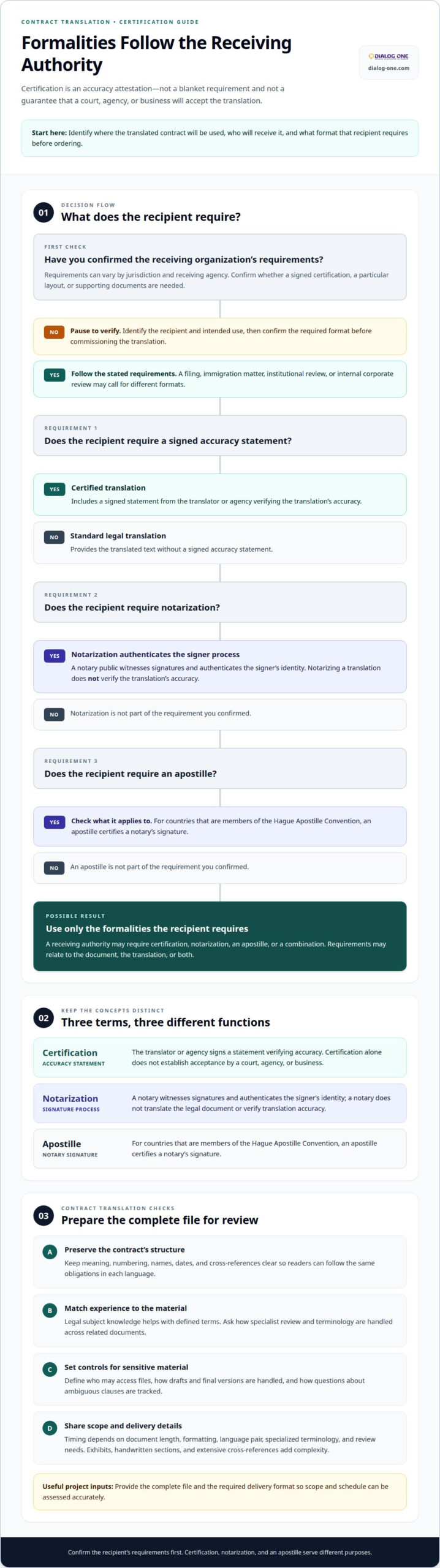
A certified translation includes a signed statement from the translator or agency verifying that the translation is accurate. Standard legal translation provides the translated text without that statement. Certification documents an accuracy attestation, but does not by itself establish that a court, agency, or business will accept the translation.
Certified translations may be required for legal filings, immigration matters, or institutional review. Documents intended for official use, including submissions to U.S. Citizenship and Immigration Services (USCIS), may need certification. For a contract submitted to a court or authority, identify the recipient and intended use, then confirm its required format before ordering.
Notarization is different: a notary public witnesses signatures and authenticates the signer’s identity, but does not translate legal documents. Notarizing a translation authenticates the signature process, not the translation’s accuracy. An apostille certifies a notary’s signature for countries that are members of the Hague Apostille Convention. A receiving authority may require certification, notarization, an apostille, or a combination relating to the document, the translation, or both.
Translator Qualifications and Turnaround
In the United States, the relevant qualifications include language proficiency and competence in the service being provided. The U.S. Bureau of Labor Statistics says interpreters and translators must be proficient in English and at least one other language, as well as in their intended translation service. For a corporate contract, relevant legal subject knowledge also helps the translator handle defined terms consistently.
There is no single turnaround time for every legal contract. Timing depends on the document’s length, formatting, language pair, specialized terminology, and review needs. A short agreement with clear text takes less work than a large contract with exhibits, handwritten sections, or extensive cross-references. Share the complete file and required delivery format so the project scope and schedule can be assessed accurately.
How To Choose the Right Contract Translation Agency?
In the United States, legal translation services cover contracts, depositions, court filings, medical records, and business agreements. Work can include certified document translation and larger projects, with scope shaped by the language, document type, and intended use.
Match the agency’s experience to the material. A commercial agreement needs consistent treatment of defined terms, while a deposition requires careful handling of questions, answers, and speaker references. For medical records submitted with a legal matter, terminology and dates must remain clear. Ask how the workflow handles specialist review and terminology across related documents. Accuracy depends on meaning and context, not just fluent English.
Law firms and courts may need translated pleadings, evidence, discovery materials, or exhibits. Preserve page references, names, dates, exhibit labels, and section numbering so counsel can compare the translation with the source. For example, a translated deposition with speaker labels intact is easier to review than text that merges each person’s statements. Check that the delivery format supports the court or government submission process.
Jurisdictions and receiving agencies can apply different document requirements. Before commissioning work, identify where the translation will be used and whether the recipient requires a signed certification, a particular layout, or supporting documents. This distinguishes a translation for internal corporate review from one prepared for an official filing. Native fluency alone isn’t enough; legal terminology and document structure also matter.
Protect sensitive material through clear project controls. Define who may access files, how drafts and final versions will be handled, and which agreement terms need consistent treatment. Choose a process that tracks questions about ambiguous clauses rather than silently resolving them. For contracts with exhibits, set a shared glossary and review cross-references. These steps help law firms assess accuracy across the complete file, not just its opening pages.
Legal document translation
Legal document translation converts records into another language while preserving their meaning, structure, and intended use. The document type shapes the work: a corporate compliance policy uses defined terms, while a personal court statement may include names, dates, and handwritten notes. Before translation begins, group related files and identify the receiving organization. This helps maintain consistent terminology across the complete submission.
Business and compliance files often include policies, agreements, employee records, and regulatory correspondence. A translator should preserve section references and distinguish obligations from recommendations. For example, changing “may” to “must” could alter how readers interpret a policy. A final review can compare headings, names, dates, and references against the source. For an official submission, use the format and supporting statement required by its recipient.
Financial and transaction documents require close attention to amounts, account details, dates, and defined terms. A translated invoice or closing statement must retain the relationship between figures and surrounding explanations. Immigration and visa files may include identity records, civil documents, and supporting statements. Keep names consistent across each file, including spelling differences between a passport and a birth record. This makes discrepancies visible instead of silently changing source information.
Confidential contracts and sensitive records need controlled handling throughout translation. Limit access to people assigned to the project, use secure file-transfer and storage procedures, and set clear rules for retaining or deleting working copies. For example, a merger agreement should not circulate through an open shared folder. These controls reduce unnecessary exposure, but they do not replace accuracy review.
Turnaround depends on the document’s length, language pair, legibility, terminology, and review scope. A short, typed statement differs from a scanned packet with exhibits and handwritten annotations. Send complete, readable files, note the intended use, and flag preferred spellings or established terms. For a multi-document submission, a shared glossary helps keep names and technical phrases consistent from the first page through final review.
Translation of contracts and legal agreements
Contract translation must carry the same commercial meaning across languages, not merely replace words. Start by identifying the governing version, intended readers, and business purpose. Then flag defined terms, clause references, schedules, and exhibits before translation begins. In an international agreement, one term may recur across payment provisions, warranties, and termination clauses. Consistent terminology helps readers compare duties and exceptions across the full contract.
Preserve the document’s structure so legal teams can review corresponding provisions efficiently. Keep clause numbering, party names, dates, signatures, seals, and cross-references aligned with the original. If a source refers to “Section 8.2,” the translated format should retain that pointer. Changes to numbering can slow review and make links to exhibits or carve-outs harder to trace. Compliance review also depends on seeing which clause supports each obligation.
Build a terminology record for recurring concepts before translating multiple agreements. Include defined words, company names, product terms, and phrases with a specific contractual meaning. For example, if “effective date” appears in the main agreement and an amendment, use the same translation in both. Have reviewers compare the final files against that record, then resolve inconsistent terms before the documents enter negotiations or filings.
Ambiguous source language requires careful treatment, not silent rewriting. Mark unclear passages for review by the responsible legal team, and retain a record of approved terminology decisions. A reported contract dispute over translations of “drydocking” and “tank washing” involved unnecessary costs described as millions. The example shows why industry-specific wording deserves close attention before parties rely on a translated agreement.
Scope the work before requesting an estimate. Provide the complete contract set, target language, intended use, required file format, and any related agreements. Include exhibits and amendments so reviewers can check definitions and references across documents. For sensitive files, use secure transfer and access practices. A clear scope helps establish the work required for accurate translation and review.
For a coordinated review of extensive contract materials, organize your contract translation project with the full set of agreements and supporting files.
Dialog One: On-Demand Phone & Video Interpreters
Dialog One supports multilingual communication when contract work leads to a live discussion. Use on-demand phone or video interpreting for conversations where participants need to communicate across languages. For planned meetings, scheduled on-site and remote interpreters can support the discussion format.
Written files call for a different approach. Large document project translation can support extensive document sets, while certified translation for personal documents serves personal records that require a signed certification. The right format depends on whether you need live communication, a large written project, or a certified personal document.
For business agreements, keep translated documents and live interpretation distinct: interpretation supports spoken exchange, while translation produces written material. Contact Dialog One to discuss the language support that fits your project.
Prepare Your Agreement for Its Next Step
Before a translated agreement moves into negotiation, signature, or filing, identify the governing version, intended audience, and process for recording approved changes. Note who will resolve questions about ambiguous clauses and how later amendments will be handled. This preparation gives legal contract translation services a clear brief and helps keep translated language aligned with business decisions.
Dialog One supports different communication needs through On-Demand Phone & Video Interpreters for live discussions, Scheduled On-Site & Remote Interpreters for planned meetings, and Certified Translation for Personal Documents when personal records need certified treatment. For a contract project, gather the source files, related exhibits, target language, and recipient’s formatting requirements. A defined scope helps coordinate document work with the conversations that follow.
Start with the materials and decision points your team already has. Contact Dialog One about your translation to discuss the next step. Clear language can help every participant move forward with informed decisions.
Frequently Asked Questions
What type of documents can you translate?
Dialog One handles certified translations for personal documents and large document translation projects. For a business project, this can include contract sets and supporting materials submitted together for review. Personal records may include documents where a signed certification is requested. Share the document type and intended use when describing the project, so the scope reflects the materials you need translated.
Are translations done by humans or through Artificial Intelligence (AI)?
Dialog One combines AI technology with human expertise. Document translation uses subject-matter-expert linguists, formatting preservation, and multi-step quality assurance. AI translation can also be paired with human review. For a contract containing specialized terms, clarify which passages or terminology need particular attention, and provide any approved glossary your team uses. Human judgment remains important for accuracy, ethics, and accountability in high-stakes communication.
How do I request a quote?
Prepare the source files and share the target language, document purpose, and required format when requesting a quote from Dialog One. Include related exhibits or appendices so the project scope reflects the complete set. Note whether you need certified translation for personal documents or a large document project. Clear, readable files and a precise description help establish what the requested work involves.
How much does translation cost?
Translation pricing depends on the project and is provided after a quote request. The cost can vary with document volume, language pair, certification needs, formatting, and review scope. For example, a single personal record differs from a multi-file corporate project with appendices. Share the full set of materials and requirements to receive a quote based on the work involved.
What Are The Essential Services for Global Contracts?
Global contracts may require written translation for agreements and supporting files, plus interpreting for live negotiations or meetings. Choose written translation when teams need a translated record to review; use an interpreter when participants need spoken communication. Dialog One offers large document project translation and scheduled on-site or remote interpreters, supporting separate document and meeting needs without treating them as interchangeable.
What languages can you translate?
Dialog One provides language services in over 200 languages. The right language pair depends on the source document and the readers who need to use it. For a contract package shared across teams, identify each target language and keep the same terminology requirements across versions. Include the intended audience and document purpose when outlining your project, so translation needs are clear from the outset.