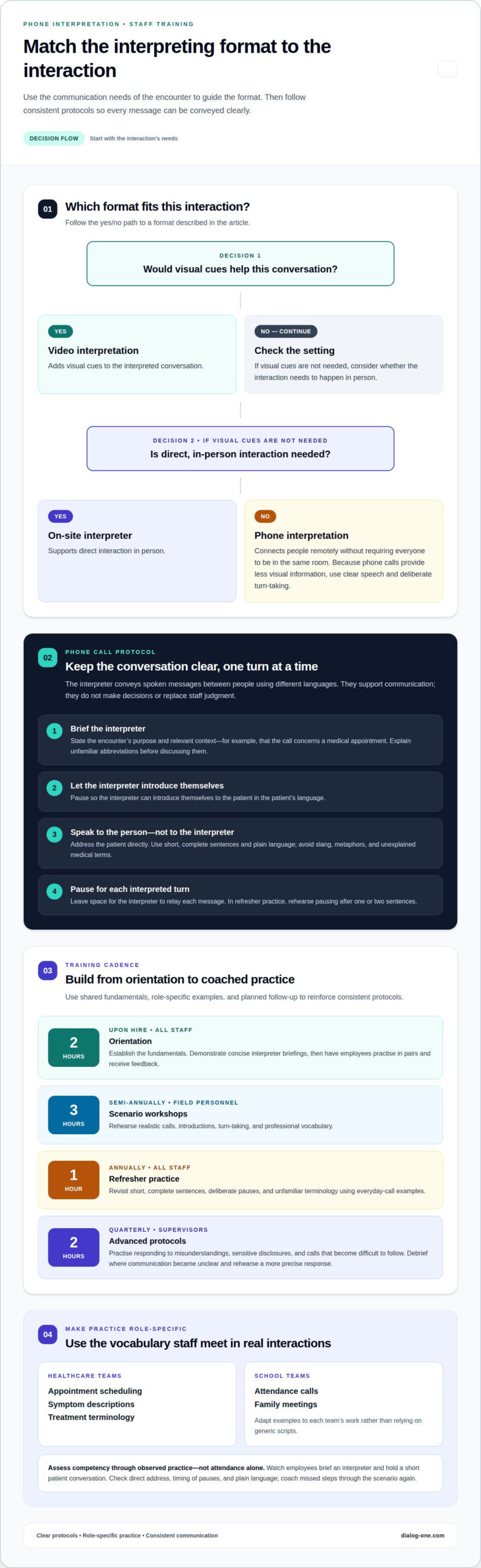
Effective phone interpretation depends on more than connecting a call; staff need clear protocols they can use under pressure. Training staff to use phone interpretation can start with 2 hours of orientation upon hire for all staff, followed by 3 hours of scenario workshops semi-annually for field personnel. This structure gives employees a foundation, then a chance to practise realistic interactions.
It’s natural to focus on the call itself: staff need to communicate clearly while an interpreter relays each message. Good preparation also teaches employees how to brief the interpreter, address the person directly, and pause so each turn can be interpreted without rushing.
This article explains how to provide initial training, what phone interpreters do, and how refreshers and advanced practice can reinforce consistent protocols. It also shows how to adapt training to settings where accuracy, confidentiality, and clear communication matter.
Key Takeaways
- Brief interpreters on the encounter, speak directly to the person, and leave space for each message to be relayed.
- Shape training around staff roles and the professional vocabulary they use in real service interactions.
- Use refreshers and advanced protocols to reinforce clear turn-taking, confidentiality, and consistent practice.
- Identify where trained staff need live language support, then choose phone, video, or scheduled interpreting to fit the interaction.
Definition and role of an over-the-phone interpreter
An over-the-phone interpreter conveys spoken messages between people using different languages during a call. Staff training clarifies the interpreter’s role and gives employees practical techniques for challenging conversations.
Interpreter Role and Importance
A phone interpreter listens to one speaker, then conveys the message in the other person’s language. The interpreter supports communication, but does not make decisions or replace staff judgment. Give brief context, such as saying the call concerns a medical appointment. Use clear wording, and explain unfamiliar abbreviations before discussing them, so the interpreter can convey the message accurately.
In the United States, Title VI of the Civil Rights Act of 1964 prohibits discrimination based on national origin, according to the U.S. Department of Justice. The Americans with Disabilities Act is also relevant to effective communication accommodations.
Phone interpretation connects people remotely, without requiring everyone to be in the same room. Video interpretation adds visual cues, while an on-site interpreter supports direct interaction in person. Because phone calls provide less visual information, speakers should use clear speech and take turns deliberately.
Speaking Through a Phone Interpreter
Address the patient directly, allow the interpreter to introduce themselves, and speak in short, complete sentences. Avoid slang, metaphors, and unexplained medical terms. Long stretches of speech make it harder to convey every point; directing questions to the interpreter instead of the patient shifts attention away from the person receiving care.
Assess staff competency through observed practice, not attendance alone. Have each employee brief an interpreter, explain the encounter, and hold a short patient conversation. Check whether they address the patient directly, pause at the right moments, and use plain language. Note any missed steps, then coach the employee through the scenario again.
Use role-play and group discussion to rehearse challenging situations. One employee can play the patient, another the staff member, and a facilitator can model the interpreter’s role. Practise explaining an appointment change, clarifying a misunderstood term, and returning attention to the patient after an interpreted turn. Discuss what helped communication and where staff need more practice.
How is the training delivered?
Deliver training through role-specific instruction, practical exercises, and planned follow-up. A tailored curriculum helps staff apply consistent interpreting practices in their actual service settings.
Customized Curriculum and Vocabulary
Start with shared fundamentals, then tailor examples to each team’s work. Healthcare staff can practise appointment scheduling, symptom descriptions, and treatment terminology; school staff can rehearse attendance calls and family meetings. The Fundamentals of Interpreting course covers settings, protocols, techniques, speech rate, pronunciation, and professional demeanor. Use these topics to build exercises around the vocabulary employees encounter, rather than relying on generic scripts.
Staff Introductions and Interpreter Briefings
Brief the interpreter before the conversation by stating the encounter’s purpose and any relevant context. Then pause so the interpreter can introduce themselves to the patient in the patient’s language. A practical delivery model begins with 2 hours of orientation upon hire for all staff. Trainers can demonstrate a concise briefing, then have employees practise it in pairs and receive feedback on clarity and professional presentation.
Training Resources for Organizations
Organizations in the United States can build internal learning from structured courses, staff protocols, and scenario workshops. According to Cross-Cultural Communications, organizations train bilingual staff in settings including hospitals, courts, school systems, and human services agencies. Use those settings as a guide for tailoring practice, not as a substitute for role-specific instruction. Field personnel can take 3 hours of scenario workshops semi-annually, using realistic calls to rehearse introductions, turn-taking, and professional vocabulary.
Give staff a clear path from orientation to coached practice. After each workshop, supervisors can identify one skill to strengthen, such as explaining an unfamiliar term or briefing an interpreter concisely. Revisit that skill in the next scenario. This makes progress observable and connects course concepts to daily work.
Some hospitals and healthcare organizations include guidance on working with interpreters in new-hire and annual staff training, giving employees regular opportunities to revisit these practices.
Annual refresher training and advanced protocols
Schedule refresher practice so phone interpretation protocols stay familiar after onboarding. Use advanced sessions to prepare supervisors for complex calls, interruptions, and confidentiality decisions.
Refresher Practice for Everyday Calls
Plan 1 hour of refresher training annually for all staff. Rehearse the habits employees use repeatedly: speak in short, complete sentences, then pause after one or two sentences so the interpreter can relay each message. Include a medical example, such as explaining a follow-up instruction, and ask staff to identify unfamiliar terminology before speaking. This keeps routine practice focused and gives employees a chance to correct rushed pacing.
Advanced Protocols for Supervisors
Schedule 2 hours of quarterly advanced-protocol training for supervisors. Use scenarios that require staff to manage a misunderstanding, a sensitive disclosure, or a call that becomes difficult to follow. Supervisors should practise allowing the interpreter to flag confusion and help clarify it with the patient. Include a debrief: identify the point where communication became unclear, then rehearse a more precise response.
Include confidentiality in every exercise. Medical interpreters should follow confidentiality standards, including those outlined by HIPAA, the Health Insurance Portability and Accountability Act. Have staff practise recording the interpreter’s ID number in the patient file. A supervisor can review the scenario record for completeness and reinforce the organization’s documentation process.
If the Interpreter Disconnects
If a call drops or an interpreter is unavailable, pause the interpreted conversation instead of continuing based on assumptions. Follow the organization’s escalation process to reconnect or arrange interpretation, then resume by briefly restating the context. In an urgent medical situation, follow established clinical procedures while arranging communication support.
Track recurring issues in refresher sessions, such as missed pauses or unclear terminology. Use them to update scenarios and guide coaching. Bilingual employees may contribute language knowledge, but bilingual ability alone does not replace professional interpretation; staff should follow the organization’s interpreter protocols. Training programs and professional associations can inform ongoing development, while internal protocols keep practice relevant to each setting.
Benefits of staff interpreter training
Structured practice turns communication principles into repeatable habits. During a medical appointment, for example, a trained employee can manage turn-taking, explain unfamiliar terms plainly, and keep the patient involved. The goal is not to make staff interpreters, but to help them work effectively with a qualified interpreter while remaining responsible for their own professional decisions.
Training helps organizations identify gaps before they affect a real conversation. A supervisor can observe a role-play, check whether an employee addresses the patient directly, and coach them on missed pauses or unclear phrasing. Repeating the scenario lets staff apply feedback immediately. Over time, this establishes a shared approach across teams instead of leaving each employee to improvise during a challenging interaction.
- Clearer exchanges: Staff practise plain language and concise turns, which helps interpreters relay each message accurately.
- More consistent service: Shared protocols make it easier for employees in different departments to follow the same communication steps.
- Stronger accountability: Practice can include documenting interpreter details and following confidentiality procedures.
Training can also support professional growth. Employees can identify specific skills to strengthen, such as explaining a process without jargon or responding calmly when someone signals confusion. A certificate may document completion of a particular program, but it does not demonstrate every workplace skill. Assess performance through observed practice, realistic scenarios, and supervisor feedback.
Use training outcomes to improve the process: record recurring errors, revise scenarios, and revisit challenging steps during later practice. To support a real interaction that requires language assistance, arrange professional interpretation support as part of your service workflow.
Dialog One: On-Demand Phone & Video Interpreters
Dialog One provides on-demand phone and video interpreters for service interactions that require language support. Use phone interpretation for spoken conversations when participants are in different locations; video can support exchanges where visual communication is useful. Staff training remains essential: employees guide the conversation, while the interpreter conveys messages between speakers.
When an interaction benefits from advance planning or an in-person setting, scheduled on-site and remote interpreters offer another format. Dialog One also provides certified translation for personal documents and large document translation projects, which support written communication rather than live conversations.
Choose the interpreting format that fits the interaction, then use the protocols in this guide to support clear communication. Contact Dialog One to discuss interpretation for your service setting.
Build communication into your service workflow
Make language access part of how your team prepares for each interaction, rather than an improvised response. Assign responsibility for maintaining call procedures, coaching new employees, and reviewing practice scenarios. This makes training staff to use phone interpretation an ongoing part of service quality, not a one-time exercise.
For live language support, Dialog One offers On-Demand Phone & Video Interpreters and Scheduled On-Site & Remote Interpreters. For written communication, it provides certified translation for personal documents. Choose the format that fits the interaction, and ensure staff communicate clearly and respectfully throughout.
Take the next step by aligning your team’s protocols with the interpreting support it uses. Contact Dialog One about staff training to discuss your organization’s needs. A thoughtful process helps staff approach each conversation with greater clarity and care.
Frequently Asked Questions
What skills are developed in this course?
Staff learn to recognize when language support is needed and manage interpreted conversations professionally. Practice can build active listening, cultural sensitivity, confidentiality awareness, and composure under pressure. For example, employees can rehearse confirming a person’s name, date, or another key detail without changing its meaning. These skills help staff communicate accurately while staying within their professional role.
Who is this course meant for?
This training is for employees who communicate with people who prefer another language, including healthcare, education, legal, and public-service staff. It also benefits supervisors who set team procedures and coach colleagues. A clinic receptionist, for example, may coordinate an appointment, while a clinician leads the consultation. Tailor practice to each role’s responsibilities and the conversations staff actually handle.
What topics should phone interpreter training cover for healthcare staff?
Healthcare training should cover common interactions such as registration, appointment coordination, and explaining next steps after a visit. Teach staff to recognize specialized terms and acronyms, and to spell names or explain them in plain language when needed. Include scenarios where a patient asks for clarification or staff need to restate information more simply. For example, practise explaining a referral without relying on unexplained abbreviations.