What if a healthy overall satisfaction score is hiding a poor experience for customers who need support in another language? Measuring the impact of multilingual customer support means looking beyond blended scores, translation volume, or faster AI handling. Those figures can miss whether customers understood the response, resolved their issue, and felt confident about what to do next. Leaders need evidence to decide where language access, staffing, and human oversight can make the greatest difference.
This practical framework connects language access to customer experience, service quality, and operational outcomes. You’ll learn how to choose meaningful measures, including customer effort, first-contact resolution, repeat contacts, and human-reviewed accuracy, then compare results fairly across languages and channels. It also shows how to separate direct operational improvements from broader revenue effects, so findings can guide service decisions without overstating return on investment. The goal is to measure whether multilingual support helps customers get understood and helped, not simply whether more interactions are being handled.
Key Takeaways
- Define impact across access, experience, quality, and operations, and distinguish early indicators from customer outcomes.
- Build a fair comparison by setting a baseline, matching interaction types and time periods, and reviewing results before drawing conclusions.
- Make measuring the impact of multilingual customer support more consistent by defining each KPI’s calculation, data source, owner, and review cadence.
- Use scorecard findings to prioritize language coverage, channels, training, or workflow changes, then assess both intended and unintended effects.
What Measuring Multilingual Customer Support Impact Really Means
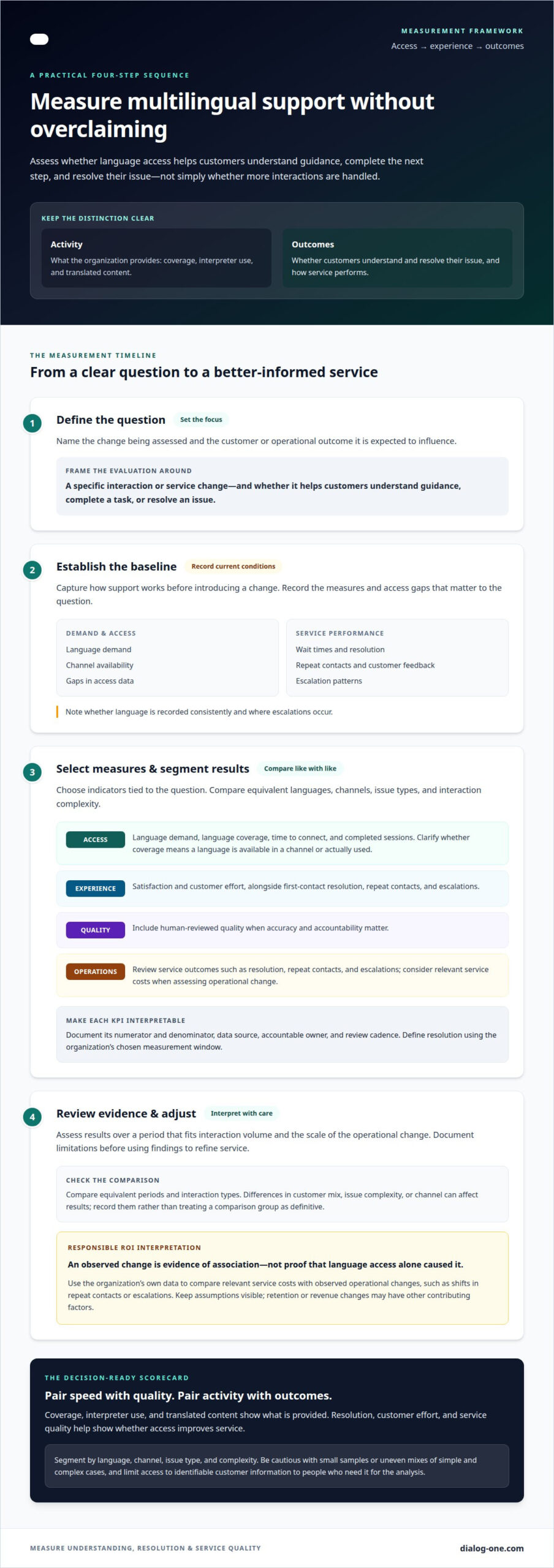
Measuring the impact of multilingual customer support means assessing whether language access changes what customers can understand and accomplish, how well support performs, and what happens operationally. A useful distinction is: Language-access activity shows what an organization provides; customer and operational outcomes show whether that access improves service. Coverage, interpreter use, and translated content are leading indicators. Resolution, customer effort, and service quality are outcomes. Both matter, but they answer different questions.
Total call volume or translated-word counts can show demand and workload. On their own, they don’t show whether customers understood the response, completed the intended task, or had to contact support again. Pair activity measures with outcomes, and include human-reviewed quality when accuracy and accountability matter.
Which outcomes should multilingual support influence?
Assess whether customers understood the guidance, could complete the next step, and felt the interaction required a reasonable effort. Customer feedback, including customer satisfaction metrics, helps interpret these experiences alongside successful issue resolution. Service outcomes add another view: repeat contacts, escalations, and whether the interaction reached its intended conclusion. Retention, conversion, and cost changes may also be relevant, but they are possible effects, not automatic proof that language support caused the change.
Why should results be segmented by language and channel?
Compare like with like. A phone interaction may involve different tasks and constraints than a video appointment, chat, or written request, so combining channels can blur meaningful differences. Segment results by language, channel, issue type, and complexity. Limit access to identifiable customer information to people who need it for the analysis. Then interpret the pattern carefully: a small sample or an uneven mix of simple and complex cases can distort comparisons. Record those limitations before using results to change service design.
How to Measure Multilingual Customer Support Without Overclaiming ROI
A credible evaluation starts with a specific question, such as whether adding language access helps customers complete a particular type of interaction. A disciplined approach to measuring the impact of multilingual customer support follows a clear sequence: define the question, establish a baseline, choose measures, segment results, review the evidence, and adjust the service. Guidance on federal standards for language access and multilingual services can also inform how teams consider access and service quality.
- Define the question. Identify the change being assessed and the customer or operational outcome it is expected to influence.
- Establish a baseline. Record current language demand, wait times, resolution, repeat contacts, customer feedback, channel availability, escalation patterns, and gaps in access data.
- Select measures and segment results. Choose indicators tied to the question, then compare equivalent languages, channels, issue types, and interaction complexity.
- Review and adjust. Assess results over a period that fits interaction volume and the scale of the operational change. Document limitations and use findings to refine the approach.
How do you create a useful baseline?
Capture how support works before introducing a change. Note which channels customers can use, where escalations occur, and whether language is recorded consistently. Compare equivalent periods and interaction types before and after implementation. If a comparison group is available, treat it cautiously: differences in customer mix, issue complexity, or channel can affect results. Record those differences rather than presenting the comparison as definitive.
How can you interpret ROI responsibly?
Use the organization’s own data to compare relevant service costs with observed operational changes, such as shifts in repeat contacts or escalations. Keep assumptions visible, and don’t attribute every retention or revenue change to language access when other factors may have contributed. An observed change is evidence of association, not proof that language access alone caused it. Present ROI as an evidence-based estimate, not a promised return. For teams evaluating interpretation workflows, phone and video interpretation support can be part of a broader language-access approach.
Which KPIs Belong on a Multilingual Support Scorecard?
A useful scorecard balances four views: access, customer experience, quality, and operational efficiency. For each KPI, document its numerator and denominator, data source, accountable owner, and review cadence. This makes results easier to interpret and exposes gaps in how information is collected. When measuring the impact of multilingual customer support, pair speed measures with quality indicators so a faster interaction isn’t mistaken for a better one.
- Access: Track language demand, language coverage, time to connect, and completed sessions. State whether coverage means a language is available in a channel or actually used, and compare demand with availability.
- Customer experience: Review satisfaction and customer effort alongside first-contact resolution, repeat contacts, and escalations. Define resolution as an issue addressed without another contact for the same need within the organization’s chosen measurement window.
- Quality: Use human review, where appropriate, to assess accuracy, context, and whether customers understood next steps. In high-impact interactions, speed alone can’t establish communication quality or accountability.
- Operational efficiency: Monitor handling time and staffing utilization alongside session completion and resolution. Break results down by language, channel, issue type, and complexity before making resource decisions.
Which customer and service-quality measures matter?
Use a consistent survey method for satisfaction and effort, and define the denominator, such as responses received or eligible interactions. For resolution, repeat contact, and escalation, specify which interactions count and how they’re linked. Review quality samples against clear criteria, including whether the customer understood the next step. Protect sensitive information and restrict access to what reviewers need.
Which operational measures help leaders allocate resources?
Compare demand, connection time, coverage, completion, and staffing utilization within equivalent language and channel groups. A short handling time may signal efficiency, or an interaction cut short. Check resolution and quality before interpreting it. Assign an owner to each measure and set a review cadence that supports timely adjustments.
Build a scorecard around your support needs, then connect access measures to phone and video interpretation support where those channels fit.
Turn Multilingual Support Findings Into Better Language Access
Turn measurement into a controlled service improvement, not a one-time report. If results point to unmet demand, consider language coverage. If customers struggle to connect, review channel access or routing. If interactions repeat or escalate, examine training and workflow. State what the change is expected to improve, then reassess the same measures. Record intended effects, such as easier task completion, and unintended ones, such as added wait time in another queue. This keeps decisions grounded in customer experience and service quality.
How should teams communicate results to decision-makers?
Lead with the operational question, the key result, the sample size or other limitations, and the next action. Use concise charts to show language-level differences, with definitions that clarify what each measure counts and the period covered. Share trends without exposing personally identifiable customer information. A clear explanation helps leaders distinguish a meaningful service gap from a difference caused by case mix or limited data.
How can human and AI support be measured together?
Compare workflows by task and outcome, while accounting for issue complexity, channel, and escalation. For example, don’t compare routine requests handled with AI assistance directly with complex interactions that require a human linguist. Track whether human review or rollover supports accuracy, context, and accountability when consequences are significant. Evaluate each workflow against its purpose and the level of human oversight it uses.
Use the evidence to refine language access, then review the measures again after the change. Dialog One’s multilingual language services include on-demand phone and video interpreters, scheduled on-site and remote interpreters, document translation, and AI captioning and transcription.
Make Language Access a Measurable Commitment
Measurement is most useful when it leads to a clear next decision: where to strengthen access, which workflows need attention, and how to keep communication understandable as customer needs change. Treat each review as an opportunity to learn, not as a claim that one service change explains every outcome. That discipline helps teams improve support while preserving trust.
Dialog One provides 24/7 interpreter access in 200+ languages, along with scheduled interpretation and document translation services. In high-impact communication, human judgment supports accuracy, ethics, and accountability. These services can help organizations build language access into customer communication with care.
Use measuring the impact of multilingual customer support to guide practical improvements, then keep listening to the people who rely on those interactions. Explore Dialog One’s multilingual language services to support your organization’s customer communication needs.
Frequently Asked Questions
How do you measure the ROI of multilingual customer support?
Estimate ROI using your organization’s own service costs and outcome data, and make the assumptions behind the estimate explicit. Separate direct operational changes, such as fewer repeat-handling hours, from outcomes such as retention that may have several causes. For example, compare similar customer groups and account for product or policy changes during the same period. Measuring the impact of multilingual customer support should produce an evidence-based estimate, not a guaranteed return.
Which KPIs are most useful for multilingual customer support?
The most useful KPIs depend on the decision you need to make. For example, a team investigating incomplete requests might track session completion alongside first-contact resolution and escalation rates. Define the numerator and denominator for each measure, such as resolved eligible contacts divided by all eligible contacts. Keep the definition stable across languages and channels, and note sample size so a small number of interactions doesn’t drive a major staffing decision.
How can you tell whether language support improves customer satisfaction?
Look for a consistent pattern across customer feedback and service records, not a higher score in isolation. Ask the same satisfaction question after comparable interactions, and record how many customers respond. If response rates differ by language or channel, the scores may reflect different groups of respondents. Check whether the same cohort also completes its support journey successfully, and investigate changes in the issues customers brought to the service.
Can AI metrics show the full impact of multilingual customer support?
No. Automation volume and response speed describe system activity, but not necessarily whether a customer received a clear, accurate answer. For a more complete view, evaluate a sample of completed interactions against task-specific quality criteria, such as whether key information was conveyed correctly. Record corrections, escalations, and cases requiring human judgment separately. This can reveal where automation assists routine work and where human oversight remains important.
How often should an organization review multilingual support metrics?
Set review timing according to how often interactions occur and how quickly teams need to respond to operational changes. Availability or routing indicators may warrant closer monitoring after a workflow adjustment, while customer outcomes need enough comparable interactions to be meaningful. Add an extra review when a channel, script, or staffing approach changes. Keep definitions consistent between reviews, and annotate unusual demand shifts so teams don’t mistake temporary variation for a lasting trend.