Schedule secure video interpreting for legal depositions once you know the date, language needs, and remote format. No single advance-notice period suits every case. Allow enough time to confirm interpreter qualifications, set confidentiality expectations, and test the video setup before testimony.
That preparation matters: a deposition relies on accurate, impartial interpretation and a clear record, not just a working video connection. This guide covers scheduling, confidentiality, video remote interpreting (VRI), and how federal procedure and interpreter qualifications inform your choices. It also explains how to prepare participants and when scheduled remote interpretation can support the proceeding.
Key Takeaways
- Schedule once the deposition date, language needs, and remote format are clear, leaving time to prepare the interpreter and test the setup.
- Protect the integrity of testimony by setting clear confidentiality expectations and keeping the interpreter impartial and focused on linguistic conversion.
- Assess whether video interpreting suits the proceeding, and plan for clear visibility, reliable connections, and an agreed process if the connection fails.
- Understand how federal procedure and interpreter qualifications affect planning, including the qualification and oath requirements for interpreters under Federal Rule of Evidence 604.
1. Confidentiality and attorney-client privilege
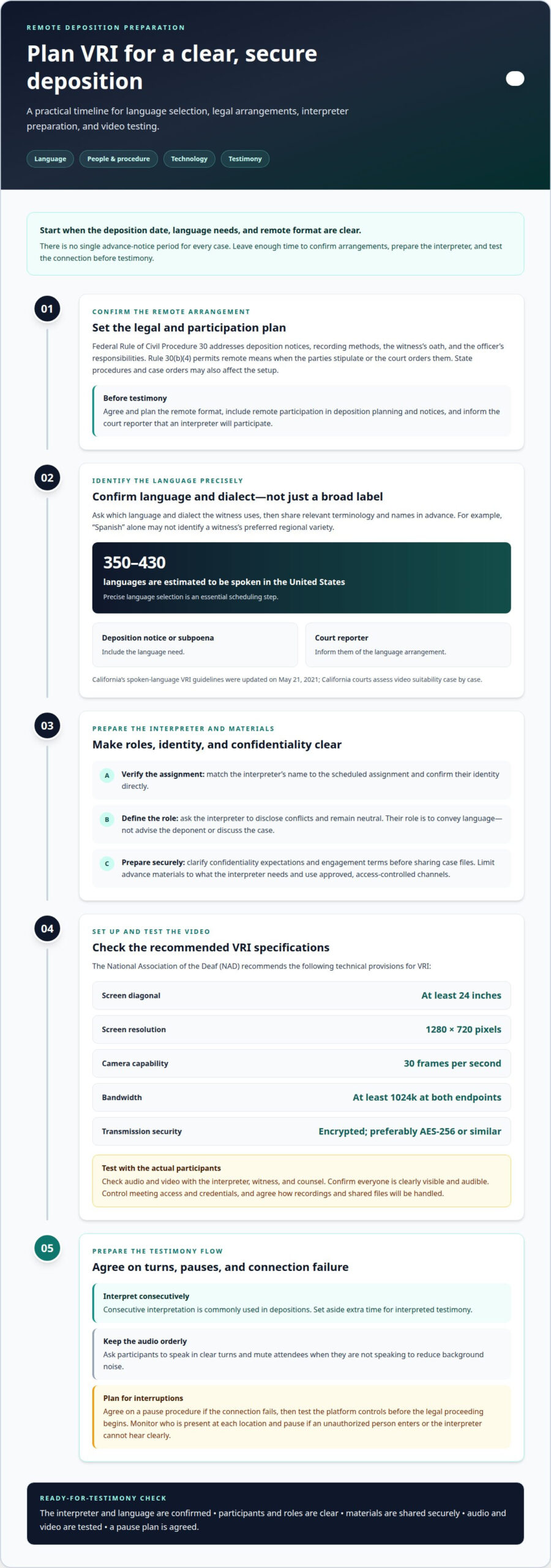
Remote interpreting changes where the interpreter works, not the need for impartial, complete testimony. In person, participants share a room; by video, each location adds possible risks, such as an unobserved person or an insecure connection. Federal Rule of Civil Procedure 30(b)(4) permits remote depositions when the parties stipulate or the court orders them. The format should be agreed and planned before testimony, with the court reporter informed that an interpreter will participate.
Protect confidentiality by defining roles and controlling access. Before the session, identify the interpreter, deponent, counsel, and court reporter, then confirm who may join and how participants will be admitted. Ask the interpreter to disclose conflicts, remain neutral, and avoid advising the deponent or discussing the case. The interpreter’s role is to convey language, not provide legal guidance. Counsel should clarify confidentiality expectations and applicable engagement terms before sharing case files. Limit advance materials to what the interpreter needs for accuracy, and share them only through approved, access-controlled channels. During testimony, monitor who is present at each location. Pause if an unauthorized person enters or the interpreter cannot hear clearly.
For secure video interpreting for legal depositions, the National Association of the Deaf (NAD) recommends encrypted transmissions, preferably AES-256 or similar. The NAD also recommends cameras capable of 720p or greater video, helping participants see facial expression and signing where relevant. Encryption alone does not establish confidentiality: control meeting access, protect credentials, and agree how recordings and shared files will be handled.
Remote video can reduce travel and connect participants across locations; in-person interpreting avoids dependence on a video connection and gives participants a shared room. Neither format is automatically more confidential. California courts decide case by case whether VRI suits a proceeding. Under Federal Rule of Civil Procedure 30(b)(4), remote means require party stipulation or a court order; state rules and case orders may add requirements.
Before the deposition, match the interpreter’s name to the scheduled assignment, confirm their identity directly, and document confidentiality expectations. These steps help counsel know who is interpreting and the boundaries of their role.
2. VRI guidelines for spoken-language interpretation
In U.S. federal civil cases, Federal Rule of Civil Procedure 30 covers deposition notices, recording methods, the witness’s oath, and the officer’s responsibilities. Rule 30(b)(4) permits remote means when parties stipulate or the court orders them. State procedures and case orders can affect the arrangements, so law firms should address remote participation in deposition planning and notices.
California’s spoken-language VRI guidelines were updated on May 21, 2021. California courts assess whether video is suitable for each proceeding. An estimated 350 to 430 languages are spoken in the United States, making precise language selection an essential scheduling step. Ask which language and dialect the witness uses, then share relevant terminology and names in advance. For example, identifying only “Spanish” may not clarify a witness’s preferred regional variety. Include the language need in the deposition notice or subpoena, and inform the court reporter.
Technical preparation matters. The National Association of the Deaf recommends VRI screens with a diagonal size of at least 24 inches and screen resolution of 1280×720 pixels. It also recommends cameras capable of 30 frames per second and bandwidth of at least 1024k at both endpoints. Before testimony, test the platform’s audio and video with the interpreter, witness, and counsel. Confirm that speakers are clearly visible and audible; poor sound can disrupt accuracy and the record.
Plan the session around consecutive interpretation, which is commonly used in depositions. Set aside extra time for interpreted testimony, provide relevant case materials and glossaries in advance, and ask participants to speak in clear turns. Mute attendees when they aren’t speaking to reduce background noise. Agree on a pause procedure if the connection fails, then test platform controls before the legal proceeding begins. For planned sessions, scheduled remote interpreting can support deposition preparation.
3. Compliance references including Title VI, HIPAA, and GDPR
Compliance planning starts by identifying who participates, what information is shared, and which legal framework may apply. Title VI of the Civil Rights Act of 1964 requires federally funded U.S. courts to provide language access for participants with limited English proficiency. For a deposition connected to such a court, the law firm should document the participant’s language needs and arrange meaningful communication during the proceeding. A remote format doesn’t remove that access consideration.
Disability access requires a separate assessment. Under Title II of the ADA, courts and law enforcement agencies must give primary consideration to the deaf person’s choice of auxiliary aids or services, under 28 C.F.R. §35.160(b)(2). The ADA also requires public entities to consult deaf people about communication access and consider their feedback when assessing VRI. A court should therefore record the person’s expressed preferences and the reasoning behind the selected communication method.
HIPAA or GDPR may also be relevant when a legal matter involves health information or participants connected with other jurisdictions. Applicability depends on the organizations, information, and circumstances involved. Before sharing records with an interpreter or video platform, have counsel identify the relevant factors. Do not assume every deposition falls under either framework. Counsel should assess applicable obligations and document handling instructions for the proceeding.
Build a practical compliance record before testimony. Note the language or communication need, the chosen format, participant preferences, and any instructions governing case materials. Keep access limited to people involved in the proceeding, and provide only terminology or records needed for accurate spoken interpretation. If a witness raises an access concern, pause planning and address it before the official record begins.
These steps connect access obligations with the deposition’s actual conditions. Title VI concerns language access, while ADA Title II addresses communication access for deaf participants. HIPAA and GDPR call for context-specific legal review, not assumptions based only on the deposition’s subject. A clear record of decisions helps counsel explain how the chosen approach served the witness and the proceeding.
4. Interpreter certification and legal credentials
A deposition interpreter needs language competence, impartiality, and familiarity with legal testimony. In the United States, Federal Rule of Evidence 604 requires the interpreter to be qualified and swear or affirm to provide a true translation. Certification can support an assessment, but legal teams should distinguish a credential from the rule’s qualification and oath requirements. Requirements may also depend on jurisdiction and proceeding type.
Before scheduling, review the interpreter’s language qualifications, relevant legal experience, and ability to interpret the witness’s specific language variety. Ask how they handle legal terminology, unfamiliar names, and requests for clarification. Confirm their identity and qualifications before testimony, and ensure the required oath or affirmation is administered. The court reporter should understand the interpreter’s role so the official record reflects the communication process.
State programs can set additional credential expectations. Arizona’s court interpreter credentialing program identifies multiple tiers and requires Tier 3 or 4 for courtroom engagements. In California, participating courts may use optional telephonic and remote interpreter services when they cannot secure a California certified or registered court interpreter. These examples show why legal teams should examine the rules for the relevant jurisdiction instead of treating one credential as universal.
Automated translation presents different risks: it can miss context, tone, false starts, or specialized terminology. Deposition interpretation must convey each word and nuance without paraphrasing or simplifying testimony. An automated tool can produce fluent wording without ensuring that the witness’s meaning is rendered accurately. Human judgment is especially important when testimony affects the record or a later legal decision.
Choose a qualified human interpreter for sworn testimony, and use technology only in a supporting role. Attorneys arranging a remote deposition can plan scheduled remote interpretation with the language, case terminology, and proceeding requirements in view.
Dialog One: On-Demand Phone & Video Interpreters
Dialog One provides on-demand phone and video interpreting, as well as scheduled remote and on-site interpreters for legal matters. For a deposition with a confirmed date, language, and remote format, scheduled interpreting lets legal teams plan interpreter participation alongside platform testing and case preparation. If an unexpected language need arises, on-demand phone or video interpreting provides another way to support communication.
When arranging support, share the language and dialect, format, timing, and relevant legal terminology. These details help match interpretation to the proceeding’s communication needs. Dialog One also provides large document project translation for substantial document workloads and certified translation for personal documents when relevant to the matter.
Contact Dialog One to discuss interpreting support for your deposition.
Put your deposition plan into action
Turn your language-access plan into a practical schedule as the deposition date and format take shape. Assign someone to coordinate interpreter arrangements, share relevant case terminology through an appropriate channel, and set aside time to test the platform. These early decisions help counsel, the witness, and the court reporter prepare for testimony.
A secure video interpreting plan for legal depositions should address the proceeding’s specific communication needs, not rely on technology alone. Dialog One provides certified translation for personal documents when supporting paperwork also needs translation. To arrange interpreting, contact Dialog One with the format and language needs of your matter.
Contact Dialog One to discuss deposition interpreting. Thoughtful preparation can help your team begin the proceeding with greater clarity and confidence.
Frequently Asked Questions
How far in advance should a law firm schedule a deposition interpreter?
Schedule once the deposition date, language, and format are known. This gives the legal team time to coordinate the interpreter, prepare terminology, and account for changes to the witness list or schedule. If the date or language need changes, promptly update the relevant participants so preparation stays aligned with the proceeding.
How do you choose a provider for multilingual remote depositions?
Start by defining the witness’s language and dialect, the deposition format, and the legal subject matter. Then establish how interpreter qualifications, confidentiality expectations, and platform access will be addressed. For each witness, share names and specialized terms that may arise. A precise brief helps tailor language support to the proceeding instead of treating every remote session as interchangeable.
How do you handle exhibits, coaching and confidentiality during the deposition?
Clearly identify exhibits for the interpreter and witness, and share relevant materials through a controlled channel before testimony. During the deposition, attorneys should address the witness directly rather than asking the interpreter to explain or summarize an exhibit. The interpreter conveys communication, not case advice. If a private consultation is needed, pause testimony and follow the legal team’s agreed procedure.
How do you safeguard the technical record remotely?
Coordinate with the court reporter before the session so spoken testimony and interpreted responses can be captured clearly. Test each audio source, confirm who is speaking, and agree on how the reporter will identify interpreted testimony in the record. If a connection problem obscures words, pause and resolve it before continuing. Do not rely on an unreviewed automated transcript as the official record.
Simultaneous vs consecutive interpretation, which protects the deposition record?
Consecutive interpretation is generally better suited to sworn testimony because speakers take turns, helping the reporter capture each statement and its interpretation distinctly. Simultaneous interpretation overlaps with the speaker, which can make individual turns harder to follow in a transcript. Counsel can help keep the record clear by asking participants to speak one at a time and pause for interpretation.
What should law firms know about remote deposition interpreting?
Remote interpreting requires coordination among counsel, the witness, interpreter, and court reporter, not just a video link. Clarify participant roles, the witness’s language needs, exhibit handling, and how the team will respond to connection problems. Give the witness a chance to raise communication concerns before testimony starts. These steps help the legal team address practical issues before they affect questioning or the record.