What if a flat quote covers the printed text but not the stamps, handwritten notes, or reverse side of your birth certificate? A flat rate certified translation for birth certificate is useful only when the document scope and deliverables are clear. It’s reasonable to want one straightforward figure, especially when an overlooked detail could complicate a submission to the organization receiving your translation.
This guide explains what to look for in a quote, including how pages, sides, seals, and handwritten details can affect the scope. You’ll also learn how translation certification differs from notarization, why requirements vary by receiving organization, and what to prepare before placing an order. Dialog One prices translation projects by word or page, with the project scope based on the document submitted.
Before requesting a quote, gather a complete, legible copy of every side of the certificate, including stamps, seals, and notes. The sections below explain how to assess the scope, compare deliverables, and prepare your personal document for certified translation.
Key Takeaways
- A flat rate certified translation for birth certificate is easiest to assess when the quote clearly defines the document scope and deliverables.
- Compare quotes using the same language pair and document details, not the headline rate alone.
- Review the receiving organization’s requirements to find out whether it calls for certification, notarization, or a particular document format.
- Check the certificate for unclear or missing details before requesting a quote so the translation scope can be established accurately.
- Dialog One provides certified translation for personal documents, backed by more than 25 years of language-service experience.
What Does a Flat-Rate Certified Birth Certificate Translation Mean?
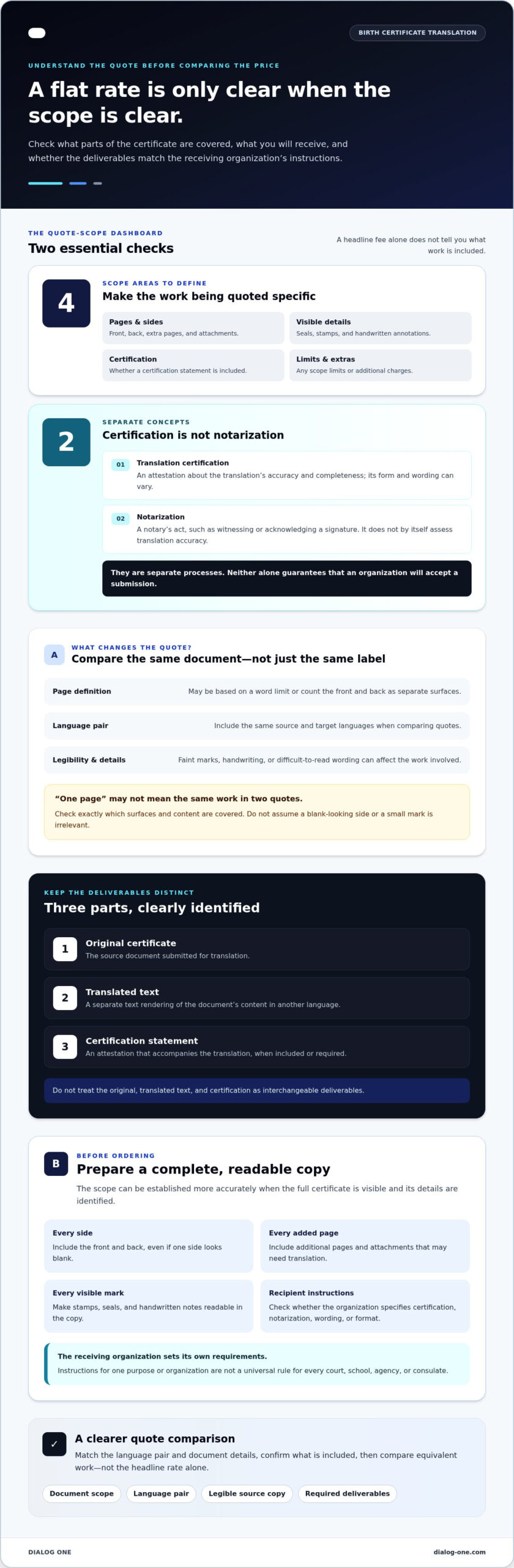
A flat-rate quote sounds simple: one stated fee for the job. But that fee only has meaning alongside the work it covers. A flat-rate translation is a project fee tied to an agreed document scope and specified deliverables. Unlike per-word or per-page pricing, it isn’t calculated by multiplying a stated unit rate by the document’s word count or page count. The scope should identify which parts of the certificate are included and what you’ll receive.
Definitions of a “page” can differ. A quote might set a word limit or count the front and back as separate surfaces. Certification and other deliverables may also be itemized separately from the translated text. As a result, two quotes that each say “one page” may cover different amounts of work. Dialog One prices translation projects by word or page, so a complete description of the document helps establish the project scope.
The language pair and the source document’s legibility also affect the work involved. A certificate with clear printed text is easier to assess than one with faint marks, handwritten annotations, or wording that is difficult to read. The Certified translation overview describes the general purpose of this type of translation. For a particular submission, the receiving organization’s instructions determine what it needs.
What may count as one birth certificate translation?
Identify every part of the record that may need translation: the front, the back, additional pages, attachments, seals, stamps, and annotations. Don’t assume a blank-looking side or small mark is irrelevant. Note what appears on each side and provide a complete, readable copy so the scope reflects the document you need translated.
The original certificate is the source document. The translation is a separate text rendering its content in another language, and a certification statement is an attestation that accompanies the translation. These are distinct components. The quote should make clear which deliverables it covers rather than treating the original document, translated text, and certification as interchangeable.
Why a flat-rate quote needs a clear scope
An undefined page limit makes advertised rates difficult to compare. One quote might cover one side, while another defines a page by a word limit or includes both sides. Don’t assume either definition. Compare quotes using the same document details and language pair, then check exactly what work is included.
A useful scope should name the document and clarify whether it includes:
- Each page, side, and attachment submitted for translation
- Visible seals, stamps, and handwritten annotations within the agreed scope
- The translation certification statement, if required for your purpose
- Any stated limits or additional charges for content beyond the defined scope
This clarity helps you understand what the quoted fee represents before proceeding. If the certificate has extra pages or unclear details, identify them early so the project scope accounts for them. Comparing equivalent work is more useful than relying on a headline rate alone.
What Should Certified Birth Certificate Translation Include?
A certified translation typically comes with an attestation from the translator or translation provider about the translation’s accuracy and completeness. The form and wording of that statement can vary, as can the receiving organization’s instructions. The receiving organization sets its own document requirements, so match the certification or notarization to the instructions for your specific submission.
For example, USCIS describes its translation requirements in its USCIS Translation Requirements. This guidance is relevant to documents submitted for immigration purposes, but it is not a universal rule for every court, school, agency, or consulate. Read the current instructions for the organization handling your document, and note any specific language about the certification statement or format.
Certified translation and notarization are different
Certification addresses the translation: an attestation states that it is complete and accurate, and may identify the translator’s competence in the relevant languages. Notarization concerns a notary’s act, such as witnessing or acknowledging a signature. A notary doesn’t assess the translation’s accuracy simply by notarizing a document. These are separate processes, and neither alone guarantees that an organization will accept a submission.
Check the recipient’s current instructions before ordering. If they specify a signed certification statement, follow the required wording or format. If they mention notarization, treat it as separate from certification instead of assuming one replaces the other.
Check the deliverables against the intended use
For a flat rate certified translation for birth certificate, the stated fee is only one part of the decision. Compare the deliverables with the recipient’s requirements and the quote’s scope. A quote should make clear whether it covers items such as:
- The translated certificate, including content within the agreed scope
- A signed certification statement, if specified for your intended use
- Any stated format or document presentation requirements
- Separate services or charges, if notarization or another option is required
- Physical-copy or mailing options, distinguished from the translation itself
Keep these categories distinct. Translation and certification are document deliverables; mailing and physical-copy options concern how materials are provided. A quote should identify which items are included and which are separate, without suggesting that a particular format will guarantee acceptance. Dialog One provides certified translation for personal documents, with project pricing by word or page. If you’re preparing a personal record for translation, explore certified personal-document translation.
How to Compare Flat-Rate Birth Certificate Translation Quotes
Start by comparing quotes based on equivalent inputs. If one covers a single side and another covers both sides, their headline rates don’t describe the same work. Compare the same certificate, language pair, visible details, and requested deliverables. Then separate the translation scope from optional services, such as physical delivery or notarization, to see what each fee represents.
Which pricing model fits a standard document?
A flat rate sets a project fee for an agreed scope. Per-page pricing uses a defined page unit, while per-word pricing is calculated from the source or translated text, depending on the provider’s method. None is automatically best. A flat rate can make budgeting more predictable when the document and included work are clearly defined. Extra pages, attachments, or irregular layouts can change the scope.
Dialog One prices translation projects by word or page. When comparing pricing models, use the same document details and intended language pair before drawing conclusions.
How to spot incomplete quote comparisons
Use the questions below to check whether a quote describes the full assignment. If an item doesn’t apply, mark it as not applicable rather than assuming it’s included.
| Quote detail | What to compare |
|---|---|
| Scope | Does it identify the certificate and account for each page and side you’re submitting? |
| Certification | Does it state whether a certification statement is included and describe its format? |
| Extra pages | Does it explain how attachments or content beyond the stated page or word limit affect the quote? |
| Delivery | Are physical-copy or mailing options distinguished from translation deliverables? |
| Stated turnaround | Does the quote give a timeframe, and are you comparing quotes with the same stated timing? |
Before comparing totals, verify that stamps, handwritten notes, and other visible content are addressed in each quote. Differences in scope can explain why totals vary, even when documents look similar. Keep notarization separate from translation, and include it in your comparison only when the receiving organization’s instructions call for it. Note whether it is priced as an additional service.
For a flat rate certified translation for birth certificate, the key is a like-for-like comparison, not the lowest headline figure. Record each quote’s scope, certification, extra-page terms, delivery options, and stated turnaround in one place. This makes gaps easier to spot before you proceed.
- Match the certificate and language pair across quotes.
- Check how each quote treats every side, stamp, attachment, and certification statement.
- Separate translation work from optional delivery or notarization charges.
Once you’ve outlined the document and deliverables, you can start a certified document translation with Dialog One.
How to Prepare a Birth Certificate for Certified Translation
A complete, readable copy helps establish what the translation project needs to cover. If a side, stamp, or attachment is missing from the materials you submit, the scope may not reflect the full certificate. Prepare the document before requesting a quote so the project can be assessed against the record you need translated. Flag unclear details rather than guessing at them.
Check every page, side, and visible detail
Review the certificate from edge to edge. Include the front and back, attached pages, seals, stamps, handwritten entries, and annotations. Make sure each image shows the entire document and that the text is legible. If a name, date, or place is hard to read, flag it for review instead of trying to interpret or correct it yourself. A complete copy helps clarify the work in scope.
- Gather the full record. Collect every page and any attachment that belongs with the birth certificate. Check both sides, even if one appears mostly blank.
- Inspect all visible content. Look for seals, stamps, handwritten notes, registration marks, and details beyond the main printed fields. These are easy to miss in a quick review.
- Check readability and framing. Confirm that text and marks are clear and that no edges or details are cropped. If something is faint or obscured, note it so it can be addressed without guessing.
- Review name spellings. Compare the certificate with relevant identity documents or established records. Note consistent spellings and known variations, but don’t alter the source document.
- Prepare the submission copy. Follow the receiving organization’s current instructions about originals, copies, and required formats. Submit the complete, readable materials through its specified process.
Keep names and intended use consistent
Include the name of the organization receiving the translation and the document’s intended purpose in your request. This context helps you compare the requested deliverables with the organization’s instructions. If a person’s name appears differently across records, note the established spelling and the variation rather than silently choosing one. Follow the recipient’s rules for originals and copies; no single format meets every organization’s requirements.
Before submitting, check that every page and side is accounted for, visible details are readable, unclear text is flagged, and the receiving organization’s document instructions have been reviewed. These steps support a well-defined project scope. They’re especially useful when requesting a flat rate certified translation for birth certificate, since the quote should reflect the actual pages and content being translated.
With the document and intended use organized, you can start a certified birth certificate translation with Dialog One. Dialog One provides certified translation for personal documents, with project pricing by word or page.
Start a Certified Birth Certificate Translation with Dialog One
You’re ready to proceed when the document scope is clear and you understand what the receiving organization requires. Gather the complete certificate and identify every page or side that needs translation. Then review the recipient’s current instructions for certification, notarization, and any requested format. With those details in hand, you can assess a quote against the work and deliverables you need, rather than relying on a headline rate alone.
Dialog One provides certified translation for personal documents, backed by more than 25 years of language-service experience. Translation projects are priced by word or page, so the document and defined scope help frame the project fee. If you’re comparing a flat rate certified translation for birth certificate with a word- or page-based quote, focus on whether each covers the same document and requested work.
What to have ready when beginning
Prepare a complete, legible copy of the birth certificate, including all sides, attached pages, and visible details. Identify where you plan to submit the translation and what it will be used for. Keep relevant name spellings available, especially if the person’s name appears differently across records. Use the receiving organization’s latest instructions to guide the requested certification or format, and follow its directions about originals and copies.
These details establish a clear starting point. If part of the record is faint or difficult to read, identify it rather than guessing. If the certificate includes a reverse-side stamp or an attached page, include it when describing the document. That context helps define the project scope and supports a more useful review of the quote.
What a clear next step should accomplish
A suitable quote should help you understand what document is in scope, how the pricing is calculated, and which deliverables are included. The receiving organization’s instructions should guide the request. Translation certification and notarization are distinct, and acceptance of a document is determined by the organization receiving it.
Keep your decision practical. Match the quote to the complete certificate, the relevant language pair, and the instructions for your intended use. If those details align, you can move forward with a clearer understanding of the work and its pricing basis. Dialog One provides certified personal-document translation, with project pricing by word or page.
Begin your certified document translation with Dialog One.
Move Forward with a Clearly Scoped Translation
A birth certificate translation is a personal document, and getting the details right begins with a well-defined project. Before proceeding, make sure the quote reflects the complete record and the deliverables you need for its intended use. That gives you a practical basis for comparing a flat rate certified translation for birth certificate with other pricing approaches without relying on the price alone.
Dialog One brings more than 25 years of language-service experience to certified translation for personal documents. Project fees are calculated by word or page, so the document’s scope helps frame the quote. The receiving organization sets its own submission requirements. A translation provider can prepare the translation, but acceptance is determined by the recipient.
With the document ready and the intended use clear, take the next step with Dialog One. Begin your certified document translation.
Frequently Asked Questions
How much does a flat-rate certified birth certificate translation cost?
There isn’t one universal fee: the total depends on the document scope and pricing method. Dialog One calculates translation project fees by word or page, so the quote is based on the submitted text rather than a fixed public price stated here. To assess a quote, compare the same language pair, pages, sides, and requested certification. The phrase flat rate certified translation for birth certificate describes a pricing approach, not a standard industry-wide amount.
Does a flat-rate translation quote cover both sides of a birth certificate?
Not necessarily. The quote’s scope determines whether both sides are included. The reverse may contain a registration stamp, issuing-office note, or other text, even if most of the page looks blank. Compare the quote’s description with the copy you submitted. If a reverse side or attachment wasn’t included in the materials used for the quote, the scope may need to be revised.
Is a certified translation the same as a notarized translation?
No. Certification is an attestation about the translation, while notarization records a notary’s act involving a signature or document. A notary’s seal does not, by itself, assess whether the translation is accurate. The terms can appear together in a service description, so read them as separate components. Check the receiving organization’s instructions to determine which, if either, it asks for in your specific case.
Does USCIS require a notarized birth certificate translation?
USCIS generally requires a foreign-language document submitted to it to include a complete English translation and the translator’s certification, rather than notarization. Requirements can change, so consult the current USCIS Policy Manual and instructions for your filing before ordering. Translation certification relates to the translated content, while notarization is a separate act and should not be assumed necessary.
Can I use a scan or photo of my birth certificate for translation?
A clear scan or photo can help the translator review the document, but the organization receiving it determines whether a copy is acceptable for your application. For a useful image, place the certificate on a flat surface, keep the camera parallel to the page, and avoid glare or shadows over text. Save each side as a separate, clearly labeled image, and retain the original unless the recipient’s instructions say otherwise.
What happens if my birth certificate includes handwritten notes or stamps?
Visible handwritten notes and stamps may contain information relevant to the record, so identify them when preparing the translation request. A translator should not guess at unclear names, dates, or wording. If a mark cannot be read from the image, a clearer copy may help. Otherwise, the unclear portion can be addressed transparently rather than silently omitted. This is especially important if the receiving organization requires a complete translation of the document.
Can I translate my own birth certificate for official use?
That depends on the receiving organization, but for a document submitted to USCIS, applicants shouldn’t translate their own records. USCIS guidance calls for a translator’s certification of competence and accuracy; it also excludes the applicant and family members from certifying the translation. Other organizations may set different rules. Review the current instructions for the specific submission, and use an independent translation resource when self-translation isn’t permitted.