Speaking two languages is not the same as being prepared to interpret accurately. Trained interpreters can convey meaning faithfully, handle specialized terminology, and follow professional standards; bilingual staff may not have that preparation. The hidden costs of using untrained interpreters include possible errors, delays, repeat work, and avoidable risk.
Bilingual staff can seem like a convenient, lower-cost option, especially for routine conversations. But the true comparison goes beyond time spent interpreting: a misunderstanding can affect a decision, require work to be repeated, or take employees away from their primary responsibilities.
This article explains how trained and untrained interpreters differ, where errors and ethical risks can have serious consequences, and how to weigh professional interpreting fees against the broader costs of relying on bilingual employees. The level of risk in a conversation is also an important factor when deciding how to communicate.
Key Takeaways
- Match interpreter qualifications to the stakes of the conversation; clinical decisions and legal matters call for more than conversational fluency.
- Look beyond the immediate expense of interpretation by accounting for staff time, repeat work, delays, and the consequences of misunderstanding.
- Protect privacy and informed communication by considering confidentiality, impartiality, and the interpreter’s role in sensitive discussions.
- Use the article’s comparison to decide when bilingual staff may suit a low-risk exchange and when professional interpreting is the more responsible choice.
Clinical errors involving medication, symptoms, and informed consent
A missed symptom or altered dosage can change a treatment decision. In clinical conversations, interpreters need accuracy, relevant medical training, and a clear understanding of the patient’s words.
Medication and Symptom Communication Errors
Medication and symptom errors can occur when an interpreter omits, changes, or guesses at details during a health discussion. A patient may misunderstand a dosage, describe symptoms inaccurately, or follow the wrong discharge instructions. In one hospital example, a patient took the wrong medication dosage for several days after a relative misunderstood discharge instructions. Clear interpretation helps clinicians hear the patient’s account and explain next steps accurately.
Interpreter Qualifications and Medical Training
A qualified medical interpreter brings skills beyond conversational fluency, including training in medical terminology, accuracy, and professional ethics. Hospitals should not assume that speaking a patient’s language qualifies an employee to interpret clinical conversations. CMS Conditions of Participation and Joint Commission standards require qualified interpreters for patient communication in hospitals. In high-stakes discussions, relevant interpreter training helps preserve meaning without replacing or simplifying the patient’s words.
Medical Terminology and Patient Safety
Medical terminology includes precise words for symptoms, diagnoses, medications, and treatment instructions. An untrained interpreter may skip or guess at an unfamiliar term, changing information a clinician needs to assess the patient. For example, confusing a symptom description with another condition can direct attention away from the patient’s actual concern. Accurate interpretation supports informed consent by helping patients understand the discussion before agreeing to care.
Malpractice Risks and Language Access Requirements
Medical malpractice risk can arise when an interpreting error contributes to a missed diagnosis, incorrect treatment, or misunderstood consent. What are the legal requirements for qualified interpreters in the United States? Federally funded health care organizations must provide language services to patients with limited English proficiency; hospital standards also require qualified interpreters. What does Title VI require regarding language access and interpreters? Title VI of the 1964 Civil Rights Act is a federal legal basis for language access. The U.S. Department of Health and Human Services, Office for Civil Rights, states that required health care language assistance must be free and provided by qualified translators and interpreters. An Alabama hospital settled an Office for Civil Rights complaint in 2010 after untrained staff interpreted for a Spanish-speaking patient, resulting in improper consent and treatment errors.
What’s the difference between a trained and an untrained interpreter?
Trained interpreters combine language ability with interpreting skills; bilingual fluency alone does not establish those skills. Errors can lead to repeat appointments, corrective work, or liability, while healthcare risks include missed information and unsafe care.
Common Errors by Untrained Interpreters
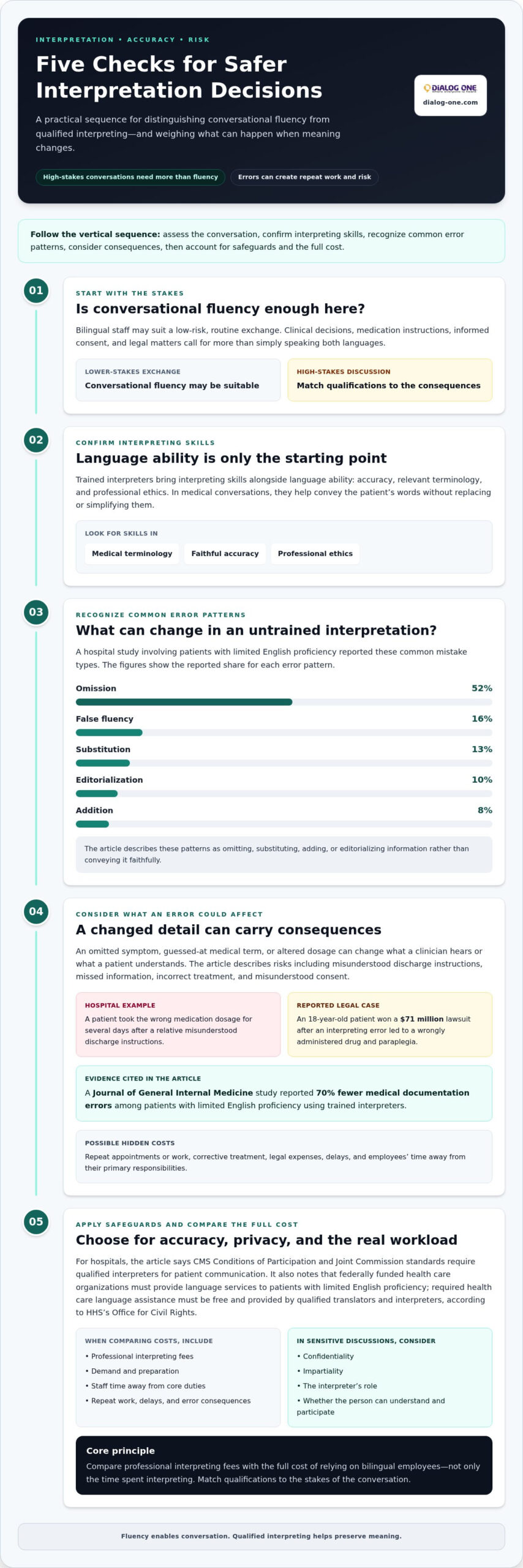
Untrained interpreters may omit, substitute, add, or editorialize information instead of conveying it faithfully. In a hospital study involving patients with limited English proficiency, omission represented 52% of common mistakes, false fluency 16%, substitution 13%, editorialization 10%, and addition 8%. These patterns matter because they can change what a patient reports or understands. Organizations need to distinguish language ability from the specific practice of interpreting.
Malpractice Liability from Interpreting Errors
Malpractice liability can arise when an interpreting error contributes to harm and becomes part of a claim. A reported case involved an 18-year-old patient who won a $71 million lawsuit after an interpreting error led to a wrongly administered drug and paraplegia. The financial impact may also include legal expenses, corrective treatment, and repeat appointments. The hidden costs of using untrained interpreters can therefore extend well beyond the original conversation.
Legal Interpretation Errors and Fairness
Legal interpretation errors can distort a record and undermine a person’s ability to understand proceedings. In one deposition example, misinterpreted ownership and zoning terms compromised the record, so the deposition had to be redone with a court-certified interpreter. In legal claims or court cases, an independent trained interpreter helps both parties understand significant matters and the consequences of noncompliance. Language access supports a fair opportunity to participate.
Communication Errors and Readmissions
Communication errors can contribute to readmissions when patients misunderstand medication, follow-up appointments, or discharge instructions. Medical interpreters with specialized education and training have been shown to help decrease readmission rates and improve outcomes for patients with limited English proficiency. A Journal of General Internal Medicine study reported 70% fewer medical documentation errors among limited-English-proficient patients using trained interpreters.
Professional interpreter costs compared with bilingual staff expenses
Compare professional interpreting fees with the full employment costs of assigning bilingual staff. An accurate calculation accounts for demand, preparation, time away from core duties, and the consequences of errors.
What the Costs Include
Professional interpreting may be billed by the hour, by the minute for phone or video, or by project. Relevant factors include session length, interpreting mode, location, language, and scheduling needs. These details shape the estimate provided after a quote request. Bilingual employees also carry ongoing costs, even when interpreting demand is low.
Include salary, benefits, payroll taxes, overtime, and lost productivity when comparing staff costs. For example, an employee interpreting during a client meeting may have to delay their primary work. Inexperienced interpretation can also extend calls, adding time and increasing the chance of misunderstandings and repeat work.
Training, Modes, and Professional Boundaries
Preparing a bilingual employee to interpret in medical settings requires language proficiency testing, medical terminology training, ethics education, and ongoing competency assessment. These steps take staff time and resources. A professional interpreter may use consecutive interpreting, speaking after each turn, or simultaneous interpreting, speaking as the other person talks. The setting and communication needs determine which mode is appropriate.
Professional boundaries matter, too. A bilingual employee may already have a working relationship with the patient or colleague, making impartial communication more difficult. A trained interpreter conveys the exchange rather than making decisions or managing emotional responses. This separation can help protect privacy and patient rights during sensitive discussions.
Budgeting for Interpreting
Build a budget around actual communication patterns: encounter frequency, duration, language needs, and whether phone, video, or on-site interpreting suits the setting. Use professional support for high-risk conversations, such as consent or complex treatment discussions, and rely on bilingual staff for low-risk exchanges only when their role and ability are appropriate. Compare total staff costs with interpreting expenses, including delays, repeat appointments, and potential malpractice exposure. This gives organizations a clearer picture than comparing a service charge with an employee’s hourly wage alone.
Confidentiality and ethical obligations
Confidentiality means protecting information shared during interpreted conversations, including diagnoses, family circumstances, and treatment choices. The Health Insurance Portability and Accountability Act (HIPAA) provides a relevant privacy framework in medical settings. An untrained interpreter may lack formal confidentiality training or a binding agreement, raising the risk that private details are mishandled or disclosed. For example, a relative interpreting a sensitive consultation may share details outside the care team.
Consent requires patients to understand what they’re agreeing to and to communicate without pressure. Section 1557 of the Affordable Care Act prohibits relying on family members or friends as medical interpreters, except in specified emergencies when no qualified interpreter is immediately available. A relative may have personal interests or emotional ties that affect how a patient’s words are conveyed. That conflict can influence the patient’s ability to speak openly about symptoms, relationships, or treatment preferences.
Privacy risks also depend on the setting and the information shared. HIPAA and the Family Educational Rights and Privacy Act (FERPA) are relevant privacy considerations when unqualified or ad hoc interpreters handle sensitive information. A school meeting, for example, may involve a child’s education record, while a clinic conversation may include health details. Limit access to information needed for the conversation, and document interpretation in the patient’s health record when applicable.
Ethical language services depend on accuracy, impartiality, and clear boundaries. If an interpreter softens a patient’s words or adds personal advice, the record may not reflect what the patient actually said. Errors can complicate consent, create liability concerns, and harm an organization’s reputation. Staff can reduce avoidable exposure by explaining the interpreter’s role, protecting private records, and documenting who interpreted. These practices support accountability without placing responsibility for high-stakes interpretation on family members.
Dialog One: On-Demand Phone & Video Interpreters
Dialog One provides on-demand phone and video interpreting in over 200 languages, helping organizations connect with a professional interpreter for time-sensitive conversations. Use remote interpreting when a patient or service user needs clear communication without waiting for an on-site appointment. For complex discussions that benefit from in-person support, scheduled on-site and remote interpreters offer another option.
Choose the format to suit the interaction: phone or video for immediate remote conversations, or scheduled interpreting when the timing or setting calls for advance planning. Both options help staff focus on their professional responsibilities while an interpreter conveys the exchange. For written records, Dialog One also provides certified translation for personal documents and large document project translation.
Contact Dialog One to discuss interpreting support for your organization’s communication needs.
Make Clear Communication Part of Your Operating Practice
The hidden costs of using untrained interpreters are easiest to overlook when language support is handled informally, one conversation at a time. A practical next step is to build interpreting into your organization’s regular workflow. Identify interactions where accurate communication is essential, clarify who arranges support, and document how staff should respond when language needs arise.
A clear process helps employees respond consistently instead of improvising during sensitive conversations. Review how requests move through your organization, where delays occur, and how concerns are recorded. Then make the process clear to everyone who needs to use it. Reliable language-access practices support sound decisions and make communication part of responsible service.
For help planning interpreting support around your organization’s needs, contact Dialog One to discuss interpreting. A clear process is a practical step toward more confident communication.
Frequently Asked Questions
How do untrained interpreters affect informed consent, confidentiality, and patient privacy?
An untrained interpreter may leave a patient unclear about choices, risks, or next steps. For example, if a patient asks a sensitive question and a relative answers on their behalf, the clinician may not hear the patient’s own concern. Organizations can protect privacy by limiting access to relevant records, explaining the interpreter’s role, and documenting interpretation in the health record.
How do professional interpreter services compare with untrained staff or family interpreters in cost and accuracy?
Professional interpreting costs vary with service format and usage, while employee expenses continue through salary and benefits even when demand is low. Family or staff interpreting can seem less costly at first, but the comparison changes if the conversation requires correction, extra staff time, or another appointment. For budgeting, review how often language support is needed and which interactions carry the greatest consequences.
What risks do organizations face from using minors or family members as interpreters?
Minors and relatives may face emotional pressure, lack specialized vocabulary, or find it difficult to convey sensitive information impartially. A child interpreting a parent’s medical discussion, for instance, may hear details that are distressing or beyond their role. Section 1557 of the Affordable Care Act prohibits relying on family members or friends as medical interpreters, except in specified emergencies when no qualified interpreter is immediately available.
What do studies show about errors made by untrained versus professional interpreters?
A study of conversations in two pediatric emergency departments in Massachusetts found significant errors in 12% of conversations with interpreters who had more hours of training, compared with 22% with non-trained interpreters. Conversations without an interpreter had significant errors in 20%. These findings show why organizations should consider interpreter training and the communication risks of proceeding without language support.
What steps should organizations take to assess interpreter qualifications and provide language access?
Set a language-access policy that identifies critical interactions, explains how staff request interpreters, and clarifies procedures. Assess relevant credentials, experience, training, and ongoing competency. Then track complaints, service delays, and satisfaction to identify gaps. For example, a clinic can review whether patients understand appointment instructions and whether staff know how to arrange support for consent discussions.