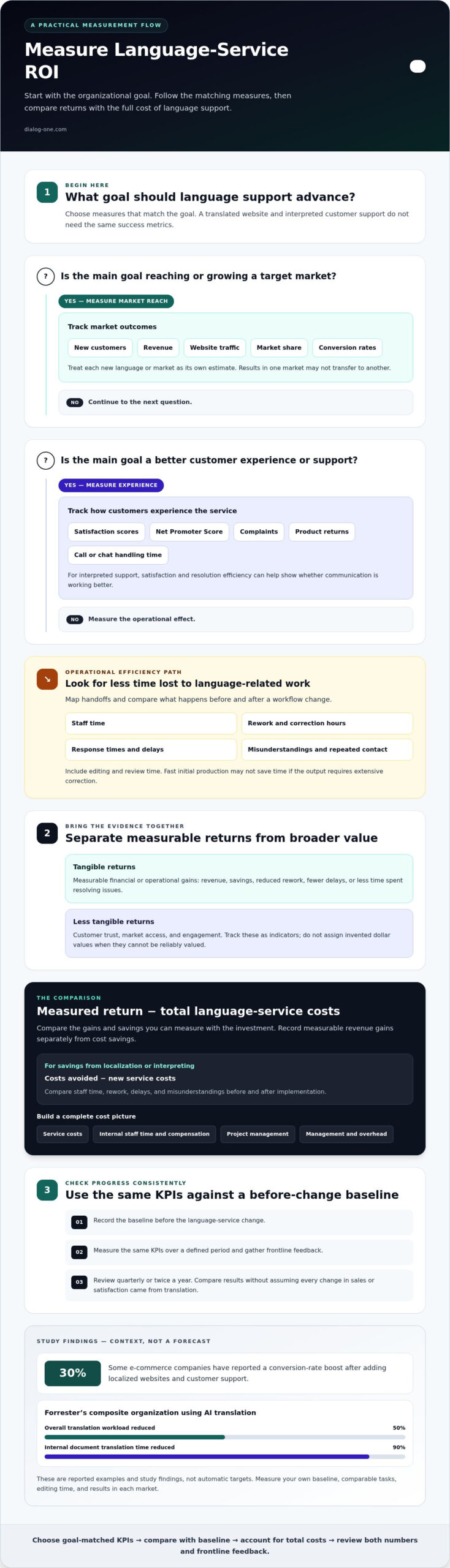
To understand how to calculate ROI of language services, compare the returns they create with their total costs. Start with the basic calculation: return minus costs. Count measurable financial gains and savings, then track additional value such as broader market access, stronger customer relationships, and more efficient operations.
It’s reasonable to focus on spending first, especially when language support competes with other priorities. But looking only at costs can miss time saved, rework avoided, and opportunities made accessible through clear communication.
This article explains how to weigh measurable and less tangible returns, account for efficiency and staffing costs, and estimate the potential value of adding languages. You’ll also learn how to connect the investment to organizational goals and choose practical measures for evaluating results over time.
Key Takeaways
- Compare financial gains and savings with total costs, while also accounting for less direct value such as customer trust and market access.
- Track operational measures like rework, response times, and delays to see where language support may improve efficiency.
- Estimate the potential of a new language using that market’s audience, goals, and expected performance rather than assuming results will transfer from another market.
- Include the time and compensation involved in internal language work, along with the management and overhead required to support it.
- Build a complete cost picture by considering project management, staffing, and the resources needed to deliver language services.
Calculating language-services ROI through tangible and intangible returns
Start by linking language support to an organizational goal, then identify its costs and expected returns. A useful calculation compares measurable gains and savings with the investment, while tracking less direct value separately.
Tangible and Intangible Returns
Tangible returns are measurable financial or operational gains. Less tangible returns include customer trust, market access, and engagement. Both matter: translation can support sales while helping people understand information and use customer support effectively.
For a target market, track new customers, revenue, website traffic, and market share. Also monitor satisfaction scores, Net Promoter Score, complaints, product returns, and call or chat handling time for customers who use other languages. Together, these indicators show whether localized content or interpreting support reaches users and improves their experience.
Some e-commerce companies have reported a 30% boost in conversion rates after adding localized websites and customer support. Treat conversion as one possible indicator, not the whole return: a stronger result may also appear in fewer misunderstandings or better customer engagement.
That example offers a way to set a target, but results can differ in another market.
Measure the same KPIs over a defined period. Review language-services performance quarterly or twice a year, comparing results with the baseline from before the change. This provides a consistent view of progress without attributing every shift in sales or satisfaction to translation.
ROI KPIs and Cost Savings
ROI KPIs connect language-service spending to business outcomes. Useful measures include conversion rates, revenue, customer satisfaction, Net Promoter Score, complaints, returns, and average call or chat handling time. Choose metrics that match the goal: a translated website may be measured by conversions, while interpreted customer support may be measured by satisfaction and resolution efficiency.
To calculate savings from localization or interpreting, compare staff time, rework, delays, and misunderstandings before and after implementation. Subtract the new service costs from the costs avoided, and record measurable revenue gains separately. This distinguishes savings from broader returns.
To understand how to calculate ROI of language services, define the return measures first, then subtract total language-service costs from the measured return. Track less tangible gains as indicators rather than assigning them invented dollar values. For example, rising satisfaction among target-language users can support the business case even when it cannot be reliably valued in money.
Keep quality in view: translation errors can create lasting costs and affect how a business is perceived. Gather feedback from frontline teams alongside KPI data, and record examples of smoother communication or recurring issues. Reviewing both types of evidence quarterly or twice a year helps leaders refine targets and assess whether returns justify continued investment.
Operational efficiency and reduced rework
Language workflows affect staff time, turnaround, and the ability to keep work moving. Measure these operational effects alongside revenue to see where translation removes barriers or creates extra effort.
Operational Efficiency Gains
Operational efficiency gains are reductions in time, duplicated work, or delays caused by fragmented language tasks. They matter because every repeated handoff uses staff capacity that could go toward core work.
Map how requests move between departments, then identify where teams repeat translations, wait for language support, or resolve misunderstandings. A centralized process can reduce coordination work across departments. Track response times and delays, and compare them with user experience and operating costs.
Translation memories in computer-assisted translation tools store previously translated text segments for reuse. When product instructions recur across documents, a shared resource can reduce time spent translating identical or similar text. Keep terminology resources current as products and services change, so reuse supports accuracy instead of carrying outdated wording forward.
Forrester found that a composite organization using AI translation reduced overall translation workload by 50% and internal document translation time by 90%. Treat those as study findings, not automatic targets. Record your own baseline workload, review comparable tasks, and measure editing time as well as initial production.
Quality, Errors, and Risk Reduction
Quality and risk measures capture the downstream cost of unclear or inaccurate communication. They matter because a fast workflow can lose efficiency if errors trigger corrections, delays, or repeated contact.
To account for translation quality, errors, and risk reduction in ROI, record correction hours, rework, complaints, and delays linked to language-related misunderstandings. Compare results before and after a workflow change, including staff time spent resolving each issue. Clear communication can reduce costly mistakes across internal teams and external partners.
Assess machine-translated output by measuring Time to Edit, or TTE, the time a professional translator needs to edit a segment. Some translators report that correcting machine output can take longer than translating from scratch. Compare editing time with original translation time by content type, then include review effort in the workflow’s total cost.
Use frontline feedback to interpret the figures. For example, if a team reports fewer repeated explanations after translated instructions are updated, compare that feedback with correction hours and complaint trends. This connects operational evidence to quality without assigning unsupported dollar values to avoided risk.
When recurring document work creates review bottlenecks, large document translation projects can provide a structured path for addressing that workload.
Estimating future ROI when adding languages
Forecasting a new language starts with a defined audience and business goal. Estimate potential returns for that market separately, because results from one language or country may not carry over to another.
Begin with a specific use case, such as adapting a website for a global audience or improving customer support for a language group. Identify who will use the content, what action they should take, and which business result matters. For an online store, that might mean turning product views into completed purchases. For a service organization, it could mean more completed inquiries.
Next, establish a baseline before launch. Record current visits, inquiries, conversion rates, and revenue connected to the target audience, where available. Then define which changes will count as evidence of progress. Separate traffic growth from conversions: more visitors may not improve results if the localized experience does not address customer needs.
Use a comparable market example to frame, not guarantee, a forecast. One technology example found that localizing a software product and website for Germany led to a 20% increase in subscriptions. That figure shows a possible outcome, but Germany’s audience, product fit, and market conditions may differ from another expansion.
A French-language e-commerce example illustrates the potential scale: translating a company website can make products accessible to millions of new customers. Estimate what portion of that audience fits the product, then model how awareness, visits, and purchasing behavior connect. Do not treat the entire potential audience as likely buyers.
Build scenarios around factors that can shift the forecast:
- Audience fit: Compare the target language group’s needs with the product, service, and current demand.
- Channel reach: Assess whether localized pages, marketing, and customer support can reach that audience.
- Operational readiness: Include the effort to translate, review, update, and maintain content.
- Compliance considerations: Identify whether the target market has language-related requirements relevant to the planned materials.
Finally, set a review point and compare actual performance with the forecast. If a translated page attracts visits but few purchases, examine the offer, navigation, and support experience before expanding the approach. If inquiries rise but teams cannot respond clearly, language barriers may be shifting from marketing to service operations. Use those findings to adjust the next language investment and its success measures.
Use these comparisons to refine each market’s forecast rather than copying results from another audience. Markets have distinct characteristics, so localizing a website for one language may produce different results from localizing it for another. Treat each language as a separate investment case, with its own audience, expected path to conversion, and costs to create and maintain the localized experience.
As performance data accumulates, revisit the key assumptions: whether the intended audience is being reached, whether visitors complete the desired action, and whether the team can sustain the content and support. If the evidence is mixed, adjust the forecast and identify what to test next before a broader rollout. This keeps projections tied to observed results while allowing for differences in market fit, customer behavior, and execution. A forecast is most useful when it guides decisions instead of presenting an uncertain outcome as assured.
In-house staffing costs
Compare in-house and outsourced language services using the same scope, volume, quality requirements, and management effort. Include internal labor and overhead, then compare those costs with the external work needed to meet the same goals.
Calculate internal translation costs using the time required and the applicable salary or hourly rate. Add the share of benefits and overhead tied to the work, along with project management time. For example, if a multilingual employee spends part of their week translating customer materials, count that time even if translation is not their formal role.
Staffing needs go beyond translation itself. An international workflow may require people to review terminology, coordinate deadlines, answer questions, and revise content when products change. Record these tasks separately. Otherwise, a spreadsheet may capture translation hours but miss the work needed to keep the process accurate and usable.
Treat that figure as an estimate for the staffing setup described, not a universal benchmark. Actual internal costs depend on roles, workload, and the share of time devoted to language work.
How should you compare in-house language services with outsourced providers? Match the scope and quality expectations, then compare internal time and overhead with the external work and management required. Use equivalent deliverables, such as the same document volume or interpreting demand, so the comparison reflects actual needs.
Choose metrics that show whether internal capacity is productive. Track hours spent, turnaround, revisions, and completed volume. If multilingual staff also handle their core responsibilities, account for the work displaced by translation. Lower direct spending may not mean a better return if important duties are delayed.
Conversion and engagement metrics add context when language work supports marketing. For example, compare target-language page performance with the staff time spent producing and maintaining those pages. Keep the comparison tied to a defined period and audience, since changes in visits or conversions may reflect other business activity.
Finally, examine workload patterns before assigning permanent roles. A steady stream of recurring work may justify dedicated capacity, while uneven demand can leave internal staff underused during quiet periods. Map recurring tasks, peak requests, and review responsibilities to see which model supports reliable delivery without overlooking the full cost of communication and coordination.
Which costs should be included when calculating language services ROI?
A useful ROI estimate includes every cost directly connected to language work, not just the final translation or interpreting charge. Separate recurring expenses from project-specific work so the comparison reflects the full scope and avoids counting a cost twice.
Start with the provider’s charges. Translation companies may charge by word or by time spent translating, and some also charge project management fees. For a document project, record translation and management charges together. For interpreting, capture costs tied to the sessions and delivery model.
Then include internal labor. Count the time employees spend preparing source material, answering questions, reviewing terminology, coordinating schedules, and approving deliverables. For example, a product team may spend time explaining technical terms before a manual can be translated. That effort belongs in the project cost, even if it appears on another department’s timesheet.
Account for review and rework separately. Editing machine-translated segments, correcting errors, and revising content after a product change all use resources. Track the work instead of assuming the initial translation completes the task. If the same content is revised across several documents, distinguish essential review from duplicated correction.
Include technology and workflow expenses when they can be attributed to the work. These may cover translation tools, terminology resources, file preparation, and time spent moving content between systems. Include only the portion used for the language project. If a tool serves several departments, allocate its cost consistently instead of assigning the full expense to one project.
Group the cost record into clear categories:
- External work: Translation or interpreting charges and any project management fee.
- Internal labor: Preparation, coordination, review, approvals, and revisions.
- Workflow resources: Relevant technology, file handling, and terminology maintenance.
- Rework: Corrections, repeated communication, and avoidable delays connected to language tasks.
Use the same scope when comparing alternatives. Do not compare a translation-only estimate with a workflow that also includes review and project coordination. Keep the measurement period consistent, document how shared costs are allocated, and compare total costs with returns measured for the same work. This makes the calculation more useful for budgeting and future planning.
For a substantial document workload, request support for a large document translation project as you assess the work and resources involved.
Dialog One: On-Demand Phone & Video Interpreters
Dialog One provides on-demand phone and video interpreters in over 200 languages, helping organizations address communication needs as they arise. Use this option when a conversation requires clear interpretation without scheduling an on-site session. For planned meetings, scheduled on-site and remote interpreters can support more structured communication.
Match the service to the work being measured. Track interpreter use, response delays, and staff time spent resolving communication barriers. For written materials, certified translation of personal documents and large document project translation address different needs. Keeping interpreting and translation costs separate makes ROI reporting more accurate.
If your analysis shows a need for professional language support, contact Dialog One to discuss the interpreting or translation service that fits your requirements.
Turn your ROI analysis into a measured next step
Use your findings to shape a focused language-services plan. Choose a defined communication need, identify who it affects, and set a baseline before changing the workflow. This gives your team a practical way to apply how to calculate ROI of language services to future decisions, rather than treating one estimate as a permanent answer.
Dialog One supports this next step with On-Demand Phone & Video Interpreters for live conversations, Scheduled On-Site & Remote Interpreters for planned interactions, and Certified Translation for Personal Documents when written materials need translation. Choose the service that matches the communication task, then assess it against the outcomes your organization has chosen to track.
Language access is an operational decision as well as a financial one. A clear scope and useful measures help leaders assess where support fits, what it should address, and how to review its contribution over time. Contact Dialog One to discuss your ROI analysis and identify a suitable next step for your language-service needs.
Frequently Asked Questions
Why Measure ROI in Language Solutions?
Measure ROI to determine whether language support advances a specific organizational priority, not merely whether a task was completed. For example, a company translating employee onboarding materials can assess whether staff understand procedures and need fewer repeated explanations. That evidence helps leaders decide which communication needs deserve continued attention and where the approach should change. It also grounds budget discussions in operational outcomes.
Need to Improve the ROI of Your Translation Efforts?
Improve translation returns by prioritizing content that supports an important user task, such as completing an application or understanding product instructions. Clarify the source text before translation, assign an accountable reviewer, and capture user questions after publication. If readers repeatedly misunderstand an instruction, revise that passage first. This focused feedback loop directs effort toward content problems with clear consequences, rather than broad changes without a defined purpose.
What is ROI and How Can It Be Calculated?
ROI assesses the return created by an investment relative to its costs. For language services, first define the outcome being evaluated, such as completed applications, fewer repeat inquiries, or successful use of translated instructions. Then compare the measured return with the costs tied to that work. Keep nonfinancial outcomes, such as clearer communication, as separate indicators unless they can be credibly valued.
What is the formula for calculating ROI of language services?
To understand how to calculate ROI of language services, identify the return and subtract the related costs: ROI = return minus costs. Define what counts as return before comparing results, such as revenue generated or measurable savings. Use costs from the same project and period. For example, assess a translated customer journey using its associated investment and resulting outcomes, rather than combining unrelated work.