What if a translation is wrong, but the mistake still isn’t enough to support a legal claim? A lawsuit for incorrect document translation may be possible when the facts show more than an error: the translator had an applicable duty, failed to meet it, and caused demonstrable harm. The legal test varies by jurisdiction and circumstances, so a mistake alone doesn’t determine the outcome.
If an inaccurate document may have affected a case, agreement, or important decision, it’s understandable to want clear answers. This article explains the difference between a translation error and a potentially viable claim, and what records may help an attorney assess your situation. It isn’t a substitute for legal advice.
You’ll learn what to preserve, including the original and translated documents, instructions, revisions, and records showing how the error affected events or decisions. We’ll also cover practical next steps and how human expertise and accountable translation processes can support clearer work going forward. No process can guarantee a particular legal outcome, but careful documentation can make the issue easier to evaluate.
Key Takeaways
- A lawsuit for incorrect document translation depends on the circumstances. An error alone doesn’t establish a viable claim.
- The document’s purpose matters. A translation may affect a contract, business record, declaration, or evidence in a separate case in different ways.
- Assess potential responsibility, the link between the error and its consequences, and the harm alleged before drawing conclusions about legal options.
- Preserve the original and translated files, versions, instructions, review notes, and communications so the issue can be evaluated in context.
- For future documents, professional translation that combines AI technology with human expertise can support clearer communication without guaranteeing a particular outcome.
When Can an Incorrect Document Translation Lead to a Lawsuit?
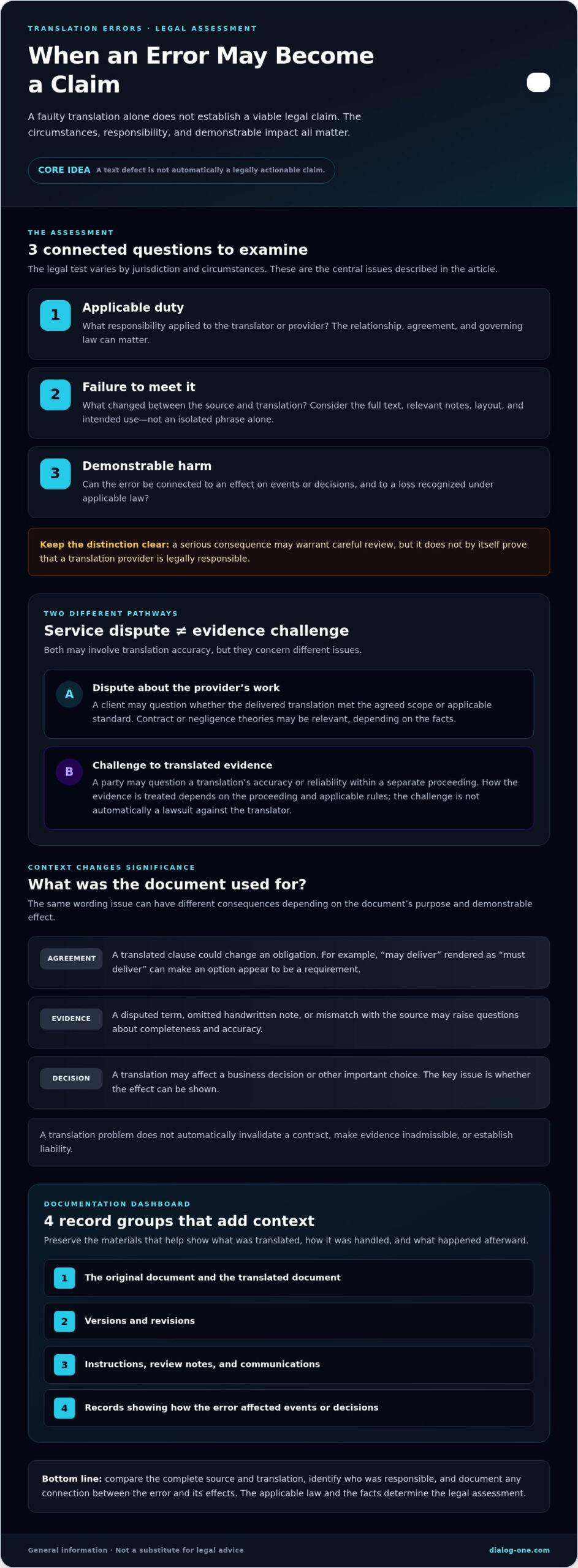
A faulty translation may matter legally when it causes identifiable harm. But an inaccurate word, phrase, or sentence doesn’t automatically establish negligence, breach of contract, or a right to damages. Someone considering a lawsuit for incorrect document translation generally needs to examine what changed, who was responsible, what duties applied, and whether the error caused a legally recognized loss.
Two situations are easy to confuse. In one, a client disputes the translation service, perhaps alleging that the delivered work failed to meet the agreed scope or standard. In another, a party challenges translated evidence in a separate legal case, arguing that the document’s meaning or reliability is in question. That challenge may affect how the evidence is considered, but it isn’t automatically a lawsuit against the translator.
Possible legal theories may include contract or negligence claims, depending on the relationship and facts. The applicable standard, available remedies, and who may bring a claim depend on governing law and any relevant agreement. A serious consequence, such as a delayed decision or a disputed contract, may warrant careful review, but it does not by itself prove that a translation provider is legally responsible.
A translation defect describes a problem with the text. A legally actionable claim requires a supported connection between responsibility for that defect and harm recognized by applicable law.
What counts as a material document translation error?
A material error is one that could alter how a document is understood or used. It may involve mistranslating a term, omitting text, using the same key term inconsistently, or formatting content in a way that changes its apparent meaning. For example, a translated contract clause might turn an obligation to deliver a report into language that makes delivery optional.
Whether a difference matters depends on context. Compare the source text with the complete translation, including relevant notes and layout, then consider the document’s intended use. A phrase that seems inaccurate in isolation may have a different meaning in context. Conversely, a small omission could affect a critical condition.
Who might bring a claim, and against whom?
A potential claimant would need to show a relevant relationship to the translation and resulting harm. A client may point to an agreement with the provider, while another party’s ability to pursue a claim depends on applicable law and the circumstances. A recipient of a translated document isn’t automatically entitled to sue simply because they relied on it.
Keep the two pathways distinct. A dispute about the provider’s work concerns responsibility for the service. A challenge to translated evidence is usually raised within the separate proceeding where that evidence is being used, and the court determines how to address it under applicable rules. The facts, contract, source and target texts, and evidence of impact help clarify which issue is involved. This overview is general information, not legal advice. An attorney can assess how local law applies.
How Translation Errors Can Affect Evidence, Contracts, and Decisions
A translation’s consequences depend on how the document is used. A wording issue in a record kept for internal reference may have a different effect from an error in a signed agreement or a document submitted in litigation. The key questions are whether the difference changes meaning, how the document was relied on, and whether that reliance can be shown to have affected events or decisions.
Consequences depend on the document’s purpose, the significance of the error, and its demonstrable effect. A translation problem can prompt review or a dispute, but it doesn’t automatically invalidate a contract, make evidence inadmissible, or establish liability. The result depends on the facts and applicable rules.
When a translated document is used in litigation
During discovery, a translated document may be exchanged so parties can understand and assess relevant material. Questions can arise about whether the translation is complete and accurate, especially if it omits handwritten notes, uses a disputed term, or doesn’t match the source. Producing a document during discovery is distinct from later relying on it in a deposition, motion, or trial.
Before a translated document is used as evidence, a party may contest its accuracy, interpretation, or suitability for that purpose. A court’s treatment depends on the proceeding, the material’s role, and applicable procedural and evidence rules. For example, a translation used to interpret a witness’s statement may raise different questions from a document exchanged during discovery. Don’t assume an error necessarily excludes the document or determines the outcome of a case.
When an error changes a contract or business decision
In a contract, a changed obligation, date, amount, or qualification could affect how a party understands its commitments. If “may deliver” is rendered as “must deliver,” for instance, a reader could believe a deadline is binding when the source text describes an option. Whether that difference affects rights or remedies requires review of the full agreement and applicable law.
Business records can also inform decisions about payment, compliance, staffing, or whether to proceed with a transaction. A mistranslated figure in a report, or a missing qualification in a declaration, may influence how someone interprets the underlying information. The actual effect depends on the document’s purpose and what happened after it was received.
Preserve the signed version, source document, translated copy, and translation history. Instructions, revisions, and communications may help clarify which version was used and how a disputed phrase arose. These records can also distinguish a translation issue from a disagreement about the source document itself. For future projects, professional document translation from Dialog One combines AI technology with human expertise to support clearer communication, without guaranteeing a particular legal outcome.
What Must Be Established Before Suing Over a Translation Error?
Assessing a claim requires more than identifying an inaccurate phrase. The central questions are whether someone had a relevant obligation, whether the translation failed to meet it, and whether that failure caused a supportable loss. A contract claim, negligence theory, or other professional-liability framework may be considered, but none applies automatically. The agreement, facts, and governing law shape the analysis.
Use this framework to organize the questions and records an attorney may examine:
| Issue | What to assess | Evidence to investigate |
|---|---|---|
| Possible error | Was meaning changed by a mistranslation, omission, inconsistent term, or misleading formatting? | Source document, translated version, and a careful comparison of the relevant passage in context. |
| Potential duty | What work was agreed to, and what accuracy or review obligations may apply? | Contract, scope, instructions, correspondence, and any applicable professional standards. |
| Causal link | Did the translation error contribute to a specific decision or event, rather than merely coincide with it? | Decision records, communications, timelines, and evidence of how the translation was used. |
| Alleged harm | What identifiable loss is claimed, and can it be connected to the error? | Relevant financial, business, or case records, along with documentation of corrective steps. |
Error, duty, and breach are separate questions
A translation can contain a material error without proving that the provider breached a duty. The assessment asks whether the work departed from the agreed scope or an obligation recognized under applicable law. Contracts, instructions, review records, and relevant professional standards may help establish what was expected. The governing standard varies with the agreement and circumstances.
That distinction matters in a potential lawsuit for incorrect document translation. A disputed word may be clear on comparison, yet responsibility may remain contested if the source text was ambiguous, the task had defined limits, or the client supplied incomplete instructions. Conversely, a clear departure from agreed requirements may warrant closer legal review. Neither conclusion follows from the error alone.
Causation, damages, and possible defenses
Next, ask whether the alleged error caused a specific, supportable loss. Counsel may examine whether someone independently reviewed the translation, whether a decision-maker relied on it, whether an intervening event also contributed, and whether reasonable steps were taken to limit the impact. These factors can affect responsibility and available remedies, depending on governing law.
An imperfect translation by itself doesn’t prove recoverable damages. A practical next step is to arrange the source text, translation, agreement, instructions, and impact records for legal review. For future high-stakes documents, professional translation that combines human expertise with AI technology can support a more accountable process, though it can’t guarantee a particular result.
What to Do After Finding an Error in a Translated Document
Act methodically. A suspected error may need prompt correction, but changing files or sending an unverified revision can make it harder to establish what was originally delivered and how it was used. Preserve the record first, then assess the discrepancy and its possible effects. If the document is part of an active case or transaction, get legal guidance before taking steps that could affect your obligations.
Preserve the record before making changes. Keep original files intact and work from copies wherever possible.
- Preserve the documents. Save the source and translated files, every available version, and related metadata where practical. Avoid editing, overwriting, or renaming originals in ways that could obscure their history.
- Compare the relevant text. Record the exact passage, the source-language wording, the translated wording, and why you believe the meaning differs. Note omissions, inconsistent terminology, or layout that may change how a reader interprets the passage.
- Document the impact. Write down when and how the translation was used, who relied on it, and what decision or event may have followed. Keep supporting records together, such as contracts, scopes of work, invoices, delivery dates, instructions, review notes, and communications.
- Notify appropriate parties carefully. If a correction is urgent, identify the document and passage at issue and follow any applicable process for notifying people who rely on it. In active litigation or a regulated process, ask counsel how to handle notice and any corrected version before sending or filing it.
- Seek legal advice promptly. A qualified attorney can assess possible claims, deadlines, privilege, and procedural obligations under the relevant law. Time limits may apply, and their calculation can depend on the facts and jurisdiction, so don’t rely on a general article to determine when action is due.
Preserve records and assess the discrepancy
Keep the evidence in a clear, dated folder or secure repository, retaining emails and other communications in their original form when possible. If the issue turns on a linguistic distinction, an independent assessment by a qualified reviewer may help clarify the source and target wording. Keep that assessment separate from the original translation and record who prepared it and when.
Choose a response proportionate to the risk
Correcting a document for immediate use and deciding whether to pursue a formal claim are separate questions. A replacement may be needed quickly, while legal decisions require review of the agreement, impact, and applicable rules. A lawyer can advise on how to preserve relevant material and communicate without compromising procedural duties or legal protections.
For future document projects, explore Dialog One’s professional translation expertise. Dialog One’s translation services combine AI technology with human expertise, supporting a risk-conscious approach without promising to resolve a past dispute or prevent every error.
How Professional Translation Supports Clearer Legal Documents Going Forward
Once an existing translation issue has been assessed, the focus can shift to reducing avoidable ambiguity in future document projects. A clear brief, well-organized source files, and consistent version handling give everyone a stronger basis for understanding the work. These steps can support accuracy and accountability, though they can’t guarantee that a document will be error-free or accepted by a court or agency.
What a careful document translation workflow should make clear
Begin with the source. Provide complete, legible files and identify the document’s intended use, relevant audience, and any deadlines or formatting needs. Flag unclear passages rather than asking a translator to infer missing meaning. For recurring terms, share approved terminology or reference documents so key phrases are handled consistently across the project.
Context matters. A term may carry a specialized meaning in a contract, policy, or personal record that differs from its everyday use. Human expertise can help interpret nuance and identify questions that need clarification, while AI technology can support translation work. The process should make responsibilities clear without implying that technology or human review can eliminate every risk.
Set a practical version-control approach before work begins. Identify the source file to translate, label later revisions clearly, and keep a record of instructions and approved changes. Agree on how questions or proposed corrections will be raised and addressed. This makes it easier to distinguish an updated source from a translation revision and helps reduce confusion when several people handle the same materials.
When Dialog One can support a translation project
Dialog One provides certified translation for personal documents and translation for large document projects. Individuals with personal-document needs and organizations managing substantial written material can benefit from a clear scope, relevant context, and consistent terminology. Dialog One combines AI technology with human expertise, bringing a human-centered approach to work where meaning and accountability matter.
With more than 25 years of experience and translation and interpretation services in over 200 languages, Dialog One supports a broad range of document needs. These capabilities don’t promise a particular legal result. They reflect experience and language coverage that may be relevant when planning work involving important written records.
Professional translation is a forward-looking measure, not a way to determine responsibility for a past error. If you have personal documents or a larger document set to translate, prepare the source files, intended use, and any terminology guidance, then discuss your document translation project with Dialog One. A clear conversation about the project’s scope and context is a practical place to begin.
Take the Next Step Toward Clearer Documents
If you’re weighing a lawsuit for incorrect document translation, treat the decision as a fact-specific legal question, not an automatic response to a mistake. An attorney can assess the applicable law and help you determine what to do about a past dispute. For future work, set a clearer foundation by defining the document’s purpose, sharing context, and agreeing how questions and revisions will be handled.
Careful preparation can make complex material easier to understand and manage. It won’t guarantee a particular legal result, but it can help keep communication and responsibilities clear from the start.
For an upcoming personal document or larger translation project, plan your document translation project with Dialog One. Bring your source materials and intended use into the conversation, and take a practical step toward clearer communication.
Frequently Asked Questions
Can I sue a translator for an incorrect document translation?
Possibly, but a lawsuit for incorrect document translation depends on the facts and applicable law, not the error alone. An attorney may review who ordered the work, what the service agreement required, and whether the wording affected a decision or caused a loss. For example, a recipient who never relied on a translation may face a different claim analysis from a client who acted on a consequential mistranslation. Preserve relevant records and seek legal advice.
What happens if a translated document contains a material error?
The next step depends on how the document is being used. If an agency, business partner, or other decision-maker has received it, the parties may need to clarify which version is being considered and whether a correction is appropriate. Keep the original and any revised version distinct, and record who received each one. If the document supports a pending application, transaction, or proceeding, get guidance before making a replacement that could create confusion.
Is a translation error enough to prove negligence?
No. The presence of an error does not, by itself, show that the translator acted negligently. The assessment may turn on the agreed assignment, the information supplied, the work performed, and the effect of the alleged mistake. For instance, a translator’s handling of an ambiguous source phrase may be assessed differently from an omission of clear text included in the instructions. An attorney can assess the evidence and legal standard that apply to the circumstances.
How do I prove that an incorrect translation caused financial or legal harm?
Build a timeline showing when the translation was delivered, who received it, and what action followed. Pair the disputed passage with records of the decision it may have influenced, such as a payment instruction, signed approval, or filing correspondence. This can help distinguish a direct effect from losses caused by other events. Whether the claimed harm is legally recoverable depends on the facts and applicable law, so discuss the timeline and supporting documents with an attorney.
Can a court reject a document because its translation is inaccurate?
A court may address a translation challenge, but an alleged error does not automatically mean the document will be excluded. The court’s response depends on the applicable rules, the purpose for which the document is offered, and the record presented. A party may need to identify the specific disputed wording and explain its relevance. If the issue arises in an active case, ask counsel about the correct procedure before submitting a corrected version or making arguments about the translation.
Should I correct a translated document before speaking with an attorney?
Preserve the existing version before arranging any correction. If a decision or filing is imminent, tell your attorney about the urgency and ask how to handle the document, its recipients, and any replacement. If you do obtain a revised translation, retain the earlier file and note the revision date and reason. That record can help explain which version was used at each stage and avoid treating a correction as though it were the original.