A state agency’s duty to provide an interpreter depends on the communication barrier and the law that applies. The legal requirements for providing interpreters include the ADA’s requirement that covered entities communicate effectively with Deaf people. Title VI requires recipients of federal funding to take reasonable steps to provide people with limited English proficiency meaningful access to programs and services. State rules may add further requirements.
There isn’t one rule for every situation. The applicable standard depends on the person’s needs, the agency’s role, and the type of communication. This article explains when agencies must arrange interpretation, how certification and licensing rules vary, and when an accompanying adult or child may interpret. It also explains what qualified interpretation means in legal and public-service settings, helping you understand access obligations before deciding how to support communication.
Key Takeaways
- Identify whether disability-access rules or language-access obligations apply; the type of communication and agency role shape the duty to provide an interpreter.
- Maryland state agencies must translate vital documents into a language spoken by at least 3% of the population they serve, according to the Maryland General Assembly.
- Certification requirements vary by state and setting, but interpreters must be qualified to communicate accurately and impartially.
- Family members and other accompanying adults may not be suitable interpreters, especially when impartiality or effective communication is in doubt; legal proceedings can have separate requirements.
When must state agencies provide you with an interpreter?
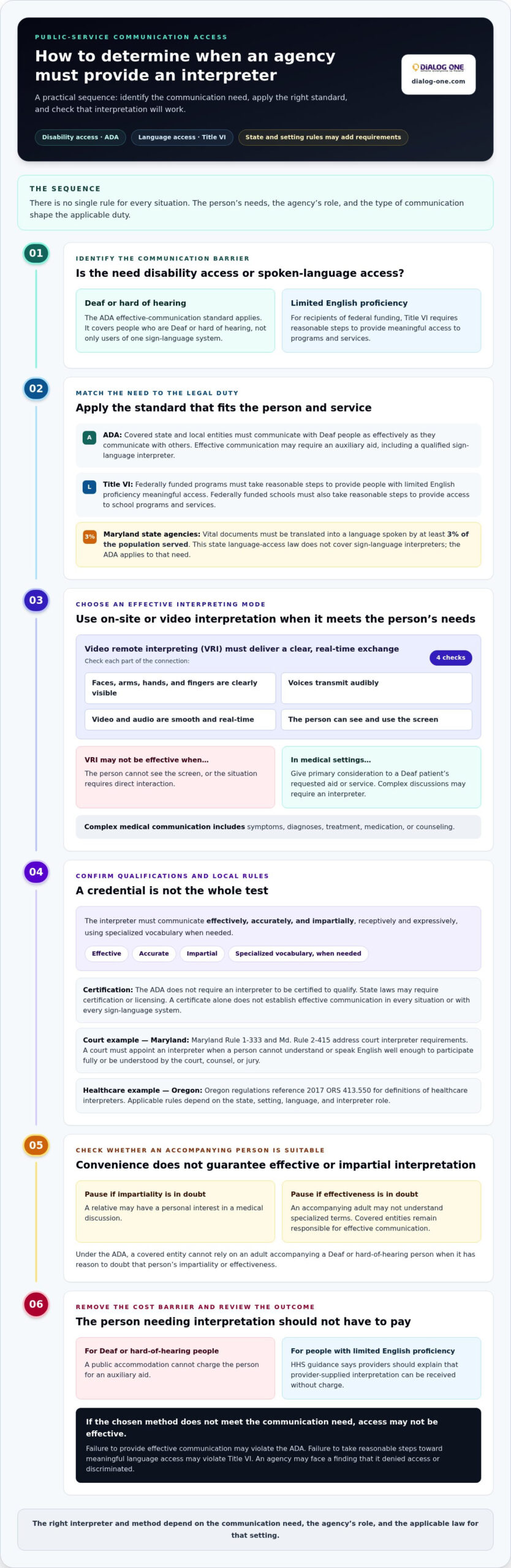
Under the ADA, covered state and local entities must communicate with Deaf people as effectively as they communicate with others. The rule appears at 28 C.F.R. § 35.160(a)(1). Effective communication may require an auxiliary aid, including a qualified sign-language interpreter. The interpreter must communicate effectively, accurately, and impartially, receptively and expressively, using specialized vocabulary when needed. This standard applies to people who are Deaf or hard of hearing, not only those who use one sign-language system.
For spoken-language access, Title VI requires recipients of federal funding to take reasonable steps to provide people with limited English proficiency meaningful access to programs and services. Maryland has an additional state requirement: according to the Maryland General Assembly, state agencies must translate vital documents into a language spoken by at least 3% of the population served. Maryland’s state language-access law does not cover sign-language interpreters; the ADA applies to that need. For students and parents with limited English proficiency, federally funded schools must take reasonable steps to provide meaningful access to school programs and services. The precise language assistance depends on the communication need.
Choose an interpreting mode that makes communication effective. A covered entity may use video remote interpreting (VRI) or an on-site interpreter when either meets the person’s needs. VRI must clearly show faces, arms, hands, and fingers, transmit voices audibly, and provide smooth, real-time video and audio. If someone cannot see the screen or the situation requires direct interaction, VRI may not be effective. In medical settings, providers must give primary consideration to a Deaf patient’s requested aid or service. Complex discussions about symptoms, diagnoses, treatment, medication, or counseling may require an interpreter rather than routine assistance.
The person who needs interpretation should not have to pay for it. A public accommodation cannot charge a Deaf or hard-of-hearing person for an auxiliary aid. HHS guidance says providers should explain that people with limited English proficiency can receive provider-supplied interpretation without charge. Failing to provide effective communication may violate the ADA; failing to take reasonable steps toward meaningful language access may violate Title VI. An agency may face a finding that it denied access or discriminated, particularly if its chosen method did not meet the person’s communication needs.
State interpreter certification or licensing requirements
Certification rules depend on the setting and state. Under the ADA, an interpreter does not have to be certified to qualify, but state laws may require certification or licensing. Qualification still depends on effective, accurate, impartial communication, including the ability to handle specialized vocabulary. A certificate alone does not show that an interpreter can communicate effectively in every situation or with every sign-language system.
Understanding the legal requirements for providing interpreters means distinguishing the rules for state agencies, courts, healthcare providers, and other covered entities. A state statute may define interpreter qualifications for healthcare, while a court rule may set separate appointment procedures. Professional interpreter associations can explain credentials and professional standards, but applicable state law or court rules determine the legal requirements.
Maryland illustrates how rules can differ by service. Its state agency language-access law is cited as Md. Code, State Government § 10-1103. Court interpretation follows separate rules: Maryland Rule 1-333 and Md. Rule 2-415 address court interpreter requirements. Applicants for spoken-language interpreters in court should check the applicable procedures well in advance. The court must appoint an interpreter when a person cannot understand or speak English well enough to participate fully or be understood by the court, counsel, or jury.
Healthcare has its own framework. Oregon’s regulations reference 2017 ORS 413.550 for definitions of healthcare interpreters. That citation shows why patients and agencies should identify the setting and governing state rule instead of assuming one credential applies nationwide. State officials, legislative information, and court administration materials can help locate applicable requirements. Determine whether a rule covers the language, setting, and interpreter role involved.
In short, the legal requirements for providing interpreters in courts, healthcare, and other settings depend on the applicable qualification standard, state law, and setting. For situations requiring organized language access, professional interpreting support can help bridge communication needs.
Use of accompanying adults or children as interpreters
An accompanying adult may seem convenient, but convenience does not ensure effective, impartial interpretation. Under the ADA, covered entities cannot rely on an adult accompanying a Deaf or hard-of-hearing person if they have reason to doubt that person’s impartiality or effectiveness. A relative, for example, may have a personal interest in a medical discussion or may not understand specialized terms. The entity remains responsible for effective communication.
Title III of the Americans with Disabilities Act requires public accommodations to provide auxiliary aids and services when needed for people who are deaf or hard of hearing to have equal access. An auxiliary aid may include a qualified sign-language interpreter. A family member or friend’s presence does not, by itself, show that the person needing access can communicate effectively. The relevant circumstances include the complexity of the discussion and the accompanying person’s ability to interpret accurately and impartially.
For people with limited English proficiency, HHS guidance says healthcare providers may not require them to use a family member or friend as an interpreter. Providers should explain that an interpreter supplied by the provider is available without charge, even when a relative offers to help. Family members may be personally or emotionally involved, affecting neutrality. A child should not be the default interpreter for a parent’s healthcare discussion simply because the child is present. Sensitive or complex information calls for competent, impartial interpretation.
Workplaces have related duties under the ADA. Employers must provide qualified ASL interpreters for essential job functions, interviews, training, and meetings to support equal employment opportunities for Deaf individuals. A coworker or family member may not be qualified for these settings. Consider the communication demands: an interview requires accurate exchange between applicant and employer, while training may involve specialized vocabulary. Choose an auxiliary aid that supports full participation instead of assuming an accompanying person can interpret adequately.
Legal interpreter and transliterator requirements
Legal settings require communication that supports meaningful participation, not merely someone who knows two languages. The ADA applies to court proceedings, jury trials, witness interviews, and legal consultations involving Deaf individuals. A qualified sign language interpreter can help a Deaf or hard-of-hearing person understand questions and communicate responses. The interpreter must convey meaning accurately and impartially, including specialized legal vocabulary. A transliterator serves a different communication need, so the person’s preferred method and the proceeding’s demands matter.
Title VI requires recipients of federal funding to take reasonable steps to provide people with limited English proficiency meaningful access to programs and services. This obligation can affect government departments, federally funded legal assistance, and healthcare providers. HHS guidance allows competent interpreters who are not formally certified to provide oral language assistance. The key test is competence for the task, not a credential alone. A doctor discussing treatment and a lawyer explaining a legal document require different specialized vocabulary.
In a legal consultation, an interpreter must preserve the speaker’s meaning without summarizing, editing, or answering on anyone’s behalf. This matters when someone describes events, reviews evidence, or asks counsel a question. For Deaf clients, the communication method must support full participation. An interpreter who uses a different sign-language system may not communicate effectively with that client. Agencies and legal professionals should match the interpreter’s skills to the language, communication method, and subject matter.
Separate the duty to provide access from the question of certification. Federal guidance allows competent, non-certified interpreters for oral language assistance, while state rules may impose additional credential requirements in particular settings. A legal office should identify the governing state and proceeding rules, then assess whether the interpreter can handle the required terminology and communicate impartially. Qualified interpretation is available without charge to people with limited English proficiency, even if a family member offers to help. For clear communication in legal discussions, arrange professional interpreting support.
Dialog One: On-Demand Phone & Video Interpreters
Dialog One provides on-demand phone and video interpreting for conversations that need language support, as well as scheduled on-site and remote interpreters for planned appointments, hearings, or meetings. Choose a format suited to the task: remote interpreting supports conversations by phone or video, while scheduled interpreting can help prepare for a specific event.
For agencies and organizations, professional interpreters can support accurate, impartial communication when staff, family members, or other attendees cannot provide it. The format should still suit the individual’s language, communication method, and circumstances. Dialog One also provides certified translation for personal documents and translation for large document projects.
Contact Dialog One to arrange interpreting support for an upcoming conversation or event.
Put an effective communication plan in place
Applying the legal requirements for providing interpreters starts with a clear process: identify who is responsible for arranging language access, record communication needs, and match the format to the interaction. This preparation helps agencies and organizations respond consistently, whether planning a formal meeting or addressing an immediate communication need. It also gives staff a practical basis for choosing support instead of relying on an accompanying person by default.
Dialog One offers On-Demand Phone & Video Interpreters, Scheduled On-Site & Remote Interpreters, and Certified Translation for Personal Documents. These services support spoken conversations, planned appointments, and personal documents requiring certified translation. Choose the service that fits the communication task and your organization’s needs.
For help arranging language support, contact Dialog One about interpreter services. A deliberate plan is a meaningful step toward clearer, more accessible communication.
Frequently Asked Questions
Who Decides Which Aid or Service Is Needed?
The covered organization is responsible for selecting an aid that enables effective communication. For medical appointments, providers must give primary consideration to a Deaf patient’s requested aid or service. If a patient requests an on-site sign-language interpreter because video is difficult to see, for example, the provider should weigh that request against the communication needs and circumstances, rather than choosing a format solely for convenience.
Which U.S. federal laws require organizations to provide interpreters?
The ADA requires covered entities to communicate effectively with Deaf people. Title VI requires recipients of federal financial assistance to take reasonable steps toward meaningful access for people with limited English proficiency. The Rehabilitation Act also prohibits disability discrimination in federally funded programs and activities. Which law applies depends on the organization, its funding, and the communication need, so a public agency and a privately run business may have different obligations.
When must courts provide qualified interpreters under federal and state law?
Courts must address interpreter access when a participant cannot understand proceedings or communicate effectively without assistance. The ADA covers court proceedings involving Deaf individuals. In Maryland, a court must appoint a spoken-language interpreter when a person cannot understand English well enough to participate fully or assist counsel, or cannot speak English well enough to be understood. Maryland court rules also govern interpreter requirements and application procedures.
What interpreter requirements apply to hospitals and healthcare providers under Section 1557 and the ADA?
Healthcare providers must consider effective communication needs under the ADA and meet language-access obligations that apply to federally funded programs. For Deaf patients, providers must give primary consideration to the patient’s requested aid or service. For patients with limited English proficiency, HHS guidance says providers may not require reliance on family or friends. During a treatment discussion, the interpretation method must support accurate exchange of symptoms, diagnoses, and care information.
When must businesses and government agencies provide sign language interpreters under the ADA?
Covered businesses and government entities must provide an auxiliary aid when needed for effective communication and equal access for a Deaf or hard-of-hearing person. The aid depends on the interaction. A brief, routine exchange may call for a different approach than a public hearing, medical consultation, or detailed service discussion. The organization must assess whether its chosen method actually enables communication.
When are remote video or telephone interpreting services legally acceptable?
Remote interpreting is acceptable when it provides effective communication for the person and situation. Video remote interpreting must deliver clear, real-time video and audible voices, without choppy images or irregular pauses. Faces, arms, hands, and fingers must be visible at a sufficient size. If someone has difficulty seeing the screen or the interaction requires an on-site interpreter, remote video may not meet the communication need.