What if “official” doesn’t describe a single type of translation at all? For official document translation in the U.S., the receiving organization’s instructions matter more than the label. A signed translator’s certification may meet one requirement, while notarization or an apostille may apply to a separate part of the submission. Confusing these steps can lead to avoidable delays.
Before submitting a birth certificate, court record, academic transcript, or other important document, identify exactly what the recipient requires. Then make sure the translation covers the entire source document, including stamps, seals, handwritten notes, and other visible details. This guide explains what “certified” means, how certification differs from notarization and an apostille, and how to prepare documents for accurate translation. It also covers practical steps for checking recipient-specific instructions and preventing common submission issues. Dialog One brings more than 25 years of language services experience to personal documents and larger translation projects, combining AI technology with human expertise and oversight.
Key Takeaways
- For official document translation, follow the receiving organization’s current instructions rather than assuming one standard applies everywhere.
- Distinguish translation certification from notarization and an apostille, since each serves a different purpose.
- Match the translation workflow to the document’s legibility, terminology, handwriting, layout, and intended use.
- Before submission, assemble readable, complete copies and identify every page and detail that needs translation.
- Dialog One supports personal documents and larger translation projects with AI technology and human expertise, grounded in accuracy and accountability.
What Does Official Document Translation Mean in the United States?
Official document translation is a translation prepared for formal submission or institutional use. The term describes the document’s purpose, not a single certification standard that applies across the United States. Depending on the recipient, a translation may need a signed accuracy statement, a particular format, or other supporting details.
The receiving government agency, court, school, or other institution sets the requirements for documents submitted to it. One recipient may ask for a complete translation and a translator’s certification, while another may specify different supporting materials. Don’t assume a translation accepted for one application will automatically meet another organization’s requirements.
Certified translation in the United States offers useful general background, but it can’t replace the receiving organization’s current instructions. Start with those instructions, then prepare the translation and supporting materials accordingly.
Which documents commonly need official translation?
Formal applications may involve birth, marriage, and other civil records. Academic submissions may call for transcripts or diplomas, while legal matters may involve court records. Businesses may need contracts, corporate records, or other documents translated for institutional use.
The document type alone doesn’t determine what’s required. Its purpose and intended recipient do. A transcript submitted to one school, for example, may have different requirements from a transcript included in another formal application. Check the instructions for the specific submission before arranging the translation.
What does a certified translation usually include?
A certified translation generally pairs the translated content with a signed statement from the translator or translation provider affirming that the translation is complete and accurate. The statement may also identify the translator’s competence in the relevant languages. Wording and supporting details can vary, so follow the recipient’s stated requirements.
The translation should cover the full document, not just its main paragraphs. Stamps, seals, handwritten notes, and other visible text may carry meaning or help identify the record. If a detail is unclear, it should be handled transparently rather than guessed or silently omitted.
A certified translation is a complete translation accompanied by a signed statement of accuracy, prepared to meet the receiving organization’s instructions. Certification describes the translator’s attestation. By itself, it doesn’t guarantee acceptance by every agency or institution.
Certified Translation, Notarization, and Apostille: What Is the Difference?
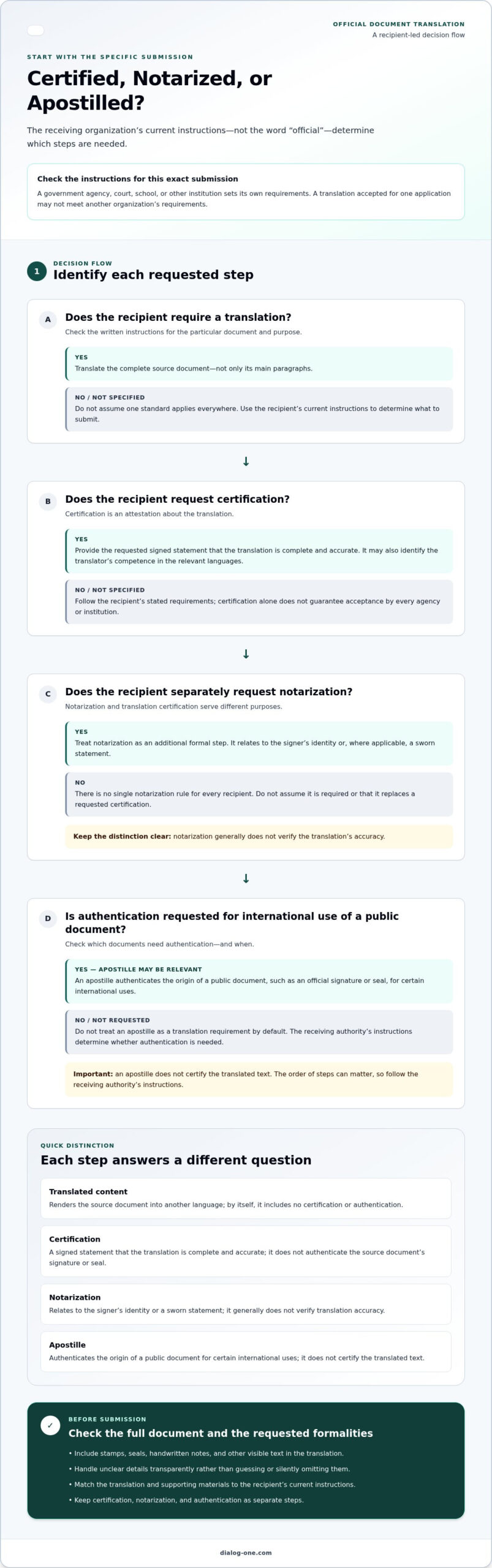
These terms refer to different steps, not interchangeable labels for an “official” translation. Certification addresses the translated work. Notarization concerns a signer’s identity or sworn statement. An apostille authenticates the origin of certain public documents for international use. For official document translation, identifying which step the recipient requires can help prevent unnecessary formalities and submission gaps.
| Item | What it relates to | What it does not establish |
|---|---|---|
| Translated content | The complete rendering of the source document into another language. | By itself, it does not include a certification or authentication. |
| Certification | A signed statement that the translation is complete and accurate, often with a statement of language competence. | It does not authenticate the source document’s signature or seal. |
| Notarization | A notary’s act related to the identity of a person signing or, where applicable, a sworn statement. | It generally does not verify the translation’s accuracy. |
| Apostille | Authentication of the origin of a public document for certain international uses. | It does not certify the translated text. |
Does official document translation always need notarization?
No single notarization rule applies to every agency, institution, or document. Certification and notarization are separate procedures: a translator’s accuracy statement addresses the translation, while notarization concerns the signer or a sworn statement. Some recipients request certification alone; others may specify additional formalities. Don’t assume notarization is required or that it can replace the certification the recipient asks for.
Read the current written instructions for the specific submission. If they describe a certification statement, follow those details. If they separately request notarization, treat it as an additional requirement, not as evidence that the translation itself has been verified for accuracy.
When might an apostille or authentication be relevant?
An apostille may be relevant when a public document, such as a civil record, will be used in another country that accepts apostilles under the applicable international process. It authenticates the document’s origin, such as an official signature or seal. It doesn’t confirm that a translation is accurate or complete.
Keep the steps distinct. A recipient may require a translation, authentication of the source document, or both. The order can matter, so follow the receiving authority’s instructions about which documents need authentication and when. Dialog One provides certified translation for personal documents, with human expertise supporting accuracy and accountability.
How to Choose an Official Document Translation Approach
The right workflow depends on the document and how it will be used. A clean, typed form with familiar terminology may be suitable for a technology-assisted process with human review. A low-quality scan, handwritten annotations, specialized vocabulary, or complex tables call for closer attention. These approaches aren’t interchangeable: technology can support efficient handling, while qualified human judgment remains essential for interpreting context and taking responsibility for the final translation.
Let the document’s purpose guide the translation workflow. The higher the stakes and the greater the ambiguity, the more carefully a human reviewer should assess its details.
When does document complexity call for closer human review?
Legal, medical, and academic records can rely on precise terminology, abbreviations, or context-specific phrasing. Handwriting may be difficult to read, and inconsistent rendering of a date or name can create confusion. Human expertise helps interpret ambiguous wording, preserve meaning, and flag text that can’t be read confidently rather than silently guessing. Technology may assist with processing, but it shouldn’t replace accountable review of consequential content.
Consider the source quality as well as the subject. A clearly typed document with consistent terms presents different review needs from a court record with marginal notes or a medical document containing abbreviations. Match the level of review to the risks in the actual file.
How should formatting and document details be handled?
Layout carries information. Headings, columns, tables, stamps, signatures, and attached pages can show how entries relate to one another. A translation should preserve those relationships clearly, even if it can’t reproduce the original design exactly. Names, dates, seals, and marginal notes deserve particular care because a small transcription error or unexplained omission may affect how the reader understands the record.
Start with complete, legible copies of every page and relevant attachment. Check that scans aren’t cropped, blurred, shadowed, or missing text near the edges. If handwriting or a seal is unclear in the source, a translator may be unable to render it reliably. Clearer source images support more complete work.
- Include every page, including blank or reverse sides if they contain marks, stamps, or notes.
- Keep pages in order and make attachments easy to identify.
- Point out known spelling variations or name conventions without altering the source record.
- Share the intended use and recipient instructions so the workflow can reflect the submission’s needs.
For official document translation, accuracy involves more than converting words. A careful process considers context, legibility, terminology, and document structure, with human oversight proportionate to the consequences of the submission.
How to Prepare Documents for Official Translation and Submission
Prepare the submission around the recipient’s current written instructions, not assumptions based on a previous application. A complete source file, clear notes about uncertain details, and a final comparison against the requirements can help prevent avoidable corrections.
- 1. Read the recipient’s instructions. Confirm the required language, whether a certification statement is needed, the preferred format, and any separate authentication steps. Note whether the recipient asks for original documents, copies, attachments, or both sides of a page.
- 2. Gather every relevant page. Provide complete, readable copies of the source document and identify each page that needs translation. Include pages with stamps, seals, handwriting, or other marks, even if they contain little printed text.
- 3. Flag details that need careful attention. Point out difficult handwriting, abbreviations, unclear text, and name spellings that vary across records. Share the spelling used in relevant official records as context, but don’t alter the source document.
- 4. Arrange the translation to match the stated requirements. Make sure the requested certification and format are addressed. Don’t assume the translated document alone satisfies every part of an application.
- 5. Review before submission. Compare names, dates, page order, and translated details with the source. Check that the delivered materials include the required certification and align with the recipient’s instructions.
What should you check before submitting a document?
Confirm the required language, certification wording, file or paper format, and any authentication steps. Check whether the recipient needs originals or copies, and whether it expects attachments, reverse sides, or supporting pages. Instructions can vary by organization and purpose, so verify the requirements for this specific submission.
For immigration filings, USCIS instructions provide a concrete example: a foreign-language document must include a complete English translation and a translator’s certification stating that the translation is complete and accurate and that the translator is competent to translate. USCIS does not require notarization for this certification. These requirements are specific to USCIS, so don’t assume they apply to another agency or application.
How can you reduce preventable translation delays?
Send scans that show all text and page edges clearly. Make sure seals and relevant handwritten information are visible, and include every page and attachment the recipient requires. If names are transliterated differently across official records, provide consistent spelling information so the difference can be handled transparently. Don’t expect a translator to infer text hidden by a crop or unreadable mark.
Before submitting, compare the finished translation with both the source and the recipient’s checklist. For personal records or a larger document project, prepare your documents for professional translation with a clear view of the intended use and supporting materials.
How Dialog One Supports Official Document Translation
Official document translation calls for more than a word-for-word rendering. The source, intended use, terminology, and document structure all shape the work. Dialog One provides certified translation for personal documents and project-based translation for larger document needs, backed by more than 25 years of language services experience.
Technology can assist with document workflows, while human expertise remains central to interpreting meaning and addressing sensitive details. That balance matters when a record contains specialized terminology, ambiguous wording, or details where a small error could affect understanding. AI supports the process; it doesn’t replace appropriate human judgment, ethical practice, or accountability for the translated content.
What can readers expect from a professional translation workflow?
A responsible workflow considers the complete source material, the translation’s intended use, and the terminology and formatting that need attention. For a personal record, that may mean focusing on names, dates, and visible annotations. For a larger project, consistency across documents and recurring terms can also be important. Human expertise helps preserve meaning and handle sensitive content with care.
Recipient instructions remain the guide for submission. A translation process can address the requested content and supporting documentation, but it can’t establish that every agency or institution will accept the same format or certification. Keep the receiving organization’s requirements in view as the project is prepared.
What is the next step for a document translation project?
Begin by organizing clear source files and the receiving organization’s current written instructions. Identify the intended use, list the pages or attachments that need translation, and note terminology or name spellings that require attention. This gives the project a clear foundation, whether it involves a personal document or a larger set of records.
- For individuals: Gather the complete personal document and its submission instructions.
- For organizations: Arrange source files in a clear order and identify recurring terms or formatting requirements across the project.
Dialog One brings AI technology together with human expertise to support careful, accountable translation work. To discuss certified translation for personal documents or a larger document project, start a conversation about your translation needs.
Prepare Your Documents with Confidence
Official document translation is guided by the organization receiving your documents, not by a single universal standard. Check its current instructions first, and distinguish translation certification from notarization or an apostille. A complete, readable source file, including relevant stamps, handwriting, and attachments, gives the translation process a sound foundation.
Dialog One brings more than 25 years of language services experience to certified translation for personal documents and larger document projects. AI technology supports the workflow, while human expertise and accountability remain central to careful, responsible translation.
Gather your source files and recipient instructions, then start your official document translation project with Dialog One. A clear process and careful attention to detail can help you prepare a well-organized submission.
Frequently Asked Questions
What is official document translation?
Official document translation is a translation prepared for formal submission or institutional use. The phrase doesn’t refer to one universal U.S. certification standard. The receiving agency, court, school, or institution sets its own instructions, which may specify a complete translation, a signed accuracy statement, a format, or other supporting materials. Check the requirements for your specific submission before arranging the translation.
Is certified translation the same as notarized translation?
No. A certified translation is generally accompanied by a signed statement attesting that the translation is complete and accurate and that the translator is competent in the relevant languages. Notarization concerns a signer’s identity or sworn statement, not the accuracy of the translated text. A recipient may request certification, notarization, or another formality, so follow its current written instructions rather than treating these steps as interchangeable.
Does an official document translation need an apostille?
Not automatically. An apostille authenticates the origin of certain public documents for international use; it doesn’t verify the accuracy of a translation. Whether one is relevant depends on where and how the source document will be used and what the receiving authority requires. Check the authority’s instructions for which document needs authentication and the required sequence, especially if both an apostille and a translation are requested.
What documents commonly require official translation?
Documents used in formal applications or institutional processes may need translation. Examples include birth and marriage records, other civil documents, academic transcripts and diplomas, court records, and business documents. The document category alone doesn’t determine the requirements. A transcript submitted to one institution may be subject to different instructions from the same document submitted elsewhere. Confirm the recipient’s requirements for your specific purpose before preparing the translation.
Can I translate an official document myself?
It depends on the receiving organization’s rules, so don’t assume a self-prepared translation will qualify. For example, USCIS requires a foreign-language document to be accompanied by a full English translation and translator certification, and the applicant cannot provide that translation themself. Other recipients may set different conditions. Review the current instructions before translating, and arrange an independent translation when the recipient’s requirements call for one.
How do I prepare a document for official translation?
Start with the recipient’s current written instructions. Gather complete, readable copies of every page and relevant attachment, including sides with stamps, seals, or handwriting. Flag unclear text, abbreviations, and name spellings that vary across records. Identify the required language, certification statement, format, and any separate authentication steps. Once the translation is delivered, compare names, dates, and page coverage against the source and submission checklist.
Will a certified translation be accepted by every U.S. agency?
No. There is no guarantee that one certification format will meet every U.S. agency’s requirements. Each receiving organization may specify its own translation, certification, formatting, or supporting-document instructions. A translation prepared for one submission may not satisfy another recipient’s rules. Read the current instructions for the exact application and check that the translation and its certificate address those requirements before submitting the documents.