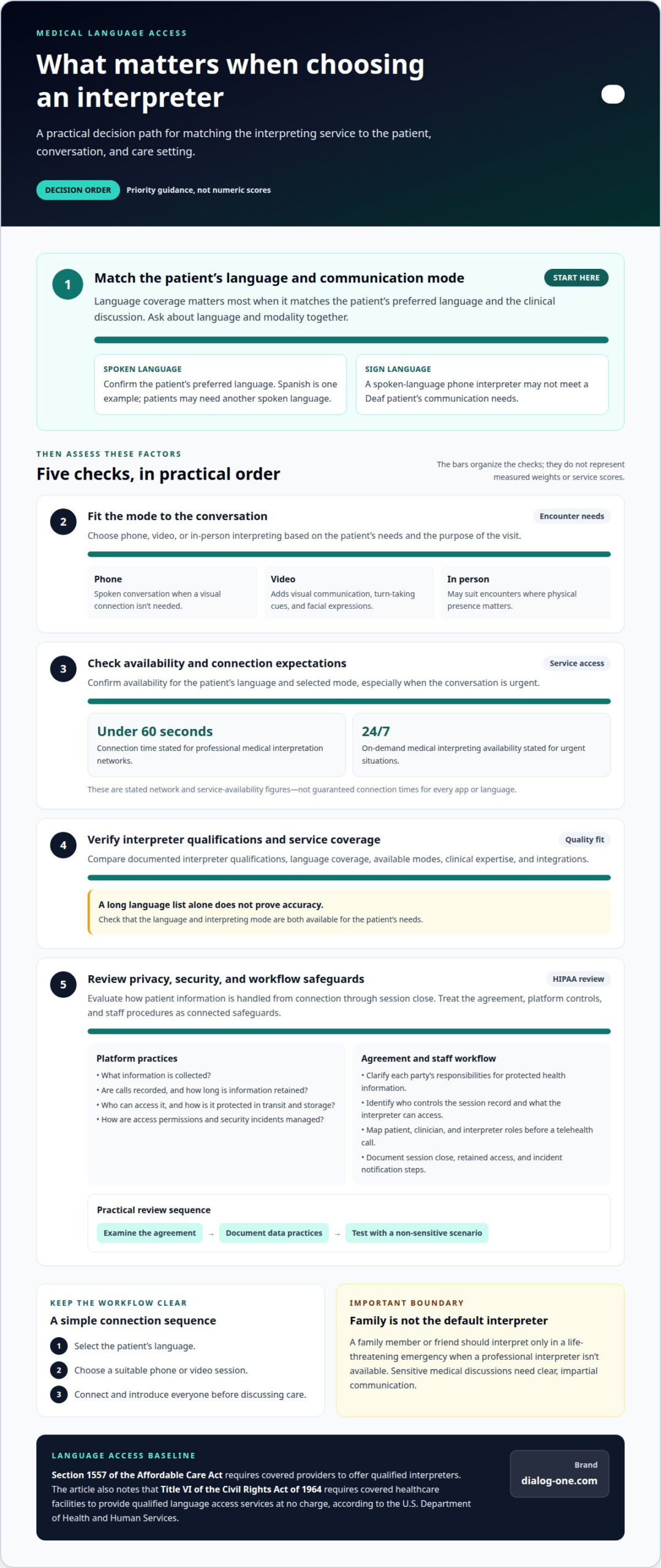
A patient’s family member or friend should interpret only in a life-threatening emergency when a professional interpreter isn’t available. Section 1557 of the Affordable Care Act requires covered providers to offer qualified interpreters, and an on-demand interpreter app for doctors can connect care teams with language support when a conversation can’t wait. Family members may want to help, but sensitive medical discussions need clear, impartial communication.
That need is practical as well as personal: clinicians must understand patients’ concerns and help them understand care decisions. The right interpreting method depends on the conversation, clinical setting, and patient’s needs.
This guide explains how video interpretation works, when it can support communication with patients who have limited English proficiency, and which HIPAA safeguards to review when evaluating a service. It also explains when remote interpretation may be suitable and when another format may better fit the interaction.
Key Takeaways
- Match the interpreting format to the clinical conversation, the patient’s needs and the care setting.
- Review how a video service protects patient information and documents its responsibilities in a business associate agreement.
- Understand the basic steps for connecting with a medical interpreter by phone or video during care.
- Consider on-demand or scheduled interpreting when your practice needs professional language support for patient communication.
Language support for patients with limited English proficiency
Effective language access helps patients explain symptoms and understand clinical decisions. Choose an interpreting method based on language, setting, and communication needs.
Supported Languages and Sign Languages
Language coverage matters most when it matches the patient’s preferred language and the clinical discussion. Spanish is one example, but patients may need another spoken language or sign language. Ask about the language and modality together: a spoken-language phone interpreter may not meet a Deaf patient’s communication needs. Title VI of the Civil Rights Act of 1964 requires covered healthcare facilities to provide qualified language access services at no charge, according to the U.S. Department of Health and Human Services.
Compare apps by documented interpreter qualifications, language coverage, and available interpreting modes. Assess whether the service clearly describes its clinical expertise and integrations, too. A long language list alone does not prove accuracy.
Interpreter Connection Times and Availability
Connection speed affects how quickly a clinical conversation can begin. Professional medical interpretation networks connect providers with interpreters in under 60 seconds, and on-demand medical interpreting is available 24/7 for urgent situations. These figures describe the stated network and service availability, not a guaranteed connection time for every app or language.
Before a visit, identify the patient’s preferred language and whether the discussion requires specialized clinical vocabulary. Then select an available interpreter and confirm the patient can hear or see the conversation clearly. This simple workflow helps staff start with the right language and mode.
Interpreting Modes and Health Equity
Phone interpreting supports spoken conversations when a visual connection isn’t needed. Video adds visual communication, while in-person interpreting can suit encounters where physical presence matters. Apps vary in the modes they provide, so compare language and mode coverage together rather than assuming every language is available in every format.
Patients who can communicate in their preferred language can participate more fully in clinical discussions. For Deaf patients, language access means providing communication suited to their needs. Equitable access makes qualified interpretation available without treating English fluency as a condition for meaningful participation.
For example, a spoken-language phone session may suit a brief follow-up, while video can support visual interaction. Match the format to the encounter and the patient’s communication needs.
HIPAA safeguards and business associate agreements
For a clinic, an interpreting platform supports conversations related to care. Review its privacy practices, security controls, and written responsibilities before using it for appointments, telehealth, or emergency communication.
Privacy and Data Security
Start by asking what patient information the platform collects during a session. Clarify whether calls are recorded, how long information is retained, who can access it, and how it is protected in transit and storage. These details matter whether an interpreter joins from a hospital, clinic, or remote care setting.
A HIPAA label or strong user rating doesn’t explain a platform’s actual safeguards. Review its privacy documentation and security procedures, including how it manages access permissions and reports security incidents. Trace how information is handled from connection through session close.
HIPAA-Sensitive Workflows
A business associate agreement should clarify each party’s responsibilities for handling protected health information. Before an appointment, identify which organization controls the session record, what information the interpreter can access, and how each party handles an incident. Set those expectations in the agreement rather than relying on informal assurances.
For a telehealth workflow, map the patient’s, clinician’s, and interpreter’s roles before the call begins. Staff should know how to connect an interpreter without sharing unnecessary patient details. In an emergency, a clear escalation process helps the care team focus on communication and clinical decisions.
Use a practical review sequence: examine the agreement, document the platform’s data practices, and test the workflow with a non-sensitive scenario. Confirm how staff end a session, whether patient information remains accessible afterward, and whom to notify if a concern arises. These steps help distinguish a suitable process from a broad “HIPAA-compliant” claim. Treat the agreement, platform controls, and staff procedures as connected safeguards, not substitutes for one another. A secure connection alone doesn’t establish how information is handled throughout the interpreting workflow.
What Is On-Demand Medical Interpretation?
On-demand medical interpretation connects a clinician and patient with a professional interpreter by phone or video. During a visit, staff select the patient’s language, start a session, and introduce everyone before discussing care.
Phone and Video Interpretation
Phone interpreting supports spoken conversations when audio is sufficient. Video adds a visual channel, which can help participants follow turn-taking and see facial expressions. A medical practice can choose the mode based on the patient’s needs and the visit’s purpose.
Both formats connect clinicians with trained interpreters without requiring an in-person appointment. Interpreting differs from translation: an interpreter conveys spoken communication, while translation converts written material. Keep written instructions and live conversation within their appropriate workflows.
Using the App During a Patient Visit
To use an app, staff open the service, select the patient’s language, and connect to an interpreter. The clinician introduces everyone, speaks directly to the patient, and pauses regularly so the interpreter can convey each statement. This structure keeps the session clear and organized.
For example, before discussing a medication change, the clinician can explain its purpose, invite questions, and confirm the patient’s understanding through interpreted conversation. Practices should decide how staff will start a call and integrate interpreting into appointment workflows, including telehealth visits.
Professional Interpreters and Patient Safety
Professional medical interpreters are trained to convey meaning accurately and impartially during clinical discussions. A 2012 Annals of Emergency Medicine study reported a 22% error rate for ad hoc interpreters, compared with 12% for professional linguists. This illustrates why familiarity alone doesn’t replace interpreting skill.
National medical interpreter certification requires at least 40 hours of specialized medical training. When assessing qualifications, distinguish interpreter training from general bilingual ability, and consider whether the interpreter can handle clinical terminology. A qualified professional supports communication; the clinician remains responsible for diagnosis and care decisions.
Video remote interpreting
Video remote interpreting connects a patient and clinician with an interpreter through a live video call. Choose video or phone based on the patient’s communication needs and the clinical setting.
Video Remote Interpreting Requirements
A high-quality video remote interpreting connection requires at least 5 Mbps upload and download speed. A stable connection, working camera, and clear audio help each participant follow the exchange. Before a visit, position the device so the interpreter can see the speakers, and reduce background noise that could obscure medical terminology.
Check that the patient can see and hear the interpreter before discussing care. If video quality drops, pause the conversation and restore the connection or switch to audio. This simple step helps prevent technical problems from becoming a barrier to language access.
Audio and Video Calls
Video calls provide visual context, which can help participants observe facial expressions and manage turn-taking. Phone interpretation relies on audio alone, so clear speech and short turns are especially useful. Neither mode suits every interaction; the patient’s communication needs and the subject of the conversation should guide the choice.
For example, a brief spoken update may work by phone, while a discussion involving visual cues may benefit from video. In either format, clinicians should address the patient directly, pause regularly, and allow time for the interpreter to convey each statement.
Remote interpreting can reduce practical barriers when an in-person interpreter cannot join the encounter. A video session depends on adequate connectivity, while a phone call needs a usable audio connection. Clinics can prepare by positioning the device, testing sound and camera, and deciding how staff will switch formats if technical issues interrupt a visit.
For remote phone or video language support during patient care, explore on-demand phone and video interpretation.
Dialog One: On-Demand Phone & Video Interpreters
Dialog One provides on-demand phone and video interpreters for healthcare conversations that need professional language support. Choose phone or video based on the patient’s communication needs and the clinical setting. For encounters that benefit from advance planning or an in-person presence, scheduled on-site and remote interpreters offer another option.
Dialog One’s on-demand interpreting covers over 200 languages, helping care teams connect with patients across a wide range of language needs. For written materials, certified translation for personal documents and large document project translation address needs beyond live interpretation. Each service supports a distinct communication task, from a spoken appointment to translating documents.
Contact Dialog One to discuss language support for your healthcare setting.
Build a language-access workflow your team can use
Make interpreter access part of routine care, rather than improvising during a difficult conversation. Decide who starts a session, how staff identify the patient’s preferred language, and what happens if video or audio fails. A clear workflow helps clinicians focus on the patient while keeping communication organized.
Choosing an on-demand interpreter app for doctors is one part of the process. Your practice can also consider scheduled interpreting for planned encounters and certified translation when patients need written documents in another language. Dialog One provides these options for different communication needs.
Set a practical next step: discuss your clinical setting, the conversations your team handles, and the interpreting format that fits your workflow. Contact Dialog One to discuss interpreting and identify a suitable path for your care team. Clear communication supports patients’ participation and helps clinicians make informed decisions with them.
Frequently Asked Questions
Do practices have to provide interpreters?
Covered healthcare providers must provide qualified language assistance under Section 1557 of the Affordable Care Act. Title VI of the Civil Rights Act of 1964 also applies to healthcare facilities receiving federal funds, according to the U.S. Department of Health and Human Services. These requirements include language access at no charge for patients with limited English proficiency. An app doesn’t replace a practice’s responsibility to provide appropriate access.
When is in-person interpreting recommended over other modalities?
In-person interpreting may be preferable when an encounter involves a group, trauma, or visual or cognitive limitations. AMN Healthcare recommends in-person interpreting in these situations. For example, a complex care discussion with several participants may require an interpreter physically present to manage turn-taking and communication. The deciding factors are the patient’s needs, the setting, and whether remote communication supports meaningful participation.
What on-demand medical interpreter apps are available in the United States?
U.S. practices can access on-demand phone and video interpreting through language-service providers. Dialog One offers on-demand interpreting by phone and video, alongside scheduled on-site and remote interpreting. An on-demand interpreter app for doctors can fit into a practice’s workflow, but the key is the interpreting service and format it provides. Select the option that suits the patient’s language and the encounter.
How do on-demand interpreter apps for doctors work?
A practice typically selects the patient’s language and preferred format, then starts a remote interpreting session through its chosen service. Staff can prepare by identifying who will initiate the call, where the conversation will take place, and how the clinician will address the patient directly. For telehealth, clarify how the interpreter will join before clinical questions begin.
Are on-demand medical interpreter apps HIPAA-compliant, and how do they protect patient data?
Don’t assume a service protects patient data based on an app label alone. Review the provider’s business associate agreement and its stated practices for handling session information, access, retention, and security incidents. For example, ask whether session details are stored after a call and which parties can access them. These details help a practice assess how the service fits its privacy and security procedures.
What are the risks and limitations of using an app instead of a qualified in-person medical interpreter?
Remote interpretation depends on a usable connection and, for video, clear audio and visibility. Phone calls also lack visual cues, and a remote interpreter isn’t physically present to support communication among people in the room. Group discussions, trauma situations, and cases involving visual or cognitive limitations may call for in-person support, as AMN Healthcare recommends. Match the format to the encounter and the patient.