A low-cost interpretation arrangement can become costly when legal communication is misunderstood. A cost-benefit analysis of professional interpreters weighs the service expense against the time, disruption, and communication risks of relying on an untrained bilingual employee. For legal matters, a qualified interpreter is the stronger choice when accuracy, impartiality, and clear understanding are essential.
It’s reasonable to consider whether an employee who speaks both languages can bridge the gap. But language fluency alone doesn’t ensure someone can interpret legal terminology accurately or manage the responsibilities of the role. This article compares professional interpreters with bilingual employees, explains the risks interpretation can help reduce, and considers how remote and on-site options suit different legal settings. The goal is to help you choose an approach that supports clear communication without treating the lowest immediate expense as the only measure of value.
Key Takeaways
- Compare the full workplace impact of assigning bilingual employees to interpret, including time diverted from their regular responsibilities.
- Reserve high-stakes legal communication for a professional interpreter who can support accuracy, impartiality, and clear understanding.
- Match the interpreting format to the setting: remote support can connect participants across locations, while on-site support fits in-person proceedings.
- Assess interpreter value by considering communication quality and the potential costs of misunderstandings, not just the immediate service expense.
Why is it better to use a professional interpreter than a bilingual employee?
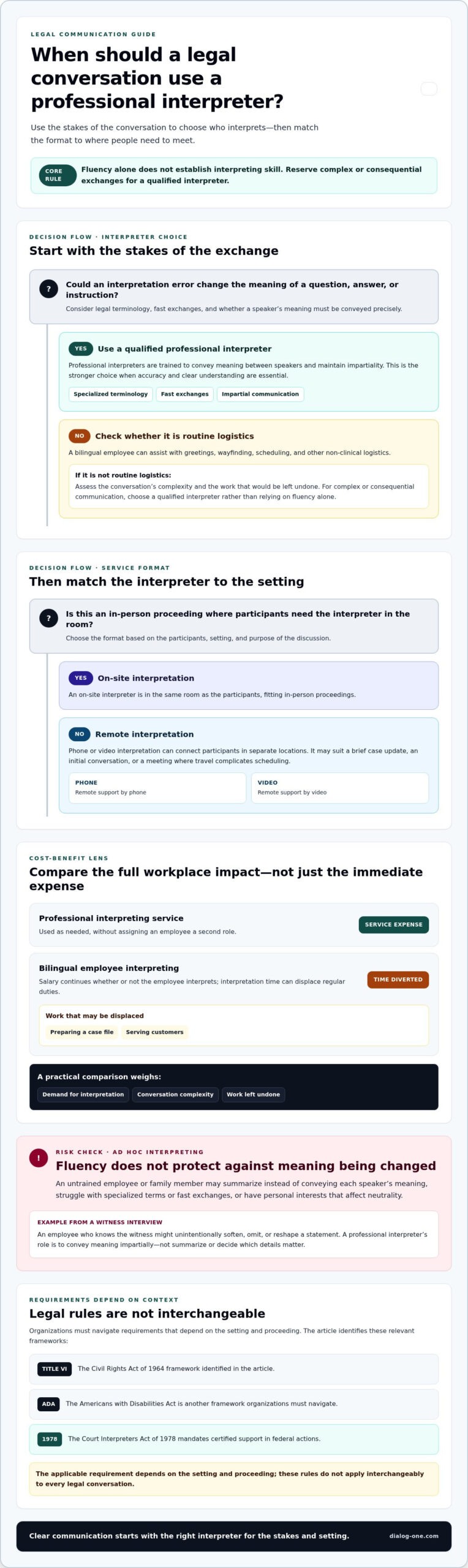
A bilingual employee may help with routine exchanges, but fluency alone doesn’t establish interpreting skill. In legal discussions, professional interpreters bring focused language expertise and a defined role.
Interpreter Services and Staff Costs
Interpreter services are used as needed, while employees draw salaries whether or not they interpret. The cost comparison should account for the employee’s diverted work, not just the expense of arranging interpretation.
That time can displace core duties, such as preparing a case file or serving customers. A practical assessment weighs demand, the complexity of the conversation, and the work left undone. Professional interpreting services provide language support without requiring a staff member to perform two roles.
Risks of Using Employees or Family Members
Ad hoc interpreting means relying on someone without professional interpreting preparation, such as a bilingual employee or family member. In legal settings, that person may summarize instead of conveying each speaker’s meaning, or struggle with specialized terms and fast exchanges. A relative may also have personal interests that affect neutrality.
Consider a witness interview involving unfamiliar legal terminology. An employee who knows the witness might unintentionally soften, omit, or reshape a statement. Professional interpreters are trained to convey meaning between speakers while maintaining impartiality. That distinction matters when participants need to understand questions and responses clearly.
Qualified Interpreter Requirements and Cost-Effectiveness
U.S. requirements depend on the setting and proceeding. Organizations must navigate Title VI of the Civil Rights Act and the Americans with Disabilities Act; the Court Interpreters Act of 1978 mandates certified support in federal actions. These are not interchangeable rules for every legal conversation.
In healthcare, cost-effectiveness includes more than the interpreting charge. Clear communication can support accurate understanding of diagnoses, care plans, and medication instructions. A study published in the Journal of General Internal Medicine associated professional medical interpreters with fewer medication errors, better patient comprehension, and higher patient satisfaction.
Bilingual staff can still assist with greetings, wayfinding, scheduling, and other non-clinical logistics. Reserve complex or consequential communication for qualified interpreters, especially when misunderstanding could affect informed decisions. This division lets employees support access without making them responsible for interpreting high-stakes exchanges.
Accuracy and error risks in high-stakes communication
In high-stakes settings, an interpretation error can change the meaning of a question, answer, or instruction. Medical terminology, legal language, and unfamiliar accents can complicate communication, even when participants share some English. Professional interpreters convey meaning between speakers, helping everyone understand the same exchange.
Consider a medical consultation where a patient describes symptoms and a clinician explains treatment options. An omitted detail can affect the clinician’s understanding or the patient’s decisions. Skilled medical interpreters work with terminology, cultural nuances, and ethical considerations. Their role is to communicate the speaker’s meaning, not summarize or decide which details matter.
A study published in the Journal of General Internal Medicine associated professional medical interpreters with reduced odds of medication errors, improved patient comprehension, and higher patient satisfaction. This finding highlights the practical effect of clear communication. Interpretation cannot eliminate every risk, but it can help reduce language-based misunderstandings during important discussions.
Discharge communication deserves particular care. A patient leaving a hospital may need to understand a diagnosis, follow-up plan, or medication instructions. If a key direction is misunderstood, the patient may not know what to do next. Include an interpreter in the conversation so patients can ask questions and hear the care plan in their preferred language.
International partners also need precise exchanges. A contract discussion, for example, can turn on the meaning of a delivery condition or a negotiated responsibility. An interpreter helps participants convey questions and responses clearly instead of relying on one person’s English fluency to bridge specialized terminology. This supports informed discussion across language differences.
To reduce avoidable errors, identify the purpose of the communication, use a qualified interpreter for complex or consequential exchanges, and pause for clarification when a term is unclear. In a discharge conversation, invite the patient to explain the next steps in their own words. This makes gaps in understanding easier to address before the discussion ends.
Remote and on-site professional interpretation
Choose the format based on the participants, setting, and purpose of the legal discussion. Remote interpretation connects people in separate locations, such as a client and lawyer speaking by phone or video. On-site interpretation places the interpreter in the same room as the participants. Neither format is automatically right for every meeting.
Remote support can suit a brief case update, an initial conversation, or a meeting where travel would complicate scheduling. Before the call, identify each speaker, share the subject and relevant terminology, and arrange a quiet space. For example, a lawyer discussing a filing with a client should speak in manageable segments and pause for interpretation. Video can also help participants see one another during the exchange.
On-site interpretation can suit interviews, conferences, or meetings where several people need to communicate in person. Position the interpreter so participants can hear each other clearly without making the interpreter the focus of the conversation. For a witness interview, agree on seating and speaking turns before beginning. This preparation supports orderly communication and reduces interruptions.
Use the same preparation for either format. When appropriate, give the interpreter a relevant document or case reference beforehand, explain specialized terms, and identify the meeting’s objective. Don’t ask the interpreter to review or explain legal advice; their role is to interpret what each speaker says. Participants should address one another directly, not treat the interpreter as a decision-maker.
Assess the format using practical measures: whether everyone could participate, whether the meeting stayed on track, and whether follow-up was needed to clarify communication. Note recurring barriers, such as poor audio during remote calls or difficulty managing multiple speakers on site. Participant satisfaction can offer another useful measure, but it doesn’t replace clear understanding. Choose the format that best serves the meeting, whether that means remote convenience or in-person discussion.
What does research show about the cost-effectiveness of professional interpreters in healthcare?
Healthcare models suggest interpreter use can reduce costs associated with limited-English-proficiency care. Its results depend on the setting and assumptions, so the modeled savings are not a universal forecast for every hospital.
The difference shows why organizations should assess their own patient mix, care pathways, and access to interpreters.
The model also separated inpatient and outpatient results. These are scenario estimates, not interpreter service prices.
Readmissions provide another measure of potential value. A study published in Health Affairs associated professional interpreter use with a 20% reduction in 30-day readmission rates among U.S. patients with limited English proficiency and diabetes. These findings connect communication support with outcomes that affect both patients and hospital resources.
Five included studies used hospital administrative patient data to examine length of stay and readmissions among patients receiving professional interpretation. A National Institutes of Health study estimated that medical errors due to language barriers cost the U.S. healthcare system billions of dollars annually in avoidable expenditures. Together, these findings support evaluating interpreter use alongside care quality, patient comprehension, and avoidable utilization.
For healthcare conversations requiring language support, arrange professional interpreting support from Dialog One to help patients and providers communicate clearly.
Dialog One: On-Demand Phone & Video Interpreters
Dialog One provides on-demand phone and video interpreting for legal conversations that need language support without placing an employee or family member in the interpreter role. Phone interpreting can suit a focused call; video can support exchanges where seeing participants matters. For planned meetings, scheduled on-site and remote interpreters offer formats suited to the setting and participants.
Choose the format according to the conversation’s complexity, location, and timing. A brief client update may work remotely, while a planned in-person meeting may benefit from an on-site interpreter. Share relevant context and documents beforehand so the terminology and purpose of the discussion are clear.
For legal communication that calls for professional language support, contact Dialog One to discuss your interpreting needs.
Make clear communication part of the plan
Build language access into legal communication before a meeting begins. Decide who needs to participate, what information must be exchanged, and whether the conversation is better suited to remote or on-site interpretation. Preparation helps teams treat communication as part of the work, not an interruption to it.
A cost-benefit analysis of professional interpreters is most useful when it accounts for the consequences of misunderstanding, not only immediate staffing choices. Apply that perspective to each interaction, from a client discussion to reviewing a personal document. Dialog One also offers certified translation for personal documents.
When professional interpretation can help your next legal conversation proceed with clarity, contact Dialog One about interpretation. A considered communication plan is a practical step toward more informed participation.
Frequently Asked Questions
What are the risks of using machine translation instead of a live interpreter?
Machine translation can miss context, ambiguity, or specialized legal terminology, especially during fast, back-and-forth exchanges. A translated phrase may sound fluent while changing a speaker’s intent. For example, a client describing a conditional agreement may use wording that depends on earlier statements. A live interpreter can convey the exchange as it unfolds and ask for clarification when the meaning is unclear.
What is the average hourly cost of a professional interpreter in the United States?
There isn’t one useful hourly figure for every U.S. assignment because format, language, session length, and subject matter affect the quote. The price depends on the case and is provided after a quote request. For budgeting, define the meeting’s purpose, expected duration, and whether interpretation is needed remotely or on site before requesting a quote.
How do interpreter costs vary by language, location, and specialization?
Costs can reflect the requested language, where an in-person assignment takes place, and the expertise required for the subject. A specialized legal proceeding may need different preparation from a general appointment. Location can also affect the logistics of an on-site session. Clarify the language, setting, topic, and schedule so the estimate reflects the actual assignment.
What are typical rates for in-person, phone, and video interpreting?
There is no single typical rate for in-person, phone, and video interpreting. The format affects assignment logistics, while language, subject, length, and scheduling also shape the quote. In-person work involves attendance at the meeting location; phone and video connect participants remotely. Share the format and meeting requirements when requesting a quote.
How do interpreter costs compare with the cost of using untrained staff or bilingual employees?
A cost-benefit analysis of professional interpreters should compare the assignment with its operational consequences, not simply compare a service quote with an employee’s salary. For example, if a bilingual staff member must leave a customer-facing role to interpret a legal meeting, account for interrupted work and any follow-up needed to clarify the discussion. Consider how often interpretation is needed and how consequential each exchange is.
What are the benefits of professional interpreters for accuracy, safety, and outcomes?
Professional interpreters help participants communicate accurately by conveying complete exchanges rather than relying on informal summaries. In a legal consultation, this can help a client follow questions, explain relevant details, and understand the discussion before responding. The interpreter supports communication, while the legal professional remains responsible for advice and decisions. Clearer exchanges help participants take part more fully.