What if a translated phrase changes who must perform, when payment is due, or what a license permits? These are real risks of google translate for business contracts: fluent output can still miss defined terms, obligations, exceptions, or context that determines a clause’s meaning.
The speed is appealing, especially when a decision is waiting. Machine translation can help you understand a document’s general subject, but it shouldn’t be treated as verified legal wording. Confidentiality matters, too. Before uploading a contract, check the tool’s current terms, privacy controls, and settings, as well as your organization’s confidentiality requirements.
This guide explains where machine translation can put meaning, sensitive information, and business decisions at risk. You’ll learn which contract passages need qualified human review, how to match the review process to the document’s stakes, and when to involve counsel and a professional translation provider. The goal isn’t to rule out useful technology. It’s to ensure speed doesn’t replace accountable review when contractual meaning matters.
Key Takeaways
- Fluent machine-translated wording isn’t proof that an obligation, exception, deadline, or negation has kept its contractual meaning.
- The risks of google translate for business contracts include both language errors and potential information-handling concerns, which should be assessed separately.
- Before using an online tool, check its current terms and settings alongside your organization’s policies for sensitive documents.
- Match the review process to the contract’s purpose, sensitivity, audience, and potential consequences. Use machine translation as an aid, not automatic approval.
- Prepare for professional review by clarifying the language pair, document type, audience, terminology, deadline, and confidentiality needs. Involve counsel when legal judgment is needed.
Risks of Google Translate for Business Contracts: What Can Go Wrong?
Machine translation uses software to convert text from one language into another. It can make a contract easier to scan, but a fluent result isn’t the same as a verified translation. The system produces wording through computational methods, as outlined in this introduction to how machine translation works. It doesn’t establish whether each phrase preserves the source document’s legal or commercial intent.
A missed negation, shifted deadline, or altered exception can affect how a reader understands what a party must do. For example, changing “may terminate” to wording that suggests “must terminate” could influence a business decision. The actual consequences depend on the contract’s terms and context, the governing law, and how the parties use each language version. A translation error alone doesn’t determine the legal outcome.
Machine translation can help readers understand a business document, but it cannot verify that translated wording preserves the source contract’s intended obligations or legal effect.
Why contract language is harder to translate than ordinary business text
Contracts rely on defined terms that may carry a specific meaning throughout the agreement. If a term is translated inconsistently in later clauses, it may be harder to tell which rights, assets, or services a provision refers to. Syntax matters, too: the placement of a condition, cross-reference, or exception can change how an obligation applies.
Hypothetical example, not legal advice: A clause requires delivery by a set date “unless the parties agree to an extension in writing.” If a translation drops or misplaces that exception, a reader may misunderstand whether the deadline can change.
When a readable translation still creates risk
Grammatical fluency describes how natural a translation sounds. Fidelity concerns whether it accurately reflects the source, including qualifications and consistent terminology. A polished sentence can conceal a missing nuance or a key term rendered differently elsewhere in the document. That’s why the risks of google translate for business contracts aren’t always obvious on a quick read.
Before relying on either language version, ask counsel which version controls and how the translated text should be used. For consequential clauses, qualified human review can help identify discrepancies for counsel to assess. This supports informed review, but it isn’t a substitute for legal advice.
Confidentiality and Accuracy Risks When Translating Contract Text
Contract translation presents two distinct concerns: whether the translated wording accurately reflects the source, and whether the text is handled appropriately by the tool or service. These risks aren’t identical, and different tools may have different terms, settings, and data practices. Assess the risks of google translate for business contracts against both the document’s content and the specific way the tool is being used.
Pricing, personal information, negotiation positions, and trade secrets may be sensitive even when they appear in routine clauses or attachments. A Radboud University discussion of whether using Google Translate could constitute a data leak highlights why organizations should examine confidentiality before entering text into an online tool. Don’t assume every service handles submitted material the same way.
A contract’s sensitivity should determine what text may enter an external translation tool.
What to check before entering contract text into an online tool
Before uploading or pasting text, review the tool’s current privacy notices, retention terms, and available account controls. Verify those details at the time of use; don’t rely on assumptions or outdated descriptions. Check organizational policies, too. They may specify approved vendors, restrict third-party processing, or prohibit placing confidential information in unapproved tools.
If you only need to understand a limited passage, avoid submitting the entire agreement when an approved, lower-risk process can meet the need. Remove or mask sensitive details only if your organization permits it and the remaining text still provides enough context for the task.
Accuracy traps in clauses, definitions, and attachments
Even when data handling is acceptable, the translation still needs appropriate review. Prioritize provisions where a wording difference could affect rights, responsibilities, or interpretation:
- Liability limits, indemnities, and termination rights: Check conditions, exclusions, and who must act.
- Governing-law clauses and defined terms: Confirm terminology and references remain consistent throughout.
- Attachments and document formatting: Compare tables, scanned pages, footnotes, tracked changes, and cross-references against the source.
Schedules, amendments, and earlier versions can use the same term differently or contain changes that a reader might miss. Compare each relevant passage with its source and flag inconsistencies for qualified review. If you’re assessing a translation project, you can discuss the document type, language pair, confidentiality needs, and review requirements with a professional translation provider.
Google Translate vs. Professional Contract Translation: How to Compare
Choose a translation approach based on what the document will be used for, not just how quickly you need a readable draft. Machine translation may help with internal comprehension when organizational policy permits it. It isn’t a blanket substitute for review, especially if someone will rely on the text to negotiate, approve, or perform contractual terms.
| Factor | Machine translation | Professional contract translation |
|---|---|---|
| Speed | Can produce a draft quickly, depending on the tool and document. | Requires time for translation and review; timing depends on scope and requirements. |
| Terminology control | May not consistently preserve defined terms or preferred wording. | A translator can work with supplied terminology and check consistency across the document. |
| Confidentiality review | Depends on the tool, account settings, and organizational approval. Verify current terms and controls. | Review the provider’s confidentiality and information-handling practices before sharing material. |
| Human accountability | Output may lack a responsible human reviewer. | Human review provides an accountable opportunity to identify language issues and query ambiguity. |
| Intended use | May support permitted, low-risk internal understanding. | More appropriate to consider when external use or consequential decisions require reviewed wording. |
When machine translation may support an internal first pass
For a low-risk internal read, an approved tool may help staff identify a document’s general subject or locate passages for closer attention. Treat the result as provisional. Compare relevant wording with the source before making a decision or communicating terms externally, and don’t enter text if policy or confidentiality requirements prohibit it. Escalate ambiguous, high-impact, or negotiation-sensitive clauses for human review.
When a human translator and legal review matter most
Consider professional translation when preparing signed agreements, supporting external negotiations, or reviewing consequential commercial terms and regulatory obligations. A translator can assess context, terminology, consistency, and unclear source wording, then flag questions rather than silently resolving ambiguity. Counsel provides legal review; translation review doesn’t determine a contract’s legal effect. Certification needs vary by recipient, purpose, and jurisdiction, so confirm requirements before commissioning work.
Manage the risks of google translate for business contracts by matching review to the document’s use and consequences. Ask a translation provider about the language pair, document scope, confidentiality needs, and review process, then involve counsel where legal judgment is required.
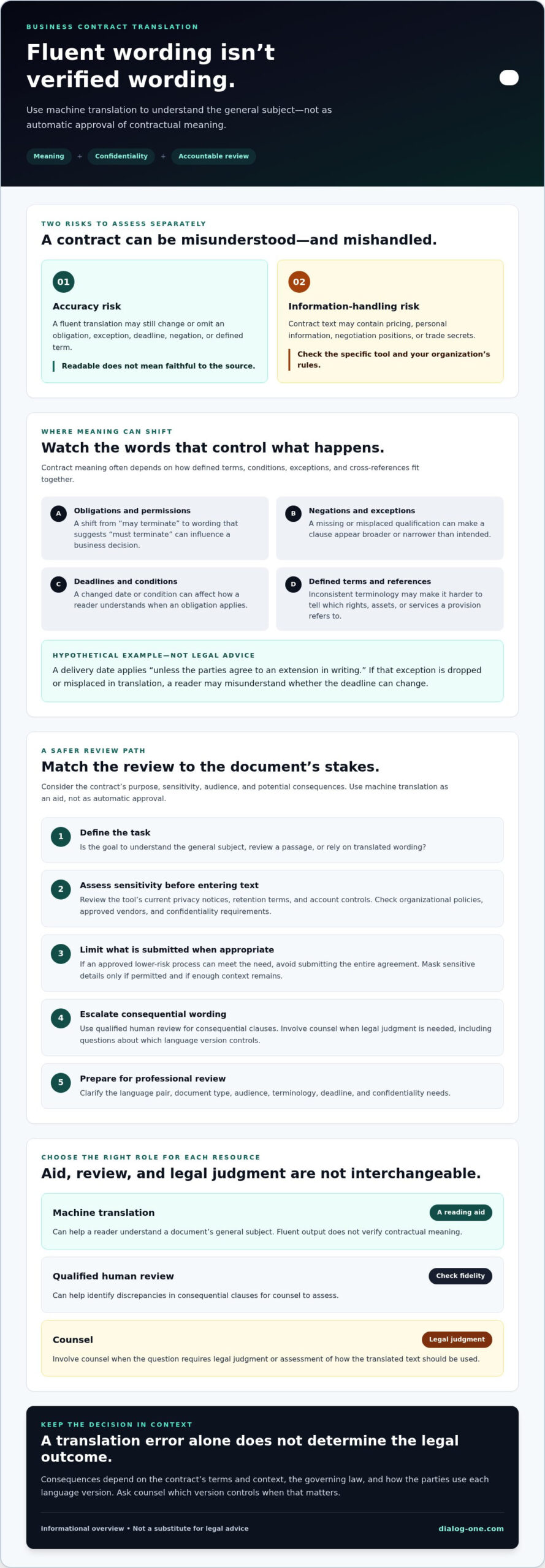
A Safer Workflow for Reviewing Machine-Translated Business Contracts
A controlled process makes review more accountable. Before anyone relies on a translated contract, identify its purpose, sensitivity, audience, and the decisions it may influence. These factors help determine whether machine translation is permitted at all and what level of human and legal review is appropriate.
Five review steps before anyone relies on a translated contract
- Classify the document. Decide whether it’s for internal understanding, negotiation, signature, or another purpose. Assess sensitive information and potential consequences, then confirm that organizational policy permits the proposed tool for that level of risk.
- Preserve the source and record the process. Keep an unchanged copy of the original. Note the tool used, translation date, relevant settings or version information available, and which translated file is under review. This creates a clear reference if questions arise later.
- Arrange a source-to-translation check. Have a qualified language reviewer compare the translated text with the original. Focus on obligations, defined terms, exceptions, dates, cross-references, and schedules. Check that key terminology remains consistent throughout.
- Escalate uncertainty. Record unclear source wording, conflicting translations, or passages where a small language difference could affect a decision. Ask the translator to flag language issues; send questions about meaning, legal effect, or approval to counsel or the responsible contract owner.
- Approve the intended use. Confirm that the review is sufficient for the document’s purpose before sharing or relying on the translation. Restrict access and handling of sensitive information according to organizational policy, including any rules for external tools and providers.
How to document approvals and resolve conflicting versions
Don’t let parallel drafts become competing sources of truth. Ask counsel to identify the authoritative language version and the person responsible for approval. Keep a controlled record of revisions so reviewers can compare changes against the original and see which version was checked. Retain review notes, approval records, and escalation decisions according to organizational policy.
The risks of google translate for business contracts are easier to manage when each version has a clear status: draft, reviewed, or approved for a defined use. If you’re planning a document translation, discuss your language pair, confidentiality needs, and review requirements with a professional translation provider.
When to Use Professional Contract Translation & Next Steps
Choose review depth according to the contract’s sensitivity, intended audience, and consequences. A document for internal orientation may need a different process from one being negotiated, signed, or used to make a significant commercial decision. Unclear source wording raises the need for review, too. If a phrase could change an obligation or a party’s rights, don’t rely on an unreviewed machine translation.
Professional language review can help assess context, terminology, and consistency across a document. Dialog One combines human expertise with AI technology and handles large document projects, including work for high-stakes sectors such as legal services. Confirm directly that the specific contract type and language pair are within the provider’s project scope. Translation supports understanding; it doesn’t replace counsel’s legal judgment.
Questions to ask before choosing a translation provider
Before sharing a document, describe its purpose and ask how the provider would approach the work. Clarify the review process and information-handling expectations, then confirm the provider can support the requested scope. Useful questions include:
- How will defined terms and preferred terminology be handled consistently?
- What reviewer experience is relevant to this document type and language pair?
- How will confidentiality and access to the document be managed?
- What quality checks are included, and how are unclear source passages raised?
- Does the provider handle this document type and language pair?
- Does the recipient or intended use require certified translation?
Certification isn’t automatically needed for every business contract. Requirements depend on the recipient and purpose, so verify them before commissioning a certified service. When briefing a provider, include the language pair, document type, intended audience, deadline, terminology references, and confidentiality needs.
Choose the next step based on your contract’s intended use
If the translation is for internal understanding, first confirm that your organization permits the tool and review level. If parties will negotiate, sign, or formally rely on translated wording, seek professional translation and appropriate human review. Ask counsel to resolve questions about the governing language, interpretation, enforceability, or legal approval.
The risks of google translate for business contracts call for a review process proportionate to the document, not an assumption that every contract needs the same treatment. To discuss your document type, language pair, confidentiality requirements, and review needs, discuss your document translation needs with Dialog One.
Make Your Contract Review Process More Reliable
Machine translation can help with an initial understanding, but fluent wording doesn’t confirm that contractual meaning has been preserved. The risks of google translate for business contracts include both language errors and questions about how sensitive text is handled, so assess each separately. Match the level of human review to the contract’s sensitivity, intended use, and potential consequences.
Before relying on translated terms, compare them with the source, resolve unclear language, and ask counsel which version controls and where legal judgment is needed. For larger document needs, Dialog One brings more than 25 years of language-services experience, professional translation services for large document projects, and AI technology combined with human expertise. Confirm that your document type and language pair are within the available project scope.
Discuss your document translation needs with Dialog One, including your language pair, confidentiality requirements, and review expectations. With a clear process and the right people involved, you can move forward with greater confidence in your decisions.
Frequently Asked Questions
Is Google Translate accurate enough for business contracts?
Google Translate can help you get a rough internal sense of a business contract, but fluent output doesn’t establish that obligations, defined terms, exceptions, or deadlines are accurately translated. Context and any governing-language provision also matter. Before negotiation, signature, or reliance, have a qualified human reviewer compare the translation with the source. Ask counsel to address questions about legal interpretation and consequences.
Can I use Google Translate for a confidential business contract?
Whether Google Translate is suitable depends on the document’s sensitivity, your organization’s policies, and the tool’s current terms and settings. Don’t assume how information is handled. Check current privacy information and available account controls, then confirm that organizational rules permit the proposed use. If sensitive contract text isn’t expressly permitted, don’t upload it. Use an approved workflow that fits the document’s confidentiality requirements.
What happens if a contract is mistranslated?
A mistranslation may cause a reader to misunderstand duties, deadlines, exceptions, or rights. The legal and business consequences depend on the facts, the contract’s wording, and applicable law; a translation error alone doesn’t determine the outcome. Preserve the original and the translated version, record the disputed passage, and avoid relying on it until reviewed. Ask counsel and a qualified translator to assess the issue.
Can a machine-translated contract be legally binding?
Machine translation alone doesn’t determine whether an agreement is binding. The answer can depend on the parties’ agreement, applicable law, the contract’s wording, and any provision identifying which language version controls. These factors vary by situation, so don’t assume a machine-translated version has a particular legal status. Consult qualified counsel before signing or relying on a translated agreement, especially if the language versions differ.
Should a lawyer or a professional translator review a translated contract?
A professional translator and a lawyer serve different roles. A translator reviews language accuracy, meaning, terminology, and consistency between the source and translation. Counsel advises on legal interpretation and possible consequences. For consequential agreements, both reviews may be appropriate. Ask the translator to flag unclear source text and inconsistent terms, and ask counsel to assess governing-language provisions and legal questions. Neither role should be treated as a substitute for the other.
How can a business translate a contract more safely?
Start by classifying the contract’s sensitivity and intended use. Confirm that organizational policy approves the tool and review its current data terms and settings. Preserve the source, then arrange qualified human review. Compare defined terms, obligations, exceptions, and cross-references with the original, and route unresolved language or legal questions to counsel. Set the review depth according to the contract’s audience and consequences, not how readable the machine output seems.
Is professional contract translation the same as certified translation?
No. Professional translation describes translation completed by a language professional; certification is a separate status or requirement that may depend on the recipient, purpose, and jurisdiction. Not every business contract needs certified translation. Before ordering, ask the receiving organization what it will accept, and confirm any legal or procedural requirements with counsel. Also verify that the provider can meet the requested document type, language pair, and review needs.