Video remote interpreting had reached an estimated 33% of the U.S. hospital market, but video is only one way to connect patients and interpreters. The Stratus Video Interpreting competitors landscape includes 41 active competitors, including 2 funded competitors and 4 that had exited. For healthcare teams, the practical comparison is broader than vendor names: it’s about choosing between video, phone, and on-site interpreting for the encounter at hand.
Video supports visual communication, while phone interpreting offers an audio-only option and on-site interpreting brings an interpreter into the room. Each format has its place, and the right fit depends on the setting, the conversation, and how participants need to communicate. This guide compares cloud-based video interpretation with alternatives and explains how service formats differ. You’ll get a practical framework for weighing access, workflow, and the demands of a healthcare interaction, so you can identify the approach that fits your organization’s needs.
Key Takeaways
- Assess cloud-based video interpreting by how well its workflow supports the encounter, including the need for visual communication and dependable access.
- Compare alternatives by service format and operational fit, not competitor counts alone; the best option depends on how care is delivered.
- Match video, phone, or on-site interpreting to the interaction’s communication needs, setting, and level of complexity.
- Evaluate language coverage and interpreter experience against the specific conversation, then choose an interpreting format that supports clear understanding.
Cloud-based video remote interpretation
Cloud-based video remote interpretation connects patients and interpreters through an internet-connected device. A clinician can initiate a session from a private room, while the interpreter joins remotely. The format supports healthcare visits where facial expressions, gestures, or visual materials help clarify meaning. It also avoids coordinating an interpreter’s travel to the facility. Video remote interpreting had reached an estimated 33% of the U.S. hospital market, showing its role in healthcare communication.
Video interpreting platforms differ in how they connect sessions with scheduling, electronic health records, and devices. Compare integration, setup steps, and whether interpretation fits the clinician’s existing workflow. A hospital may prioritize starting a session from a workstation, while a clinic may need mobile access. Those differences affect staff routines, not just the software’s appearance. Consider how the platform handles connection problems and how users can switch to audio when video becomes impractical.
Video remote interpretation works best when participants have a stable connection and can see one another clearly. Visual conditions can affect how effectively participants use nonverbal cues during a video interpretation session. Before a visit, position the device so the patient and clinician remain visible, then test the sound. During sensitive conversations, confirm that the patient can hear and understand the interpreter before continuing.
Assess each vendor’s healthcare privacy practices individually. Compare documented safeguards for protected health information, user access, session handling, and contractual responsibilities. A platform’s name alone does not establish which HIPAA-related safeguards it applies or how they align with a healthcare organization’s obligations.
Use a practical review before selecting a video remote service:
- Map the steps staff use to request and join an interpreter session.
- Identify which devices and clinical workflows need to connect.
- Review privacy controls and procedures for handling session information.
- Test audio and video in the rooms where patients receive care.
This review clarifies whether cloud-based video suits routine appointments, visual consultations, or conversations that benefit from visible communication. It also helps teams identify encounters where phone or on-site interpretation may fit better. Choose the format based on the patient interaction and workflow, not the platform’s feature list alone.
Listed competitors and alternatives
The market includes different vendors and service models, not just direct video-platform rivals. Stratus Video Interpreting had 41 active competitors, including 2 funded competitors and 4 that had exited. That count offers context, but it doesn’t establish which option suits a hospital. Compare the service behind each listing: video access, phone interpretation, scheduled interpreting, language coverage, and fit with clinical workflows. A platform focused on remote sessions solves a different operational need from an on-site interpreter arranged for a planned appointment.
Customer reviews and satisfaction ratings vary by review platform, date, and user experience. Look for specific themes, such as interpreter connection, audio clarity, language availability, and ease of use. A positive rating may reflect a smooth routine appointment, while a written review may describe a difficult connection during a busy clinic session. Compare recurring details rather than treating one score as a complete measure of service quality.
Interpreter availability and connection times depend on the requested language, service format, demand, and staffing. When comparing on-demand video services, consider how requests work and what happens if the first connection attempt fails. Scheduled interpreting follows a different model: the appointment time and language are arranged in advance. These distinctions shape how teams plan for urgent encounters and recurring visits.
Use a consistent comparison across vendors and alternatives:
- Service format: Identify whether the offering is video, phone, on-site, or a combination.
- Language access: Match coverage to the languages patients need during actual care encounters.
- Workflow: Map the steps staff take to request, join, and continue an interpreted visit.
- Review evidence: Look for specific experiences tied to connection, communication, and usability.
A practical assessment of Stratus Video Interpreting competitors looks beyond names and ratings. Connect each capability to a real clinical scenario. A short follow-up, for instance, may call for a different format than a complex consultation involving several participants. Document these scenarios, then evaluate which service arrangement supports each one. This keeps the decision focused on communication needs, language access, and practical use in care settings.
Video, phone, and on-site interpretation
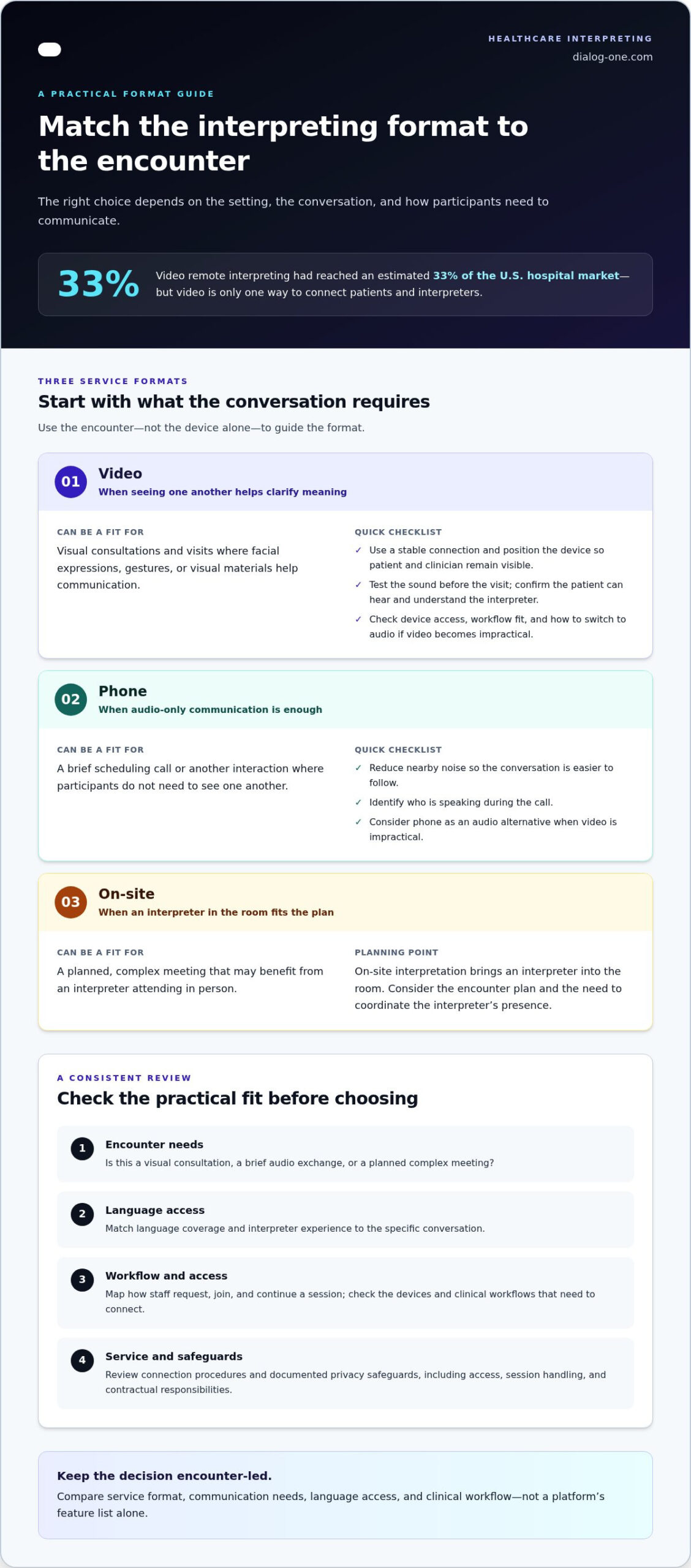
Choose an interpreting format based on the encounter, not the device alone. Video lets participants see one another, phone interpretation connects them through audio, and on-site interpretation places an interpreter in the room. A clinician conducting a visual consultation may value video, while a brief scheduling call may work by phone. A planned, complex meeting may benefit from an interpreter attending in person.
A smartphone can support a video or phone session when staff need mobility, but the room and task still matter. For video, position the camera so the patient and clinician are visible, and check the audio before discussing care. For a phone call, reduce nearby noise and identify who is speaking. These steps help participants follow turn-taking and avoid unnecessary confusion.
On-site interpreting requires advance coordination around the appointment, location, language, and participants. It can suit conversations where several people need to communicate in person or where a device would disrupt the interaction. Video and phone connect people remotely, which can help when travel or room access is a constraint. Each format has practical tradeoffs, and no single mode fits every clinical exchange.
Use these questions to match the method to the situation:
- Is visual communication useful? Consider video when facial expressions, gestures, or shared visual material matter.
- Can the conversation work through audio? Phone interpretation may fit a focused discussion without visual requirements.
- Does the appointment call for in-room participation? Plan on-site interpreting when participants need an interpreter physically present.
- What device and setting are available? Check privacy, sound, camera placement, and connectivity before starting.
For a routine follow-up, a clinician might choose phone interpretation if the discussion is straightforward and the audio is clear. A conversation about a visual examination may call for video. A scheduled family meeting with several participants may be better suited to on-site interpreting. These examples guide planning, not clinical judgment: the conversation’s communication needs determine the format.
Healthcare teams can combine formats across their workflows. An appointment may use scheduled on-site interpretation, while a later call uses phone access. Define the request process for each mode, including who initiates the session and how staff proceed if the chosen format does not suit the encounter.
What languages and interpreter specialties do Stratus competitors support?
Language coverage varies by vendor and service format, so compare options against patients’ actual needs. A hospital might need Spanish for routine visits, while another patient may request an uncommon language or regional dialect. A language label alone may not resolve differences in vocabulary, accent, or preferred terminology. List the languages and dialects patients use, then assess how each service handles those distinctions.
Interpreter expertise matters when a conversation involves precise healthcare terminology. Consider medication instructions, behavioral health discussions, discharge planning, and informed consent. These situations call for accurate interpretation of clinical language and careful communication between participants. Consider how a vendor matches interpreters to healthcare encounters and what information helps them prepare for scheduled appointments. For on-demand sessions, assess whether the process supports clear communication when the conversation is unplanned.
Use a focused review to evaluate language and specialty fit:
- Map patient needs: Record requested languages, dialects, and recurring care scenarios.
- Match service format: Decide whether the encounter calls for video, phone, or scheduled on-site interpreting.
- Review terminology: Identify clinical terms likely to arise, such as medication names or treatment instructions.
- Plan for uncommon requests: Define how staff communicate the language and context needed for an encounter.
A language match is only one part of the assessment. A Spanish-language appointment about medication instructions, for example, still requires clear interpretation of dosage terms and patient questions. A behavioral health conversation may call for a different communication approach than a brief appointment reminder. Document these scenarios alongside language needs, then compare how each service arrangement supports them.
For a language-specific healthcare encounter, align the requested language, clinical context, and interpreting format before the session. Explore language access options for healthcare to plan support around those communication needs.
Coverage varies by vendor and service format, from widely used languages such as Spanish to less common languages and regional dialects. Relevant interpreter expertise can include medication instructions, behavioral health, discharge planning, informed consent, and other healthcare terminology.
Dialog One: On-Demand Phone & Video Interpreters
Dialog One provides On-Demand Phone & Video Interpreters for healthcare teams that need language support during patient conversations. Its interpreters work in over 200 languages, making the service relevant when a patient’s language needs call for remote communication. Choose phone interpretation when audio is sufficient, or video when seeing participants supports the interaction.
For planned appointments where an interpreter’s presence or a scheduled connection better suits the encounter, Dialog One offers Scheduled On-Site & Remote Interpreters. The appropriate format depends on the setting, conversation, and communication needs. Care teams can choose from options for immediate discussions and appointments arranged in advance.
If your healthcare team is assessing interpreting formats, contact Dialog One to discuss your language access needs.
Put Your Language Access Plan Into Practice
Assessing Stratus Video Interpreting competitors should lead to a practical plan for real care settings. Identify encounters where communication barriers could affect understanding, then define who requests interpretation and how staff begin each session. A clear process helps teams respond consistently, whether an appointment is planned or an immediate conversation needs language support.
Dialog One offers On-Demand Phone & Video Interpreters, Scheduled On-Site & Remote Interpreters, and Certified Translation for Personal Documents. These services address different communication needs, from patient conversations to personal records. Discuss which needs matter most to your organization and how they fit your workflow.
Contact Dialog One about interpreting to discuss your language access needs. With a thoughtful plan and the right human support, your team can make communication clearer for patients and care professionals.
Frequently Asked Questions
Which competitors offer video, phone, and in-person medical interpreting?
Compare providers’ remote video and phone interpretation with scheduled on-site services, since available formats differ. Dialog One offers On-Demand Phone & Video Interpreters and Scheduled On-Site & Remote Interpreters. A clinic could use remote interpretation for a brief follow-up and arrange an on-site interpreter for a planned, complex appointment. Assess each service against the encounter and language needs.
What are customer reviews and satisfaction ratings for Stratus and its competitors?
Customer reviews and satisfaction ratings vary by review platform, date, and user experience. Compare recurring comments about interpreter connections, audio clarity, language availability, and ease of use instead of relying on a single score.