A translation can leave your control as soon as you submit it. The data security risk of free translation tools is that text may be retained, used to train systems, or exposed through a service’s data-handling practices. The outcome depends on the tool’s terms and settings, so sensitive information requires more care than a routine phrase.
Free translation can be quick and convenient, but convenience alone doesn’t explain what happens to text after submission. This article explains the risks of exposure, retention, AI training, and data transfers, and outlines safeguards to look for in enterprise translation services. You’ll learn how to assess the information you plan to translate, limit unnecessary exposure, and recognize when a professional translation service is a better fit for confidential or high-stakes content.
Key Takeaways
- Before submitting text, identify whether it contains personal, confidential, or commercially sensitive information.
- Read a translation tool’s data terms to understand whether submitted text may be stored, shared, or used for AI training.
- Compare services by their practical safeguards, including encryption, access controls, retention limits, and clear data-processing terms.
- For sensitive material, minimize identifying details and use a translation process with clear protections for handling and returning your data.
- Choose professional human translation when accuracy, accountability, or the consequences of an error make automated output unsuitable on its own.
1. What Are the Hidden Data Security Risks of Free Machine Translation Tools?
A free translation tool can create a serious security risk when sensitive text leaves an organization’s controlled systems. A pasted contract, patient note, or product plan may be sent to a provider’s servers, where access, storage, and later use depend on the service’s policies and technical controls. The data security risk of free translation tools is not limited to a visible breach: unclear retention and access practices can also expose information.
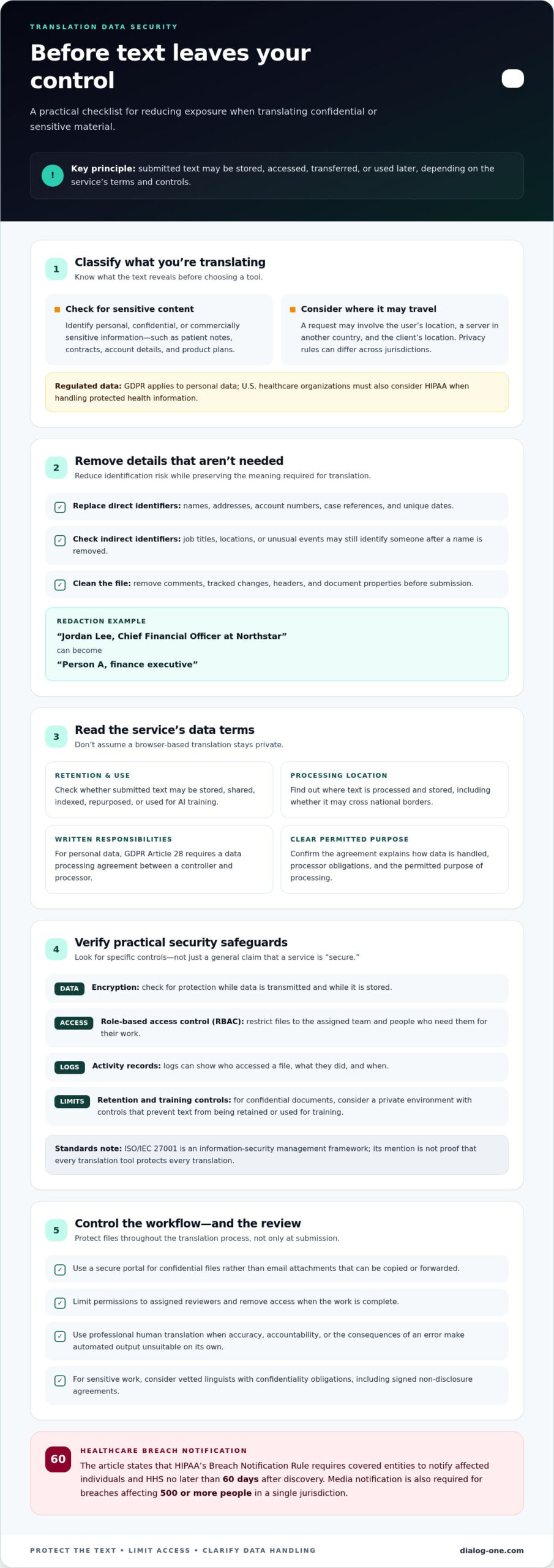
Start by identifying where submitted text is processed and stored. A translation request may involve the user’s location, a server in another country, and the client’s location, creating a cross-border transfer. Data location matters because privacy rules can differ across jurisdictions. For example, the GDPR applies to personal data, while U.S. healthcare organizations must also consider HIPAA when handling protected health information.
Assess security controls instead of relying on the word “secure.” Look for encryption while data is transmitted and stored, plus safeguards for accounts and stored files. ISO/IEC 27001 is an information-security standard; its relevance is as a framework for assessing an organization’s security management, not proof that every tool bearing a security claim protects every translation. Confirm whether the service describes its controls clearly.
Limit access to people who need the file for their work. Role-based access control, or RBAC, can restrict a translation file to an assigned team instead of everyone with a general account. Activity logs can record who accessed a file, what they did, and when. For example, a legal team can limit a draft filing to assigned reviewers and track access throughout the project.
Use contractual terms to define responsibilities. GDPR Article 28 requires a data processing agreement between a controller and a processor handling personal data. The agreement should establish how data is handled, the processor’s obligations, and the permitted purpose of processing. A written agreement also helps an organization understand which party manages data requests and responds to a breach.
HIPAA’s Breach Notification Rule requires covered entities to notify affected individuals and HHS no later than 60 days after discovery, according to the U.S. Department of Health and Human Services. The U.S. Department of Health and Human Services also states that HIPAA requires media notification for breaches affecting 500 or more people in a single jurisdiction. These duties make access controls and incident procedures especially serious for healthcare data.
For confidential documents, consider a private translation environment with encryption, a data processing agreement, and controls that prevent text from being retained or used for training. Organizations can also use professional human translation for sensitive contracts, regulatory filings, or patient records. Set an employee policy that classifies information, names approved tools, prohibits entering restricted text into unapproved services, and explains how to request an approved option.
2. Confidential information exposed by online translation services
A confidential file can expose more than its wording when pasted into an online translation tool. Names, account numbers, contract terms, case details, and comments in document metadata may identify people or reveal business decisions. Some services’ terms may reserve rights to repurpose, share, or index submitted text. Read the service’s data terms before entering material that could harm a person or organization if exposed.
Search visibility is a concrete exposure route. Norwegian broadcaster NRK reported in September 2017 that Statoil employees’ confidential data became publicly discoverable in search engine results after they used a free online translation tool. The incident shows why an organization should treat pasted text as a potential disclosure, not assume it remains private because the translation happened in a browser.
Search engines can make exposed material easier to find, but access risks go beyond search results. A file may also be accessible through account access, shared links, or the service’s storage and handling practices. For example, a draft acquisition agreement could reveal negotiations if its text becomes accessible beyond the intended project team. A data breach can therefore affect both privacy and commercial decisions.
To remove identifying details, replace names, addresses, account numbers, case references, and unique dates with neutral labels before translation. Review the surrounding text as well: a job title, location, or unusual event may identify someone even after their name is removed.
Redaction should preserve the meaning needed for translation. Replace “Jordan Lee, Chief Financial Officer at Northstar” with “Person A, finance executive” if those specifics aren’t essential. Remove comments, tracked changes, headers, and document properties, then review the final text for indirect identifiers. For a regulatory filing, patent application, or certified legal translation, automated output alone may not provide the human review the material needs.
For confidential translation files, use a professional process with clear confidentiality protections. Vetted linguists who have signed non-disclosure agreements can work under obligations to keep client information secret. Transfer files through a secure portal rather than email, where attachments can be copied or forwarded outside the intended workflow. Limit file permissions to assigned reviewers, and remove access when the work is complete.
Before submitting sensitive content, follow a practical sequence: classify the document, remove unnecessary identifying details, and review the tool’s data-use terms. If the tool’s handling doesn’t suit the document’s sensitivity, use an approved secure translation process instead. Preserve human review for high-stakes wording, such as legal obligations or regulatory statements, where a mistranslation can change the meaning. These steps reduce exposure without relying on assumptions about how an online service handles text.
3. Data retention and use of submitted text for AI training
Submitting text for translation can send personal data beyond the user’s device. A service may retain text temporarily to provide translation or use it under terms governing model improvement. These are different purposes. For example, an employee translating a customer complaint should consider whether names and account details are necessary before pasting the text.
Google Translate, DeepL, and Microsoft Translator don’t have one shared free-plan data policy. Handling depends on the specific product, account type, and applicable terms. Compare each service’s current privacy and data-use terms for text retention, training, deletion, and differences between personal and organizational settings.
Free translation services often retain submitted text and may use it to train systems. Some translation services retain submitted text for 30 days. That example shouldn’t be treated as a universal retention period. A document may also pass through the user’s location, the service’s server location, and the client’s location, creating a transfer involving three jurisdictions.
Server location matters because it can affect which legal and contractual rules apply to data handling. Before submitting a file, identify where processing and storage occur and whether the service explains those locations. For example, a U.S. employee translating a customer record through a server in another country should account for the cross-border transfer, not just the language conversion.
Deletion deserves separate attention from retention. Removing text from a visible history doesn’t prove that stored copies, backups, or derived data have also been deleted. Review the terms for how deletion requests work, what data they cover, and how long removal takes. For a sensitive document, don’t treat clearing browser history as proof that the service erased the submitted text.
To reduce exposure, use data minimization: submit only the information necessary for translation. Replace names with labels, remove account identifiers, and exclude unrelated paragraphs. Then choose a service with a data processing agreement, a no-training commitment, and, where suitable, stateless processing. A zero-retention setting and a clear prohibition on training with submitted content provide stronger safeguards for confidential material.
Organizations can put these protections into practice with an approved-tool policy. Define which document types employees may translate, prohibit entering restricted personal data into unapproved services, and provide a secure alternative. Assign responsibility for reviewing product terms and retention settings when a service changes. For high-stakes documents, use an accountable translation process with human review instead of treating automated output as the final version.
Their handling varies by product, account type, and applicable terms; there is no shared free-plan policy. Free translation services often retain submitted text and may use it to train systems, so check each service’s current terms for retention, training, deletion, and settings.
Policies and retention periods vary by product, account type, and applicable terms. Free translation services often retain submitted text and may use it for training; some retain text for 30 days, but that period is not universal.
4. Differences between free and enterprise translation services
A free translation tool usually offers a quick route from pasted text to translated text. Enterprise translation services are designed to support organizational workflows, where access, storage, and responsibility need defined controls. The difference isn’t simply price or translation quality. It’s whether an organization can manage who handles files, how the work moves, and what happens to information afterward.
Start by comparing technical safeguards. A secure service should protect files with encryption during transmission and storage, and address protection while data is in use. For example, encryption in transit protects text moving between an employee’s device and the service. Encryption at rest helps protect stored files. These controls reduce exposure, but organizations also need access restrictions and clear handling procedures.
An enterprise translation management system can bring uploads, translation work, and publishing together in one central environment. This can make file movement more visible than separate browser-based tasks. Look for activity logs that record who accessed a file, what they did, and when. Role-based access control (RBAC) can limit a language project to employees who need it instead of granting access to an entire team.
Review contractual controls alongside the software. A data processing agreement should define permitted data use and each party’s responsibilities. For sensitive projects, look for explicit terms on retention, deletion, and whether submitted text can train models. A no-training commitment and zero-retention settings can help limit data exposure. Contract terms should match the organization’s actual workflow, not just describe general security intentions.
Certifications can inform a security review, but they don’t replace it. ISO/IEC 27001 is an information-security standard that can indicate a structured approach to managing security. PCI DSS is relevant when a translation workflow involves payment-card information. Check which entity and systems a certification covers, then assess whether those controls apply to the specific service and files being used.
Evaluate language service providers by examining how they handle files. Confirm that project access is restricted, transfers use secure channels, and linguists handling confidential materials work under non-disclosure agreements. A secure portal is preferable to emailing attachments because it can keep files within a managed workflow. Review how completed files are returned, who can download them, and how access ends after delivery.
Map the workflow before sending a real document. For example, a legal team can classify a contract, remove unnecessary personal data, assign access to named reviewers, and record each handoff. Then select a private machine-translation environment or professional translation process with safeguards suited to the content. A general public tool may suit low-risk phrases, while confidential records call for stronger controls and accountable handling.
5. Free translation tools and data return
“Data return” means more than receiving translated text. It also concerns access to source files, translated outputs, revisions, and the ability to remove information from a service. For example, a project owner may need both the translated document and a record of which version was approved. A free machine translation tool may not provide a managed process for those needs.
Before submitting a document, decide what you need returned and in what format. List the source file, translated text, comments, and revision history. Then review whether the service lets you retrieve those materials, control who can download them, and delete submitted content. Don’t assume that closing a browser window returns or removes data from the service.
Data protection also depends on what happens after translation. A no-training commitment addresses whether submitted text is used to improve a model; it doesn’t explain retrieval or deletion on its own. For sensitive material, look for clear terms covering every step: processing, access, output delivery, retention, and removal. A data processing agreement can establish responsibilities between the parties.
Use a written return checklist for each translation workflow. Identify who receives the completed file, where it will be stored, and which employees may access it. For instance, a legal team can save the approved translation in its document system, restrict access to assigned reviewers, and remove working copies from shared folders.
If an employee submits protected information to an unsuitable tool, act promptly. Record the tool, account, document type, and submission time, then notify the organization’s security contact. Guidance recommends acting within 24 hours after sensitive content is submitted to contain and assess exposure. Follow internal incident procedures and request deletion through the service’s stated process.
Build data return into vendor requirements before a project begins. Define delivery formats, access controls, deletion procedures, and how source and translated files are handled. For ongoing work, a translation management system can centralize uploads, review, and publishing, creating a clearer chain from submitted text to the approved final document.
For confidential documents, choose a translation workflow that accounts for protected source material, human review, and controlled delivery. A confidential document translation workflow can help align the process with the document’s purpose and sensitivity.
Dialog One: On-Demand Phone & Video Interpreters
Dialog One provides On-Demand Phone & Video Interpreters for conversations where people need to communicate across languages without submitting confidential text to a free translation tool. This can suit a live discussion, such as clarifying instructions or addressing questions in a meeting. For planned interactions, Scheduled On-Site & Remote Interpreters offer another way to support communication.
For documents, choose a service suited to the material: Certified Translation for Personal Documents or Large Document Project Translation. These options distinguish live interpreting needs from written translation projects, where document handling and review matter. The right format depends on whether you need support for a conversation or a translated file. Contact Dialog One to discuss which service fits your communication needs.
Make your next translation decision deliberate
Make data protection a routine decision, not a last-minute reaction. Before translating, decide who needs the information, what format will serve them, and whether the task calls for a live conversation or a written document. That distinction helps teams choose a suitable approach without exposing more text than necessary.
The data security risk of free translation tools is a reason to match the method to the material. For a conversation, Dialog One offers On-Demand Phone & Video Interpreters and Scheduled On-Site & Remote Interpreters. For personal documents, Certified Translation for Personal Documents serves a different need. A human-centered process helps people communicate clearly while keeping responsibility and judgment in view.
Make the next step specific: identify the language need, the type of communication, and the sensitivity of the information. Then choose a service that fits the task. Contact Dialog One about translation security to discuss your translation needs and move forward with greater clarity.
Frequently Asked Questions
What Are the Hidden Data Security Risks of Free Machine Translation Tools?
Risks include losing control over who can access submitted text and how it may be used later. Even a short excerpt can expose sensitive context, such as a negotiation deadline or an employee’s role. Before translating, classify the material, identify its owner, and decide whether you need a full document or only a non-identifying passage. This simple triage helps prevent unnecessary disclosure.
Sensitive documents: what’s most at risk?
Documents that combine identity details with consequential information deserve particular care. A medical letter with a patient’s name, a legal notice with a case reference, or a business plan with an unreleased product detail can reveal more together than each detail alone. Review attachments, footnotes, and document properties too. Even when the main text appears anonymous, context may still point to a person, case, or organization.
Tools and software: practical, but secure?
Translation software can be practical for low-risk wording, such as a public event notice or general product description. For internal material, use a tool approved for that data category and account type. Separate public text from restricted content before translation. For example, translate a generic appointment reminder without including a patient’s name, diagnosis, or contact details. Convenience alone doesn’t make a tool suitable for confidential work.
What to look out for when choosing a provider?
Assess the entire handling process, not just the translation interface. Ask how source files enter the workflow, who can work on them, how completed versions are delivered, and how access is closed afterward. Use a low-sensitivity sample document to map each handoff before moving confidential files. Assign an internal owner to document the approved workflow so employees follow the same process across teams and projects.
What data security risks do free online translation tools pose?
The data security risk of free translation tools includes exposing text through unclear access, retention, or data-use practices. Risk can also arise when an employee pastes just one paragraph but leaves names, account references, or confidential context intact. Treat each submission as a data-handling decision: identify the information, remove unnecessary details, and use only a tool approved for that content.
What sensitive information should never be entered into free translation tools?
Organizations should prohibit entering credentials, financial account details, patient records, legal case materials, employee files, and confidential business plans into unapproved tools. A password-reset email, for example, can disclose both an account identifier and a security process. Give staff clear policy examples, including what counts as personal data and proprietary information. If a text needs those details to make sense, use an approved translation workflow.
Can free translation tools expose confidential business, medical, legal, or personal data?
Yes. Text submitted to a service can expose confidential information if its handling allows unauthorized access, reuse, or disclosure. A draft contract may reveal negotiating positions, a medical note may identify a patient, and a personal letter may contain contact or identity details. Risk also depends on surrounding context. A document without a name can still identify someone through a unique event, role, or location.
Are free translation tools compliant with US privacy laws such as HIPAA, CCPA, or state privacy laws?
A free tool’s label doesn’t establish whether its use meets an organization’s obligations. HIPAA is relevant when protected patient information is involved, while CCPA and other state privacy laws may also matter depending on the organization and data. Assess the text submitted, the service’s terms, and the organization’s responsibilities together. For a healthcare workflow, involve the privacy or compliance lead before staff enter patient information.