If federal language-access guidance has changed, can your organization stop supporting people with limited English proficiency? No. Title VI language access requirements still call for careful attention to whether federally funded programs provide meaningful access, but the funding relationship and the services involved matter.
It’s understandable to feel uncertain. Executive Order 13166 was revoked in March 2025, and some agencies have withdrawn guidance built around it. Older compliance checklists are therefore less reliable as a stand-alone answer. Start by assessing your specific program, funding, communities served, and current legal obligations, including applicable state requirements.
This guide explains the Title VI baseline and where program-specific legal analysis may be needed. You’ll learn how to assess language needs, consider the importance and frequency of interactions, and create interpretation and translation procedures that support clear communication and accountability. It also explains how professional language services can help put those procedures into practice, with human expertise for consequential conversations and documents.
Key Takeaways
- Trace the federal funding relationship and identify which program or activity may fall within Title VI’s scope.
- Distinguish statutory requirements from agency regulations, guidance, and court decisions when reviewing current obligations.
- Use the Title VI language access requirements as a starting point for assessing language needs, service frequency, and the consequences of communication barriers.
- Build practical procedures that assign responsibility, help staff recognize language needs, and make assistance easier to activate.
- Match on-demand phone or video interpretation and scheduled remote or on-site support to the communication setting and operational need.
What Title VI language access requirements mean for federally funded programs
Title VI of the Civil Rights Act of 1964 prohibits discrimination based on race, color, or national origin in programs and activities receiving federal financial assistance. The statute doesn’t specify every language service an organization must provide. Rather, federal agencies have interpreted national-origin protections to address situations where limited English proficiency (LEP) can prevent people from accessing a covered program. The resulting Title VI language access requirements depend on the program’s coverage, applicable agency rules, and the circumstances of the people it serves.
Title VI isn’t a universal checklist for every organization or service. An organization’s connection to federal funds, the activity supported by those funds, and the relevant agency’s requirements all matter. A school district receiving federal assistance, a healthcare program funded through a federal agency, and a local public-service program may each need to assess language access, but their governing rules and practical obligations may differ.
For historical context, Executive Order 13166 directed federal agencies to clarify language-access responsibilities for federally assisted programs. The order was revoked in March 2025. Its history helps explain how language access became associated with Title VI, but the order itself shouldn’t be confused with the statute or treated as a complete statement of current program obligations.
Who may have Title VI responsibilities?
A recipient is an entity that receives federal financial assistance, such as a grant, for a program or activity. A subrecipient receives some of that assistance through another recipient, for example, a community organization carrying out part of a funded public program. The funding path matters, but it doesn’t answer every coverage question by itself.
Review the source and terms of funding, the specific program or activity supported, and the regulations or conditions that apply through the responsible federal agency. A contractor paid by a recipient isn’t automatically subject to the same Title VI duties simply because it works on a funded project. Its role, relationship to the program, and applicable rules may affect the analysis. Don’t assume that one organization’s responsibilities transfer identically to every partner or vendor.
What does limited English proficiency mean?
LEP describes a person’s limited ability to read, speak, write, or understand English. It isn’t a measure of intelligence, education, or decision-making ability. A person may communicate comfortably in English in a familiar conversation yet need language assistance to understand a detailed notice, discuss a student’s support needs, or complete a healthcare intake accurately.
Ask what communication support is needed for the particular task, rather than making assumptions based on a person’s accent or apparent fluency. Someone’s preferred spoken language may differ from the language they read most easily. A conversation may call for interpretation, while a written form may require translation. This distinction helps organizations identify access needs respectfully and avoid treating language ability as all-or-nothing.
How to understand Title VI alongside current agency rules and guidance
To interpret Title VI language access requirements responsibly, separate four sources that are often blended together: the statute, agency regulations, agency guidance, and court decisions. The statute establishes the legal prohibition. Regulations adopted by an agency can set requirements for programs under its authority. Guidance explains how an agency interprets or administers its rules, but it isn’t automatically equivalent to a statute or regulation. Courts, in turn, may interpret these sources in cases within their jurisdiction.
Changes to executive policy or agency guidance can affect enforcement priorities and the resources organizations use to understand their responsibilities. They don’t, by themselves, erase the text of an act of Congress. Executive Order 13166 was revoked in March 2025, and agencies have reviewed or withdrawn some related materials. That history makes older checklists worth rechecking, not a reliable substitute for examining the governing statute, current regulations, and relevant legal decisions.
Be cautious with familiar frameworks, too. The four-factor analysis has historically helped organizations consider language needs, contact frequency, the importance of a service, and available resources. Don’t present it as a universally binding current checklist without verifying its status for the specific agency and program. A useful planning tool and a controlling legal standard aren’t necessarily the same thing.
How Title VI differs from Section 1557 and other requirements
Section 1557 is a separate nondiscrimination provision relevant to covered health programs and activities. It may apply alongside Title VI in some healthcare settings, but it has its own statutory and regulatory framework. Identify which laws cover the particular program rather than treating one provision as a replacement for another. The article “Language Access Services in Healthcare” offers related background on language support in health settings.
Education programs may also need to consider education-specific civil rights requirements, while disability laws can address access needs that language assistance alone doesn’t meet. State or local laws may add requirements as well. Applicable obligations depend on the program and jurisdiction. Don’t assume that a rule applying to a healthcare recipient applies in the same way to a school or public agency.
Why current guidance needs careful checking
Before relying on a policy summary, check current primary sources: the statute, the responsible agency’s regulations, official notices about guidance changes, and relevant court decisions. Record the agency, program, source, publication or effective date, and whether the document is a binding regulation or interpretive guidance. This source log helps teams spot outdated materials and explain the basis for their procedures.
Also distinguish an agency’s administrative enforcement process from a private lawsuit. The routes, standards, and available claims can differ, and a change in agency guidance doesn’t alone resolve what a court would decide. Questions about a specific recipient, program, jurisdiction, or litigation risk call for qualified legal counsel, not a generalized conclusion. For operational planning, professional interpretation and translation support can help put established access procedures into practice.
How organizations assess language needs and effective assistance
A sound assessment starts with actual points of contact, not a language-access plan copied from another organization. Map where people seek information, make decisions, submit documents, and receive notices. In a school setting, that may include enrollment, parent-teacher meetings, special education discussions, discipline notices, and emergency communications. Include phone calls, video meetings, in-person conversations, websites, forms, and letters. Then identify which interactions could affect access, rights, safety, or important outcomes if the message isn’t understood.
Effective assistance means communication support that lets a person with LEP understand and participate in the particular program interaction accurately and in a timely way. The appropriate support depends on the task, the language need, and the consequences of misunderstanding.
What belongs in a language-needs assessment?
Combine several kinds of evidence instead of relying on a single data source. Review the languages people request during service interactions, language information gathered through appropriate intake processes, community input, and staff observations. The U.S. Census Bureau’s American Community Survey can help identify languages spoken and English proficiency in a geographic area; local service records can show which needs arise in the organization’s own programs.
Next, rank interactions by their importance and likelihood. A routine request for general information may call for a different response than a meeting about a student’s placement or a time-sensitive notice. Ask what could happen if someone misunderstands, whether there is time to arrange assistance, and whether the same need arises across multiple channels. Don’t treat low recorded demand as proof that a language need is absent if people may have been unable to request help.
Keep a short assessment record that identifies:
- Languages and interaction types considered, with the data sources used.
- High-impact conversations, documents, and communication channels.
- Known gaps, assumptions, and how they might affect the assessment.
- The staff member responsible for review and the date for updating it.
This record turns an informal impression into a decision process that can be reviewed and improved.
When are interpretation and translation appropriate?
Interpretation conveys spoken or signed communication between people. Translation conveys written content in another language. Choose the service based on the interaction: an interpreter may support a live meeting, while a translated notice lets someone review written information at their own pace. Some situations call for both, such as a translated form followed by an interpreted conversation about its contents.
For complex, sensitive, or high-stakes discussions, use a qualified human interpreter who can support accurate communication and appropriate confidentiality. A bilingual employee or family member may not have the language skills, impartiality, or role clarity needed for a consequential exchange. Prioritize written materials according to their significance and the rules that apply to the program. Review whether forms, notices, instructions, or consent information are vital to understanding and participation, then set a process for translation, review, distribution, and updates.
Finally, connect each identified need to an operational response. Staff should know how to recognize a request, who arranges assistance, and where translated materials are stored. Revisit the assessment when services, communities, or communication patterns change.
How to turn language-access responsibilities into an operational plan
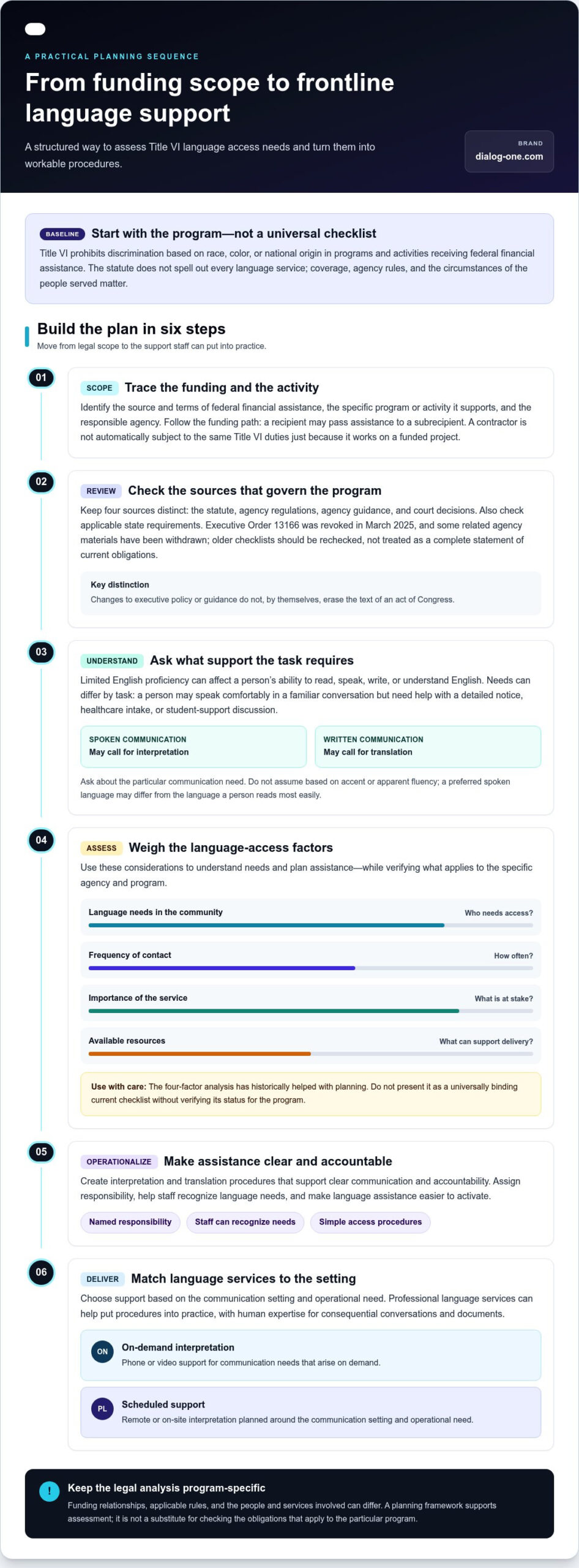
A written plan makes language support dependable across offices, classrooms, and service channels. Assign an owner, connect assessment findings to specific staff procedures, train employees on their roles, and review whether the process works in practice. This sequence turns Title VI language access requirements into repeatable actions without treating one template as a legal answer for every program.
What should a language-access plan include?
Start by naming a coordinator and identifying who handles requests at each point of service. Document how staff arrange interpretation, locate translated materials, and escalate urgent or complex communication needs. Set a process for reviewing important documents when content changes, so outdated translations don’t remain in circulation. Make the plan easy for staff to find, and explain language-assistance options in formats community members can understand.
Training should be practical. Employees need to know how to recognize a language need, ask respectfully about preferred communication, and activate the right pathway without delaying a high-impact interaction. Explain how to work with an interpreter: speak directly to the person, use clear language, and pause to allow complete interpretation. Clarify that staff shouldn’t routinely ask a child or another family member to interpret sensitive or consequential communication instead of using planned assistance.
For schools, procedures should account for distinct interactions, from enrollment and family notices to meetings about student services. An IEP Meeting Language Guide for Schools and Families can provide education-specific context for preparing communication around those meetings. The operational plan should still identify who arranges assistance, how relevant documents are shared, and what staff do if planned support isn’t available when needed.
How should organizations monitor and improve access?
Review whether the process works, not just whether a plan exists. At regular intervals, examine requests by language and service setting, response times, delays, complaints, interpreter or translation issues, and feedback from staff and community members. Look for patterns. Repeated delays in one office, for example, may point to a workflow problem that general annual training won’t fix.
Keep records that support accountability while protecting privacy. Track the operational details needed to identify gaps, such as the date, service channel, language requested, and whether assistance was arranged. Avoid collecting sensitive personal or case information unless it’s necessary for the program’s work and handled under applicable privacy rules. Limit access to records and follow the organization’s retention policies.
Assign someone to document findings, corrective actions, and follow-up dates. Revisit the plan when programs change, new language needs emerge, staff identify recurring barriers, or applicable rules are updated. A clear record helps leadership see whether changes resolved a problem or whether the procedure needs another adjustment.
Build reliable interpretation pathways into your procedures with professional interpretation support for interactions that require clear, accurate communication.
How professional language services support a Title VI access plan
Professional language services can turn an organization’s established procedures into practical support for conversations and document-based interactions. They help staff communicate across language differences, but they don’t determine which laws apply, replace an organization’s own responsibilities, or guarantee compliance with Title VI language access requirements. The organization remains responsible for assessing its programs, setting procedures, and reviewing whether assistance is effective.
Which language-service models support different interactions?
Match the service model to the interaction. On-demand phone or video interpreting can help staff respond to an immediate communication need, such as a family calling with a question or a student’s caregiver arriving for an unexpected conversation. Remote access can be useful when an in-person interpreter isn’t already part of the plan. Choose the method that fits the interaction and the organization’s procedures.
Scheduled interpretation is better suited to planned meetings where participants may need time to prepare, or where the subject is complex, sensitive, or consequential. A school could arrange a remote or on-site interpreter for a meeting about student services or family concerns. Planning ahead can help staff coordinate participants and materials, while the interpreter supports accurate communication during the discussion.
Written and digital communication need their own approach. Translated documents can help people review notices, forms, and instructions in their preferred language. Identify which materials are important to participation, then use a consistent process for translation, review, distribution, and updates. AI live transcription and captioning can support access to spoken content, but serve a different function from interpretation or translation. For important communications, consider whether human oversight is appropriate and how the technology fits the needs of the people involved.
How does Dialog One support language access work?
Dialog One provides 24/7 on-demand phone and video interpretation in more than 200 languages, along with scheduled remote and on-site interpreters. These options support both unplanned interactions and meetings arranged in advance. Dialog One also provides certified translation for personal documents and large document project translation, supporting written communication needs across different types of work.
AI transcription and captioning can provide another form of communication support, with optional human oversight. It isn’t a substitute for an interpreter when a live exchange requires language mediation. Select a service based on the organization’s assessment of the interaction, communication channel, and consequences of misunderstanding.
Keep accountability with the organization. A service provider can support an access plan, but it can’t decide whether an organization is covered or certify that its procedures satisfy legal requirements. Pair professional language services with current program-specific guidance, staff training, and ongoing review. Explore Dialog One language services to find support for those procedures.
Make language access part of everyday practice
Make your plan usable under real conditions. Choose one common interaction, such as a family meeting or an urgent phone call, and walk through how staff would recognize a language need, arrange support, and record any service issue. This practical test can reveal unclear responsibilities before they affect someone’s ability to participate. Then set a review date and assign an owner to follow through.
Legal analysis still needs to reflect your funding, program, and applicable rules. Dialog One brings more than 25 years of language-services experience to interpretation, translation, and communication support. Professional services can strengthen your procedures, while your organization remains responsible for its own obligations and decisions.
Build a dependable process for communication across languages. Explore Dialog One language services to identify support for your organization’s access plan.
Frequently Asked Questions
Who must follow Title VI language access requirements?
Title VI applies to programs or activities receiving federal financial assistance, but coverage depends on the funding relationship and governing agency rules. For a school system, trace which grants support which activities, then review award terms and applicable regulations. Recipients and some subrecipients may have responsibilities; a contractor’s role alone doesn’t establish identical duties. This distinction helps organizations assess Title VI language access requirements without assuming every service or partner has the same obligations.
Does Title VI require every organization to translate every document?
No. There isn’t a universal rule that every document must be translated, and a broad translation quota may not reflect the applicable requirements. Consider whether a document affects someone’s ability to participate or make an informed decision, such as an enrollment notice, consent form, or deadline notice. Check the rules for the specific program, and maintain a version-control process so translated materials are reviewed when the source document changes.
Are language assistance services required to be free under Title VI?
Some applicable federal rules and agency guidance require covered programs to provide language assistance without charge to the person receiving it, but the requirement depends on the program and governing authority. Before setting or communicating a policy, verify current official regulations and guidance for the relevant funding agency. Staff should know what the applicable policy says so they don’t give families inconsistent information or assume that a rule for one sector applies everywhere.
What is the four-factor analysis for language access?
Federal LEP guidance has described a planning framework that considers the number or proportion of people with LEP, how often they interact with a program, the importance of the service, and available resources. Check the responsible agency’s current official materials before treating that framework as applicable. For example, an interaction that occurs infrequently may still warrant careful planning if misunderstanding could affect an important decision. The framework doesn’t replace current legal analysis.
Do schools have to provide interpreters for IEP meetings?
Federal special-education rules address language access in certain IEP meeting circumstances. IDEA regulations, including 34 C.F.R. § 300.322(e), address steps to ensure a parent understands IEP team proceedings, including arranging an interpreter when needed. Schools should consult the current regulation and relevant guidance for details and exceptions. Title VI may also apply to a federally assisted education program, but it isn’t the only framework relevant to an IEP meeting.
Can AI translation or captions meet Title VI language access needs?
Technology can sometimes support access, but it isn’t automatically suitable for every task or a substitute for interpretation. For example, captions may help someone follow a presentation, while a sensitive meeting may require a qualified human interpreter. Assess accuracy needs, the consequences of errors, applicable rules, and privacy safeguards. If automated output is used, establish how staff will identify errors, involve human review when appropriate, and provide another communication method if the technology fails.