A clinic’s VRI plan needs a clear fallback, not just a video connection. A VRI implementation guide for clinics should cover when staff use video remote interpretation, when they switch to over-the-phone interpretation (OPI), and what to do if either service cannot support the conversation. Under 28 C.F.R. § 35.160(d), VRI must provide real-time, full-motion video and audio over a dedicated high-speed, wide-bandwidth or wireless connection, with high-quality images and clear audio.
VRI can provide quick interpreter access, but a clinic’s communication plan must also account for patient needs, staff decisions, and service interruptions. This guide explains how to align VRI use with communication requirements, train staff to choose the right method, troubleshoot problems, and include OPI as part of a practical language access plan.
Key Takeaways
- Build your communication plan around effective access, including the video and audio quality needed for VRI to work.
- Give staff a decision-making process that accounts for the patient’s communication needs and the purpose of the interaction.
- Prepare a troubleshooting and escalation path so staff can change approaches when VRI is ineffective.
- Assign VRI and OPI complementary roles in your language access plan, rather than treating either as the only option.
ADA and Rehabilitation Act communication requirements
Clinics should plan for effective communication under the ADA and Rehabilitation Act. A workable plan connects applicable requirements with staff procedures, interpreter access, and reliable video equipment.
Communication Access Requirements
Communication access means patients can understand and participate in clinical conversations through an effective communication method. The ADA’s VRI rule, 28 C.F.R. § 35.160(d), requires real-time, full-motion video and audio using a dedicated high-speed, wide-bandwidth connection or wireless connection, with high-quality images and clear audio. The listed hospital provision is 28 C.F.R. § 36.303. These standards matter when a clinic uses video for communication with patients who are deaf or hard of hearing. A frozen image or unclear audio can prevent an interpreter from conveying information accurately, so staff need a process for recognizing when the connection is ineffective.
Language Access Compliance
Language access compliance concerns meaningful communication with patients who have limited English proficiency, alongside communication access for people with disabilities. Relevant national frameworks include Title VI of the Civil Rights Act of 1964, Section 1557 of the Affordable Care Act, and the Americans with Disabilities Act. The National Standards for Culturally and Linguistically Appropriate Services in Health and Health Care provide a language access guideline. Together, these frameworks make language access a planning issue, not simply a technology decision. A clinic’s plan should distinguish spoken-language interpretation from sign-language interpretation and explain how staff obtain the appropriate support for each encounter.
Technical Requirements
Technical readiness affects whether VRI can support a patient conversation. Before relying on video, check the connection, image quality, sound, and camera position. The ADA regulation sets performance requirements rather than one universal screen or camera specification. Staff should be able to see the interpreter clearly and hear speech without disruption. Assign responsibility for reporting connection failures, and document what staff should do when video is unclear. A device that connects but cannot maintain real-time, full-motion communication does not meet the regulation’s stated VRI standard.
For state or local practices, start with the clinic’s language access plan and applicable procedures. Identify who is responsible for interpreter access, which communication methods are available, and how to escalate when VRI fails. This gives teams a consistent operational resource without assuming every jurisdiction follows the same process.
Staff training and VRI decision-making
A VRI implementation guide for clinics should link staff training to practical decisions during patient encounters. Clinics need a shared process for choosing VRI, responding to service problems, documenting use, and reviewing performance.
Staff Training and Troubleshooting
VRI training prepares staff to start a session, position the screen, and respond to connection or communication problems. It matters because technical familiarity helps staff identify when the interaction cannot proceed effectively. Medical providers should ensure that staff receive appropriate training when VRI services are introduced or resumed. Include practice scenarios, such as a frozen image or unclear audio, and teach staff how to report unresolved problems.
Staff Procedures for VRI
A staff procedure provides a shared decision path for selecting and using VRI during an encounter. Staff need to consider the patient’s communication needs, the interaction, and whether video supports effective communication. Build a decision tree into the clinic’s language access plan: identify the needed language or communication mode, choose an appropriate interpretation method, and reassess if the session is ineffective. Track VRI use and performance to identify recurring training or service issues.
- Use VRI when video supports the patient’s communication needs.
- Choose another appropriate method when VRI does not support the exchange.
- Record recurring service issues for follow-up and staff learning.
Documenting VRI Use
Documentation provides a useful record of the communication method and the patient’s stated preferences. For each encounter, staff can record whether they used VRI, the language or communication mode, available interpreter details, and any technical issue or change in method. Note the patient’s preference when expressed and how staff responded. These details help supervisors review use and performance, refine the decision tree, and target follow-up training when patterns emerge.
Use a VRI implementation guide for clinics to keep procedures practical: maintain a consistent record workflow and review examples during staff refreshers. Clinics seeking on-demand support for spoken or signed-language interpretation can consider on-demand phone and video interpreting as one part of their communication plan.
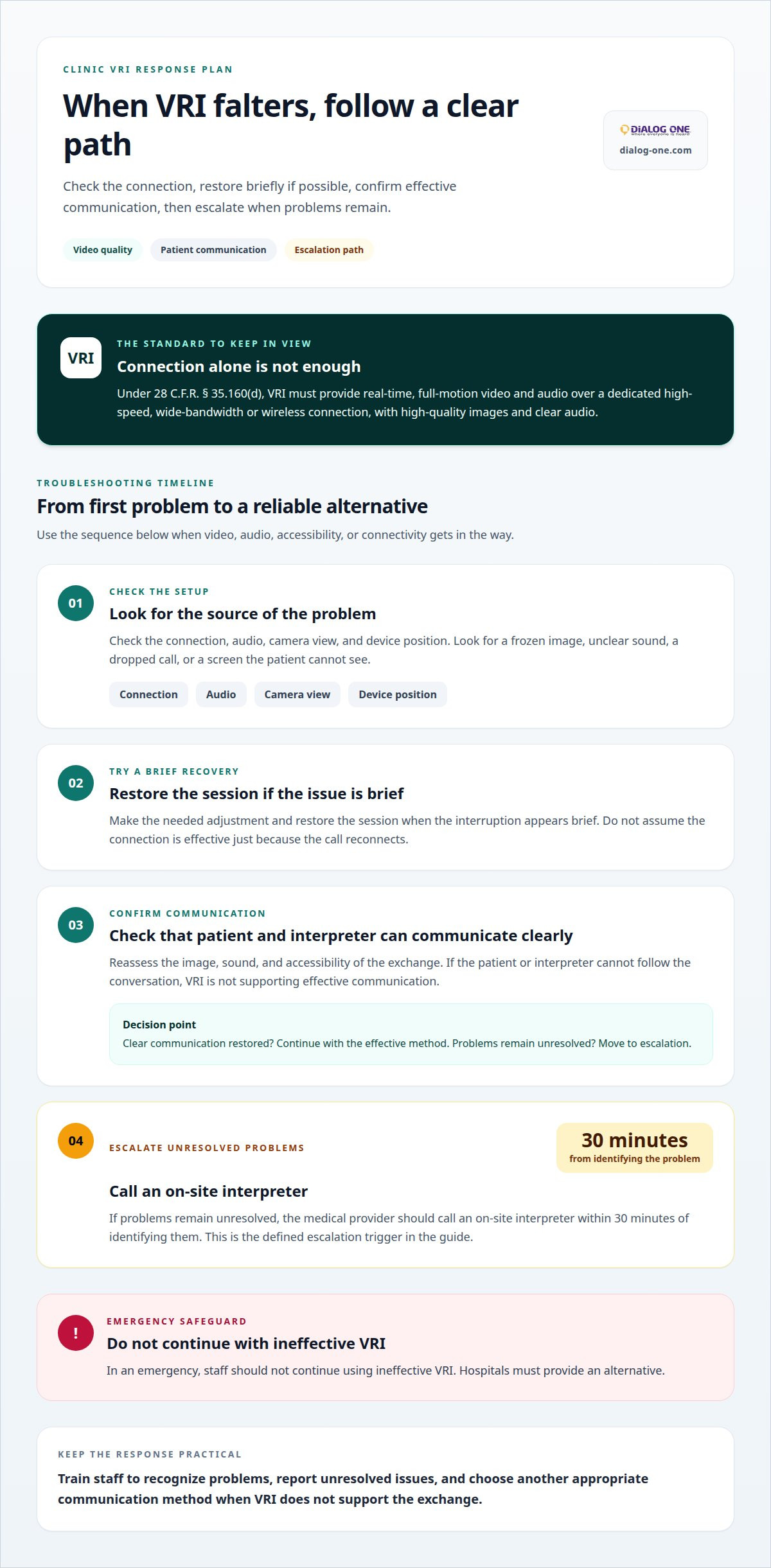
VRI troubleshooting and escalation to an on-site interpreter
VRI may fail when video, audio, accessibility, or connectivity problems prevent clear communication. Clinics need a defined response to maintain communication during routine visits and urgent events.
Accessibility problems can include an image that obscures signing, a screen the patient cannot see, or an interpreter who cannot follow the conversation. Connectivity issues may cause frozen video, unclear audio, or dropped calls. In an emergency, staff should not continue using ineffective VRI. Hospitals must provide an alternative.
Start troubleshooting by checking the connection, audio, camera view, and device position. Restore the session if the issue is brief, then confirm that the patient and interpreter can communicate clearly. If problems remain unresolved, the medical provider should call an on-site interpreter within 30 minutes of identifying them. The 30-minute escalation point gives staff a defined trigger, not a reason to keep relying on ineffective video.
Interpreter qualifications and response
Interpreter quality matters as much as a working connection. Healthcare organizations should work with interpreters who demonstrate language proficiency, interpreting skills, ethics, professional conduct, specialized vocabulary knowledge, required certification, and cultural sensitivity. These capabilities support accurate communication during clinical conversations.
The VRI service should answer interpreter calls within 45 seconds, 24 hours a day, every day. Staff should record whether connection delays or communication problems affected the encounter, then use that information to review service performance and escalation procedures.
Choosing VRI, OPI, or on-site support
VRI provides visual cues that OPI cannot. OPI supports spoken-language interpretation, but not signed-language interpretation, and does not provide visual nonverbal cues. For spoken-language encounters, OPI can be a phone-based alternative. For sign-language communication, an audio-only option does not meet the same need.
For unscheduled medical events, the NAD-DSA model policy recommends using VRI while an on-site interpreter is en route, for no more than two hours from the time of request. Treat this as a bridge, not a substitute for escalation when VRI is ineffective. Match the method to the patient’s communication needs, the urgency, and whether video supports a clear exchange.
Combining VRI and OPI in a language access plan
A language access plan should give VRI and OPI complementary roles, rather than treating either method as the default for every encounter. Start with the patient’s communication needs: determine whether visual communication is necessary, then choose an interpretation method that supports the conversation. A planned alternative gives staff a clear next step if the first method becomes ineffective.
For example, a clinic might use VRI for an encounter that benefits from visual communication, while including OPI for spoken-language interpretation when video is unnecessary or ineffective. This distinction helps staff make an informed choice. OPI cannot provide signed-language interpretation, while VRI depends on a usable video connection. The plan should make these differences clear before staff face a time-sensitive conversation.
Set out the decision path in plain language. Staff should know who identifies the patient’s communication needs, how to access each interpretation method, and what to do if the selected method does not support effective communication. Include a process for escalating unresolved VRI problems and explain when another method or an on-site interpreter is appropriate. These steps connect everyday decisions with the clinic’s broader language access plan.
- Match the method to the patient’s communication mode.
- Use VRI when visual access supports the encounter.
- Use OPI for spoken-language interpretation when video isn’t required.
- Switch methods when the current session can’t support clear communication.
Review the plan in practice. Staff can record which method they selected, whether it supported the exchange, and why they changed approaches. Clinic leaders can use these records to identify unclear decision points, recurring technical barriers, or training needs. The goal is a coordinated system: VRI and OPI serve distinct roles, and staff have a defined response when either method falls short.
Build that complementary approach into your clinic’s communication workflow with a blended interpretation plan.
Dialog One: On-Demand Phone & Video Interpreters
Dialog One supports clinics that need interpreter access as part of a practical communication plan. Its On-Demand Phone & Video Interpreters provide remote spoken- or sign-language interpretation for encounters. For planned appointments or situations better suited to in-person support, Scheduled On-Site & Remote Interpreters offer another option.
Use these services within clinic procedures that help staff choose a communication method, recognize when it is ineffective, and escalate appropriately. The right approach depends on the patient’s communication needs and the encounter, not simply on which technology is easiest to access.
For clinics building or refining their interpreter workflow, Dialog One provides on-demand and scheduled interpretation. Contact Dialog One to discuss interpreter support for your clinic.
Make your communication plan actionable
Make your VRI implementation guide for clinics part of daily care by assigning clear responsibility for interpreter access, staff decisions, and follow-up. A plan is more useful when teams can apply it consistently across appointments, urgent conversations, and changing communication needs.
Dialog One offers On-Demand Phone & Video Interpreters and Scheduled On-Site & Remote Interpreters for different encounter needs. For written materials, its Certified Translation for Personal Documents can help patients access translated personal documents. These services can fit into a broader clinic workflow alongside procedures for choosing and escalating interpretation methods.
Consider where your current process needs practical support, then take a focused next step. Contact Dialog One to plan VRI and discuss interpretation support for your clinic. A clear, considered plan helps your team keep communication accessible as care needs arise.
Frequently Asked Questions
Providing VRI services: How do I get started?
Start by identifying the communication needs your clinic’s VRI process must support. Map how staff will access interpretation, who decides whether video fits an encounter, and what alternative to use if it does not. Then test the workflow with a sample appointment, from requesting an interpreter to recording the outcome. Use staff feedback to clarify responsibilities before applying the procedure in patient care.
What is Video Remote Interpretation?
Video Remote Interpretation is interpretation delivered in real time through a video telecommunications service. The interpreter and patient communicate remotely, with audio and visual access during the conversation. This differs from Video Relay Service, which helps people with hearing disabilities who use American Sign Language communicate with voice telephone users through video equipment. These services address different communication situations, so clinics should distinguish them in staff procedures.
What is video remote interpreting (VRI) and when should clinics use it?
VRI connects a patient and interpreter through live video for a spoken- or signed-language conversation. A clinic can consider it when an encounter benefits from visual communication, such as a discussion where signing must be visible. Staff should also consider whether the patient can use the video setup and whether the interaction remains clear. For spoken-language interpretation without visual needs, OPI is another option in the clinic’s plan.
What federal laws and regulations require clinics to provide VRI or qualified interpreters?
Federal communication and language-access frameworks relevant to healthcare include the ADA, Rehabilitation Act, Title VI of the Civil Rights Act of 1964, and Section 1557 of the Affordable Care Act. These requirements do not make VRI the only interpretation method for every situation. If a clinic uses VRI, the ADA regulation at 28 C.F.R. § 35.160(d) sets performance requirements; 28 C.F.R. § 36.303 is also cited for hospitals.
What technical requirements and equipment are needed to implement VRI in a clinic?
Prepare a stable network connection, a camera, a screen, and clear audio. Recommended VRI specifications include 1024k video calling with an uninterrupted 1.2M Ethernet connection, a 720p camera at 30 frames per second, and a 19.5-inch diagonal screen for viewing from no more than two feet. Test the full setup in the room where staff will use it, since placement affects the interpreter’s view.
How should clinics assess VRI vendors, interpreter qualifications, languages, and availability?
Assess whether a service can support the clinic’s spoken- and signed-language needs, expected appointment patterns, and escalation procedures. Review interpreter proficiency, interpreting skills, ethics, professional conduct, specialized vocabulary, required certification, and cultural sensitivity. Consider how staff access interpreters and what process to follow if a session fails. Use these criteria to compare operational fit with the clinic’s language access plan, not just the video interface.