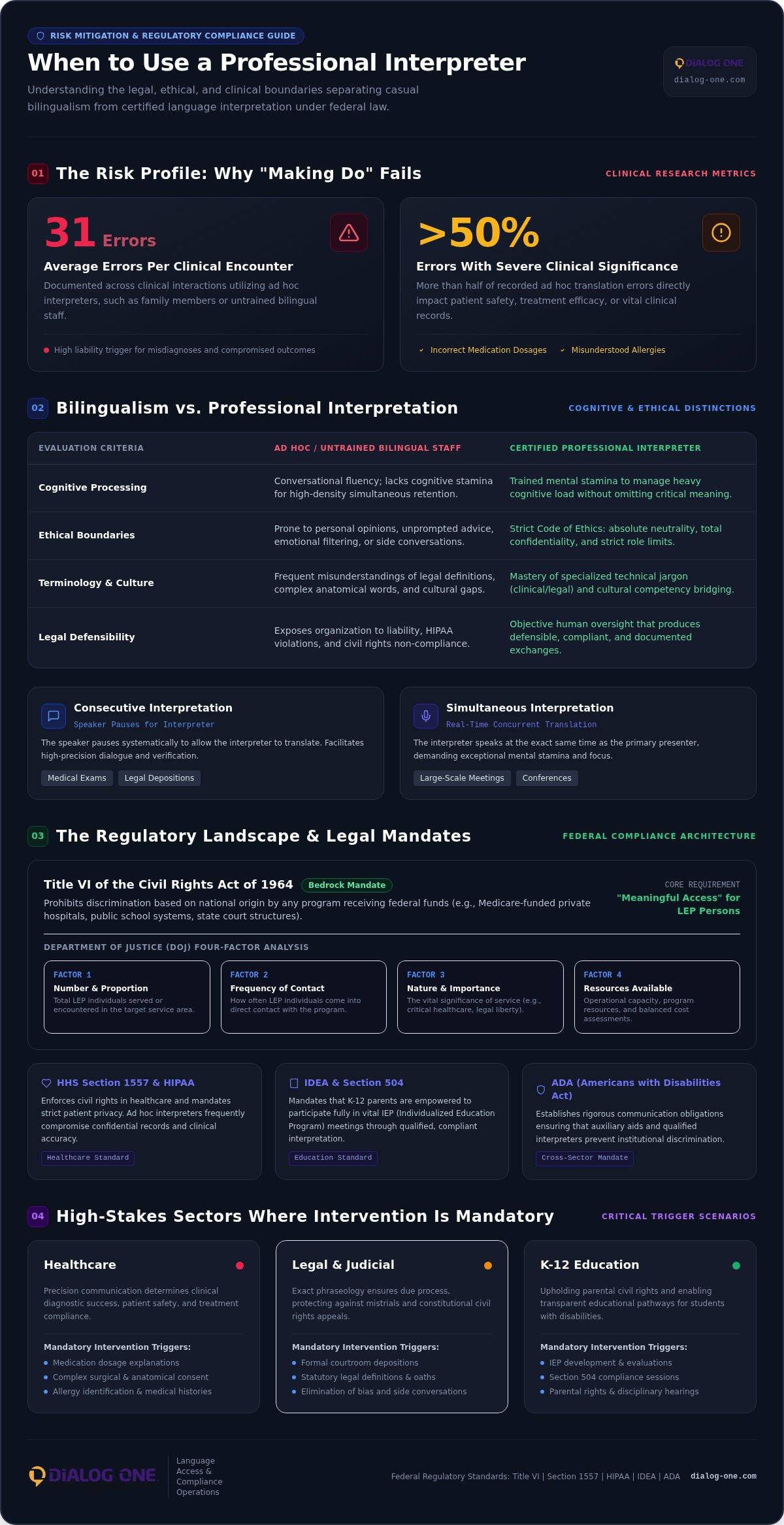
Research indicates that ad hoc interpreters, such as family members or untrained staff, make an average of 31 interpretation errors per clinical encounter. More than 50% of these mistakes carry serious clinical significance, including incorrect medication dosages or misunderstood allergies. You likely recognize the immense responsibility of managing high-stakes communication where a single mistranslated phrase could lead to legal liability or a compromised outcome. Understanding exactly when to use a professional interpreter isn’t just a matter of convenience; it’s a critical strategy for risk mitigation and regulatory compliance.
This guide provides the clarity you need to navigate complex mandates like Title VI and the HHS Section 1557 Final Rule. We’ll outline the specific scenarios that necessitate certified expertise and the dangers of relying on unverified bilingual staff. You’ll learn how to identify the precise moments when professional intervention is required to maintain safety and uphold your ethical obligations. We’ll explore the clear criteria for hiring qualified professionals and the federal requirements that protect both your organization and the individuals you serve.
Key Takeaways
- Distinguish between simple bilingualism and the specialized skills of professional interpretation, including the essential roles of neutrality and confidentiality.
- Navigate the complex regulatory landscape to ensure your organization complies with federal mandates like Title VI and Section 1557.
- Identify the critical triggers for when to use a professional interpreter in healthcare, legal, and educational settings to prevent high-stakes communication failures.
- Evaluate the significant legal and ethical liabilities associated with using ad hoc interpreters, such as family members or untrained bilingual staff.
- Master the practical steps for implementing a robust language access strategy, from assessing frequency of need to selecting the right delivery model for your workflows.
What Defines a Professional Interpreter?
Professional interpretation is a distinct, high-level cognitive discipline. It requires far more than the ability to speak two languages fluently. Many people believe that bilingualism is the only prerequisite for this role, but that’s a dangerous assumption in professional settings. Understanding the standards of professional language interpretation ensures that your organization meets the highest benchmarks for accuracy and ethics. A professional doesn’t just swap words; they manage complex linguistic structures while maintaining the integrity of the original message.
Bilingualism vs. Professional Interpretation
Fluency is the foundation, but it’s not the entire structure. An untrained bilingual individual might understand two languages, but they often lack the mental stamina and specialized training required for high-stakes environments. Interpreters must handle a significant cognitive load, especially during simultaneous interpretation where they listen and speak at the same time. Determining when to use a professional interpreter often depends on the technicality of the conversation. Professional interpretation is the bridge between languages, cultures, and technical contexts.
- Consecutive Interpretation: The speaker pauses to allow the interpreter to speak. This is common in medical exams or legal depositions.
- Simultaneous Interpretation: The interpreter speaks at the same time as the speaker. This is the standard for conferences and large-scale meetings.
The Ethics of Professional Language Services
Ethics form the backbone of the profession. A trained interpreter adheres to a strict Code of Ethics that mandates absolute neutrality and confidentiality. They don’t offer personal opinions, advice, or side conversations. This boundary is vital in legal and medical settings where bias can lead to catastrophic errors. Accountability is paramount. Unlike unverified staff or family members, professional interpreters are trained to recognize their own limits and maintain role boundaries. This human oversight ensures that the communication remains objective and legally defensible.
Cultural competency and specialized terminology are also critical components. A professional understands the nuances of specific sectors, such as the exact legal definitions used in a courtroom or the complex anatomical terms used in a surgery. They recognize when a cultural gap might lead to a misunderstanding and bridge it with poise. This level of precision is why knowing when to use a professional interpreter is a fundamental part of risk management for any organization. It transforms a simple conversation into an accurate, compliant, and safe exchange of information.
The Regulatory Landscape: When Law Mandates Professional Services
Compliance isn’t just about ethics; it’s a legal safeguard. Federal mandates dictate when to use a professional interpreter to prevent national origin discrimination across various sectors. Organizations receiving federal financial assistance must provide “Meaningful Access” to individuals with Limited English Proficiency (LEP). Failure to do so invites civil rights investigations and substantial financial penalties. It’s not a suggestion. It’s a requirement that protects both the provider and the individual from the high costs of miscommunication.
Title VI of the Civil Rights Act
Title VI of the Civil Rights Act of 1964 serves as the bedrock for language access in the United States. It prohibits discrimination based on national origin by any program or activity receiving federal funds. This includes private hospitals accepting Medicare, public school districts, and state court systems. To determine their specific obligations, the Department of Justice utilizes a “Four-Factor Analysis.” This assessment looks at the number of LEP persons served, the frequency of contact, the nature of the program, and the resources available to the organization.
Industry-Specific Mandates: HIPAA, IDEA, and ADA
Industry-specific rules add layers of complexity to these requirements. In healthcare, HIPAA requires absolute privacy and precision, which ad hoc interpreters often compromise. For K-12 education, the Individuals with Disabilities Education Act (IDEA) and Section 504 mandate that parents participate fully in IEP meetings through qualified interpretation. The Americans with Disabilities Act (ADA) takes this further, setting strict ADA effective communication requirements that prohibit relying on a patient’s companion to interpret except in extreme, life-threatening emergencies. These rules ensure that communication is effective, private, and accurate.
Meaningful access is defined by three pillars: timeliness, accuracy, and cost. Communication must happen in real time without placing a financial burden on the LEP individual. The HHS Section 1557 Final Rule, which took effect in 2024, explicitly prohibits using untrained bilingual staff or minors for interpretation. It treats language access as a core component of patient safety and civil rights, leaving no room for “making do” with unverified resources. Ensuring your team knows how to access qualified language services is a vital step in protecting your institutional integrity.
The consequences of ignoring these mandates are severe. Communication breakdowns contribute to a significant percentage of malpractice claims, where the average defense cost sits near $242,000 according to industry research. Beyond litigation, federal agencies can strip an organization of its funding entirely if a pattern of discrimination is found. Knowing exactly when to use a professional interpreter isn’t just a best practice; it’s a shield against systemic risk and a guarantee of equitable service.
Three High-Stakes Sectors Where Professional Interpreters Are Essential
Identifying the specific environments that demand linguistic precision is the first step toward institutional safety. Determining when to use a professional interpreter is most critical in sectors where a misunderstanding carries life-altering consequences. While general bilingualism might suffice for casual social interactions, it fails to meet the rigorous demands of specialized fields. In these high-stakes arenas, accuracy isn’t just a goal; it’s a prerequisite for safety, equity, and due process.
Medical and Healthcare Environments
Patient safety hinges on clear communication. Research shows that LEP patients treated without dedicated language access have a 24% higher 30-day readmission rate than their English-proficient peers. This disparity often stems from misdiagnosis or a failure to understand discharge instructions. Professional medical interpreters are vital during informed consent discussions for surgeries or complex treatment authorizations. They ensure that the patient fully understands the risks and benefits, protecting the facility from malpractice claims. For immediate needs, professional phone interpretation services provide a reliable solution in emergency departments where every second counts.
Legal and Judicial Proceedings
The legal system relies on the exactness of language. The federal judiciary conducts more than 138,000 court proceedings requiring foreign language interpretation annually. Specialized legal interpreters navigate “legalese” and complex procedural terminology that standard bilingual speakers often find overwhelming. Whether it’s a deposition, an attorney-client consultation, or a formal hearing, a professional ensures that due process is maintained. They provide a neutral, accurate record that stands up to judicial scrutiny. Organizations often use Scheduled On-Site Interpreters for sensitive, high-profile trials while utilizing remote options for routine administrative hearings.
K-12 Education and IEP Meetings
Equitable access to education is a civil right. Under IDEA requirements, school districts must ensure that parents with Limited English Proficiency can participate fully in their child’s education. This is particularly challenging during Individualized Education Program (IEP) meetings. These sessions involve highly technical terminology regarding developmental milestones, behavioral assessments, and legal accommodations. Professional interpreters bridge the gap between educators and families, ensuring that parents aren’t just present, but are active participants in the decision-making process. This prevents procedural errors that could lead to costly litigation or state audits.
Access to these specialized services must be consistent and reliable. Emergencies don’t follow a schedule. A steady partner provides 24/7 access to qualified professionals across these sectors, ensuring that your organization is never left without a voice during critical moments. Knowing when to use a professional interpreter allows administrators to move from a state of reactive crisis management to proactive, compliant service delivery.
The Risks of “Making Do”: Why Ad Hoc Interpreters Are a Liability
Relying on ad hoc interpreters is a high-stakes gamble. These individuals, typically bilingual staff, family members, or friends, lack the specialized training required to navigate complex professional environments. While they may speak the language, they don’t possess the technical vocabulary or ethical framework necessary for accuracy. This gap creates significant legal and clinical liabilities for any organization. Understanding when to use a professional interpreter is a matter of institutional safety and risk management. It’s about protecting the integrity of your services.
The Hidden Cost of “Free” Interpretation
Clinical studies have documented the dangers of untrained help. Research indicates that ad hoc interpreters make an average of 31 interpretation errors per encounter. More than 50% of these mistakes have clinical significance, such as omitting medication dosages or misunderstanding allergies. Beyond patient safety, there is a financial toll. Pulling bilingual staff away from their primary duties creates operational inefficiencies and increases the risk of burnout. It’s a drain on resources. The cost of a professional interpreter is far lower than the cost of a single malpractice lawsuit, which averages $242,000 in defense and indemnity costs according to industry data.
Confidentiality and Power Dynamics
Untrained individuals often struggle with neutrality. Family members may intentionally filter or summarize information to protect a loved one, inadvertently omitting critical details. This dynamic is especially dangerous in legal or medical settings where full disclosure is required. Patients often withhold sensitive information about substance use or domestic concerns when a relative is in the room. Professional interpreters maintain absolute neutrality and confidentiality, ensuring the integrity of the original message remains intact. They don’t offer opinions or advice; they facilitate an objective exchange of information without the interference of personal bias.
Compliance is another critical factor. Section 1557 of the Affordable Care Act explicitly prohibits relying on minor children or untrained staff except in extreme emergencies. Using non-professional help isn’t just a poor choice; it’s a violation of federal law that can lead to HIPAA audits. These privacy risks are compounded when sensitive data is handled by individuals who haven’t signed confidentiality agreements or undergone background checks. Protect your organization from the risks of ad hoc communication by scheduling a professional interpreter today.
How to Implement a Professional Interpretation Strategy
Developing a robust language access plan requires a shift from reactive problem-solving to proactive management. You must first evaluate the specific linguistic demographics of your service area and the frequency of Limited English Proficiency (LEP) encounters. This assessment dictates when to use a professional interpreter and which delivery method best fits the specific context of each meeting. Integrating these services into your standard operating procedures ensures that staff members don’t hesitate during critical moments. Efficiency and safety depend on having clear, established pathways for communication already in place before a need arises.
Standardizing the workflow is essential for long-term compliance. Train your team to recognize the specific triggers for professional intervention, such as the start of an IEP meeting, the intake process in an emergency department, or the signing of legal documents. Clear protocols remove the guesswork and prevent the use of ad hoc alternatives that lead to liability. This organization-wide understanding of when to use a professional interpreter protects your institutional integrity and ensures that every individual receives equitable service regardless of their primary language.
Choosing the Right Mode: Phone, Video, or On-Site
Select the mode based on the complexity, duration, and sensitivity of the interaction. On-demand phone interpretation services are the most efficient choice for brief, non-visual tasks. They work well for appointment scheduling, basic administrative inquiries, or simple follow-up calls, providing immediate access without the need for specialized hardware. Video Remote Interpreting (VRI) offers a more nuanced experience. It captures essential visual cues and facial expressions, making it the preferred method for American Sign Language (ASL) or complex clinical discussions where non-verbal communication is vital. For long-form consultations or highly sensitive legal and medical meetings, Scheduled On-Site Interpreters provide a physical presence that fosters deeper trust and clarity. Matching the mode to the encounter minimizes risk and optimizes your resources.
Partnering with Dialog One for 24/7 Coverage
Reliability is the cornerstone of any successful language access strategy. Dialog One serves as an authoritative partner, offering 24/7 access to qualified interpreters in over 200 languages. With more than 25 years of experience in high-stakes sectors like healthcare, law, and education, we understand the weight of the consequences involved in your daily operations. Our platform bridges the gap between technological innovation and human intuition, ensuring that your organization remains compliant with federal mandates and ethical standards. We provide the steady guidance and professional oversight needed to handle linguistic complexity with calm efficiency. Contact Dialog One today to secure your language access strategy.
Protecting Your Institution Through Linguistic Precision
Effective communication is the foundation of institutional safety and legal compliance. You’ve learned that professional interpretation is a specialized skill that extends far beyond simple bilingualism. It’s a critical shield against the high error rates and ethical conflicts inherent in ad hoc interpretation. Determining exactly when to use a professional interpreter is a fundamental step in mitigating risk across healthcare, legal, and educational settings. By prioritizing certified expertise, you uphold your responsibility to federal mandates like Title VI and HIPAA while ensuring equitable access for every individual. It’s about moving from reactive crisis management to a proactive, ethical communication strategy.
Dialog One stands as a steady partner in these high-stakes moments. With 25 years of proven expertise and 24/7 on-demand access in 200+ languages, we provide the human oversight necessary for absolute accuracy. We remove the barriers to understanding so you can focus on your primary mission. Don’t leave your organization’s reputation or the safety of your clients to chance. Ensure Accuracy and Compliance with Dialog One Professional Interpreters and build a reliable bridge to clear understanding today.
Frequently Asked Questions
Is it illegal to use a family member as an interpreter in a medical setting?
Under Section 1557 of the Affordable Care Act, covered healthcare entities are prohibited from using adult family members or friends to interpret unless the patient specifically requests it and the risk is documented. Using minor children is strictly banned except in extreme, life-threatening emergencies. These regulations protect patient privacy and ensure clinical accuracy. Relying on untrained individuals often leads to misdiagnosis and compromised informed consent.
What is the difference between a translator and an interpreter?
The primary difference lies in the medium of communication. Interpreters handle real-time spoken or signed language during live interactions, such as medical appointments or court hearings. Translators work with written text, converting documents like legal contracts or medical records from one language to another. While both require high-level linguistic skill, interpreting demands immediate cognitive processing and cultural mediation, whereas translation focuses on written precision and stylistic consistency over time.
When is a professional interpreter required by law in schools?
Federal law, specifically the Individuals with Disabilities Education Act (IDEA) and Title VI, requires schools to provide qualified interpreters for parents with Limited English Proficiency (LEP). This mandate is most critical during Individualized Education Program (IEP) meetings, disciplinary hearings, and enrollment processes. Schools must ensure that parents can participate meaningfully in their child’s education. Providing professional services prevents procedural errors that could lead to state audits or civil rights investigations.
Can we use a bilingual employee to interpret for clients?
You should only use a bilingual employee if they’ve been formally assessed and trained as a qualified interpreter. Simply speaking two languages doesn’t qualify an individual to manage the ethical and technical complexities of professional interpretation. Untrained staff often struggle with role boundaries and specialized terminology. This creates significant liability for your organization. Knowing when to use a professional interpreter rather than a staff member is vital for maintaining institutional safety and compliance.
How do I know if an interpreter is truly “professional”?
A professional interpreter possesses specific credentials, such as certification from recognized bodies like the NBCMI for medical fields or state court certification for legal work. They adhere to a strict Code of Ethics, emphasizing neutrality, confidentiality, and accuracy. Evaluate their experience in your specific sector and their mastery of technical terminology. Reliable partners don’t just provide bilingual speakers; they vet their linguists to ensure they meet these high-level standards for every encounter.
What are the risks of using AI or automated tools instead of a professional interpreter?
AI and machine translation tools lack the human intuition and cultural context necessary for high-stakes environments. They often struggle with regional dialects, complex legal jargon, and emotional nuances. In healthcare, Section 1557 prohibits relying solely on automated translation for vital communications without human verification. The primary risk is inaccuracy. This can lead to life-altering misunderstandings or legal failures. Professional interpreters provide the accountability and oversight that automated systems cannot replicate.
How quickly can I get a professional interpreter on-demand?
You can access a professional interpreter almost instantly through modern on-demand platforms. For over-the-phone and video remote interpreting, connection times typically range from 30 seconds to a few minutes. This rapid response is essential for emergency departments and unscheduled legal consultations. Having 24/7 access ensures your organization isn’t left without a voice. Understanding when to use a professional interpreter on-demand allows you to handle immediate linguistic needs with calm efficiency.
Does HIPAA apply to remote video interpreting services?
Yes, HIPAA regulations apply to all forms of medical interpretation, including remote video services. Providers must ensure that their interpreting partners use encrypted, secure platforms to protect patient health information (PHI). A professional service will sign a Business Associate Agreement (BAA) to guarantee compliance. This legal contract ensures that the interpreter and the platform meet federal privacy standards. Choosing a HIPAA-compliant partner is a non-negotiable requirement for any healthcare organization managing language access.