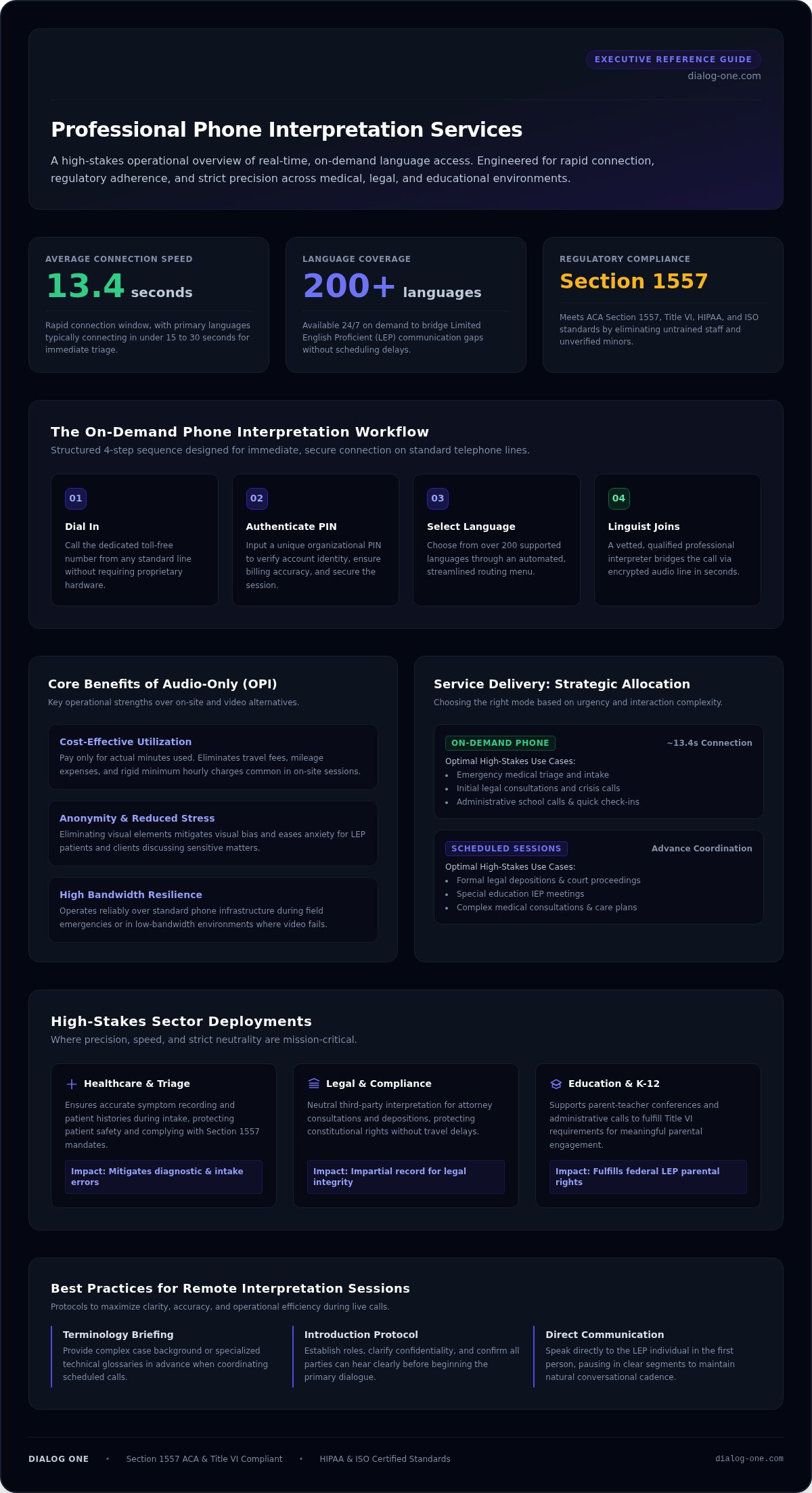
When a medical emergency or a legal deposition hinges on a single sentence, waiting minutes for a translator isn’t just an inconvenience; it’s a liability. With an average connection time of just 13.4 seconds, professional phone interpretation services have evolved from a basic utility into a critical lifeline for high-stakes sectors. You likely understand the immense pressure of managing limited English proficient (LEP) encounters while staying compliant with strict mandates like Section 1557 of the ACA or Title VI. It’s a delicate balance between speed and precision that leaves no room for error.
This guide explores how to secure instant access to over 200 languages while maintaining the rigorous accuracy your organization demands. We’ll examine the shift toward human-centric, on-demand support that satisfies HIPAA and ISO standards without disrupting your existing workflows. By the end of this article, you’ll understand how to transform language access from a regulatory hurdle into a seamless, accountable asset for your professional team.
Key Takeaways
- Learn why professional phone interpretation services are a vital risk-mitigation tool for high-stakes environments where verbal clarity is non-negotiable.
- Understand the technical workflow of on-demand interpretation to streamline your team’s access to qualified linguists in seconds.
- Compare the strategic advantages of immediate triage versus scheduled sessions for complex interactions like IEP meetings or legal depositions.
- Adopt best practices for remote sessions, including terminology preparation and professional introduction protocols, to improve communication outcomes.
- Recognize how a steady, human-centric approach ensures accountability and precision across 200+ languages in any professional scenario.
What is Phone Interpretation and Why is it Essential?
Professional phone interpretation services function as a real-time, three-way communication bridge. This process involves a professional linguist who facilitates understanding between two parties speaking different languages over a standard telephone line. This mode of delivery, often referred to as telephone interpreting, is fundamentally different from translation. While translation focuses on converting written text from one language to another, interpretation deals with the spoken word in the moment. It requires the linguist to capture nuance, tone, and cultural context instantly. It’s about ensuring the message is heard and understood exactly as intended.
For the millions of individuals in the United States with Limited English Proficiency (LEP), these services provide a vital link to essential care and legal rights. Without a qualified interpreter, critical information often gets lost. This leads to medical errors, legal misunderstandings, or educational barriers. Because crises and legal needs don’t follow a traditional business schedule, the 24/7 availability of OPI ensures that language access remains constant. It’s a steady, dependable resource for those moments when communication cannot wait for a scheduled appointment.
The Core Benefits of Audio-Only Interpretation
Audio-only interpretation offers distinct advantages over video or on-site alternatives. It remains the most resilient option in low-bandwidth environments or field emergencies where visual technology might fail. The benefits include:
- Cost-effectiveness: Organizations pay only for the minutes used. There are no travel fees or minimum hourly requirements typical of on-site visits, making it a sustainable choice for high-volume environments.
- Anonymity and comfort: The lack of a visual component can reduce stress for patients or clients in sensitive situations. It helps mitigate visual bias and keeps the focus entirely on the spoken message.
- Speed: Modern systems connect users to a linguist in seconds. For primary languages, connection times often fall under 15 to 30 seconds, providing immediate resolution to communication gaps.
Common Use Cases Across High-Stakes Sectors
High-stakes environments require precision and accountability. Professional phone interpretation services are the standard for immediate triage and intake across several specialized fields:
- Healthcare: Emergency medical triage requires instant clarity. Qualified interpreters ensure that patient histories and symptoms are accurately reported during intake, which is critical for patient safety.
- Legal: Initial attorney-client consultations and depositions benefit from the neutrality of a remote linguist. This ensures all parties understand their rights and obligations without the delay of travel.
- Education: K-12 administrative calls and parent-teacher conferences become inclusive. It allows schools to meet federal mandates by providing meaningful access to LEP parents regarding their child’s progress.
The Mechanics of Professional Over-the-Phone Interpretation
Connecting to a professional linguist involves a structured sequence designed for speed and security. Users typically dial a dedicated toll-free number and enter a unique organizational PIN. This identifies the account and ensures billing accuracy. Next, the caller selects the required language from a menu of over 200 options. Within seconds, a qualified interpreter joins the line. This streamlined workflow allows professionals in medical or legal settings to focus on their primary duties while the technology handles the routing. The process is designed to be intuitive, requiring no specialized hardware or extensive training for the staff on site.
Unlike consumer-grade apps that lack accountability, professional phone interpretation services operate on secure, encrypted audio lines. This infrastructure is essential for maintaining confidentiality and meeting federal language access guidance. Vetting is rigorous. Interpreters must demonstrate mastery of both languages and adhere to strict ethical codes regarding impartiality. This includes compliance with the ACA Section 1557 Final Rule, which prohibits the use of untrained staff or minor children for interpretation in healthcare settings. By using verified professionals, organizations mitigate the risk of catastrophic errors that occur with unvetted tools.
Human Expertise vs. Automated Tools
Human nuance remains the gold standard in high-stakes communication. While AI tools excel at rapid terminology lookups, they often fail to grasp idioms or the emotional weight of a conversation. A professional interpreter identifies when a patient is confused or when a legal client’s tone suggests hesitation. Accuracy rates for machine-only translation often plummet when faced with complex syntax or specialized jargon. Human oversight ensures that these nuances aren’t lost in the digital shuffle, providing a level of reliability that automation cannot yet match.
Ensuring Quality and Cultural Competency
Effective interpretation requires deep subject matter expertise. A linguist handling a surgical intake needs different vocabulary than one assisting in a criminal deposition. Professional phone interpretation services match callers with interpreters who understand these specific terminologies. Beyond words, cultural competency plays a vital role. Interpreters act as cultural mediators, identifying potential misunderstandings that arise from different social norms or expectations. Continuous monitoring and quality assurance protocols ensure that every call meets high professional standards, regardless of the time of day.
Comparing On-Demand and Scheduled Interpretation Solutions
Organizations must choose between immediacy and depth when resolving language barriers. On-demand phone interpretation services provide the rapid response required for unpredictable encounters, such as emergency room intake or 911 dispatch. These sessions prioritize speed, connecting users to a linguist in seconds to handle urgent triage. In contrast, scheduled interpretation is designed for high-context, lengthy interactions where the interpreter benefits from prior knowledge of the subject matter. This includes judicial hearings, complex medical consultations, or Individualized Education Program (IEP) meetings. While on-demand services handle the immediate “what” and “when,” scheduled services manage the “why” and “how” through thorough preparation.
A hybrid model often serves larger institutions best. For example, a hospital system might use on-demand access for its trauma center while scheduling specific linguists for oncology appointments. This approach balances budget constraints with the need for specialized expertise across different departments. Administrators should evaluate their department-specific call volumes and the complexity of their typical interactions to determine the correct mix. It’s about matching the intensity of the situation to the most appropriate delivery method to ensure safe and accurate communication.
Regulatory Compliance: HIPAA, Title VI, and IDEA
Maintaining compliance requires more than just a simple connection. In healthcare, HIPAA mandates that remote sessions remain secure and private to protect patient health information. Publicly funded agencies must also adhere to Title VI of the Civil Rights Act, ensuring meaningful access for LEP individuals. Education administrators face unique hurdles under the Individuals with Disabilities Education Act (IDEA). Providing a qualified interpreter for IEP meetings is a legal necessity, not a courtesy. It ensures that parents fully participate in decisions regarding their child’s specialized education plan, protecting the school from claims of procedural non-compliance.
Selecting the Right Language Service Provider (LSP)
Choosing a partner requires a rigorous evaluation of their operational capacity. A dependable provider offers 24/7/365 availability, ensuring that language barriers don’t reappear after business hours. Consider this checklist when vetting an LSP:
- Support for over 200 languages and dialects.
- Verified interpreter credentials and adherence to professional ethical standards.
- Proven scalability to handle sudden spikes in call volume without delays.
- Redundant infrastructure to guarantee high uptime and clear audio quality.
Reliable scalability is vital for any professional organization. If a provider can’t maintain connection speeds during peak times, your team faces increased liability and potential miscommunication. Before committing to a vendor, reviewing a structured 200 language interpreter service buyer checklist can help you separate superficial claims from genuine, mission-critical accountability. A seasoned partner like Dialog One acts as a steady guardian of communication, ensuring that every call receives the same level of professional attention, regardless of the time or complexity.
Best Practices for Effective Remote Interpretation Sessions
The efficiency of professional phone interpretation services depends heavily on how the session is managed by the lead professional. Preparation is the first step toward a successful outcome. Before dialing, gather all necessary documents and identify specialized terminology that may arise. If the call involves sensitive information, such as a trauma-informed medical intake or a confidential legal matter, brief the interpreter briefly before the Limited English Proficient (LEP) individual joins the line. This ensures the linguist is mentally prepared for the emotional weight or technical complexity of the session.
Introduction protocols are equally vital. Start the call by introducing yourself and the interpreter to the LEP individual in their primary language. This establishes a baseline of trust and clarity. During the conversation, maintain a steady communication flow by speaking in short, clear sentences. Pause frequently to allow the interpreter to deliver the message accurately. This “chunking” method prevents the loss of detail and reduces the cognitive load on the linguist, which ultimately shortens the total call duration and lowers costs.
Maximizing Accuracy and Reducing Call Time
To get the most value from your session, optimize your physical environment. Background noise from busy offices or medical equipment can distort the audio, forcing the interpreter to ask for repetitions. Always speak directly to the client or patient. Instead of saying, “Tell him his appointment is at ten,” say, “Your appointment is at ten.” This direct address maintains the human connection and speeds up the exchange. Encourage the interpreter to interrupt for clarification if a term is ambiguous. It’s better to pause for a second than to proceed with a misunderstanding that requires a follow-up call later.
Technology Requirements for Clear Audio
Technical stability is the backbone of remote interpretation. While cellular connections offer mobility, they are prone to dropped packets and signal interference. Landlines or dedicated VoIP systems provide the highest audio fidelity. For in-person encounters where OPI is used, dual-handset systems or high-quality speakerphones are essential. If you encounter audio issues mid-session, don’t hesitate to disconnect and redial. A clear line is non-negotiable for professional accuracy. To ensure your team is equipped with the right tools and access, contact Dialog One to integrate on-demand interpretation into your workflow today.
Dialog One: Precision and Accountability in Language Services
Dialog One stands as an ethical innovator in the language access space, bringing over 25 years of experience to every interaction. We don’t view communication as a mere transaction of words. Instead, we treat it as a grave responsibility. Our phone interpretation services offer 24/7 access to qualified linguists in over 200 languages. We maintain a steady and dependable presence for administrators who cannot afford a lapse in clarity. Our infrastructure is optimized for rapid response, ensuring that your team is never left waiting during a crisis. This reliability maintains the flow of care in hospitals and the integrity of proceedings in legal settings.
We integrate AI to enhance routing speed and terminology accuracy, but we never remove the human from the equation. High-stakes moments require the intuition and empathy that only a professional linguist can provide. This balance protects your organization from the liability of machine-only errors. We focus on accountability, ensuring that every linguist in our network of 17,000 professionals adheres to the highest ethical standards. By matching assignment risk to specialized linguistic tiers, we mitigate risk for our partners in every call.
A Human-Centric Approach to Modern Technology
Our philosophy is rooted in being a seasoned bridge-builder. We focus on removing barriers to access and facilitating informed judgment in specialized fields. True communication requires more than just literal translation. It demands an understanding of cultural nuances and emotional tone. Whether it’s a pediatric intake, a criminal deposition, or an IEP meeting, our linguists provide the cultural mediation necessary for true understanding. We provide customized solutions for healthcare, legal, and educational sectors. This ensures that the specific terminology of your industry is always handled with precision and care.
Getting Started with Professional Interpretation
Implementing our services is simple. We’ve designed our system to integrate seamlessly into your existing phone infrastructure. You don’t need additional hardware or complex software installations. You gain immediate, on-demand access to our global network of experts. Budget management is equally straightforward. We provide transparent usage tracking, allowing you to monitor minutes and volume across different departments. This level of visibility ensures that your language access program remains both effective and sustainable. It allows you to focus on your core mission while we handle the complexities of communication.
Connect with Dialog One for reliable phone interpretation services today.
Secure Your Communication Lifeline
Professional communication in high-stakes environments requires more than a literal exchange of words. It demands a partner who understands the weight of every syllable and the gravity of the situations you handle daily. We’ve explored how on-demand linguistic support bridges the gap between technical innovation and human intuition. By selecting the appropriate delivery model and following established session protocols, your organization can significantly reduce the risk of miscommunication while maintaining strict HIPAA and Title VI compliance.
Dialog One brings over 25 years of linguistic expertise to your operations, providing 24/7 on-demand access to more than 200 languages. This ensures that language barriers never compromise the quality of patient care or the integrity of legal proceedings. Our human-centric approach guarantees that accuracy remains the priority, even in your most urgent moments. You don’t have to navigate these complexities alone. Request a consultation for professional phone interpretation services today to see how we can support your team’s unique requirements. Clear, reliable understanding is always just a phone call away.
Frequently Asked Questions
Is phone interpretation as accurate as having an interpreter on-site?
Professional phone interpretation services utilize the same qualified linguists found in on-site settings. Accuracy depends on the interpreter’s specialized credentials and the audio quality of the connection. While on-site interpreters observe body language, remote linguists are trained to capture tone and nuance through active listening. This ensures that the message remains precise. For high-stakes medical or legal encounters, the accuracy of a certified remote professional far exceeds the risk of using unvetted bilingual staff.
How long does it take to connect to a phone interpreter?
Connection times for primary languages typically fall under 30 seconds. For high-demand languages like Spanish, Mandarin, or Arabic, users often connect in as little as 15 seconds. This rapid access is essential for emergency triage and immediate intake scenarios. While rare dialects may require slightly longer routing, the system is designed for maximum efficiency. This ensures that language barriers are removed almost instantly during critical professional interactions where every second counts.
Are phone interpretation services HIPAA compliant?
Professional services are designed to meet strict HIPAA and Title VI standards. This involves using secure, encrypted audio lines and ensuring that all interpreters adhere to professional ethical codes. These protocols protect patient health information and maintain confidentiality across all remote sessions. By utilizing a provider with 25 years of experience in high-stakes sectors, organizations ensure that their remote language access meets all federal regulatory requirements for privacy and data security.
Which languages are available for on-demand phone interpretation?
On-demand access is available for over 200 languages and dialects. This includes common global languages such as Spanish, Vietnamese, and French, as well as low-diffusion languages and indigenous dialects. The network of 17,000 professional linguists ensures that even rare linguistic needs are met with precision. This broad coverage allows national organizations to serve diverse populations across the country without the delay of searching for a local specialist for every encounter.
What is the difference between OPI and VRI (Video Remote Interpretation)?
OPI is an audio-only service that works on any standard telephone line. VRI includes a visual component, which is often preferred for American Sign Language or sessions where visual cues are vital. OPI remains the more resilient choice in low-bandwidth environments or field emergencies. It requires no specialized video hardware or high-speed internet. Both services provide access to certified professionals, but OPI offers the highest level of hardware independence and reliability.
Do I need special equipment to use phone interpretation services?
No specialized hardware is required to access these services. You can use standard landlines, cellular phones, or VoIP systems already in place at your facility. For in-person meetings, a high-quality speakerphone or a dual-handset system can improve audio clarity for all parties. The goal is a seamless integration into your existing workflow. This allows your team to focus on the conversation rather than troubleshooting complex technical requirements during an active session.
How are phone interpretation services billed?
Billing is structured based on the delivery model you choose. On-demand sessions are billed at a per-minute rate, ensuring you only pay for the time you actually use. Scheduled sessions, which are common for lengthy legal depositions or IEP meetings, are often billed at a flat hourly rate. This transparent approach allows administrators to manage budgets effectively. It also provides clear data for tracking usage and volume across different departments or specific projects.
Can I request the same interpreter for recurring scheduled calls?
Requesting a specific interpreter is possible for scheduled sessions. This is highly recommended for ongoing cases, such as long-term medical treatments or complex legal proceedings, where continuity improves communication. While on-demand calls route to the first available qualified linguist to ensure speed, scheduled appointments allow for better consistency. This helps build trust between the professional and the LEP individual while ensuring the interpreter is already familiar with the specific case context.