A vendor catalog advertising hundreds of spoken dialects means nothing if nobody answers when a critical call comes through for an indigenous or low-diffusion language. In high-stakes healthcare, judicial, and public sector environments, securing a dependable 200 language interpreter service isn’t simply a box-checking exercise; it demands vetted human expertise delivered with immediate composure. You already know the acute frustration of dropped calls, sluggish connection times, and the steep regulatory penalties under Title VI, HIPAA, and ACA Section 1557 when organizations rely on uncertified bilingual staff.
True language access requires a transparent vetting framework that separates superficial claims from genuine, mission-critical accountability. This guide provides an essential buyer checklist to help you evaluate language service providers across verifiable linguistic depth, on-demand connection speeds, and federal compliance mandates. Ahead, we break down the core vetting criteria, credentialing standards, and operational capabilities required to eliminate underqualified vendors and ensure seamless 24/7 access across both phone and video.
Key Takeaways
- Verify genuine linguistic depth by distinguishing between static vendor rosters and active, round-the-clock availability for a reliable 200 language interpreter service.
- Apply a structured 5-point evaluation framework to benchmark professional linguist credentials, platform uptime, and rapid connection standards.
- Compare on-demand remote options with scheduled interpreting to select the appropriate modality for complex clinical, legal, or administrative interactions.
- Ensure complete adherence to federal mandates, including HIPAA, Title VI, and the ADA, mitigating regulatory liabilities and communication risks.
- Execute a clear organizational onboarding roadmap that prepares frontline staff to dispatch qualified interpreters without operational friction.
Understanding the True Breadth of a 200 Language Interpreter Service
Catalog numbers can be deceiving. Marketing materials frequently boast rosters exceeding hundreds of languages, yet administrative buyers regularly discover that broad lists fail to translate into active, real-time availability. A commercially viable 200 language interpreter service must provide tangible linguistic coverage across nationwide operations, not a dormant spreadsheet of unvetted subcontractors. Volume metrics alone never guarantee reliable communication when an urgent intake occurs.
Operational reality hinges on the delivery infrastructure behind the directory. Modern healthcare, judicial, and educational institutions rely on on-demand telephone interpreting and video platforms to establish secure, instantaneous human connections. When an organization requires urgent language support, the core metric is not how many languages a vendor lists online, but whether a qualified professional answers within seconds.
High-Diffusion vs. Limited-Diffusion Language Support
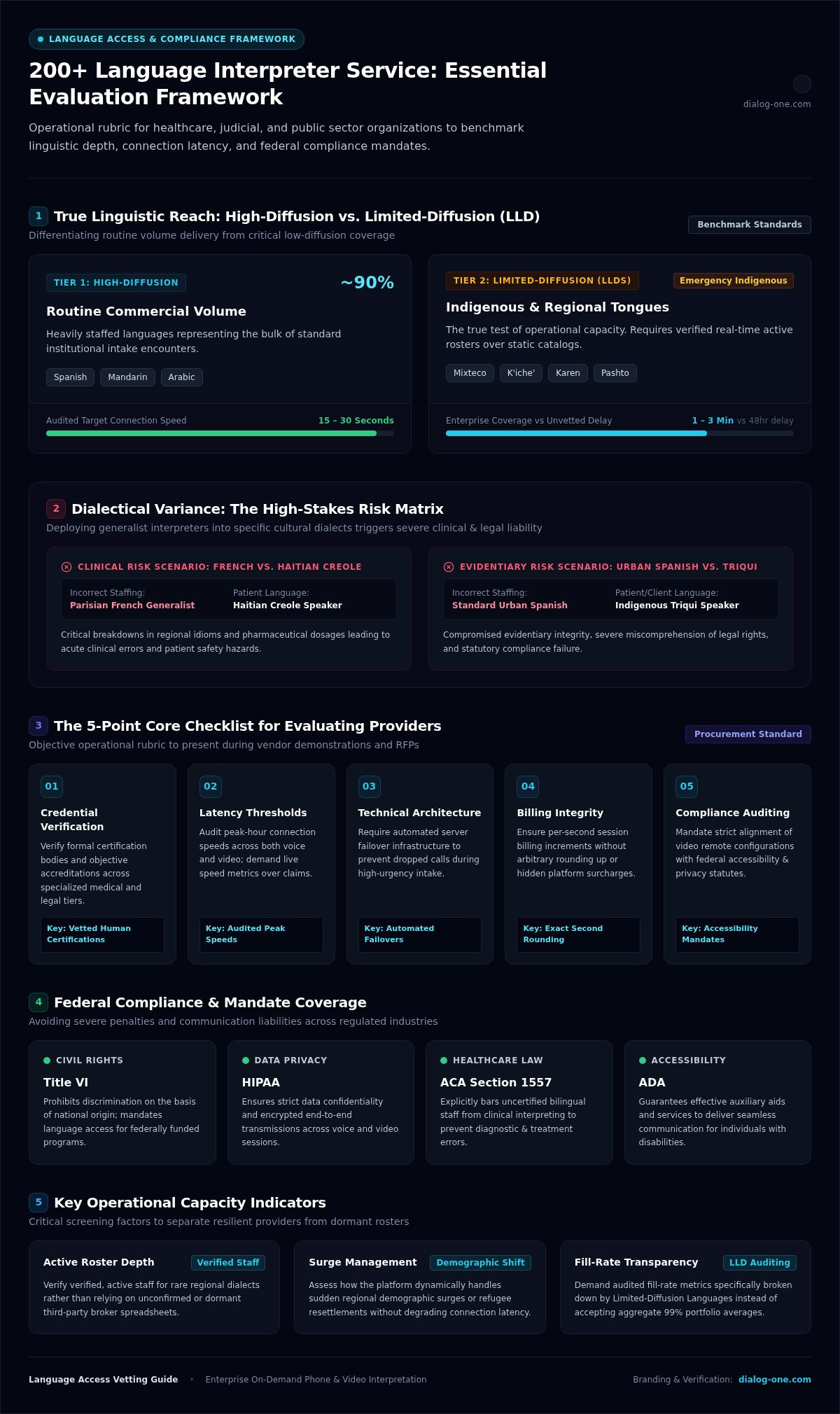
High-volume languages such as Spanish, Mandarin, and Arabic represent roughly 90% of routine commercial requests. Most vendors staff these tiers heavily. The operational test arises with languages of limited diffusion (LLDs) and indigenous tongues, including Mixteco, K’iche’, Karen, or Pashto. Buyers must verify exact fulfillment benchmarks under emergency conditions. While common languages connect in 15 to 30 seconds, enterprise-grade networks maintain dedicated coverage to bridge rare linguistic encounters within one to three minutes, rather than forcing a 48-hour prescheduling delay during an active crisis.
Evaluating vendor capacity requires scrutinizing specific operational protocols:
- Active Roster Depth: Confirm the provider maintains verified, active staff for rare regional dialects rather than relying on unconfirmed third-party networks.
- Surge Management: Assess how the vendor handles sudden regional demographic shifts or refugee resettlements without degrading connection speeds.
- Fill-Rate Transparency: Demand audited fill-rate metrics specifically broken down by LLDs instead of accepting an aggregate 99% portfolio figure.
The Role of Dialectical Accuracy in Critical Encounters
Dialectical variance directly impacts patient safety and evidentiary integrity. Deploying a generalist interpreter who speaks Parisian French to assist a Haitian Creole speaker, or an urban Spanish speaker to interpret for an indigenous Triqui patient, creates catastrophic clinical risk. Misinterpreted pharmaceutical dosages or legal rights can trigger devastating liabilities. Vetted providers screen linguists rigorously through objective proficiency assessments, ensuring they grasp regional idioms, colloquialisms, and specialized terminology before placing them in live environments.
The 5-Point Core Checklist for Evaluating Language Access Providers
Procuring a dependable 200 language interpreter service requires moving beyond slick marketing demos. Organizational risk managers and procurement officers need an objective rubric that interrogates technical capabilities alongside human qualifications. When unexpected surges occur, an unverified service level agreement (SLA) leaves frontline staff stranded. Use this structured evaluation checklist during vendor demonstrations to separate resilient partners from transactional brokers.
Before entering contract negotiations, present vendors with direct operational questions:
- Credential Verification: What formal certification bodies accredit your medical and legal interpreting tiers?
- Latency Thresholds: What are your audited connection speeds across voice and video during peak hours?
- Technical Architecture: Does your platform enforce automated server failovers to prevent dropped sessions?
- Billing Integrity: Are sessions rounded to the second, or do you enforce hidden platform access surcharges?
- Compliance Auditing: How do your video remote configurations align with federal accessibility laws?
Vetting Linguist Credentials and Ethical Standards
High-stakes environments demand strict human credentialing. Verify that candidate providers require formal accreditations from bodies like the Certification Commission for Healthcare Interpreters (CCHI) or state judicial consortiums. Language networks should demonstrate continuous professional development, ethical compliance auditing, comprehensive background checks, and formal adherence to ISO 18841 standards for community interpreting.
Assessing SLA Commitments and Platform Redundancy
Connection latency can compromise urgent interventions. Contractual SLAs should guarantee rapid access, benchmarked against real-world performance: 15 to 30 seconds for core languages and under 60 seconds for American Sign Language. For video interpretation, review whether the system maintains dedicated high-speed infrastructure to meet DOJ effective communication standards without video jitter or blur. Confirm the platform uses automated call rerouting when primary nodes encounter packet drops or server congestion.
Auditing Transparent Administrative and Usage Reporting
Administrative visibility prevents budget surprises. Enterprise portals must provide granular, department-level tracking detailing call duration, requested dialect, and modality. Ensure billing structures are straightforward, avoiding hidden connection fees or inflated minute rounding that disguise true costs. Organizations looking to consolidate these operational requirements across nationwide divisions can see how Dialog One streamlines enterprise language governance through intuitive reporting, robust compliance, and 24/7 on-demand access.
Comparing Modalities: On-Demand Remote vs. Scheduled Interpretation
Selecting the appropriate communication channel requires aligning situational urgency with procedural complexity. A comprehensive 200 language interpreter service must supply both rapid-response remote tools and planned human deployments. While remote modalities resolve immediate language barriers, certain high-stakes legal proceedings, delicate psychiatric assessments, and multi-party conferences demand scheduled on-site professionals. Understanding these operational boundaries prevents miscommunication during critical workflows.
The table below summarizes the operational trade-offs across common delivery models:
| Modality | Connection Latency | Non-Verbal Context | Best Operational Fit |
|---|---|---|---|
| Over-the-Phone (OPI) | Immediate (15-30 sec) | None (Audio only) | Intake triage, billing queries, low-bandwidth zones |
| Video Remote (VRI) | Rapid (30-60 sec) | High (Visual gestures) | Clinical diagnostics, ASL encounters, telehealth |
| Scheduled On-Site | Advance notice required | Complete physical presence | Trial testimony, complex surgeries, child welfare |
Over-the-Phone (OPI) vs. Video Remote Interpreting (VRI)
Over-the-phone interpreting excels when network reliability is compromised. In rural clinics or field operations with volatile wireless signals, audio-only channels deliver clear, uninterrupted consecutive interpretation without frame drops. Conversely, on-demand video remote interpreting adds vital non-verbal cues. Facial expressions, posture, and physical distress indicators provide indispensable diagnostic clarity for clinical staff navigating federal limited English proficiency guidance. For American Sign Language encounters, high-definition video fidelity without packet loss is legally mandated, requiring adequate screen size and unobstructed framing of hands, arms, and facial markers.
Integrating AI Live Transcription with Human Expertise
Technological advancement enables modern providers to augment service delivery through automated tools. AI live transcription and captioning offer practical utility for large internal seminars, routine municipal broadcasts, and rapid administrative record creation. These automated tools enhance accessibility across routine informational meetings.
Critical boundary lines must remain firm. Unassisted AI translation models carry verified risks of algorithmic hallucination, dialectical omission, and cultural distortion. In clinical diagnoses, informed consent dialogues, and courtroom arraignments, automated software introduces direct malpractice liability. Sustainable operations require pairing rapid digital capabilities with qualified human linguists who maintain ultimate oversight over contextual precision.
Navigating Industry Compliance Mandates in Regulated Sectors
Federal statutory mandates establish language access as an enforceable civil right, not an optional administrative accommodation. Relying on an unvetted vendor exposes organizations to severe legal liabilities, including civil rights investigations, substantial audit penalties, and loss of federal funding. For regulated organizations across the United States, contracting an enterprise-grade 200 language interpreter service provides essential risk mitigation. A compliant partner ensures that every interaction adheres to strict legal standards while protecting sensitive consumer information.
A legally sound language infrastructure requires specific operational safeguards:
- Data Sovereignty and Encryption: Enforce 256-bit SSL/TLS end-to-end encryption across all audio and video streaming sessions, with verified SOC 2 Type II controls.
- Contractual Liability Coverage: Execute formal Business Associate Agreements (BAAs) establishing clear legal culpability for data breaches.
- Zero-Data Retention Policies: Mandate that no consumer audio, video frames, or personally identifiable metadata are recorded, retained, or ingested to train machine learning models.
Healthcare Standards: HIPAA, ACA Section 1557, and Patient Safety
The HHS Office for Civil Rights enforces rigorous standards under Section 1557 of the Affordable Care Act (45 CFR Part 92). Covered entities are explicitly barred from utilizing untrained bilingual staff, accompanying adult companions, or minor children for interpretation, except during extreme, life-threatening emergencies where qualified personnel are unavailable. Clinical linguists must possess verified competency in medical terminology, patient privacy protocols under HIPAA, and informed consent procedures to prevent medical errors. Organizations navigating these tightening regulatory requirements can review the technical and compliance standards required for on-demand video remote interpreting under the HHS Section 1557 Final Rule to ensure their platforms meet current federal expectations.
Legal and Judicial Proceedings: Due Process and Accuracy
Judicial proceedings demand verbatim precision. Under federal court standards and state court rules, interpreters must convey testimony exactly as spoken without paraphrasing, omitting, or summarizing testimony. Courtroom proceedings, depositions, and administrative hearings require credentialed legal interpreters who understand evidentiary procedures. Providers must maintain documented qualification chains to ensure legal testimony withstands constitutional scrutiny under Sixth and Fourteenth Amendment due process challenges.
Educational Access: Title VI and IEP Meeting Compliance
Under Title VI of the Civil Rights Act and the Equal Educational Opportunities Act, public school districts must facilitate meaningful communication with Limited English Proficient parents. Complex Individualized Education Program (IEP) evaluations, disciplinary hearings, and academic assessments require specialized interpreters trained in educational terminology. Unqualified interpretation during an IEP conference violates the Individuals with Disabilities Education Act (IDEA), exposing districts to federal compliance reviews.
Mitigating these exposure risks requires a proven institutional infrastructure. Partner with Dialog One to deploy qualified, compliance-ready interpreters across your nationwide judicial, healthcare, or educational facilities.
Implementing Your Service: Smooth Onboarding and Organizational Adoption
Contracting a provider solves only half the operational challenge. Without structured onboarding and systematic workforce enablement, even the most capable 200 language interpreter service fails to deliver results when frontline staff hesitate. Successful implementation bridges software configuration, hardware readiness, and employee education. A disciplined rollout ensures staff members know exactly how to summon assistance without interrupting critical workflows.
A comprehensive onboarding roadmap focuses on three foundational phases:
- Device Configuration: Pre-configure VoIP endpoints, dual-handset desk phones, and encrypted video tablets with single-tap launcher profiles.
- Access Distribution: Issue department-specific pin codes to track linguistic utilization across operational units accurately.
- Frontline Enablement: Distribute quick-reference language identification cards to front desks, triage counters, and intake stations.
Staff Training and Rapid Dispatch Protocols
Frontline teams need muscle memory rather than bulky operational manuals. Provide clear visual guides showing language identification charts so intake personnel can identify spoken dialects on sight. Train administrative and clinical teams to initiate conference lines and operate video remote setups smoothly. Conducting brief, simulated emergency drills helps staff practice rapid dispatch, ensuring they connect with qualified interpreters within seconds during high-stakes encounters.
Long-Term Quality Assurance and Partnership Reviews
Sustainable language access demands consistent oversight. Establish recurring quarterly reviews with your provider to analyze fulfillment rates, connection latencies, and language usage trends. Implement a simple internal reporting mechanism where employees can log dialectical friction, dropped calls, or audio clarity concerns. Reviewing annual utilization data helps administrators forecast departmental budgets and adjust language access plans as local demographic needs shift.
Securing an Enterprise Language Partner
Transactional vendors treat interpretation as a simple commodity. A true enterprise partner understands the intense gravity of legal, educational, and healthcare communication. Prioritize providers that deliver proactive technical monitoring, comprehensive compliance frameworks, and 24/7 account support. Organizations seeking reliable national coverage can consult with Dialog One to deploy dependable phone and video interpreters backed by over 25 years of specialized industry experience.
Strengthen Your Organization’s Language Access Framework
Effective communication in regulated environments leaves no margin for guesswork. Choosing an enterprise 200 language interpreter service requires balancing responsive technical infrastructure with verified human expertise. As you evaluate prospective providers, demand transparent fulfillment rates for low-diffusion languages, test actual platform latency, and confirm strict alignment with federal mandates like HIPAA, ACA Section 1557, and Title VI. Equipping your frontline staff with intuitive dispatch tools ensures that language barriers never compromise patient safety, due process, or educational equity.
When communication matters most, dependable execution is essential. With more than 25 years of proven excellence in language access, our team provides seamless, comprehensive 24/7 on-demand access to over 200 languages across phone and video. Protect your organization against compliance liabilities while delivering dignified care to every individual. Partner with Dialog One for certified 24/7 interpreter services and build a resilient language access program you can trust every single day.
Frequently Asked Questions
How quickly can an on-demand phone or video interpreter connect?
Core languages typically connect in 15 to 30 seconds for audio calls and under 60 seconds for video sessions. Languages of limited diffusion or indigenous dialects generally connect within one to three minutes through an enterprise network. Top-tier providers maintain automated routing and server redundancy to prevent call queuing. This rapid access ensures frontline staff can handle urgent patient intakes or court proceedings without delay.
Can a 200 language interpreter service support rare indigenous dialects?
Yes, an authentic 200 language interpreter service maintains active linguist networks for rare indigenous and limited-diffusion languages rather than relying solely on static catalog listings. While common languages represent the bulk of call volume, verified providers routinely route on-demand calls for dialects like Mixteco, K’iche’, Karen, or Pashto. When specialized or ultra-rare variants arise, providers coordinate rapid scheduled remote interpreting to ensure accurate communication.
What qualifications must professional interpreters hold for medical and legal calls?
Professional linguists must hold recognized credentials demonstrating specialized domain competency and rigorous ethical compliance. In healthcare settings, qualified interpreters possess certifications from bodies such as the Certification Commission for Healthcare Interpreters or the National Board of Certification for Medical Interpreters. For legal proceedings, interpreters must meet state judicial consortium standards or federal court certification requirements, demonstrating mastery of courtroom protocols, verbatim translation rules, and statutory confidentiality standards.
Is remote video interpretation fully compliant with HIPAA and federal privacy laws?
Yes, enterprise video remote interpretation platforms adhere strictly to HIPAA, FERPA, and federal privacy frameworks through robust technical controls. Compliant systems implement end-to-end 256-bit encryption for all audio and visual streams, preventing unauthorized interception. Providers execute formal Business Associate Agreements and maintain zero-retention policies. This means that video feeds and spoken dialogue are never recorded, cached, or harvested to train public artificial intelligence models.
Why shouldn’t bilingual employees or family members be used as interpreters?
Using bilingual staff or family members introduces severe liability risks and directly violates federal mandates like ACA Section 1557 and Title VI. Untrained individuals lack professional fluency in complex clinical, legal, or administrative vocabularies. Family members often filter traumatic news or inject emotional bias, impairing objective dialogue. Federal enforcement prohibits relying on adult companions or minor children, except during extreme, life-threatening emergencies where qualified assistance cannot be obtained immediately.
What is the difference between certified translation and real-time interpretation?
Interpretation handles real-time spoken or signed communication, whereas certified translation converts written documents from one language to another. While a 200 language interpreter service delivers instantaneous oral dialogue over phone or video, translation involves written texts such as medical records, legal contracts, or school district notices. Certified translations include formal signed attestations of accuracy and thorough human review, ensuring complete acceptance by regulatory agencies, courts, and educational authorities nationwide.