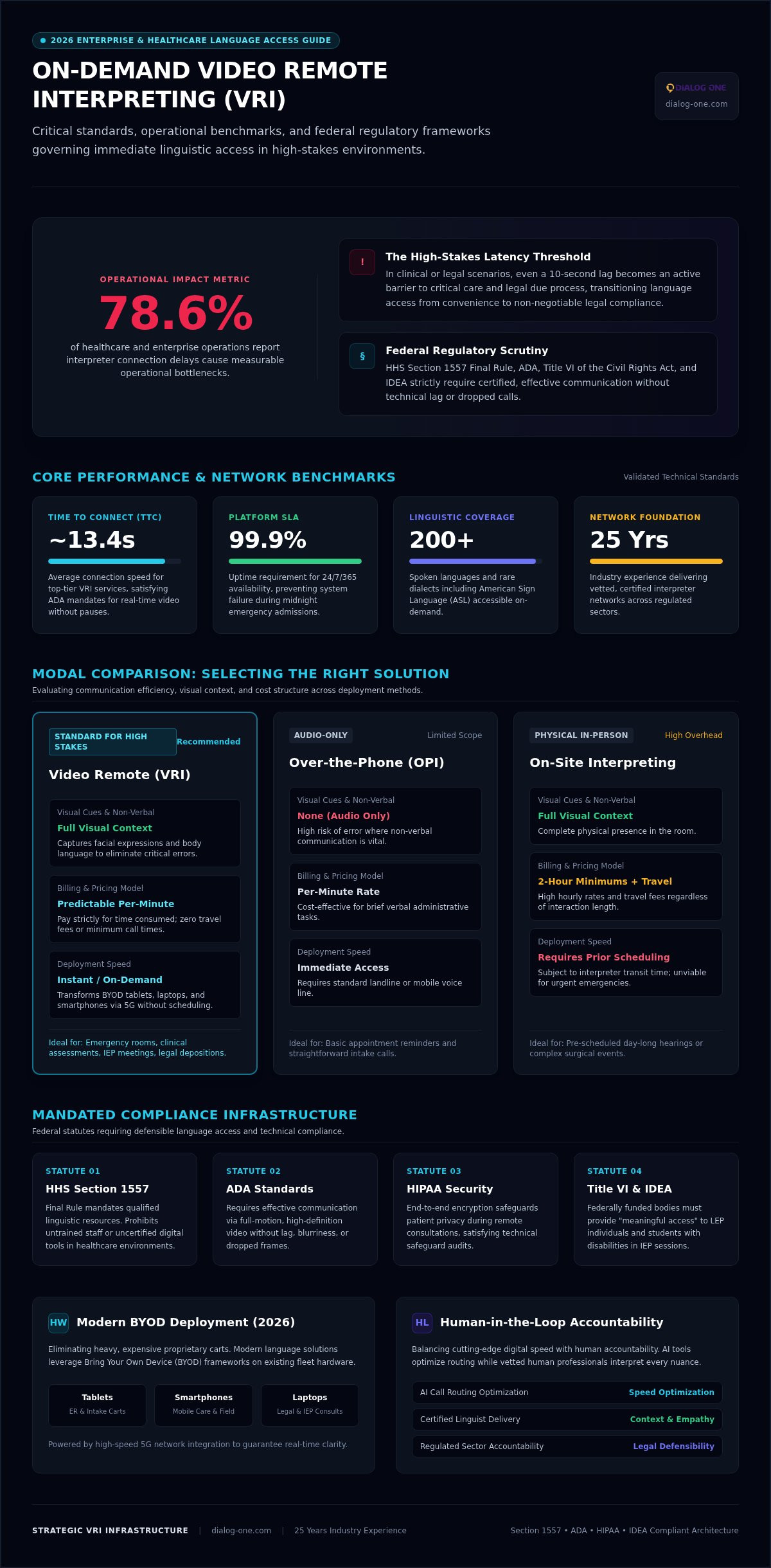
Did you know that 78.6% of healthcare and enterprise operations report that interpreter connection delays cause measurable operational bottlenecks? In high-stakes environments, a ten-second lag isn’t just a technical glitch; it’s a barrier to critical care or legal due process. As regulatory scrutiny tightens under the HHS Section 1557 Final Rule, the need for reliable on-demand video remote interpreting has moved from a convenience to a legal necessity. You need a solution that bridges the gap between digital speed and human accountability without the frustration of dropped calls or unqualified staff.
Managing language access for a diverse population is a significant responsibility. You likely feel the pressure to balance federal compliance with the reality of a fixed budget. This 2026 guide will show you how to evaluate and implement professional video remote interpreting to ensure seamless, compliant communication in any high-stakes environment. We will explore the technical standards required for ADA and HIPAA compliance, the benefits of predictable usage-based pricing, and how to gain instant access to over 200 languages.
Key Takeaways
- Understand how on-demand video remote interpreting eliminates the need for prior appointments, providing immediate linguistic support when it’s needed most.
- Learn to evaluate providers based on linguistic breadth and Time to Connect (TTC) to ensure your staff isn’t left waiting during critical encounters.
- Identify the technical infrastructure required to maintain HIPAA and Section 1557 compliance, protecting both your patients and your organization.
- Discover practical strategies for deploying VRI hardware in high-stakes settings like emergency rooms and K-12 IEP meetings.
- Leverage 25 years of industry experience to access a reliable network of interpreters covering 200+ languages at any hour of the day.
What is On-Demand Video Remote Interpreting (VRI)?
Professional video remote interpreting (VRI) is a specialized telecommunication service that connects people who don’t share a common language with a certified interpreter through high-definition video and audio. While traditional interpreting often requires advanced scheduling, the “on-demand” model provides immediate, real-time access. This technology allows organizations to transform any tablet, smartphone, or laptop into a portal for professional linguistic support. It removes the logistical burden of waiting for a physical interpreter to arrive at your facility, which is critical during emergencies or unscheduled consultations.
Adopting on-demand video remote interpreting is often driven by the need to meet federal language access mandates. Under Title VI of the Civil Rights Act, the Americans with Disabilities Act (ADA), and the Individuals with Disabilities Education Act (IDEA), organizations receiving federal funding must provide “meaningful access” to individuals with limited English proficiency or those who are deaf and hard of hearing. VRI ensures that communication is not just available, but effective and legally defensible.
VRI vs. OPI vs. On-Site: When to Choose Video
Video interpreting is rapidly replacing Over-the-Phone Interpreting (OPI) in environments where context and accuracy are non-negotiable. Research indicates that a significant portion of human communication is non-verbal. In medical diagnoses or legal depositions, an interpreter must see facial expressions and body language to capture the full intent of the speaker. This visual component reduces the risk of errors that often occur during audio-only calls. While OPI remains useful for quick tasks like scheduling an appointment, VRI is the standard for high-stakes encounters such as IEP meetings or clinical assessments.
Efficiency also dictates the move toward video. On-site interpreting typically involves high hourly rates, travel fees, and two-hour minimum commitments. In contrast, VRI utilizes a per-minute model. You pay only for the time you spend communicating. This shift allows administrators to reallocate budgets toward broader language access without sacrificing the quality of the interaction.
The Evolution of Language Access in 2026
The landscape of language services has shifted significantly. With the widespread adoption of 5G and advanced mobile hardware, technical lag is no longer an acceptable excuse for communication failure. Modern systems have moved away from heavy, proprietary hardware in favor of “Bring Your Own Device” (BYOD) flexibility. This allows your staff to launch a session instantly on existing equipment, ensuring that help is always a few taps away.
Current standards also emphasize a human-centric approach to technology. While AI tools are used to optimize call routing and connection speeds, the actual interpretation remains the responsibility of vetted human professionals. This “human-in-the-loop” model provides the accountability required in regulated sectors. It ensures that complex nuances and cultural sensitivities are handled with the empathy and precision that only a trained linguist can provide.
Key Criteria for Evaluating VRI Providers
Selecting a partner for on-demand video remote interpreting requires an evaluation that goes beyond basic software features. You must examine the reliability of the human network and the resilience of the digital infrastructure. Performance metrics serve as the baseline for safety in high-stakes environments. If the technology fails during a critical moment, the human cost can be immense.
Linguistic breadth is a primary differentiator. While many services prioritize American Sign Language (ASL), a truly comprehensive provider offers 200+ spoken languages, including rare dialects. This ensures that no individual is left without a voice during a medical or legal crisis. Connection speed, or Time to Connect (TTC), is the next critical indicator. Top-tier services achieve average connection speeds of approximately 13.4 seconds. This level of responsiveness is essential to meeting ADA requirements for effective communication, which mandate real-time, full-motion video without technical lags or irregular pauses.
Platform stability must also be verified through rigorous service level agreements. High-stakes operations require 99.9% uptime to ensure 24/7/365 availability. If a system fails during a midnight emergency room admission or a sensitive legal deposition, the consequences are severe. Reliability is the foundation of trust between the provider and the professional staff on the front lines.
Verifying Interpreter Expertise and Ethics
Professional interpretation is a disciplined craft. It’s vital to distinguish between someone who is merely “bilingual” and a professionally certified interpreter. Qualified linguists adhere to the NCIHC and RID code of ethics, ensuring confidentiality, accuracy, and impartiality. Reliable providers implement continuous training and assessment protocols to maintain these standards. If you are looking for a partner that prioritizes these rigorous qualifications, you can explore our professional interpreting services to see how we maintain linguistic excellence.
Pricing Structures and Transparency
Administrators often face complex budgets that fluctuate based on community needs. Transparent pricing is non-negotiable for long-term sustainability. Look for per-minute models rather than rigid monthly subscriptions that may include hidden platform fees or minimum usage penalties. A usage-based structure allows your organization to scale language access as needed. This ensures you only pay for the communication you actually facilitate, providing a clear and predictable path for financial planning.
Security, Compliance, and Technical Infrastructure
Protecting patient and student data is a legal and ethical mandate. Every session of on-demand video remote interpreting must utilize end-to-end encryption to prevent unauthorized access to sensitive medical or legal information during transmission. For healthcare entities, this requires a signed Business Associate Agreement (BAA) that clearly outlines how the provider handles Protected Health Information (PHI). Compliance isn’t just about the software; it’s about the entire operational framework that secures the communication bridge.
Privacy concerns often center on how data is stored or discarded. Professional providers typically avoid recording sessions to minimize the risk of data breaches and long-term liability. If transcription services are utilized, the data should be processed in real-time and purged according to strict retention policies. This disciplined approach ensures that your organization meets the rigorous standards of Title VI and IDEA, fulfilling federal civil rights obligations for every student and patient you serve. For a deeper understanding of how these obligations apply specifically to hospitals and clinics, the comprehensive guide to language access services healthcare organizations rely on provides critical context on Section 1557 compliance and clinical risk mitigation.
Technical Requirements for Reliable VRI
High-quality VRI depends on stable, high-speed infrastructure. To meet the minimum standards for video remote interpreting, organizations must ensure a dedicated bandwidth of 1.5 Mbps to 3.0 Mbps for symmetric upload and download. This prevent the choppy video or audio jitter that violates statutory thresholds. Modern platforms offer broad device compatibility, working across iOS, Android, and web browsers. They also integrate directly into existing telehealth ecosystems like Zoom or Microsoft Teams, allowing staff to launch on-demand video remote interpreting within their current workflow.
The Role of AI in Accountability
In 2026, AI serves as a powerful layer of accountability rather than a replacement for human judgment. AI live transcription services act as a support tool, helping interpreters catch complex terminology or specific numbers during fast-paced exchanges. Technology can also mitigate risk by flagging potential linguistic misunderstandings in real-time, which allows the human interpreter to clarify the point immediately. Ethical innovation means ensuring these automated tools are regularly audited to prevent the introduction of bias into high-stakes communication, keeping the human linguist as the ultimate guardian of accuracy.
Implementation Strategy: Launching VRI in Your Organization
Successful integration of on-demand video remote interpreting requires moving beyond simple software installation. It begins with a comprehensive needs assessment. Administrators must identify high-traffic areas where language barriers create the most significant risks to safety or compliance. In school districts, this often involves Special Education departments during IEP meetings. In healthcare, the focus shifts to the Emergency Room or front-office intake. Identifying these friction points allows for a targeted rollout that addresses immediate federal mandates while optimizing resource allocation.
Hardware selection should reflect the specific environment of use. Rolling carts provide stability and high-quality audio in clinical settings, while dedicated tablets offer mobility for teachers moving between classrooms. Regardless of the device, staff training is the most critical variable. Front-line workers must be able to access an interpreter in under 30 seconds. If the process is cumbersome, staff will revert to less reliable methods. Training should focus on the technical “how-to” alongside the soft skills required to manage a three-way video conversation.
Monitoring and reporting provide the data necessary for long-term success. By analyzing usage patterns, administrators can identify peak times for specific languages and adjust hardware availability accordingly. This data-driven approach transforms on-demand video remote interpreting from a reactive tool into a proactive strategy for community engagement. Regular audits of connection speeds and user satisfaction help justify budget allocations and ensure the service meets the high standards of your organization.
Overcoming Adoption Barriers
Introducing a remote interpreter can feel impersonal to patients or parents if not handled with care. Best practices include explaining the interpreter’s role immediately to establish transparency. Designating “super-users” in each department creates a local support system for technical troubleshooting, which reduces the burden on your IT staff. Additionally, deploying clear signage and “I Speak” cards streamlines the language identification process. This ensures the correct linguist is requested from the start, preventing unnecessary delays.
Optimizing the VRI Environment
Technical fidelity relies on the physical environment. Proper lighting is essential so the interpreter can see facial expressions and hand movements clearly. Sound considerations are equally important. Using noise-canceling microphones or moving to a quieter space prevents audio jitter and ensures every word is captured. Position the device so the interpreter has a clear view of all participants in the room. A professional protocol involves the staff member introducing the interpreter by name, which builds immediate trust and sets a respectful tone for the session.
To begin your transition to a more reliable system, you can contact us for a VRI implementation strategy that aligns with your specific organizational needs.
Why Dialog One is the Strategic Choice for VRI
Choosing a language access partner is a decision of consequence. For over 25 years, Dialog One has managed complex linguistic requirements for both government and private sectors. We understand that in high-stakes environments, there’s no room for error. Our platform provides 24/7/365 access to a network of professional linguists covering over 200 languages. This ensures that your organization can provide meaningful access at any hour, regardless of the dialect required.
Our approach to on-demand video remote interpreting is uniquely human-centric. We utilize cutting-edge AI to optimize connection speeds and routing, but we never sacrifice the nuance of a professional human interpreter. This combination ensures that communication remains clear, ethical, and accountable. We act as a reliable guardian of communication, removing barriers so that you can focus on providing care or education. Reliability is our standard, and accountability is our promise.
National Scale, Personalized Support
We serve organizations across the United States, providing a consistent pool of highly qualified linguists. Every encounter is supported by dedicated account management. This allows us to tailor VRI workflows to the specific needs of your industry. Whether you’re navigating the legal complexities of a deposition or the emotional weight of a medical diagnosis, our team understands the gravity of the situation. We aren’t just a software provider; we’re an accountable partner that values substance and proven experience.
Our linguists are vetted for their expertise in specialized sectors, including K-12 education and healthcare. This specialization is vital for IEP meetings and clinical consultations where precision is mandatory. By maintaining a high register of formal, functional language, we ensure that administrators and professionals can communicate with their clients with absolute confidence. We bridge the gap between technical innovation and human intuition, ensuring that no detail is lost in translation.
Next Steps: Getting Started with Dialog One
Improving your language access program is a straightforward process. You can request a live demo or set up a pilot program to see how our on-demand video remote interpreting platform performs within your specific department. We operate with a transparent per-minute fee structure, which eliminates the stress of hidden costs or long-term contracts. This predictability helps administrators manage budgets effectively while maintaining full regulatory compliance. We’re prepared to handle your complexity with calm efficiency.
If you’re ready to enhance your communication capabilities and remove barriers to understanding, Contact Dialog One for a language access consultation today.
Future-Proofing Your Language Access Strategy
Ensuring clear communication in high-stakes environments is a profound responsibility. As this guide has shown, successful on-demand video remote interpreting depends on more than just high-speed bandwidth; it requires a partnership rooted in accountability and linguistic precision. You now have the framework to evaluate providers based on connection speed, security protocols, and the ethical qualifications of their linguists. Implementing these standards helps your organization meet HIPAA and Title VI obligations while removing barriers for those you serve.
Dialog One stands ready to support your mission with 25 years of linguistic expertise. Our platform provides access to certified linguists in over 200 languages, ensuring that no voice goes unheard. By combining human-centric AI with professional intuition, we offer a steady and dependable bridge for your most critical moments. We invite you to Contact Dialog One to secure 24/7 VRI for your organization and experience a higher standard of reliability. Together, we can build a future where understanding is immediate and access is universal.
Frequently Asked Questions
Is video remote interpreting as accurate as in-person interpreting?
Professional video interpreting is highly accurate and suitable for most high-stakes environments. It preserves vital visual cues such as facial expressions and body language, which are essential for clinical and legal precision. Unlike audio-only calls, the visual component allows the linguist to see the environment and participants. While some sensitive psychiatric or surgical encounters benefit from on-site presence, video provides the same certified expertise for the vast majority of professional consultations.
How do I ensure our VRI provider is HIPAA compliant?
Verify that your provider executes a formal Business Associate Agreement (BAA) and utilizes end-to-end encryption for all transmissions. Compliance requires strict data privacy protocols, including the prohibition of recording sessions and the immediate purging of any temporary data. Dialog One maintains full regulatory compliance with HIPAA and Title VI, ensuring that sensitive medical information remains secure and protected throughout every digital interaction. This disciplined framework is essential for mitigating organizational risk.
What happens if a rare language interpreter is not immediately available?
While we provide 24/7 access to over 200 languages, rare dialects may occasionally require a brief wait or a scheduled appointment. Our system uses intelligent routing to find the first available qualified linguist across the globe. If an immediate connection isn’t possible, our team works with you to schedule a remote session at the earliest opportunity. This ensures your organization meets its federal language access obligations without compromising the quality of the communication.
Can we use our own tablets and smartphones for VRI services?
Yes, modern platforms are designed for “Bring Your Own Device” (BYOD) flexibility. You can access on-demand video remote interpreting through existing iOS and Android devices or a standard web browser. This eliminates the need for expensive, proprietary hardware. We recommend using devices with high-definition cameras and stable internet connections. This ensures the video quality meets federal standards for real-time, full-motion communication during critical medical or legal meetings.
How does VRI pricing usually work for school districts?
Most school districts benefit from a per-minute usage model that aligns with fluctuating needs. This transparent structure allows administrators to pay only for the time spent in active interpretation during IEP meetings or parent-teacher conferences. It removes the burden of travel fees and minimum hourly commitments associated with on-site services. This predictable approach helps districts manage tight budgets while providing 24/7/365 access to a wide range of professional linguists.
What is the difference between VRI and VRI for the Deaf (VRS)?
VRI is used when all participants are in the same room but the interpreter is remote. In contrast, Video Relay Service (VRS) is a federally funded program for phone calls between people in different locations. VRI is the appropriate choice for medical appointments or legal depositions where a deaf individual and a hearing professional are physically together. It provides a certified ASL interpreter to facilitate immediate, face-to-face communication in a professional setting.
Do we need special software to use Dialog One’s VRI services?
No specialized or proprietary hardware is required to access our network. Our platform is accessible via a secure web portal or a dedicated app compatible with most standard smartphones and tablets. This ensures that your staff can launch a session quickly without complex installations. Our focus is on removing technical barriers so that professional linguistic support is always available during high-stakes interactions in healthcare, education, or legal settings.
How long does it typically take to connect to a live interpreter?
Connection speeds for major languages typically average under 20 seconds. Top-tier providers aim for a Time to Connect (TTC) that allows staff to address needs almost immediately. Dialog One leverages 25 years of experience and advanced routing technology to ensure rapid access to on-demand video remote interpreting. This responsiveness is vital for emergency rooms and front-office intake where delays can lead to operational bottlenecks and safety risks.