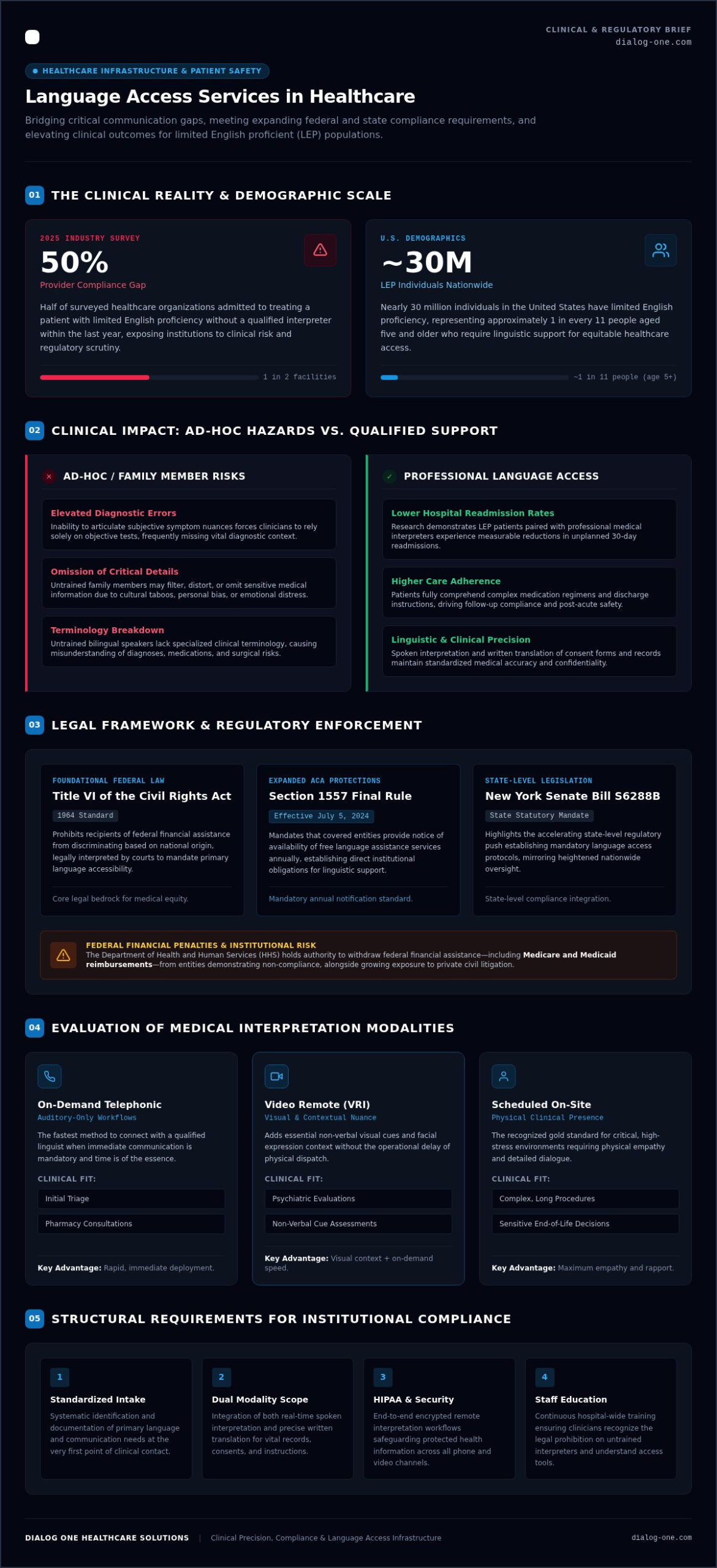
Did you know that 50% of healthcare organizations admitted to treating a patient with limited English proficiency without a qualified interpreter in the last year? According to a 2025 survey, this gap isn’t just a communication hurdle. It’s a profound clinical risk that threatens patient safety and institutional stability. Implementing robust language access services healthcare systems can trust is no longer a luxury. With the 2024 expansion of Section 1557 and new mandates like New York’s Senate Bill S6288B, the legal and ethical stakes have reached a critical point.
You’re likely balancing the need for immediate, accurate interpretation with the reality of tightening budgets and complex HIPAA requirements. It’s a heavy responsibility to ensure every patient receives the same standard of care, regardless of their primary language. This guide shows you how to bridge that gap effectively. We’ll explore how professional language access services ensure regulatory compliance, mitigate clinical risks, and elevate patient outcomes. You will learn how to navigate evolving federal mandates, improve clinical accuracy, and establish a secure, scalable remote interpretation workflow that protects your facility and your patients.
Key Takeaways
- Define the core components of comprehensive linguistic support and how they prevent miscommunication in high-stakes medical environments.
- Navigate the complex regulatory landscape of Section 1557 and HIPAA to ensure your language access services healthcare protocols remain fully compliant.
- Compare the clinical suitability and technical requirements of video remote, telephonic, and on-site interpretation modalities to optimize patient care.
- Identify the structural requirements for a successful hospital language access plan, including standardized intake protocols and rigorous staff training.
- Learn how a hybrid approach of secure technology and human oversight protects patient safety while streamlining complex operational workflows.
What Are Language Access Services in Healthcare?
Language access services healthcare systems rely on represent the specialized linguistic infrastructure designed to facilitate clear, accurate communication between clinicians and patients who speak different languages. These services aren’t merely amenities. They are fundamental components of patient safety and clinical precision. They encompass two primary functions: spoken interpretation for real-time dialogue and written document translation for vital medical records, consent forms, and discharge instructions. Without this architecture, the standard of care is compromised by default.
The demographic reality of the United States makes these services a logistical necessity. Current data indicates that nearly 30 million people have limited English proficiency (LEP), representing approximately 1 in 11 individuals aged five and older. For these patients, medical interpreting serves as the only bridge to equitable care. Relying on guesswork or ad-hoc solutions creates dangerous gaps in the care continuum, making professional language support a clinical imperative rather than an optional service.
The Core Modalities of Medical Interpretation
Effective language access requires a multi-modal approach to meet different clinical needs. On-demand phone interpretation provides a rapid solution for auditory-only workflows, such as initial triage or pharmacy consultations. It’s the fastest way to connect with a qualified linguist when time is of the essence. Video remote interpretation (VRI) adds a layer of visual context, which is essential for consultations involving non-verbal cues or psychiatric evaluations. For complex, long-duration medical procedures or sensitive end-of-life discussions, scheduled on-site interpretation remains the gold standard, providing a physical presence that can navigate high-stress environments with empathy and precision.
The Clinical Imperative for Linguistic Accuracy
Communication barriers correlate directly with increased diagnostic errors. When a patient can’t accurately describe the nuances of their symptoms, clinicians are often forced to rely solely on objective testing, which can miss critical subjective data. This lack of clarity is why using untrained bilingual family members is a significant risk. Relatives often lack specialized medical terminology and may omit sensitive information due to cultural taboos or emotional distress. By contrast, professional language access services healthcare providers implement lead to measurable clinical outcomes. Research shows that LEP patients with access to professional interpreters have significantly lower hospital readmission rates and higher adherence to follow-up care instructions because they truly understand their treatment plans.
The Legal and Regulatory Mandates Governing Medical Interpretation
Providing language access services healthcare systems can rely on isn’t just a matter of clinical preference. It’s a strict federal requirement. The legal framework governing medical communication is designed to eliminate barriers that lead to disparate health outcomes. For healthcare administrators, understanding these mandates is the first step toward mitigating institutional risk. Failure to comply doesn’t just result in poor patient satisfaction scores. It opens the door to civil rights investigations, loss of federal funding, and significant litigation.
Risk management officers must view language access as a core safety protocol. When a facility fails to provide meaningful access, they aren’t just missing a conversation. They’re violating federal law. The Department of Health and Human Services (HHS) maintains the authority to withdraw federal financial assistance, including Medicare and Medicaid reimbursements, from entities that display a pattern of non-compliance. This financial threat, combined with the rising trend of private civil litigation, makes a robust language plan an essential defensive asset.
Title VI and Section 1557 of the Affordable Care Act
Title VI of the Civil Rights Act of 1964 remains the bedrock of language access. It prohibits any recipient of federal financial assistance from discriminating based on national origin, which the courts have long interpreted to include primary language. Section 1557 of the ACA further strengthened these protections. The 2024 Final Rule, which took effect on July 5, 2024, mandates that covered entities provide a notice of availability of free language assistance services annually. This notice must be prominently displayed in physical locations and on digital platforms. Meaningful access isn’t a suggestion. It’s a requirement to ensure every individual can participate in their own care regardless of their English proficiency.
Maintaining Strict HIPAA Compliance in Remote Interpretation
Remote interpretation introduces specific data privacy challenges that require rigorous human and technological oversight. Every video and phone interpretation stream must be treated as a conduit for Protected Health Information (PHI). Generic video conferencing tools often lack the necessary end-to-end encryption to meet HIPAA standards. Healthcare providers must establish a formal Business Associate Agreement (BAA) with their language service provider to ensure legal accountability for data protection. Understanding how to ensure HIPAA compliance during remote interpretation requires a documented workflow that protects patient information before, during, and after each session. Dialog One acts as a steady partner in these high-stakes environments, offering secure, HIPAA-compliant interpretation workflows that protect both patient privacy and institutional standing. Encryption alone isn’t enough. You need a partner who understands the ethical weight of medical confidentiality.
Compliance Checklist for Healthcare Officers
- Annual Notice: Display the availability of free language assistance in the top 15 languages spoken in your state.
- Qualified Interpreters: Eliminate the use of family members or untrained bilingual staff for clinical discussions.
- Staff Training: Document that all patient-facing staff know how to access interpretation services within two minutes of a request.
- Digital Accessibility: Ensure telehealth platforms and patient portals are accessible to LEP individuals, as highlighted by the 2026 SPEAK Act guidance.
- Audit Trails: Maintain logs of all interpretation sessions, including the interpreter’s credentials and the duration of the call.
Evaluating Modalities: Video Remote, Phone, and On-Site Interpreting
Selecting the right modality for language access services healthcare requires a nuanced understanding of clinical context. One size doesn’t fit all in a hospital setting. Administrators must balance connection speed, visual context, and logistical complexity to ensure patient safety. A clear framework for selection prevents delays in care and optimizes the use of specialized linguistic resources across a large network. High-volume facilities often find that a hybrid strategy is the most resilient approach, ensuring that no patient is left without a voice during critical moments.
On-Demand Video Remote Interpreting vs. Over-the-Phone Support
Speed saves lives in triage. On-demand phone interpretation provides the fastest connection times, making it the preferred choice for emergency department intake and rapid auditory workflows. However, auditory support has limits. Visual context is critical for pediatric care, speech therapy, and psychiatric evaluations where non-verbal cues provide essential diagnostic data. Reliable video remote interpreting requires a robust technical infrastructure, including high-speed internet and HIPAA-compliant hardware, to maintain high-definition streams. When these technical standards are met, video provides a level of human connection that phone support cannot replicate.
When to Deploy Scheduled On-Site Medical Interpreters
Physical presence remains the gold standard for high-stakes, long-duration encounters. Scheduled on-site interpreters are essential for end-of-life care, complex surgical consents, and behavioral health sessions where the interpreter must navigate intense emotional dynamics. Sourcing experts for rare dialects or specialized medical fields requires advanced logistical planning. Even with the best scheduling, emergencies happen. In these cases, having on-demand video remote interpreting as a backup infrastructure is a strategic necessity. It ensures that if an on-site professional is delayed, clinical communication continues without interruption.
Operational efficiency depends on maximizing resource utilization. Large healthcare networks shouldn’t rely on a single modality. By integrating phone for speed, video for context, and on-site for complexity, organizations build a scalable and secure communication environment. This hybrid model protects the institution from the clinical risks of miscommunication while managing the costs associated with specialized linguistic support.
Key Components of an Effective Hospital Language Access Plan
An institutional language access plan isn’t a static document. It’s a dynamic operational framework. To move beyond mere compliance, administrators must design protocols that integrate language support into every stage of the patient journey. This starts with a thorough audit of the service area’s linguistic needs. As mandated by legislative shifts like New York’s Senate Bill S6288B, hospitals must translate vital documents for any group representing 1% of the population or 1,000 individuals. Effective language access services healthcare systems deploy rely on this data-driven foundation to ensure no patient group is overlooked.
Tracking these preferences within Electronic Health Record (EHR) systems is equally vital. The Joint Commission’s 2026 National Patient Safety Goals now require hospitals to stratify quality data by preferred language. This allows leadership to identify and address specific disparities in health outcomes. A plan that fails to link language data with clinical results remains incomplete. Ongoing quality assurance, including linguist performance monitoring and regular protocol audits, ensures the system remains resilient as patient demographics shift. Understanding how the language barrier in healthcare is evolving in 2026 can help administrators anticipate new compliance pressures and operational challenges before they arise.
Standardizing Patient Intake and Language Identification
The point of entry is the most vulnerable moment for an LEP patient. Staff must be equipped with language identification flashcards at every registration desk to remove the burden of communication from the patient. For facilities using digital check-in kiosks, the software should include automated interpreter cues that trigger an interpretation request the moment a non-English preference is selected. Meaningful access in emergency admissions requires that a qualified interpreter is connected before any clinical diagnostic decisions are finalized or informed consent is sought.
Vetting External Linguists for Clinical Competence
General bilingualism doesn’t qualify an individual for medical interpretation. Clinical accuracy requires a deep understanding of physiology, pharmacology, and medical ethics. Hospital plans must prioritize linguists who hold industry certifications, such as those from the Certification Commission for Healthcare Interpreters (CCHI) or the National Board of Certification for Medical Interpreters (NBCMI). These professionals are bound by strict ethical obligations regarding clinical neutrality and patient confidentiality. They don’t just translate words; they preserve the integrity of the medical record.
Establishing a scalable interpretation workflow requires a partner who understands these rigorous standards. Schedule a consultation with Dialog One to audit your current language access plan and ensure full alignment with 2026 safety standards.
Securing Patient Communication with Dialog One Healthcare Solutions
Dialog One serves as an authoritative expert for institutions requiring precise language access services healthcare systems can trust. We understand that in medical environments, a minor translation error can lead to a catastrophic clinical outcome. By combining 25 years of institutional expertise with a secure, human-centric workflow, we provide the steady guidance needed to navigate high-stakes communication. We act as an ethical guardian, ensuring that technological innovation never comes at the expense of human empathy or clinical safety. Our role is to be the reliable bridge-builder that removes barriers to understanding when they matter most.
24/7 Access to Certified Interpreters Across 200+ Languages
Emergency departments don’t operate on a schedule. Neither do we. Dialog One provides 24/7/365 availability for on-demand phone and video interpreters, ensuring that linguistic barriers never delay critical care. Our network covers over 200 languages and dialects, including rare and indigenous languages that are often difficult to source under pressure. Every interpreter undergoes a rigorous screening process to verify their mastery of medical terminology and professional ethics. This commitment to quality ensures that connection times remain rapid without sacrificing the precision required for informed consent and diagnostic clarity.
Rapid connection speeds are only half the battle. The quality of the interaction defines the patient outcome. Our linguists are trained to handle the emotional weight of clinical environments, providing a composed presence during stressful consultations. Whether you require scheduled on-site interpreters for complex procedures or immediate remote support, our network is prepared to handle the intensity of specialized medical fields with calm efficiency.
Blending Advanced Language Technology with Ethical Accountability
Reliability requires more than just a digital connection. Our platform architecture is built to protect sensitive patient data across all interpretation and translation modalities. We provide the secure tech workflows necessary for HIPAA compliance, ensuring that Protected Health Information remains confidential and encrypted. This integration of AI live transcription services and human oversight avoids the coldness of pure automation, keeping the clinician-patient relationship at the center of the care plan.
Operational efficiency is a secondary but vital benefit of our approach. Our system offers clear usage tracking and reporting tools. Administrators can monitor departmental utilization in real-time, which simplifies cost allocation and helps identify gaps in service coverage across large networks. This transparency allows leadership to make informed decisions about resource management while maintaining full regulatory compliance. Don’t leave your communication infrastructure to chance. Secure your facility’s future. Partner with Dialog One to establish a compliant, scalable language access program today.
Elevating Patient Outcomes Through Linguistic Precision
Ensuring meaningful communication is a non-negotiable standard in modern medicine. You’ve seen how professional language access services healthcare providers implement mitigate clinical risks while maintaining full compliance with Section 1557 and HIPAA. By strategically deploying phone, video, and on-site interpretation, your facility can eliminate the dangerous guesswork of ad-hoc communication. This commitment protects your institution’s legal standing and, more importantly, the safety of your patients.
Dialog One stands ready as your trusted advisor, bringing 25+ years of high-stakes interpretation experience to your clinical workflows. We provide on-demand access to professional linguists in 200+ languages, ensuring your team is never without a voice. Partner with Dialog One for HIPAA-compliant healthcare language access services today. Our secure technology and human expertise provide the steady foundation you need to handle complexity with calm efficiency. You can build a safer, more inclusive environment for every patient you serve.
Frequently Asked Questions
What are language access services in healthcare?
These services represent specialized linguistic support tools that bridge communication gaps between clinicians and patients with limited English proficiency. They include on-demand phone and video interpretation, scheduled on-site support, and certified document translation for vital records. By integrating these tools, providers ensure that language barriers don’t interfere with the delivery of safe, high-quality care. It’s an essential clinical infrastructure that facilitates accurate diagnosis and informed consent across diverse patient populations.
Is medical interpretation required by law for LEP patients?
Yes, federal law mandates the provision of language assistance for patients with limited English proficiency. Title VI of the Civil Rights Act and Section 1557 of the Affordable Care Act require healthcare entities receiving federal funding to provide meaningful access to services. Failure to comply can result in the loss of federal financial assistance and significant civil litigation risks. State laws often add specific local requirements for document translation and staff training.
How do healthcare providers ensure HIPAA compliance during remote interpreting?
Compliance is achieved by using secure, encrypted platforms and establishing formal Business Associate Agreements (BAAs) with language service providers. Every remote interpretation stream must protect Protected Health Information (PHI) through end-to-end encryption. Providers should avoid using generic consumer video tools that lack these security features. A professional partner like Dialog One ensures that all language access services healthcare systems utilize meet these rigorous data privacy standards, protecting both patient confidentiality and institutional standing. For a detailed breakdown of vendor assessment and repeatable staff procedures, review this practical guide on how to ensure HIPAA compliance during remote interpretation in 2026.
What is the difference between VRI and OPI in a medical setting?
The primary difference lies in the visual component and the speed of connection. Video Remote Interpreting (VRI) provides visual cues and non-verbal context, which is essential for pediatric care or psychiatric evaluations. Over-the-Phone Interpretation (OPI) is typically faster to connect and works well for auditory-only triage or pharmacy consultations. While VRI requires high-definition hardware and stable bandwidth, OPI offers a lower technical barrier for immediate, high-volume needs in fast-paced emergency environments.
Can bilingual hospital staff serve as medical interpreters?
Using bilingual staff is strongly discouraged unless they are specifically trained and certified as medical interpreters. General fluency in a second language doesn’t equate to mastery of complex medical terminology or professional ethics. Untrained staff may inadvertently omit critical clinical details or lack the neutrality required for sensitive medical discussions. Section 1557 of the ACA emphasizes the use of qualified interpreters to ensure patient safety and reduce the risk of diagnostic errors.
What qualifications should a professional medical interpreter possess?
A professional medical interpreter should hold national certification from bodies like the CCHI or NBCMI. These credentials verify that the linguist understands anatomy, physiology, and the ethical standards of clinical neutrality. They must demonstrate proficiency in both English and the target language, along with a deep understanding of healthcare-specific confidentiality protocols. Ongoing training is also necessary to keep pace with evolving terminology and new regulatory requirements for language access services healthcare providers must follow.
How does a language access plan improve clinical outcomes?
A structured plan reduces hospital readmission rates and minimizes diagnostic errors by ensuring patients fully understand their treatment instructions. When patients can accurately describe their symptoms and clinicians can clearly explain follow-up care, adherence to medical advice increases significantly. These plans also improve patient satisfaction scores among LEP individuals by fostering trust and reducing the anxiety associated with language barriers in healthcare settings. Ultimately, a well-executed plan leads to more equitable health outcomes across the entire community.