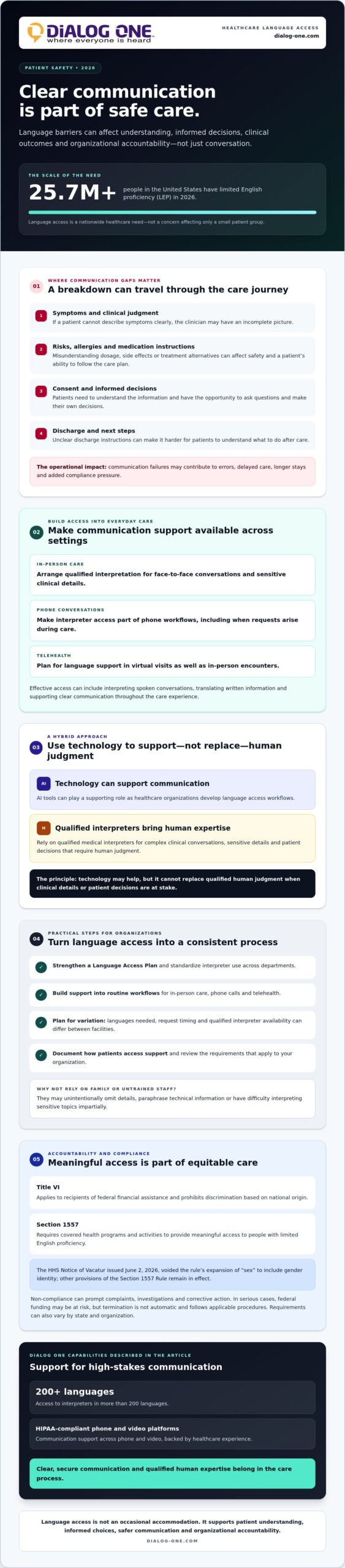
A language barrier in healthcare is more than a communication gap. In 2026, it is a patient safety and operational risk that healthcare organizations need to measure and manage. When patients and care teams cannot communicate clearly, the consequences can include errors, delayed care, longer stays, and added compliance pressure.
Healthcare leaders know interpreter access matters. The challenge is making that access reliable across in-person visits, phone calls, and telehealth while protecting patient information and preserving accuracy in sensitive conversations. Technology can help, but it cannot replace qualified human judgment when clinical details or patient decisions are at stake.
This article explores how evolving language access trends are shaping patient safety, clinical outcomes, and organizational accountability in 2026. It examines the impact of the language barrier in healthcare, recent policy developments, including the SPEAK Act and updated Joint Commission goals, and the shift toward hybrid models that pair AI tools with human expertise. You’ll also find practical considerations for building scalable access to qualified medical interpreters and clear, secure communication for patients with limited English proficiency.
Key Takeaways
- Understand how the language barrier in healthcare affects more than conversation, including patient safety, informed decisions, and organizational accountability.
- Identify communication gaps across in-person care and telehealth, then build language access into everyday workflows.
- Use AI tools to support communication while relying on qualified medical interpreters for complex clinical conversations that require human judgment.
- Strengthen a Language Access Plan and standardize interpreter use across departments.
- Learn how Dialog One’s healthcare experience, HIPAA-compliant phone and video platforms, and access to interpreters in 200+ languages can support high-stakes communication.
The Current State of the Language Barrier in Healthcare (2026)
The language barrier in healthcare is not simply a matter of translating words. It can affect whether a patient understands a diagnosis, gives informed consent, follows discharge instructions, or describes symptoms accurately. A language barrier can limit access and understanding in everyday interactions. In clinical settings, those gaps can influence safety and a person’s ability to take part in decisions about their care.
That is why language access is increasingly treated as part of healthcare quality and equity, not as an occasional accommodation. Effective access may include interpreting spoken conversations, translating written information, and making communication support available in person and through telehealth. The goal is not just to convey words. It is to support clear, meaningful communication throughout the care experience.
Evolving Demographics and Linguistic Diversity
Limited English proficiency (LEP) generally describes a person whose primary language is not English and whose ability to speak, read, write, or understand English is limited. In 2026, more than 25.7 million people in the United States have LEP, making language access a nationwide healthcare need rather than a concern affecting only a small patient group.
Facilities may encounter languages that are less common in their usual patient mix, alongside widely spoken languages. Large urban systems and rural providers alike can face challenges because the languages needed, timing of requests, and availability of qualified interpreters vary from one facility to another. Plan for that variation instead of relying on assumptions about a community’s linguistic needs.
The Legal Mandate: Title VI and Section 1557
Federal civil rights protections establish a baseline for equitable communication. Title VI applies to recipients of federal financial assistance and prohibits discrimination based on national origin. Section 1557 of the Affordable Care Act also requires covered health programs and activities to provide meaningful access to people with LEP. The HHS Notice of Vacatur issued June 2, 2026, voided the rule’s expansion of “sex” to include gender identity; other provisions of the Section 1557 Rule remain in effect.
Non-compliance can prompt complaints, investigations, and corrective action. In serious cases, federal funding may be at risk, though termination is not automatic and follows applicable procedures. Requirements can also vary by state and organization, so healthcare leaders should review their obligations and document how patients can access qualified communication support. For a broader overview, see our healthcare language access services guide.
Quantifying the Clinical and Financial Impact of Miscommunication
Communication failures can affect clinical judgment and a patient’s ability to participate in care. If a patient cannot describe symptoms clearly, a clinician may have an incomplete picture. If treatment risks or medication instructions are not understood, the patient may be unable to make an informed choice or follow the care plan. These are practical ways the language barrier in healthcare can affect safety and resource use.
Patient Safety and Adverse Events
Language differences can make it harder to confirm allergies, explain a dosage change, or establish whether a patient understands discharge instructions. A systematic review of research on language barriers and healthcare outcomes discusses associations with communication-related safety risks and physical harm. Circumstances vary, but the central concern is consistent: gaps in understanding can affect decisions at multiple stages of care.
Professional medical interpreters support accurate, two-way communication. During medication counseling, for example, an interpreter can convey the clinician’s instructions and help the patient communicate questions or concerns. This is especially important when discussing dosage, side effects, or treatment alternatives. Clear interpretation also supports informed consent by giving patients the opportunity to understand information and make their own decisions.
Family members or untrained staff may be willing to help, but they might unintentionally omit details, paraphrase technical information, or have difficulty interpreting sensitive topics impartially. A consistent process for requesting professional interpretation helps care teams avoid relying on informal support for consequential clinical conversations.
The Hidden Costs of Unmanaged Language Barriers
When clinicians cannot obtain a clear history or patients do not understand the next step, care may require repeated explanations, additional follow-up, or tests to clarify uncertain information. Language barriers are also associated with longer hospital stays and higher readmission rates. These outcomes can increase resource use, although their scale and causes differ across organizations and patient populations.
To assess the operational value of interpretation, compare service use with relevant measures such as communication-related incidents, repeat testing, length of stay, and readmissions. Review results over time and account for differences in patient needs. This gives administrators a more useful picture than evaluating interpreter expenses alone. Clear communication can support accountability and reduce avoidable misunderstandings, but it cannot guarantee lower costs or eliminate legal and malpractice risk.
On-demand video remote interpreting can connect patients and care teams with an interpreter when in-person support is not available at the point of care. Evaluate its role by examining access, utilization, privacy safeguards, and patient communication outcomes. Healthcare teams considering this approach can learn about on-demand phone and video interpreting.
2026 Trends: The Hybrid Future of Medical Interpretation
Healthcare language access is moving toward a hybrid model: digital tools can help teams work efficiently, while qualified interpreters remain central to complex, sensitive conversations. The language barrier in healthcare cannot be addressed by speed alone. Clinical communication calls for accuracy, context, and human judgment.
AI Speed vs. Human Accuracy: Finding the Balance
AI translation and transcription can support routine communication, surface terminology, and help capture spoken information. But clinical language depends on context. A phrase about symptoms, treatment risks, or a diagnosis may carry meaning that automated systems cannot reliably interpret. For discussions involving consent, complex diagnoses, or changes in care, a human interpreter can clarify meaning, recognize when a point needs repeating, and support a more responsive exchange.
A practical approach is human-in-the-loop: use technology to assist, not replace, qualified medical interpretation where nuance matters. AI live transcription and captioning can also support documentation workflows, but teams should review output for accuracy before relying on it in the medical record. Healthcare organizations are exploring links between language tools and electronic health records (EHRs), including access to translated materials and preferred-language information. Any workflow should protect privacy and make clear who is responsible for reviewing and acting on generated content.
The Shift to On-Demand Remote Solutions
Scheduled on-site interpreters remain useful for planned appointments and situations where in-person support is appropriate. Remote options add flexibility when care needs arise outside a scheduled visit or when an interpreter for a particular language is not on site. On-demand phone and video interpreting can connect staff and patients without requiring the interpreter’s physical presence. Dialog One provides 24/7 on-demand access to interpreters in 200+ languages through phone and video platforms.
Video adds a visual channel: participants can observe facial expressions, gestures, and other cues that may help communication while speaking directly with an interpreter. It can be practical in acute-care workflows, where teams need to assess the situation and arrange language support. The KFF survey on language barriers and patient experiences offers broader context for why accessible communication matters across care settings.
When assessing a remote interpreting workflow, consider language coverage, privacy safeguards, staff training, and how the interpreter joins a visit. Dialog One’s on-demand video remote interpreting guide explains how this option can fit into healthcare communication. The aim is a balanced system: responsive technology, qualified human expertise, and clear accountability at every step.
Best Practices for Overcoming the Language Barrier
A reliable response to the language barrier in healthcare depends on systems, not individual improvisation. A Language Access Plan (LAP) should explain how staff identify communication needs, request qualified interpreters, provide translated materials, and check whether patients can understand and participate in care. Assign an accountable lead and revisit the plan as patient needs and clinical workflows change.
Build a Scalable Language Access Plan
Use a practical framework to turn policy into consistent access:
- Assess language needs. Review preferred-language information in patient records and examine requests across departments, care settings, and hours of operation. Protect patient privacy and use the findings to guide staffing and service planning.
- Secure dependable coverage. Plan for communication needs beyond scheduled appointments, including urgent care situations. Confirm that interpreter access covers the languages patients need and the hours your organization operates. Dialog One provides 24/7 on-demand phone and video interpreting in 200+ languages.
- Integrate access into care. Make interpreter-request steps visible in clinical workflows and train staff to use them. Include outpatient, inpatient, emergency, and telehealth settings so patients do not have to rely on family members or find support themselves.
Standardize when and how professional interpreters are used across departments. Define who initiates a request, how staff confirm the patient’s preferred language, and how communication support is documented. Review interpreter utilization, patient feedback, and communication-related incidents to identify gaps and improve the plan.
Train Staff With Cultural Humility
Language access works best when paired with cultural humility. Clinicians should ask rather than assume, respect each patient’s preferences, and remain open to different ways of expressing concerns. Make training practical: speak directly to the patient, use short sentences, pause for interpretation, avoid unexplained jargon, and allow time for questions. Maintain eye contact with the patient rather than directing the conversation toward the interpreter.
Staff should also know how to position a video interpreter, manage turn-taking, and confirm understanding without treating a patient’s silence as agreement. These habits support clear, respectful communication and keep the patient at the center of the encounter. For guidance on matching the right format to each clinical situation, see this practical guide to LEP patient interpreter options for healthcare communication.
HIPAA-compliant remote interpretation is necessary to help protect the privacy of sensitive patient information during phone and video communication. Include technology review in the LAP, and confirm that platforms and workflows meet your organization’s privacy and security requirements. For a step-by-step approach to protecting patient information during remote sessions, see this guide on how to ensure HIPAA compliance during remote interpretation.
To strengthen your language access workflow, explore Dialog One’s on-demand phone and video interpreting for healthcare communication.
Partnering for Accountability: The Dialog One Approach
Reducing the language barrier in healthcare takes more than choosing a technology. It requires dependable access, qualified human expertise, and clear processes that help staff communicate with patients throughout the care journey. Dialog One brings more than 25 years of experience in high-stakes healthcare environments, supporting spoken communication through on-demand phone and video interpreting and written communication through certified document translation and large document project translation.
Reliable Support for Clinical Communication
Medical conversations cannot always wait for a scheduled appointment. Dialog One provides 24/7 on-demand access to interpreters in 200+ languages, including certified medical interpreters with specialized training. Its HIPAA-compliant phone and video platforms support privacy-conscious communication. For acute or sensitive discussions, interpreters help patients and clinicians understand one another, while clinical decisions remain with the care team.
Accountability depends on choosing qualified language professionals and establishing consistent procedures for using them. Healthcare organizations should define when staff request an interpreter, how they record the patient’s preferred language, and how they document interpreted conversations. These steps make access more consistent and help leaders review whether communication support reaches patients when needed.
Fit Language Access Into Existing Workflows
A workable solution should fit the way care teams communicate, not create a separate process that staff struggle to follow. Before adopting a service, administrators can review how interpreters will be accessed from clinical workflows, what privacy safeguards apply, and how staff will receive training. Confirm compatibility with existing systems directly with the provider because integration capabilities can vary.
For cost control, compare providers’ billing structures and assess them alongside utilization, language coverage, access needs, and operational requirements. Do not assume a per-minute or per-word fee model without confirming current terms. This helps organizations evaluate the full service arrangement without treating price alone as a measure of value.
Human-centered technology matters because every patient interaction carries context. Phone and video tools can extend access, while trained interpreters bring language expertise and human attention to conversations where clarity is essential. AI transcription and captioning may also support communication workflows, but organizations should determine where human review is needed for accuracy. Understanding how to ensure HIPAA compliance in remote interpretation workflows — including vendor agreements, session controls, and documentation practices — helps organizations build a defensible privacy posture alongside their language access program.
To explore professional healthcare interpretation for your organization, partner with Dialog One for healthcare interpretation.
Make Clear Communication Part of Every Care Decision
In 2026, addressing the language barrier in healthcare means treating communication as an ongoing responsibility, not a one-time accommodation. Strong language access plans help teams respond consistently, while qualified interpreters support accurate, patient-centered conversations. Technology can extend access and assist documentation, but human expertise remains essential when clinical nuance, empathy, and informed decisions matter.
Putting these practices into action can strengthen patient safety, support meaningful access, and help organizations manage communication-related risk. Dialog One brings more than 25 years of professional interpretation experience to high-stakes healthcare settings, with HIPAA-compliant platforms and 24/7 on-demand access to interpreters in 200+ languages.
Explore HIPAA-compliant medical interpretation from Dialog One to support clear communication across the patient journey.
Frequently Asked Questions
What are the most common consequences of language barriers in healthcare?
Language barriers can contribute to misunderstandings, delayed or missed care, medication errors, and difficulty giving informed consent. Patients may not be able to explain symptoms fully or understand follow-up instructions, while clinicians may need more time to clarify details. A review of 336 patient safety events in Pennsylvania found missed or delayed care in 55.8% of events involving language barriers. The effects can extend to patient trust, care continuity, and organizational risk.
Is it legal to use a family member as a medical interpreter?
Using a family member is not automatically illegal in every situation, but it should not be the default for important clinical conversations. Federal and state requirements can differ, and covered healthcare organizations may need to provide meaningful language access through qualified interpreters. Family members may unintentionally omit, change, or misunderstand clinical details, and patients may be uncomfortable discussing sensitive issues with them present. Follow your organization’s policy and applicable requirements, and arrange a qualified interpreter when needed.
How does HIPAA compliance work with remote video interpreting?
Remote video interpreting involves sharing spoken health information through a digital platform, so privacy and security need to be considered alongside language access. Healthcare organizations should assess the platform and its safeguards, define staff procedures for private conversations, and confirm how the vendor handles protected health information under applicable arrangements. HIPAA compliance depends on the parties’ responsibilities and practices, not simply on using video. Dialog One offers HIPAA-compliant phone and video platforms for interpreting.
What is the difference between medical translation and medical interpretation?
Medical interpretation conveys spoken communication between people who use different languages, such as a clinician explaining a treatment option during an appointment. Medical translation converts written materials, such as patient instructions or medical documents, into another language. Use an interpreter for a live conversation and translation for written content. Both require attention to clinical terminology and context, but they involve different skills and workflows.
How can hospitals reduce the costs associated with language barriers?
Hospitals can manage avoidable costs by making professional interpretation easy to access across departments and care settings. Clear communication may help reduce preventable delays, repeated explanations, and misunderstandings about medications or follow-up care. Track interpreter use alongside measures such as communication-related incidents, length of stay, and readmissions, then review patterns by department and language. Evaluate service options against actual patient needs and usage rather than relying on assumptions or cost alone.
What languages are most in demand for healthcare interpreting in 2026?
Demand varies by patient population, location, and care setting, so there is no universal list of the most requested languages. Hospitals can review preferred-language information, interpreter requests, and patient access needs to guide coverage decisions. They should also plan for less commonly requested languages rather than assuming demand will remain constant. Dialog One provides on-demand phone and video interpreting in more than 200 languages, supporting a broad range of linguistic needs.
How long does it take to access an on-demand interpreter?
Connection time can vary based on the requested language, service channel, and current availability, so organizations should confirm expected access times with their provider. On-demand access means staff can request an interpreter when a need arises rather than relying only on a pre-scheduled appointment. Dialog One offers 24/7 on-demand phone and video interpreting in more than 200 languages. Ask providers how requests are handled and what staff should do if a connection is delayed.
Are bilingual doctors a substitute for professional interpreter services?
Not necessarily. Speaking another language does not by itself establish that a clinician has the interpreting skills or specialized language proficiency needed for complex medical conversations. A bilingual clinician may communicate directly with a patient when qualified to do so, but the organization should have clear criteria for determining appropriate language support. Professional medical interpreters can help clinicians and patients discuss symptoms, treatment options, medication instructions, and consent with greater clarity. For a closer look at how to arrange and structure this support across different encounter types, see this guide on choosing the right LEP patient interpreter format for clinical conversations.