What if a customer’s quick “yes” signals politeness, not understanding? In an important conversation, a nod or brief answer may not confirm that someone understood the information or feels comfortable asking questions. Building trust with limited English proficient customers starts by recognizing this risk and making clear communication part of the customer experience, not an improvised response.
Staff may want to help in the moment, but gestures, family members, or unreviewed machine translation can leave room for confusion. This matters when customers need to understand key details and make their own choices. Respectful language support helps customers participate and gives staff a reliable way to communicate.
This guide shares practical steps for reducing communication barriers, protecting customer choice, and building trust through consistent language access. Learn how to prepare staff, choose appropriate support for live conversations and written information, and check for understanding without putting customers on the spot.
Key Takeaways
- Build trust by respecting language preferences and making comprehension, privacy, and informed choice part of each interaction.
- Use a consistent sequence: offer language support, confirm the customer’s preference, arrange appropriate help, speak directly, and check for questions.
- Match support to the task: use interpretation for live conversations, translated materials for written information, and human review of AI-assisted content when accuracy matters.
- Make language access repeatable by assigning ownership, mapping important customer touchpoints, training staff, and documenting how to request support.
- Building trust with limited English proficient customers takes consistent communication. Dialog One offers on-demand phone and video interpretation, as well as scheduled on-site and remote options for planned conversations.
Why Building Trust With Limited English Proficient Customers Starts With Language Access
In customer service, limited English proficiency (LEP) describes a situation where a person has difficulty communicating effectively in English and may prefer to use another language. It doesn’t measure intelligence, expertise, or overall ability. A customer may be confident and knowledgeable while still needing language support to understand specific information or explain a concern. For a foundational overview, see Limited English proficiency (LEP).
Effective language access enables customers to understand, communicate, ask questions, and make informed choices in their preferred language. It can include live interpretation for a conversation and translated written materials for information customers need to review. A multilingual greeting or translated website may help someone get started, but neither ensures they can follow a complex discussion, protect their privacy, or resolve a problem. Trust grows when people can participate fully, not simply receive a welcome.
What customers need before trust can develop
Some customers may hesitate to request language help because they don’t want to delay the interaction, draw attention to themselves, or appear difficult. Others may not know support is available. Offer it respectfully and without assumptions. Ask which language they prefer for the conversation, explain how support will work, and allow time for questions. Don’t infer a person’s preference from their name, appearance, accent, or previous interactions. Preferences can vary by situation, and customers should remain in control of how they communicate.
Clarity requires more than repeating information. Break explanations into manageable parts, use plain language, and invite questions with neutral prompts such as, “What would you like me to explain further?” This gives customers room to identify uncertainty without having to prove they understood. Privacy matters, too. A customer may not want to discuss personal information through a family member or another person accompanying them.
Where language barriers affect the customer journey
Language needs can arise at every stage, not only during a formal appointment. During discovery, a customer may need help understanding service options. At intake, they may need to provide details or complete forms. When choosing a service, they should be able to compare options and ask about next steps. Consent requires clear explanations before a customer agrees. Problem resolution calls for two-way conversation, and follow-up messages need to be understandable enough to guide what happens next.
Consider a customer trying to explain a billing concern or understand an appointment change. A translated webpage may provide useful background, but it can’t interpret the customer’s questions in a live conversation. In healthcare, communication can involve symptoms, care decisions, and follow-up instructions, so the right support depends on the interaction. See healthcare language access services for healthcare-specific applications. Across settings, building trust with limited English proficient customers means treating language access as part of service from first contact through resolution.
How to Communicate Respectfully With Customers Who Prefer Another Language
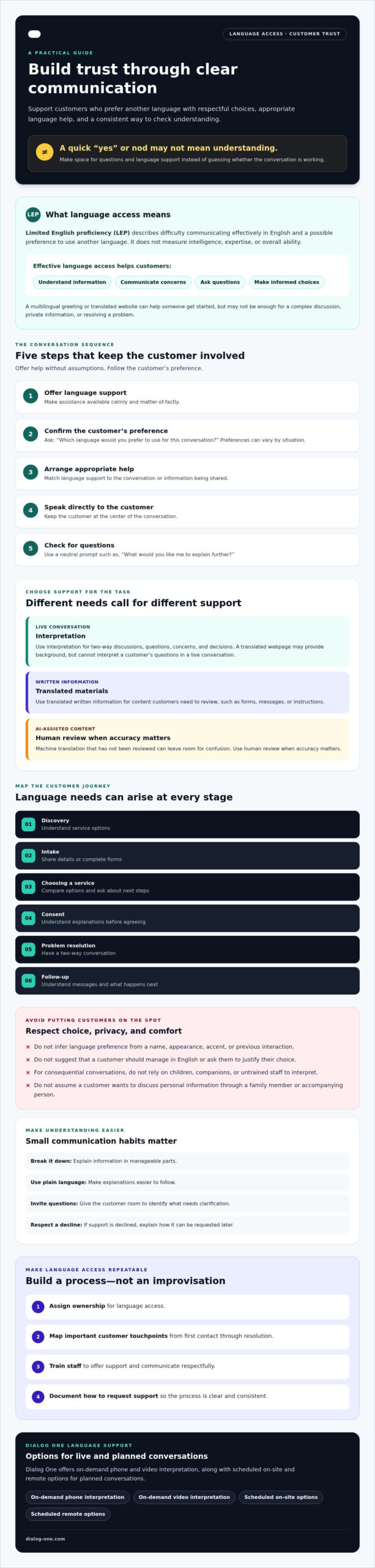
Respectful communication follows a repeatable sequence. Offer support, confirm the customer’s preference, arrange appropriate help, speak directly to the customer, and check whether they have questions. This keeps the customer involved instead of leaving staff to guess whether the conversation is working.
How to offer language assistance without making assumptions
Ask, “Which language would you prefer to use for this conversation?” Confirm the answer, then explain the available options calmly and matter-of-factly. Don’t suggest that the customer should manage in English or ask them to justify their choice. If they decline assistance, respect that decision and explain how they can request support later. Preferences can change between interactions.
For consequential conversations, don’t rely on children, companions, or untrained staff to interpret. A companion may not be comfortable sharing sensitive information, and an untrained person may not convey specialized details accurately. Offer an appropriate language-support option while allowing the customer to decide how they wish to proceed.
How to work effectively with a professional interpreter
Before the conversation, briefly explain its purpose, identify who is participating, and share relevant terminology or sensitive context when appropriate. This preparation helps the interpreter follow the discussion. During the conversation, address the customer directly and speak in the first person, as you normally would. Speaking directly to the customer, even when an interpreter participates, keeps the conversation centered on their questions, choices, and perspective.
Use short sentences and plain language. Share one idea at a time, then pause so the interpreter can convey the full message before you continue. Avoid jargon, idioms, and long strings of instructions. If the topic is complex, divide it into manageable parts and invite the customer to ask questions directly. Don’t treat a nod or brief “yes” as proof of understanding.
Check in with a neutral question, such as, “What questions do you have about the next step?” or “Which part would you like me to explain again?” These prompts invite clarification without turning the exchange into a test. The same care applies to remote conversations: make sure participants know how to take turns and that the customer can hear and respond comfortably.
Organizations assessing remote support can consider on-demand video remote interpreting as one way to connect customers and staff through a live interpreted conversation. For information about Dialog One’s interpretation options, visit Dialog One’s language services. Consistent, respectful steps help staff put building trust with limited English proficient customers into practice, one conversation at a time.
Choosing Interpretation, Translation, or Other Language Support for the Situation
Choose language support based on what the customer needs to do. A live conversation calls for a way to communicate in both directions; written materials need accurate, readable translation. Technology can assist, but the stakes, complexity, privacy needs, and customer’s preference should guide the decision. This distinction is central to building trust with limited English proficient customers.
| Support option | Best suited to | Key consideration |
|---|---|---|
| Live interpretation | Two-way conversations, especially when information is complex, sensitive, or time-critical. | Choose a suitably qualified interpreter and a format that fits the discussion. |
| Translated written materials | Forms, instructions, notices, and other recurring information customers need to read. | Translation supports written understanding, but it doesn’t interpret questions and answers in a live conversation. |
| AI-assisted tools with human review | Supporting tasks such as drafting or transcription, where the tool and use case are appropriate. | Human review helps check accuracy, tone, specialized terms, and accountability. |
When phone, video, or scheduled interpretation may fit
Phone interpretation can suit a conversation where spoken communication is enough and a remote connection fits the customer’s circumstances. Video adds a visual channel, which may help participants follow turn-taking or use visual cues. Scheduled on-site or remote interpretation can suit planned meetings that need preparation, context, or a longer discussion. Consider privacy, location, access to a suitable device, complexity, and whether visual information matters. No single format fits every interaction.
A multilingual employee may be able to help with some routine exchanges, but speaking another language doesn’t automatically establish the skill, impartiality, or subject knowledge needed to interpret consequential information. Machine translation can also miss context, nuance, or specialized terminology. Assess the task rather than assuming any one person or tool is suitable for every customer conversation.
When translation or AI-supported tools are appropriate
Use translated materials to make recurring written information available in languages customers can understand. Have the content reviewed for accuracy and clarity, especially when it concerns specialized terms or important decisions. If a customer needs to discuss that information, arrange live interpretation as well. A translated document can support the conversation, but it can’t replace two-way communication.
AI can assist with language-related tasks, including transcription and captioning, but it shouldn’t replace human judgment in consequential conversations. Review AI-assisted content when accuracy, tone, or accountability matters. Requirements in healthcare, education, legal services, and other regulated settings vary by context. Verify current obligations with appropriate official sources and qualified counsel before making compliance claims.
How to Put a Consistent Language-Access Process Into Practice
A reliable process turns good intentions into a service standard staff can follow. Start by identifying the languages customers prefer and the points where communication carries the greatest consequence. Map the journey from first inquiry through intake, key decisions, problem resolution, and follow-up. Then assign ownership, choose support options, train staff, and review how the process works. This makes building trust with limited English proficient customers less dependent on individual judgment in the moment.
Build a usable language-access workflow
Give a designated person or team responsibility for language-access decisions, coordination with providers, and escalation when support isn’t available or doesn’t fit the need. Document how staff should ask about language preference, request an interpreter, and arrange support for urgent conversations and planned appointments. Set out the steps without making unverified response-time promises. Keep instructions easy to find at service counters, in appointment workflows, and wherever customer questions are handled.
Prepare short, plain-language scripts staff can adapt, such as a neutral offer of language assistance and an explanation of how an interpreter will participate. Identify recurring documents that may need translation, then establish who reviews translated content for accuracy, terminology, and clarity before use. Make the distinction clear: translated materials support written communication, while live interpretation enables a two-way conversation.
Train staff and review customer experience
Train staff to offer help without assumptions, communicate directly with customers when an interpreter is present, and protect privacy. Include practical scenarios: a customer asks for help during intake, needs to discuss a sensitive issue, or has questions about an appointment. Staff should know whom to contact and what to do if the usual support option doesn’t meet the customer’s needs.
Review the process regularly using information that can reveal friction without setting arbitrary performance targets. Depending on what your organization can track appropriately, examine:
- Whether language support was available at the customer touchpoints you mapped.
- Wait times and instances when a customer couldn’t connect with the intended support.
- Unresolved communication issues, repeated contacts, or incomplete service interactions.
- Customer feedback and complaints, gathered through channels customers can access.
Ask only for information needed to understand the service experience. Don’t require customers to disclose unnecessary personal details to provide feedback. Look for patterns, identify where the workflow broke down, and update staff guidance or materials. Regular review helps an organization address process gaps rather than placing the burden on customers to work around them.
Organizations evaluating professional interpretation support can review Dialog One’s phone, video, and scheduled interpretation options while developing a process that fits their customer interactions.
How Dialog One Can Support Trust-Building Language Access
Consistent language access depends on matching support to the communication task. Dialog One offers on-demand phone and video interpretation in more than 200 languages, along with scheduled on-site and remote interpreters. These options can support different situations, from a verbal question that needs attention during an interaction to a meeting that benefits from preparation and a defined format. Building trust with limited English proficient customers requires support that helps people communicate, not a one-size-fits-all solution.
Match Dialog One services to customer communication needs
For a live conversation, on-demand phone or video interpretation can connect staff and customers through an interpreter. The right format depends on the interaction, including whether visual cues are useful and what works for the customer’s privacy and setting. For a planned, context-rich discussion, scheduled on-site or remote interpretation may better suit the meeting. Consider the subject, participants, and preparation needed when deciding which option to explore.
Written information calls for a different approach. Dialog One provides certified translation for personal documents and translation for large document projects. These services can support customers who need to read important written content in another language. They don’t replace live interpretation when a customer needs to ask questions or discuss information with staff.
Dialog One’s language services combine AI technology with human expertise. Technology can support language-related work, but consequential communication still calls for human judgment and clear accountability. When evaluating support, ask how human oversight is applied, how accuracy is addressed, and how concerns can be raised. These questions help clarify whether a service fits the sensitivity and terminology of the intended use.
Make the next step clear and accountable
Before discussing service options, outline the languages customers need, the types of interactions involved, when support is required, and any privacy considerations. Then ask prospective providers about interpreter qualifications, escalation paths, and human oversight. Clear answers help your organization assess how support could fit its workflow without relying on assumptions about availability or outcomes.
Organizations considering professional language support can discuss professional interpretation and translation services with Dialog One to explore which options may fit their customer interactions.
Make Consistent Language Access Part of Every Customer Interaction
Trust grows when customers can understand information, ask questions, and make choices in their preferred language. Offer support without assumptions, match interpretation or translation to the task, and give staff a clear process to follow. These practices make building trust with limited English proficient customers a consistent service commitment, not an improvised accommodation.
Dialog One provides on-demand phone and video interpretation in more than 200 languages, as well as scheduled on-site and remote interpreter services. The company also has more than 25 years of experience and operates 24/7.
Explore Dialog One’s language services and discuss your organization’s language-access needs to identify which interpretation or translation options may fit your customer interactions.
Frequently Asked Questions
Is limited English proficiency the same as low literacy?
No. Limited English proficiency describes a person’s ability to communicate effectively in English in a particular interaction. It doesn’t indicate intelligence, education, or literacy in another language. A customer may read and write confidently in their preferred language while needing help discussing a service in English. Ask which language they prefer for the conversation rather than inferring ability from appearance, accent, or background. Then provide appropriate support so they can understand options and participate meaningfully.
Can a family member interpret for a customer?
A family member may help in an informal situation if the customer chooses, but shouldn’t automatically replace a qualified interpreter in a consequential conversation. A relative may unintentionally summarize, omit details, or influence what gets shared. The customer may also feel uncomfortable discussing sensitive information in front of family. Follow organizational policies and applicable requirements, offer professional interpretation where appropriate, and consider the customer’s informed preferences before proceeding.
How can businesses build trust with customers who prefer another language?
Building trust with limited English proficient customers starts by asking which language they prefer and explaining available support without pressure. Use an appropriate interpreter when the conversation calls for one, speak directly to the customer, and communicate in plain language. Allow time for questions, protect privacy, and check for remaining concerns without turning understanding into a test. Follow through consistently, then use customer feedback to find and address communication barriers.
What happens if a customer declines an interpreter?
Respect the customer’s decision and don’t pressure them. Make sure they know what communication options are available, offer accessible written information when suitable, and explain how to request support later. For a high-impact interaction, follow your organization’s procedures and check applicable requirements before proceeding. Document the interaction according to policy, while recording only information that’s necessary and appropriate. A customer’s decision in one conversation shouldn’t be treated as a permanent language preference.
Is machine translation enough for customer service?
Machine translation may help with straightforward, low-risk information when the tool is suitable and its limitations are understood. It shouldn’t automatically replace a qualified interpreter in a complex or sensitive conversation, or reviewed translation for consequential written content. Errors in meaning, tone, or specialized terminology can affect understanding. Establish a review process, and involve human expertise when accuracy and accountability matter. For live discussions, translated text alone doesn’t provide two-way interpretation.
How should an organization know whether its language-access approach is working?
Review customer feedback, complaints, unresolved communication issues, interpretation availability, and staff observations. Look for recurring points where customers need repeated explanations or can’t complete a process. Offer feedback channels customers can use in their preferred language where practical, and collect only necessary information. Set internal measures that reflect your service needs and review them regularly. A single metric can highlight a pattern, but it can’t prove that every customer understood or felt respected.