The fastest medical conversation translator may not be the right choice for every clinical exchange. A translation app can help with a simple, low-risk interaction, but questions about symptoms, treatment, or consent call for careful communication and human judgment. When care decisions depend on details, choosing the right language support matters.
Speed and convenience are valuable, especially when a patient needs help communicating in the moment. But technology has limits, and a misunderstanding can affect a patient’s understanding of their care. Match the approach to the conversation’s complexity, urgency, and potential impact.
This article compares translation apps, professional interpreters, and combined approaches. You’ll learn when an app may be useful, when to bring in a live interpreter, and how on-demand phone or video interpretation can support immediate conversations. Scheduled remote or on-site interpretation can fit planned appointments. The goal is clear, respectful communication, with technology supporting rather than replacing human expertise when the conversation matters most.
Key Takeaways
- A medical conversation translator may use speech-translation technology or live human interpretation. The distinction matters when clinical nuance is important.
- Assess how a tool handles medical terms, accents, interruptions, and ambiguous speech before relying on it in a patient conversation.
- As part of a privacy and safety review, find out what patient information a translation app processes, retains, shares, or displays.
- Use a four-step framework: define the conversation, assess its complexity, select appropriate support, and confirm understanding.
- Dialog One’s on-demand phone and video interpreting supports conversations that need live language assistance. Scheduled remote and on-site interpreters can support planned appointments.
What Is a Medical Conversation Translator, and What Can It Do?
A medical conversation translator is a broad term for technology or professional language support that helps patients and healthcare staff communicate across languages. It might mean an app that converts spoken words, a library of prepared phrases, or a live interpreter who relays a conversation between a patient and clinician. These options serve different needs. An app may help with a short, predictable exchange, while a live interpreter can support a discussion that calls for nuance or clarification.
“Translation” and “interpretation” also describe different tasks. Translation usually refers to written content; interpretation conveys spoken communication. The broader field of Medical translation illustrates why healthcare language requires attention to specialized terminology and meaning. Neither technology nor an interpreter makes clinical decisions. Language support helps people communicate, while the clinician remains responsible for care and the patient for their choices.
How does a medical translation app handle spoken dialogue?
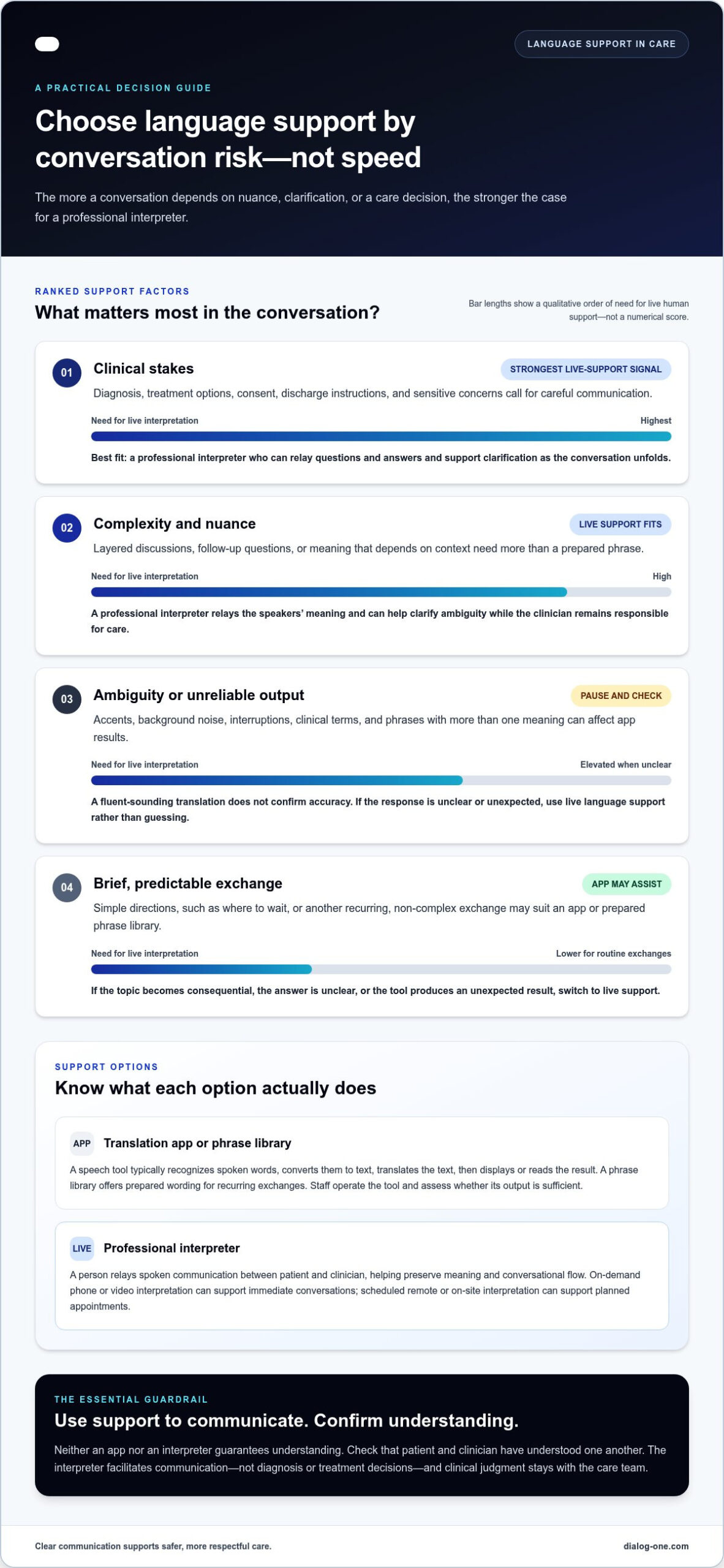
A speech translation app typically recognizes spoken words, converts them into text, translates that text, then displays or reads the result in another language. Some tools also offer phrase libraries: prepared wording for recurring, predictable exchanges, such as asking where a patient feels discomfort. These features are not interchangeable. A phrase library offers set options; real-time dialogue tools attempt to process new speech as it happens.
Results can depend on clear audio, accents, clinical terminology, and context. Background noise, interruptions, or a phrase with more than one possible meaning can affect what the tool recognizes or outputs. A fluent-sounding result does not prove that the original message was captured accurately.
What does a professional medical interpreter contribute?
A professional interpreter relays spoken messages between patient and clinician, helping preserve meaning and conversational flow. Instead of selecting a prepared phrase or relying on automated output, the interpreter listens to each speaker and conveys the message in the other language. When wording is ambiguous, the interpreter can support clarification so participants can address what was meant.
The interpreter’s role is to facilitate communication, not diagnose, recommend treatment, or speak for either participant. Impartiality, confidentiality, and accuracy are central expectations of the role. In complex discussions, an interpreter can help patients and clinicians ask follow-up questions and communicate concerns while clinical judgment stays with the care team.
Medical Translator App vs. Professional Interpreter: Which Fits the Conversation?
Choose language support based on what the conversation requires, not simply on what is quickest to open. An app may assist with routine exchanges, while a professional interpreter can relay a complex discussion and help participants clarify meaning. Neither option guarantees understanding. Staff should still check that the patient and clinician have understood one another.
| Consideration | Translation app | Professional interpreter |
|---|---|---|
| Nuance | May miss context, tone, or ambiguous wording. | Relays the speakers’ meaning and can help clarify ambiguity. |
| Conversation complexity | May suit brief, predictable exchanges. | Can support layered discussions and follow-up questions. |
| Immediacy | Can be opened for a quick exchange, subject to the tool and setting. | On-demand phone or video interpretation can provide live language support. |
| Workflow | Requires staff to operate the tool and assess its output. | Can be scheduled for planned appointments or accessed remotely when needed. |
| Human involvement | Automated output, with staff responsible for deciding whether it is sufficient. | A person relays communication between patient and clinician. |
When might an app-based translator be useful in care?
For simple directions, such as showing a patient where to wait, or another recurring, non-complex exchange, an app or prepared phrase library may provide practical assistance. Prepared wording can help staff ask common questions consistently. But if the patient’s response is unclear, the tool produces an unexpected result, or the topic shifts toward a consequential decision, pause and use live language support rather than guessing.
When should a healthcare team use a professional interpreter?
Diagnosis, treatment options, consent, discharge instructions, and sensitive concerns call for careful communication. A professional interpreter can relay questions and answers in real time, allowing the patient and clinician to request clarification as the conversation unfolds. This does not replace clinical judgment or remove the need to confirm understanding. HHS guidance addresses language assistance for people with limited English proficiency and the legal obligation to communicate accurately in applicable settings.
Digital tools and interpreters can work as complementary supports, but they are not equivalent. A team might use an app for a routine exchange, then bring in a live interpreter when the discussion becomes more complex. For conversations that need human language support, on-demand phone and video interpretation can be part of the care workflow.
How to Assess Accuracy, Privacy, and Safety in a Medical Conversation Translator
Evaluate a medical conversation translator in the conditions where it will actually be used. A clear, short sentence in a quiet room is a different test from rapid speech, unfamiliar accents, interruptions, or specialized clinical terms. An output that sounds fluent can still omit a detail or change its meaning. Teams need a plan for recognizing uncertainty and bringing in human support.
Before relying on a tool, test it with realistic, non-patient examples. Include clinical vocabulary, varied speaking patterns, background noise, and interrupted dialogue. Check whether it preserves questions, negation, and key details, such as the difference between “has taken” and “has not taken” a medication. If meaning is incomplete or inconsistent, stop and change the communication approach.
What privacy questions should healthcare organizations consider?
Map what information the tool handles at each step. Does it capture audio, create a transcript, display translated text, or retain conversation data? Identify who can access those records, whether information is shared with other parties, and how organizational policies govern use, storage, and deletion.
Privacy and regulatory compliance depend on the specific tool and how the organization implements it. Do not assume a consumer app is appropriate for patient information, or describe a tool as HIPAA-compliant without substantiation and current verification. Involve the organization’s privacy or compliance team to assess applicable requirements before use.
How can teams recognize when translation needs human oversight?
Give staff a clear pause-and-escalate process. Incomplete or confusing output, unfamiliar terminology, emotional distress, and decisions about diagnosis, treatment, or consent are signals to use live interpretation. Guidance such as Appropriate Use of Medical Interpreters can help frame why accuracy, confidentiality, and the communication method deserve careful consideration.
- Check for ambiguity: Ask for clarification rather than filling in a missing or uncertain meaning.
- Protect dignity: Address the patient directly, allow time to respond, and avoid treating a screen or translated output as the speaker.
- Confirm understanding: Use teach-back by asking the patient to explain key instructions in their own words, then clarify any gaps.
Teach-back is a useful communication check, not proof that every phrase was translated perfectly. Keep a route to live human interpretation available when uncertainty remains. This approach pairs technology’s potential convenience with human judgment and supports a respectful exchange without making software responsible for clinical decisions.
How to Choose a Medical Conversation Translator for Different Care Scenarios
Choose language support by matching the conversation’s purpose and stakes to the patient’s needs and the care setting. A brief exchange at check-in differs from discussing treatment choices or preparing for a complex appointment. This four-step framework helps teams select a suitable medical conversation translator without treating apps and professional interpretation as interchangeable.
- Define the conversation. Identify what needs to be communicated and whether the exchange is routine, time-sensitive, planned, or sensitive.
- Assess complexity. Consider clinical terminology, emotional context, follow-up questions, and the consequences of misunderstanding.
- Select support. Choose a digital tool for suitable routine exchanges or live interpretation when the conversation needs human language support. Factor in patient preference, accessibility, urgency, and the setting.
- Confirm understanding. Invite questions, clarify uncertainty, and check that key information has been understood.
Which language-support option fits routine, urgent, and planned conversations?
Use the matrix as a starting point, then adapt to the patient’s communication needs and clinical context. A higher-stakes discussion warrants more support, even if it begins as a routine exchange.
| Care scenario | Possible support | Workflow consideration |
|---|---|---|
| Simple, predictable exchange | A suitable app or prepared phrase workflow may assist. | Switch approaches if the patient’s response is unclear or the topic changes. |
| Immediate conversation needing live support | On-demand phone or video interpretation connects the conversation with a live interpreter. | Useful when staff need human language support without planning the appointment in advance. |
| Planned, high-context appointment | Scheduled remote or on-site interpretation can support advance coordination. | Consider the discussion’s complexity, setting, accessibility needs, and patient preference. |
Modality should fit the workflow, not dictate it. For example, a planned appointment about several care options may benefit from advance interpreter coordination, while an unexpected conversation requiring language support may call for on-demand interpretation. No format alone guarantees understanding. Clinicians still need to invite questions and check comprehension.
How should a care team prepare before using a translator?
Preparation supports a more respectful, focused exchange. Ask the patient which language they prefer for healthcare communication and whether they have accessibility or communication needs. For an interpreter, share relevant context to support the conversation while limiting unnecessary patient information. For a digital workflow, follow organizational privacy procedures and ensure staff know how to pause or change methods if communication breaks down.
During the conversation, speak directly to the patient, use clear language, and pause for interpreted turns. Avoid side conversations or long, compound statements. Afterward, confirm key points in a supportive way and clarify any remaining uncertainty.
For more on integrating interpretation into care conversations, see Dialog One’s interpreting services.
How Dialog One Supports Medical Conversations with Professional Interpreters
Once a care team identifies that a conversation needs live human language support, the next decision is how to fit interpretation into the workflow. Dialog One provides on-demand phone and video interpretation for conversations that arise without advance planning, as well as scheduled remote and on-site interpreters for planned appointments. The right format depends on the timing, setting, and needs of the conversation, rather than one approach being suitable for every situation.
Dialog One serves healthcare and other high-stakes sectors, combining human expertise with AI technology and bringing more than 25 years of language-services experience. This approach can complement digital workflows while keeping a human interpreter involved when spoken communication requires care and clarification.
When does on-demand medical interpretation fit a care workflow?
On-demand phone and video interpretation is available 24/7 in over 200 languages. It gives care teams a way to connect with a live interpreter when an immediate conversation needs language support, such as an unplanned exchange during a care visit. Phone interpretation may suit a conversation where audio is sufficient; video offers a visual connection when that better fits the interaction or setting.
Live interpretation allows the patient and clinician to ask follow-up questions as the discussion unfolds. It can support clearer communication, but it does not guarantee understanding or determine which format is best for every encounter. Staff should still speak plainly, allow time for interpreted turns, and check for questions or uncertainty.
When is scheduled remote or on-site interpretation appropriate?
Scheduled interpretation can help teams plan for appointments with complex topics, several participants, or specific communication needs. A remote interpreter may fit a workflow where participants can connect by phone or video. An on-site interpreter may be appropriate when the appointment’s setting or interaction benefits from in-person support. Advance coordination helps the team prepare the conversation and incorporate interpretation into the appointment plan.
For a closer look at one remote option, read this guide to on-demand video remote interpreting. Whether interpretation is on-demand or scheduled, keep the patient at the center of the exchange and confirm important information directly with them.
Choose a medical conversation translator approach according to the conversation’s urgency, complexity, and setting. To explore professional support for immediate or planned healthcare conversations, review Dialog One’s interpretation options.
Choose Language Support That Fits the Conversation
The right medical conversation translator depends on the exchange’s complexity, urgency, and potential impact on care. Translation apps may assist with brief, predictable interactions, but conversations about diagnosis, treatment, consent, or sensitive concerns often need live human interpretation. Assess accuracy and privacy, then pause and change approach if meaning remains unclear.
Dialog One provides 24/7 on-demand phone and video interpreting in over 200 languages for conversations that need live language support. For appointments requiring advance planning, scheduled remote and on-site interpreters offer additional workflow options. Dialog One combines human expertise with AI technology and has more than 25 years of language-services experience.
Explore Dialog One’s medical interpretation services for language support with immediate or planned care conversations. Thoughtful choices help patients and care teams communicate with greater clarity and confidence.
Frequently Asked Questions
Can a medical translation app replace a professional interpreter?
Usually, an app should not be treated as a universal replacement for a professional interpreter. It may help with brief, predictable exchanges, such as simple directions, but automated tools can miss context, clinical terms, or ambiguous wording. For conversations about diagnosis, treatment options, consent, or sensitive concerns, live interpretation supports follow-up questions and clarification. Choose based on the conversation’s complexity and stakes, and change approaches if meaning remains unclear.
When should a healthcare provider use a medical conversation translator?
Use language support whenever a patient and care team cannot communicate clearly in a shared language. A medical conversation translator may refer to an app or a professional interpreter, so match the method to the task. A prepared phrase or app may assist with a routine exchange, while a discussion involving care decisions or detailed instructions may call for live interpretation. Consider urgency, patient preference, accessibility, and the setting.
Are medical translation apps accurate enough for healthcare conversations?
Accuracy depends on the tool and the conditions of the conversation, so do not assume an app is accurate for every clinical exchange. Audio quality, accents, interruptions, terminology, and context can affect recognition and translation. A tool might handle a clear, short phrase differently from rapid dialogue about symptoms. Staff should watch for incomplete or inconsistent output, pause when uncertain, and use live interpretation when the conversation’s meaning or stakes require more support.
Is it safe to use a translation app with patient information?
It depends on the app’s data practices and how your organization has approved its use. Before entering patient information, determine whether audio or transcripts are collected, retained, displayed, or shared, and who can access them. Follow organizational privacy procedures and have the appropriate privacy or compliance staff assess applicable requirements. Do not assume a consumer app is suitable for patient information or describe a tool as compliant without current substantiation.
How does phone interpretation differ from video medical interpretation?
Both formats connect a care team and patient with a live interpreter. Phone interpretation is audio-based, which may suit conversations where spoken communication is sufficient. Video adds a visual connection, which may better fit some interactions or care settings. The appropriate format depends on patient preference, accessibility needs, the environment, and the conversation. Neither modality guarantees understanding, so clinicians should speak clearly, allow time for interpreted turns, and check for questions.
Can a professional medical interpreter join a conversation on demand?
Yes. Dialog One offers on-demand phone and video interpreting 24/7 in over 200 languages. This supports immediate conversations when a care team needs live language assistance without arranging the appointment in advance. Phone or video may fit different workflow and communication needs. On-demand access does not mean every situation requires the same format; teams should consider the conversation’s complexity, the patient’s needs, and the care setting.
What should a healthcare team consider when choosing a medical translator?
Start by defining the conversation, then assess its complexity and potential consequences before selecting an app or professional interpretation. Consider the patient’s preferred language, accessibility needs, urgency, setting, and opportunity to ask follow-up questions. For a digital tool, review how it handles clinical terms and patient data under organizational policies. For planned or consequential discussions, consider scheduled remote or on-site interpretation, and confirm understanding throughout the exchange.