What can a misunderstood symptom or discharge instruction cost beyond the visit? The cost of medical misinterpretation may include delayed care, avoidable complications, or repeated explanations. Healthcare organizations may also absorb extra work and operational strain. Because communication-related harm is often grouped with broader medical errors, its financial impact can be difficult to isolate.
Healthcare leaders know that language access requires resources, especially when budgets are tight. They also need to understand what those resources may help prevent. Not every adverse outcome involving a patient with limited English proficiency results from an interpretation failure, and broad medical-error estimates should not be treated as the price of misinterpretation. Careful definitions matter.
This article outlines direct and indirect cost pathways, explains why evidence can be difficult to compare, and offers practical safeguards for safer clinical conversations. It also describes how organizations can assess language-access efforts through patient-safety and operational outcomes, including clearer consent and discharge communication and fewer preventable delays. Professional interpretation, arranged for a planned appointment or accessed remotely when a need arises, can help bridge communication gaps and support informed decisions.
Key Takeaways
- Distinguish a communication breakdown from inaccurate interpretation and from a clinical error before assessing harm or cost.
- Trace how unclear communication at different points in care may lead to delays, repeat work, or avoidable use of services.
- Assess the cost of medical misinterpretation across patients, healthcare organizations, and payers, while separating financial impacts from non-financial harm.
- Use a practical review process to identify language needs, provide appropriate support, document access, and monitor missed connections and other outcomes.
- Match professional interpretation to the encounter, using on-demand phone or video support for immediate needs and scheduled remote or on-site interpreting for planned appointments.
What Does Medical Misinterpretation Cost? Define the Harm Before Counting It
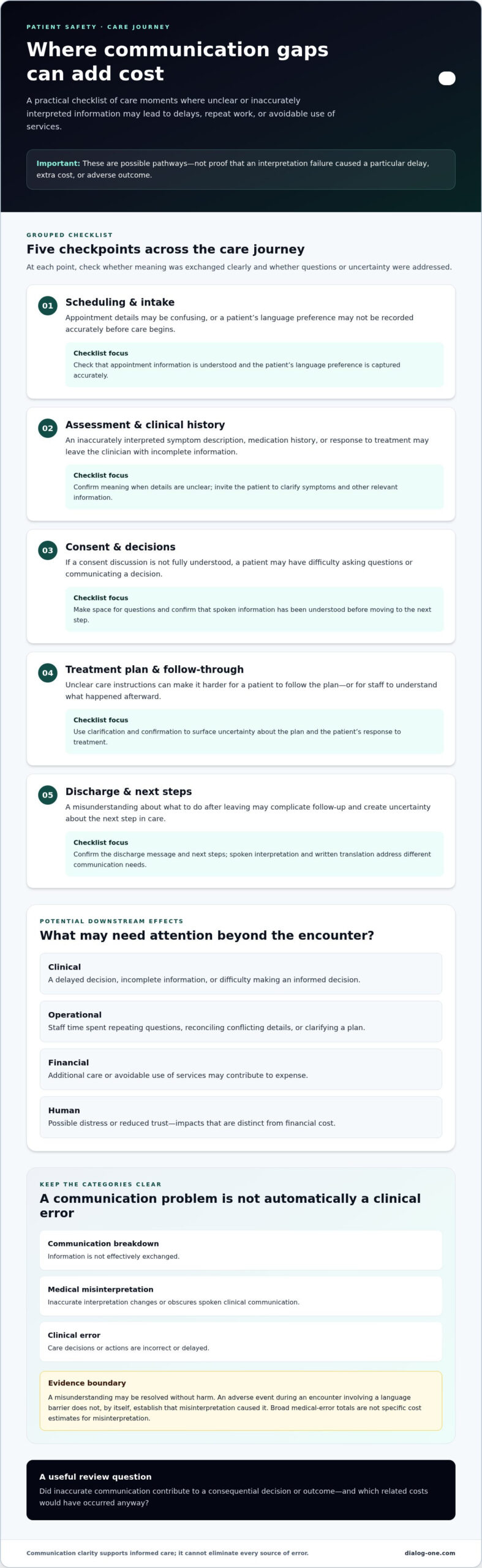
A communication breakdown, a misinterpretation, and a clinical error are related, but they are not the same event. A breakdown happens when information is not effectively exchanged. Medical misinterpretation is inaccurate interpretation that changes or obscures spoken clinical communication. A clinical error occurs when care decisions or actions are incorrect or delayed. A misunderstanding may be resolved without harm. The key question is whether inaccurate communication contributed to a consequential decision or outcome.
The Medical Error overview provides context for the broader category, but it does not quantify costs specific to misinterpretation. Potential impacts may be financial, such as additional care; clinical, such as a delayed decision; operational, such as staff time spent repeating or clarifying information; or human, including distress or reduced trust. These are possible pathways, not proof that every language misunderstanding causes harm.
When does a language misunderstanding become a safety risk?
Risk can arise when a patient’s symptoms, medication history, or response to treatment is interpreted inaccurately, or when instructions and consent discussions are not understood. That information may affect assessment, treatment choices, or the patient’s ability to make an informed decision. Interpretation supports spoken exchanges between people. Translation addresses written materials, such as consent forms or discharge instructions. Both can matter, but one does not replace the other.
Illustrative example: A patient describes a symptom using a phrase that is interpreted as less severe than intended. A clinician may then make a decision based on an incomplete history. This example describes a possible pathway, not a documented case or a claim that harm will result. Confirming meaning and inviting clarification can help reveal uncertainty before it affects the next step in care.
Why is there no single cost figure for medical misinterpretation?
Research may define communication barriers, interpretation errors, adverse events, and harm differently. Findings can also vary by setting, patient population, and accounting method. Some analyses record additional treatment or claims, while others examine clinical outcomes or staff workload. Without consistent definitions and accounting, a figure from one study cannot automatically represent costs across other settings or the nation.
Association is not the same as causation. If an adverse event occurs during an encounter involving a language barrier, that alone does not establish that misinterpretation caused it. Other clinical or system factors may contribute. To estimate the cost of medical misinterpretation responsibly, an analysis needs to identify the communication failure, assess its role in the outcome, and separate related expenses from costs that would have occurred anyway.
Broad medical-error totals are not misinterpretation-specific estimates. They can describe the wider burden of patient harm, but they do not isolate the portion attributable to inaccurate interpretation. Treating them as a precise national price would go beyond what the evidence establishes.
How Medical Misinterpretation Can Create Costs Across the Care Journey
Communication risk can arise before a patient meets a clinician and continue after they leave. A missed detail at one stage may complicate the next, although misinterpretation is only one possible contributor to delays, extra work, or an adverse outcome. Other clinical and operational factors may also be involved. Mapping the care journey helps organizations identify where clarification or language support may be needed.
Where can communication failures affect clinical decisions?
At scheduling and intake, difficulty understanding appointment details or recording a patient’s language preference accurately can create confusion before care begins. During assessment, an inaccurately interpreted symptom history or medication discussion may leave the clinician with incomplete information. If a consent discussion is not fully understood, a patient may have difficulty asking questions or communicating a decision.
Communication needs continue after a treatment plan is made. Unclear care instructions can make it harder for a patient to follow the plan or for staff to understand what happened afterward. At discharge, a misunderstanding about next steps may complicate follow-up. These are plausible pathways, not proof that interpretation failure alone caused a particular decision or outcome.
Communication accuracy supports informed clinical decisions, but it cannot eliminate every source of error. A practical safeguard is to make time for questions and confirmation at important transitions, rather than assuming information was understood simply because it was delivered.
Which downstream effects matter beyond the immediate encounter?
If key information is missed, a care team may need to repeat questions, reconcile conflicting details, or spend more time clarifying a plan. Depending on the clinical situation, uncertainty could contribute to another visit, further testing, delayed treatment decisions, or a longer period of care. These effects may also arise for unrelated reasons, so organizations should not attribute every added service or delay to language communication.
The language access services in healthcare overview provides broader context for considering communication support as part of patient care. A useful review follows information across handoffs: what the patient reported, what the care team understood, what instructions were given, and whether follow-up could be completed. This can help distinguish a documented communication gap from a cost or outcome that was merely associated with the same encounter.
Not all consequences appear on a claim. Patients and families may feel stressed when they are unsure what a diagnosis or instruction means. Repeated misunderstandings can weaken trust, while staff may take on extra work as they revisit conversations or coordinate next steps. These human and workforce effects are harder to quantify, but they matter when assessing the broader cost of medical misinterpretation.
Organizations can reduce avoidable friction by matching language support to the encounter: on-demand phone or video interpretation for immediate needs, or scheduled remote and on-site interpretation for planned appointments. Professional phone and video interpretation can support clearer exchanges, while clinical judgment and follow-up remain essential.
Who Bears the Cost? Separate Patient, Provider, and Payer Impacts
The cost of medical misinterpretation may be spread across several parties. A patient can experience the consequences of a care decision, while a provider delivers additional services and a payer processes the resulting claim. These impacts overlap, but they are not interchangeable. A cost recorded by one organization may reflect a burden experienced by someone else.
| Who may be affected | Potential cost types | Examples to consider |
|---|---|---|
| Patients and families | Direct, indirect, and non-financial | Possible out-of-pocket exposure, time spent arranging care, emotional strain, or reduced trust |
| Healthcare organizations | Direct, indirect, and non-financial | Additional care delivery, staff time spent clarifying information, administrative work, and workforce strain |
| Payers | Direct and indirect | Claims for covered additional care and administrative work related to processing or reviewing claims |
What costs may patients and families experience?
For patients and families, the burden may include time away from work, arranging transportation or follow-up, and repeating information across care settings. Depending on the care received and coverage arrangements, additional services may also create financial exposure. The consequences vary and should not be assumed to be the same for every patient. Patient-reported experiences can add context that claims data may miss, including confusion, difficulty coordinating care, or uncertainty about instructions.
How can costs be distributed across providers and payers?
Providers may record resources used to deliver further care, as well as staff and administrative time. Payers may record eligible claims and related processing costs. Liability expenses may also arise in some circumstances, but should not be presumed in every case. How costs appear in an analysis depends on its accounting boundaries. The same event may generate a provider expense and a payer claim, while patient time or distress may not appear in either record.
Published figures illustrate broader medical-error accounting, not the price of interpretation failures. The Commonwealth Fund has summarized older, broad estimates of annual medical-error costs from 2007-2008, ranging from $17 billion to $29 billion. Those historical figures are not current estimates or language-specific totals. Broader harm estimates should be treated as context, not as a measure of misinterpretation-related costs.
When prevention costs sit with one organization but potential downstream costs fall elsewhere, accounting can obscure its organizational value. A sound assessment tracks who pays, who uses additional resources, and whose experience is missing from the financial record. It also separates documented interpretation-related costs from broader harm estimates and avoids counting the same expense twice.
How Healthcare Organizations Can Measure and Reduce Misinterpretation Risk
Reducing risk starts with a reliable process, not a single tool or metric. Teams can identify where communication support is needed, make it available, record whether it was used, and review what happened. The goal is to strengthen access and learn from gaps, not to assume that every adverse outcome involving a language barrier resulted from interpretation failure.
- Identify communication needs. Ask about and record the patient’s preferred language and communication needs during scheduling or intake. Make this information visible to relevant care teams so it can inform planning throughout the encounter.
- Provide appropriate support. Match interpretation to the situation, urgency, and complexity of the conversation. Establish a clear process for arranging support when an unplanned need arises.
- Document access. Record whether interpretation was requested, provided, delayed, or unavailable. Note relevant connection problems or changes in the plan. Documentation should support continuity and review, not replace clinical judgment.
- Review outcomes. Examine access measures alongside patient-safety, experience, and utilization indicators. Look for patterns, investigate plausible communication pathways, and consider other factors before attributing a change to interpretation.
What indicators can help reveal communication gaps?
Track interpreter access and delays across encounter types and language needs, along with how often language preferences are documented and how frequently connections are missed. Add patient feedback, follow-up questions, and incident-report narratives to put the numbers in context. Protect privacy, limit access to sensitive information, and interpret small or incomplete datasets cautiously. A few cases can raise a question to investigate, but may not establish a reliable trend.
Pair these process measures with indicators such as safety events, patient-reported understanding, follow-up completion, repeat visits, or additional testing. Define each measure consistently and compare similar encounters where possible. Changes in utilization or reported harm may have several explanations. Review the details before concluding that language support caused or prevented a change.
How can teams match interpretation support to the encounter?
Immediate remote access may suit an unplanned conversation when a patient needs to communicate promptly. Planned appointments or more complex discussions may benefit from scheduled remote or on-site support that fits the encounter. The appropriate format depends on the clinical context, patient needs, and workflow. No single option is right for every interaction, and interpretation supports communication without guaranteeing a particular clinical result.
Review the process with the people who use it, including clinical and administrative staff. Ask where requests stall, whether documentation follows the patient through handoffs, and how teams respond when a connection fails. These practical details can reveal improvement opportunities that outcome data alone may not show. They can also help organizations assess the cost of medical misinterpretation carefully, rather than relying on broad assumptions.
For urgent remote encounters, on-demand video remote interpreting can be one part of a broader communication-safety approach. Explore interpretation support for healthcare encounters and consider how phone, video, scheduled remote, or on-site interpreting can fit your workflow.
How Professional Medical Interpretation Supports Clearer Communication
Professional medical interpretation is one part of a broader patient-safety and language-access strategy. It supports communication between patients and care teams, while clinical decisions remain the responsibility of patients and qualified healthcare professionals. An interpreter conveys meaning between speakers so each can ask questions, share relevant details, and take part in the conversation. The goal is a clearer, more complete exchange, not a promise that every error or poor outcome can be prevented.
What does professional interpretation add to a clinical conversation?
In a clinical encounter, an interpreter helps bridge spoken-language differences without replacing the clinician’s expertise or the patient’s judgment. Accurate communication can help a care team hear a patient’s concerns and explain options, while giving the patient a meaningful opportunity to respond. That exchange matters in routine discussions and higher-stakes conversations about symptoms, treatment choices, or next steps.
Interpretation does not replace written language access. Patients may also need medical forms, consent information, or care instructions translated into a language they understand. Nor does interpretation replace clinical skill, careful documentation, or a process for confirming that key information has been understood. It is a communication safeguard within a wider system of accessible care.
When might on-demand or scheduled interpretation fit?
The right format depends on the encounter. On-demand phone or video interpretation can support immediate communication needs, including situations that arise without a planned appointment. Scheduled remote or on-site interpretation can be arranged for planned conversations where timing, context, or the nature of the discussion makes preparation valuable. Since one format will not suit every clinical interaction, organizations can consider urgency, patient needs, and workflow when selecting support.
Dialog One provides 24/7 on-demand phone and video interpretation in more than 200 languages, as well as scheduled remote and on-site interpreters. Its language services combine AI technology with human expertise. In high-stakes conversations, human judgment and accountability remain important. Technology can support communication, but it should not be presented as a guarantee of clinical accuracy or outcome.
Interpretation and transcription also serve different purposes. Interpretation conveys meaning between people speaking different languages; transcription creates a written record of speech. AI live transcription may support documentation or accessibility workflows, but it does not perform the same communication role as an interpreter. Learn more about AI live transcription services when evaluating that separate function.
For healthcare organizations assessing the cost of medical misinterpretation, professional interpretation offers a practical way to strengthen communication access while measuring outcomes carefully. It can support clearer exchanges, but it should be integrated with staff processes, accessible written materials, and ongoing review. Connect with Dialog One about interpretation services to explore phone, video, scheduled remote, and on-site options for your care settings.
Make Clear Communication Part of the Next Safety Review
Choose one practical next step: review a recent care transition and ask whether each person had the information needed to understand and act. Check where communication needs were identified, support was arranged, and any gap was addressed. A focused review can help teams improve their process without assuming every complication has one cause or treating a broad estimate as the cost of medical misinterpretation.
Build on what the review reveals. Set a clear expectation for how staff request language support, record its use, and raise concerns when communication remains unclear. Revisit the process using patient and staff feedback so safeguards respond to real encounters rather than assumptions. Progress depends on consistent attention and accountable follow-through.
Dialog One brings more than 25 years of experience to language services that combine AI technology with human expertise. Explore interpretation options that can support clearer communication in healthcare settings and take the next step toward more accessible encounters.
Explore Dialog One’s interpretation services. A stronger communication process starts with one deliberate improvement.
Frequently Asked Questions
Is there a reliable national estimate for the cost of medical misinterpretation?
No reliable national estimate isolates the cost of medical misinterpretation. A useful estimate would need consistent records showing when interpretation was inaccurate, whether it contributed to harm, and which resulting expenses were attributable to that event. Without comparable data across care settings, a national total could combine unlike measures or assign costs to interpretation without sufficient evidence. Treat broad medical-error totals as context, not as a misinterpretation-specific figure.
Can medical misinterpretation lead to a medical error?
Yes, inaccurate interpretation can contribute to a medical error if it changes information used to guide care. For instance, a clinician might receive an incomplete account of a medication reaction, or a patient might misunderstand a treatment instruction. That possibility does not prove interpretation caused a specific error. A careful review should examine what was communicated, what decision followed, and whether other clinical or workflow factors also played a role.
How much can a medical misunderstanding cost a hospital?
There is no dependable standard amount per hospital or encounter. The financial effect depends on what care was needed, how the event was documented, and which costs the hospital includes in its accounting. An internal review can trace additional resources associated with a specific incident, such as extra staff time or services, then assess whether communication contributed. Do not treat the full cost of an encounter as the cost of a misunderstanding.
What happens if a patient misunderstands medical instructions?
The patient may have difficulty following the care plan, taking medication as directed, or knowing when and how to seek follow-up. The next step is to clarify the instructions with the care team rather than guess. Staff can use plain language, invite questions, and ask the patient to explain the plan in their own words. This can reveal confusion early, but it does not establish that a language barrier caused the misunderstanding.
Does using a professional medical interpreter eliminate communication errors?
No. Professional interpretation can support accurate communication, but it cannot eliminate every error. Clinical jargon, interruptions, unclear source information, or a patient’s changing condition can still affect understanding. Care teams should speak directly to the patient, pause for interpretation, clarify unfamiliar terms, and confirm key details. Interpreting supports the exchange; it does not replace clinical judgment, accessible written information, or a careful process for checking understanding.
How can a healthcare organization evaluate the value of interpretation services?
Evaluate both whether support reaches patients and whether communication processes improve. Review interpreter access, delays, documented language preferences, missed connections, patient feedback, and relevant safety or utilization indicators. Compare similar encounters over time and investigate changes rather than assuming interpretation caused them. Include staff workload and patient experience in the review, since claims alone may not capture those effects. Use findings to refine workflows, not to promise a specific financial return.