A remote interpreter can improve access to a court hearing, but only when the court permits the format and it suits the case. If you’re seeking a remote interpreter for court hearings, confirm approval before booking to help prevent last-minute disruptions.
Court rules and procedures vary, and a qualified interpreter must fit the language and legal context, not simply be available by video. Clear audio, reliable scheduling, and a tested connection matter too.
This guide explains how to verify court requirements, compare remote formats, and assess an interpreter’s qualifications and language fit. You’ll also learn how to coordinate participants, timing, and technology so everyone knows how to join and communicate. Dialog One provides scheduled remote interpreters for high-context settings, including courtrooms, as well as on-demand phone and video interpreting in more than 200 languages. Confirm the specific interpreter’s qualifications and availability for your request, and follow the court’s current procedures.
Key Takeaways
- Check whether the court permits remote interpretation and what approval steps apply before making arrangements.
- Choose a remote interpreter for court hearings based on language and dialect fit, relevant legal-setting experience, impartiality, and ability to interpret remotely.
- Agree on turn-taking so speakers can pause and the interpreter can convey each statement accurately.
- Use a hearing checklist to confirm the date, start time, time zone, language, dialect, duration, platform, and connection test.
- For a known hearing date and specialized context, consider scheduled remote interpretation and share the court’s instructions when requesting support.
When does a court hearing need a remote interpreter?
A remote interpreter for court hearings interprets spoken communication through a phone or video connection the court permits. Language support may be needed when someone cannot sufficiently understand or communicate in the language used during the proceeding. This may include a defendant, witness, parent, or another participant. Needs vary from person to person, so they should be assessed respectfully rather than assumed from someone’s accent or background.
The court decides whether an independently arranged interpreter is acceptable and whether interpretation may be remote for a particular hearing. Before making arrangements, ask what approval steps, interpreter qualifications, and connection format the court requires. A provider can coordinate language services, but cannot approve an interpreter on the court’s behalf.
Who may need an interpreter during a hearing?
Consider whether a participant can follow questions, instructions, and discussion well enough to take part meaningfully, and whether they can express their responses in the hearing language. Focus on communication needs, not perceived fluency. If you’re unsure, raise the question with the appropriate court contact instead of making assumptions.
Spoken-language interpretation is distinct from accessibility accommodations, including sign-language interpreting. A person who is Deaf or hard of hearing may need an accommodation suited to their communication preferences and the court’s process. Confirm the specific need and arrangements with the court. Don’t assume one form of language support addresses every access requirement.
What does remote court interpreting involve?
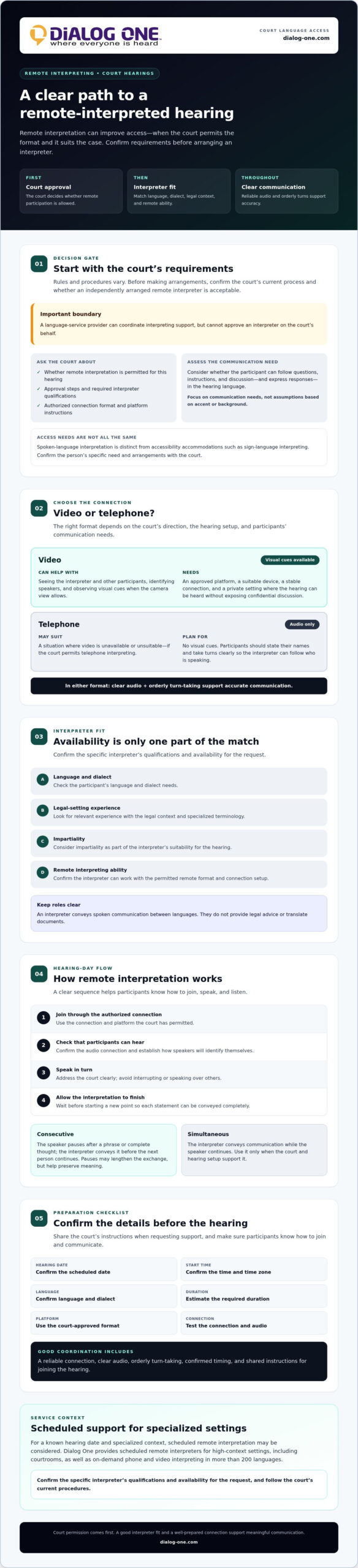
With video, participants and the interpreter connect through an approved platform. The interpreter can see speakers and observe visual cues when the camera view allows. Telephone interpreting carries voices without video, so the interpreter may not see who is speaking or notice visual context. In either format, clear audio and orderly turn-taking support accurate communication.
Interpretation may be consecutive, with the speaker pausing while the interpreter conveys each part, or simultaneous, delivered as the speaker continues. The appropriate approach depends on the proceeding and the court’s instructions. The court also determines whether remote participation is permitted and how the connection must be arranged.
Specialized legal language makes interpreter fit important. Legal translation offers background on the precision legal language can require, though oral interpreting is a separate task. An interpreter conveys communication between languages; they do not provide legal advice or translate documents.
How does remote interpretation work during a court hearing?
A remote interpreting session follows a clear sequence. The interpreter joins through the connection authorized for the hearing, confirms they can hear participants, and establishes how speakers will identify themselves. Once the proceeding begins, speakers address the court in turn, and the interpreter conveys communication between languages using the method the court allows.
In consecutive interpretation, the speaker pauses after a phrase or complete thought so the interpreter can convey it before the next person continues. These pauses may lengthen the exchange, but they help preserve the meaning of questions and responses. Simultaneous interpretation happens while the speaker continues and should be used only when the court and hearing setup support it.
Clear turn-taking and complete statements give the interpreter the context needed to convey each person’s meaning accurately. Avoid interrupting, speaking over others, or starting a new point before interpretation is complete. The National Center for State Courts provides court language-access resources, including information relevant to virtual interpreting.
Video versus telephone interpretation for hearings
Video lets participants see the interpreter and one another, which can help identify speakers and follow visual cues. It requires a suitable device, a stable connection, and a private setting where the hearing can be heard without exposing confidential discussion. Confirm the court’s platform and instructions before connecting.
Telephone interpreting may be considered when video is unavailable or unsuitable, if the court permits it. It may be simpler to join, but participants can’t rely on visual cues. Speakers should state their names and take turns clearly. The right format depends on the court’s direction and the communication needs of the proceeding.
Who controls the interpreting arrangement?
Don’t assume that a privately scheduled interpreter can replace one appointed by the court. Ask the court clerk, judge, or counsel who is responsible for arranging language support and whether an outside provider may participate. Court-appointed arrangements and independently booked services follow different processes, and the court decides what it will accept.
If the court permits an outside provider, confirm its requirements before booking and share any connection or participation instructions. Dialog One offers scheduled remote interpreting for known hearing dates, as well as on-demand phone and video interpreting where the court and situation allow. Confirm the specific interpreter’s qualifications, language fit, and availability for your request.
How do you choose the right remote interpreter arrangement?
Start with the court’s process. The court may arrange its own interpreter, or it may allow a party to schedule an outside provider, subject to approval and its requirements. Ask who is responsible for arranging the interpreter and what qualifications or procedures apply before booking. A private provider can coordinate language support, but its interpreter should not be assumed to replace a court-appointed interpreter.
A suitable remote interpreter for court hearings needs more than a working connection. Consider the language pair and dialect, relevant experience in legal settings, impartiality, and ability to interpret effectively by phone or video. Remote service does not automatically mean lower quality. Fit, preparation, clear audio, and the demands of the proceeding all matter.
What qualifications and language fit should you confirm?
Ask about the interpreter’s experience with the type of legal setting, the languages they interpret, and any relevant dialect requirements. Check credentials against the court’s stated requirements rather than assuming one credential applies everywhere. Clarify impartiality expectations and disclose any potential conflict through the process the court specifies. If details are uncertain, ask the court or counsel before finalizing the arrangement.
Compare the practical options:
| Format | Practical considerations |
|---|---|
| Video | Can help participants identify speakers and follow visual cues; requires a suitable device, stable connection, and private setting. |
| Telephone | May be considered when video is unavailable or unsuitable; offers no visual cues, so clear introductions and turn-taking are especially important. |
| In person | Allows direct visual presence without a remote connection; requires the interpreter to attend at the location. Confirm whether the court prefers or permits this option. |
When may remote interpreting be unsuitable?
Assess suitability carefully if the hearing involves frequent overlapping speech, several participants speaking in quick succession, sensitive testimony, or unreliable connectivity. These conditions can make it harder to hear, identify speakers, or keep communication orderly. They don’t automatically rule out remote service, but they are worth discussing before the hearing.
Ask the court whether an in-person interpreter or another arrangement would better support the proceeding. Don’t make legal determinations yourself. Refer unresolved questions about suitability and approval to the court or counsel. For general participant guidance, consult Mass.gov’s advice to prepare for a remote-interpreted court hearing, then follow the instructions for your specific hearing.
How should you prepare for a remote-interpreted court hearing?
Use a written checklist and confirm details with the court before arranging a remote interpreter for court hearings. A correct link alone isn’t enough: participants need clear instructions, working equipment, and an agreed plan for pauses or a dropped connection. Recheck the details if the hearing changes, since a new date, format, or participation instruction may affect the arrangements.
What should you confirm before booking?
Ask the court clerk, judge, or counsel who is responsible for arranging and paying for interpretation. Don’t assume the answer. Confirm the court’s approval process, interpreter requirements, attendance procedures, platform access, and any advance paperwork. Then verify the current hearing date, format, and instructions before confirming with a provider.
Remote-hearing preparation checklist
- 1. Confirm approval. Check that remote interpretation is permitted and establish who must arrange the interpreter and handle any payment.
- 2. Confirm the booking details. Share the hearing date, start time and time zone, expected duration, language, dialect, approved format, and platform. Ask about the interpreter’s relevant qualifications and how they should join.
- 3. Distribute participant instructions. Explain how to access the approved meeting link, identify each speaker, and request clarification. Ask participants to speak clearly, use complete statements, take turns, and avoid side conversations.
- 4. Test the connection. Before the hearing, check the meeting link and test microphones, speakers, and cameras with the relevant participants. Confirm that everyone can hear the interpreter and knows how to signal a problem.
- 5. Agree on a disruption plan. Ask the court how to pause proceedings if the interpreter can’t hear or keep up. Confirm an approved backup contact and reconnection process. Don’t substitute another link or service without authorization.
What should happen before the hearing starts?
Allow time to resolve access or sound issues before proceedings begin. Confirm that participants know whose turn it is to speak and how to pause for interpretation. If someone doesn’t understand a statement, they should use the court-approved method to request clarification rather than guessing or relying on side conversations.
For a known hearing date and specialized context, scheduled remote interpretation may allow for careful coordination. Dialog One offers scheduled remote interpreters, with language availability, qualifications, and scheduling confirmed for each request. Request scheduled remote interpreting after checking the court’s requirements.
How can a language-service provider support a court hearing?
A language-service provider can coordinate interpreting support after you confirm the court’s requirements. Share the court’s instructions so the provider can assess whether it may support the requested language, format, and schedule. The provider can discuss interpreter suitability and scheduling, but it does not appoint an interpreter for the court or determine whether the court will accept one.
For a hearing with a confirmed date and specialized context, scheduled remote interpreting may allow time to coordinate the request in advance. A provider may also offer on-demand phone or video interpreting, but consider that option only if the court and situation permit it. Availability and provider experience do not replace the need to verify the court’s rules for the specific proceeding.
What information helps a provider assess the request?
Prepare the practical details before making an inquiry. Include the language and dialect, hearing date and start time with time zone, expected duration, preferred remote format, and platform or participation instructions supplied by the court. If the hearing date or instructions change, ask how to report the change and confirm whether the interpreter’s schedule can accommodate it.
Ask how the provider assesses an interpreter’s language fit, relevant legal-setting experience, and ability to interpret remotely. Confirm any qualifications the court requires rather than assuming a general credential will meet its rules. Share terminology or case context only when necessary and through a process suitable for sensitive information. Don’t send confidential material through an unapproved channel.
How can you take the next step with Dialog One?
Once the court has clarified whether an outside provider and remote format are acceptable, you can discuss the request with Dialog One. Dialog One has more than 25 years of language-services experience and provides scheduled remote interpreters for high-context settings, including courtrooms. It also offers on-demand phone and video interpreting in more than 200 languages. Confirm the specific language availability, interpreter qualifications, and scheduling options for your request.
For an overview of the video format, read the on-demand video remote interpreting guide. Share the court’s instructions and confirmed hearing details when discussing support. This helps focus the conversation on practical fit while leaving approval and participation decisions with the court.
Plan language support with confidence
Arranging a remote interpreter for court hearings starts with the court’s current requirements. Confirm whether remote participation and an outside interpreter are permitted, then check the interpreter’s language and dialect fit, relevant experience, and qualifications against the court’s instructions.
Preparation matters as much as selection. Confirm the schedule and platform, test the connection, and make sure participants know how to take turns, request clarification, and follow the court-approved plan if the connection fails. These steps support clear communication without assuming one format suits every hearing.
When a hearing date is known and the context is specialized, scheduled remote interpreting may be worth discussing. Dialog One brings more than 25 years of language-services experience, provides scheduled remote interpreters for high-context settings including legal services, and offers on-demand phone and video interpreting in over 200 languages. Confirm specific qualifications, availability, and scheduling for each request. Court approval remains the first checkpoint.
Once you’ve checked the court’s requirements, discuss your scheduled remote interpreting needs with Dialog One. Clear coordination and appropriate human language support can help you approach the hearing better prepared.
Frequently Asked Questions
Can I use my own remote interpreter for a court hearing?
Possibly, if the court permits an outside interpreter and remote format for your hearing. Before booking, ask the court clerk, judge, or counsel who is responsible for arranging language support and what approval process applies. A provider’s availability does not establish court approval. Confirm the interpreter’s qualifications, language and dialect fit, and participation instructions with the court before relying on an independently scheduled service.
Does a court have to approve a remote interpreter?
Courts set the requirements for interpreter participation, so confirm the rules for your specific hearing before arranging remote support. The court may specify who can provide interpretation, what qualifications are needed, and whether phone or video participation is allowed. Don’t assume approval for one hearing or court applies to another. Ask the court or counsel how to submit a request and whether advance paperwork is required.
Is video or phone interpretation better for a court hearing?
Neither format is best for every hearing. Video can help participants identify speakers and follow visual cues, but it depends on an approved platform, working equipment, and a stable connection. Phone interpretation may be considered when video is unavailable or unsuitable, if the court permits it. Without a visual picture, speakers should identify themselves and take turns clearly. Follow the court’s instructions when choosing a format.
How do I request an interpreter for a remote court hearing?
Start by contacting the court clerk, counsel, or other designated court contact to ask how to request an interpreter and whether remote participation is allowed. Provide the hearing date, start time and time zone, expected duration, language and dialect, and any platform instructions. Ask who arranges the interpreter and what qualifications or paperwork the court requires. If an outside provider is permitted, confirm the interpreter’s suitability and availability.
What qualifications should a court interpreter have?
Requirements vary, so check the court’s stated qualifications rather than assuming one credential applies everywhere. Ask about the interpreter’s relevant legal-setting experience, language pair, dialect, and experience working remotely. Confirm that the interpreter can meet the court’s participation procedures and impartiality expectations. Disclose potential conflicts through the appropriate process. A provider can discuss an interpreter’s background, but the court determines which qualifications it will accept for the hearing.
What happens if the interpreter loses connection during a hearing?
Participants should alert the court immediately and follow its direction. Proceedings may need to pause until communication is restored. Before the hearing, ask the court to confirm an approved backup contact and reconnection process. Don’t switch to an unapproved platform or arrange a substitute on your own. If the interpreter can’t hear or keep up after reconnecting, tell the court so it can determine the appropriate next step.
Can an interpreter interpret confidential court information remotely?
An interpreter may handle sensitive information as part of a hearing, but confirm the court’s confidentiality instructions and ask the provider how the remote session is conducted. Discuss expectations for a private workspace and how case context should be shared, using an appropriate secure process. Don’t send confidential documents through an unapproved channel. Follow the court’s rules and the provider’s procedures for accessing and interpreting sensitive information.