The provider with the longest language list may still be the wrong choice. If you’re weighing how to choose a language service provider, start with the communication task and the consequences of an error. An urgent conversation may call for phone or video interpreting; a complex meeting may need a scheduled interpreter; a document or live event may require translation, transcription, or captions.
Language coverage and availability matter, but reliable language access also depends on how well a provider fits your workflow, applies human expertise, and takes responsibility for the work. The right approach for a routine exchange may not suit a high-stakes healthcare, education, or legal interaction.
This guide offers a practical framework for matching services to real communication needs and comparing providers against consistent criteria. You’ll learn what to assess in language coverage, service modalities, quality processes, human oversight, and the ability to adapt as needs change. Dialog One provides interpreting, translation, and AI live transcription and captioning, combining technology with human expertise. Use the steps below to identify an approach that supports clear communication as your organization’s needs evolve.
Key Takeaways
- Learn how to choose a language service provider by weighing communication risks and workflow fit, not language count alone.
- Match live interpreting, scheduled sessions, document translation, or transcription to the situation and the way people need to communicate.
- Assess subject-matter expertise, quality review, human oversight, and accountability alongside technology.
- Use a practical scorecard to compare providers consistently and identify whether they can adapt as your needs change.
- See how Dialog One’s interpreting, translation, and AI transcription and captioning services support varied language-access needs.
Why choosing a language service provider is a high-impact decision
A language service provider (LSP) helps people and organizations communicate across language differences. Services may include interpreting a live conversation, translating written material, or adapting content for a particular audience. The choice affects more than whether words are converted correctly. It can influence whether someone understands an explanation, participates in a discussion, completes a process, or trusts the organization communicating with them. That makes how to choose a language service provider a question of communication risk and workflow, not just convenience.
What does a language service provider do?
LSPs support spoken and written communication through services designed for different needs. Language interpretation conveys meaning between people communicating in different languages. Translation transfers written content into another language while preserving its meaning and context. Localization goes further by adapting content for a particular audience or market, which may involve adjusting references, tone, or conventions.
In brief: Interpretation carries meaning between people in a live exchange; translation carries meaning between written texts; localization adapts content so it makes sense to a particular audience.
Which communication needs call for a provider?
Start with the task’s purpose, timing, and consequences. A routine internal update or general information sheet may allow time for a planned written workflow. A time-sensitive conversation or consequential decision calls for a modality and expertise suited to the interaction. If someone misunderstands an appointment instruction, classroom discussion, legal explanation, or public-service process, the effects can extend beyond the exchange itself.
Consider how language access supports participation and service delivery in different settings:
- Healthcare: Patients need to understand questions, explanations, and next steps to participate meaningfully in care. The healthcare language access guide explores this context in more detail.
- Education: Families and students may need to participate in meetings, understand school communications, or follow instructions. Clear communication helps make that participation possible.
- Legal services and government: Interviews, hearings, and public-service interactions can involve complex information and consequential decisions. Subject-matter experience and clear accountability matter in these settings.
- Organizational operations: Staff training, meetings, and written procedures may need different approaches depending on the audience, language, and whether communication is live or documented.
Routine needs still deserve care, but sensitive or high-stakes exchanges call for particular attention to context, expertise, and review. A provider should be able to explain how its service fits the task and where human judgment contributes. When people can understand and respond, interactions are more likely to support participation and trust. When communication breaks down, even a well-designed process can become difficult to follow.
Match language service types to your workflows and use cases
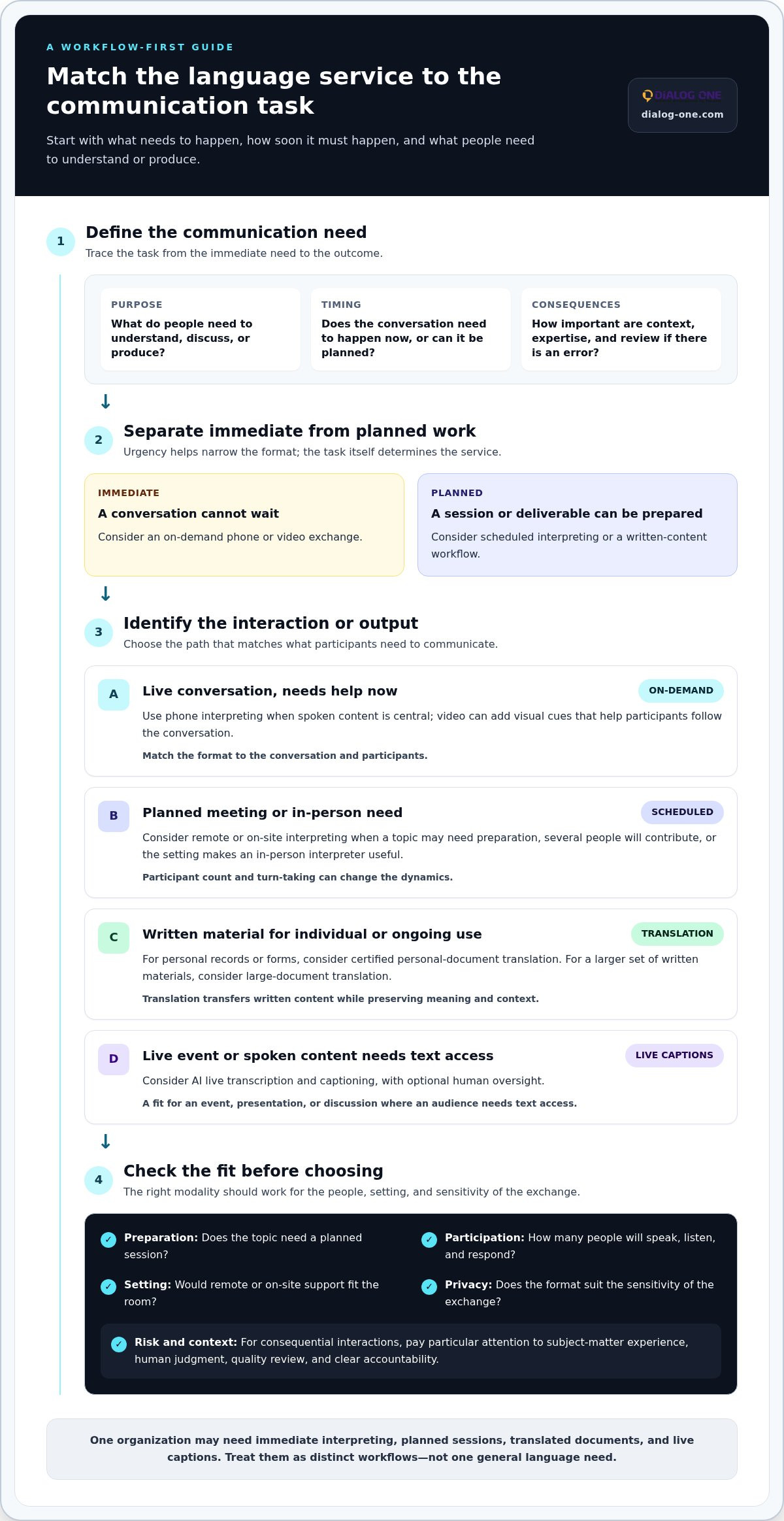
Choose a service by tracing the communication from need to outcome: how quickly it must happen, who is involved, and what they need to understand or produce. One organization may need immediate help with a phone conversation, a planned interpreter for a meeting, translated documents for ongoing use, and captions for a live event. Treat these as distinct workflows rather than one general language need. This scenario-first approach makes how to choose a language service provider more practical.
When does on-demand or scheduled interpretation fit?
Use on-demand phone or video interpreting when a conversation needs to happen before a scheduled appointment is practical. Phone access suits exchanges where spoken content is central; video can add visual cues that help participants follow the conversation. For a planned session, consider whether the topic needs preparation, whether several people will contribute, and whether the physical setting makes an on-site interpreter useful. Privacy also matters: choose a format that fits the room, the participants, and the sensitivity of the exchange.
Participant count can change the dynamics. A brief one-to-one conversation differs from a group meeting where speakers take turns and need to see one another. Match the modality to how people will speak, listen, and respond rather than selecting it by habit. Dialog One provides on-demand phone and video interpreting, along with scheduled remote and on-site options.
When do translation and transcription fit better?
Choose document translation when the audience needs written material in another language, such as a personal record or a larger collection of organizational content. Consider how the translation will be used and whether the intended readers need a certified translation. Larger projects may involve multiple documents and audiences, so organizing source files and defining review expectations at the outset can help keep the work aligned with its purpose.
For spoken content unfolding live, AI transcription and captioning create text during the event rather than a translated document for later distribution. Optional human oversight can complement AI when context or accuracy needs additional attention. Define whether the audience needs captions in the same language or translated text, and how the output will be used afterward. To see how video interpreting can fit remote conversations, explore on-demand video remote interpreting. Organizations considering several modalities can also review Dialog One’s language services.
Evaluate provider quality, expertise, technology, and accountability
A broad language list can indicate reach, but it doesn’t show whether a provider is suited to a particular conversation, document, or audience. Quality depends on fit: the subject matter, communication setting, level of review, and consequences of misunderstanding. Language coverage is one useful criterion, not a substitute for evaluating how a provider’s services support your specific workflow.
Technology can support language work, but accountability needs defined human roles. That distinction is especially important when communication is sensitive, technical, or consequential. As you consider how to choose a language service provider, weigh capability and oversight together. A technology feature or a long language list alone does not establish quality.
How should buyers assess linguistic and subject expertise?
Look for experience relevant to both the subject and the setting. A conversation about a complex process may require different preparation from a routine exchange; similarly, a personal record and a large document project have different review needs. Dialog One brings more than 25 years of experience and serves education, healthcare, and legal settings. For each service, consider what expertise supports the work and how responsibility is handled if an issue needs attention.
For written materials, assess whether the workflow accounts for terminology, context, and intended readers. Consistent terms across forms or a large document set can matter as much as sentence-level fluency. Consider what review is appropriate for the document’s purpose and how corrections or questions are managed. For live interpretation, consider the communication setting and subject matter, as well as how participants can speak and respond clearly.
How should buyers evaluate AI, privacy, and compliance?
AI may support some tasks, but suitability depends on complexity, sensitivity, and the required output. Live transcription and captioning, for example, produce text from spoken content; the need for human oversight depends on how that text will be used and the stakes involved. Dialog One offers AI live transcription and captioning with optional human oversight, combining technology with human expertise without treating automation as the right answer for every situation.
Evaluate privacy and data-handling practices against your organization’s requirements before choosing a workflow. Consider what information is involved, how it will be used, and whether the proposed process aligns with internal policies. A general technology description does not answer these questions. Accountability includes clarity about the human roles and review points in the process.
Compliance obligations depend on the organization, service, and circumstances. Healthcare, education, and public-sector teams should verify whether HIPAA, Title VI, or IDEA requirements apply to their specific situation with qualified compliance advisers. A language provider can support communication, but that does not establish that an organization has met its legal obligations.
Use a practical scorecard to compare language service providers
A scorecard turns a broad comparison into a documented decision. Start with your actual workflows, then assess each provider against the same needs. Give the greatest weight to requirements where communication failure could have the greatest consequences. A high score for a secondary feature shouldn’t outweigh a gap in a critical language, modality, or accountability process.
Build a weighted provider evaluation scorecard
Before assigning scores, record the work the service must support. Be specific about audiences, settings, urgency, and expected demand. This gives your team a shared basis for evaluation and makes it easier to see where a provider fits well or falls short.
- Document the workflows. List needed languages, service modalities, audiences, settings, expected demand, and critical workflows. Separate routine requests from time-sensitive or high-consequence interactions.
- Set priorities by risk. Mark each requirement as essential, important, or beneficial. Give more weight to essentials tied to comprehension, participation, or continuity of service. Don’t treat every feature as equally important.
- Rate fit and expertise. Assess whether the service matches the task and whether relevant subject-matter experience supports it. Consider interpretation, translation, and transcription needs separately.
- Examine operations and accountability. Include availability for the expected workflow, technology fit, human oversight, issue escalation, and ongoing support. Note implementation effort and the likely experience of staff and service users.
- Record evidence and gaps. Use a consistent scale, such as strong fit, partial fit, or unmet need. Support important ratings with documented information about processes and capabilities; distinguish evidence from assumptions.
The scorecard should make trade-offs visible, not create false precision. For example, a provider could offer useful technology but require more staff effort to fit your process. If that workflow is high-volume, implementation and support may deserve more weight. If it involves sensitive communication, relevant expertise and a clear route for resolving issues may take priority.
Plan onboarding and ongoing performance review
Selection is only the start. Map how staff will access each service, who is responsible for arranging it, and where it fits into existing procedures. Make sure employees understand how to use the workflow and where to direct an issue. A short pilot with representative tasks can reveal practical friction before a wider rollout, though one test cannot predict every future interaction.
Agree on review measures that reflect your goals. These might include responsiveness against your operational needs, how issues are resolved, staff experience, and feedback from the people using the service. Review patterns over time and revisit priorities as languages, settings, or demand change. Use findings to improve the process, not simply to produce a score.
If live captions or transcription are part of your workflows, explore AI live transcription services as you define the right evaluation criteria. You can also review Dialog One’s language services across interpreting, translation, and captioning.
How Dialog One supports varied language service needs
A useful provider relationship should support the way communication happens across your organization, not force every need into one service type. Dialog One brings more than 25 years of experience to interpreting, translation, and AI live transcription and captioning. Its services support organizations, individuals, and government agencies, with the modality chosen according to the task, audience, and required output.
Match Dialog One services to organizational workflows
For a conversation that needs to happen without a scheduled session, Dialog One provides 24/7 on-demand phone and video interpreting in more than 200 languages. Phone interpreting supports spoken exchanges; video adds a visual connection when that suits the interaction. For planned meetings where participants, setting, or subject matter call for advance coordination, scheduled on-site and remote interpreting provide options suited to the session.
Written and live-content needs call for different workflows. Dialog One provides certified translation for personal documents, as well as translation for large document projects. The first supports individuals who need a translated personal record; the second serves organizations working with broader collections of written material. In both cases, the project’s purpose and audience help define what the translated text needs to accomplish.
For spoken content that needs to appear as text during a live event or interaction, Dialog One offers AI live transcription and captioning with optional human oversight. AI and human expertise can play complementary roles. The appropriate balance depends on the content, context, and intended use of the output, particularly when people will rely on the text to follow or participate in communication.
- Immediate conversation: on-demand phone or video interpreting.
- Planned session: scheduled remote or on-site interpreting.
- Written record or project: certified personal-document translation or large-document translation.
- Live spoken content: AI live transcription and captioning, with optional human oversight.
Move from evaluation to a clear next step
Before selecting a service, bring your priority audiences and workflows into one brief: the languages needed, the settings where communication happens, the level of urgency, and the output people must receive. Then apply your evaluation criteria: service fit, relevant experience, availability, technology, human oversight, accountability, and the ability to support changing needs. This keeps the decision specific to your organization instead of relying on language coverage alone.
Dialog One’s range of services lets you assess different workflows separately within a broader language-access plan. If your organization is deciding how to choose a language service provider, use your priorities and communication needs to guide the evaluation. Explore Dialog One’s language services.
Build language access into the way your organization works
A provider decision is also an opportunity to make communication access part of everyday planning. Assign clear ownership for arranging services, preparing staff, and reviewing how well each workflow serves its audience. As programs, teams, and communication needs evolve, revisit those arrangements so language support remains practical and accountable rather than an afterthought.
The lasting value of learning how to choose a language service provider is that you’re not only selecting a service for today. You’re creating an approach your organization can refine as needs change. Begin with the conversations, documents, and live content that matter most, then identify services that support them with care and clarity.
Dialog One provides interpreting, translation, and AI live transcription and captioning to support different language-access workflows. Discuss your language service needs with Dialog One and take a considered next step toward clear, accountable communication.
Frequently Asked Questions
What is a language service provider?
A language service provider (LSP) is an organization that helps people communicate across languages through services such as interpretation and translation. Interpretation supports live exchanges, while translation produces written content in another language. An LSP’s scope varies according to the workflows it supports. Before selecting one, define the communication tasks you need handled, then assess the provider’s expertise, quality practices, technology, and accountability against those needs rather than relying on its label alone.
How do I know whether I need an interpreter or a translator?
Choose an interpreter for spoken communication during a live or scheduled interaction; choose a translator for written content that readers need in another language. The key distinction is the format and intended outcome. For example, a staff meeting may call for interpretation so participants can communicate in real time, while a policy document may need translation for later reading. An organization may need both, but assess each workflow on its own.
What should I look for when choosing a language service provider?
Compare service fit, language coverage, relevant subject experience, quality practices, availability, technology, human oversight, accountability, and support. The weight of each factor depends on the task: an occasional general document and a sensitive live interaction may call for different priorities. To make how to choose a language service provider a consistent decision, document your needs first and assess each provider against the same criteria, recording evidence for important capabilities and any gaps.
Is AI enough for professional interpretation or translation?
AI may support some language workflows, but it isn’t automatically suitable for every interaction or document. Consider the complexity and sensitivity of the content, its intended use, and the consequences of an error. Then determine what human review and accountability are appropriate. Automated transcription turns speech into text; it isn’t the same as an interpreter facilitating communication between people. Don’t assume AI alone meets every quality or compliance need.
How can an organization assess language service quality before committing?
Review experience relevant to your subject and setting, the provider’s quality assurance process, its workflow, and how it handles issues. Look for examples that resemble your actual needs, such as a similar document type or interaction format. Where appropriate, define a pilot with clear review questions, then gather feedback from staff and service users. Treat the findings as useful evidence, not a guarantee that every future task will perform the same way.
How much does a language service provider cost?
Fees depend on the service and how the work is structured. Interpretation charges may be based on usage time or scheduled time; document translation may be charged by word or page, and transcription may use usage-based fees. For a fair comparison, align the scope, deliverables, review expectations, and billing basis before assessing proposals. A billing model that suits a short interaction may not be the right way to evaluate a substantial written project.
Can one language service provider support both interpreting and translation?
Yes, some providers support multiple language service types, but assess each service against its own workflow and quality needs. A team might use interpretation for a staff meeting and translation for written materials shared afterward. A broader portfolio can simplify coordination across those tasks, but it doesn’t establish that every service is suitable by default. Consider the expertise, review process, and accountability relevant to each task before making a decision.