Using a relative to interpret doesn’t automatically make a healthcare provider liable. But if important information is misunderstood, consent is unclear, or language-access requirements aren’t met, the liability of using family members to interpret can become a serious concern. A patient’s preference for a relative matters, but it doesn’t always remove the provider’s responsibility to support effective communication.
It’s understandable to turn to someone a patient trusts, especially when a conversation is urgent. Still, relatives may unintentionally omit details, struggle with medical terminology, or find it difficult to interpret sensitive information impartially. This article explains how those risks can affect communication, confidentiality, and informed consent, and why a legal finding of liability depends on the circumstances, not the family relationship alone. You’ll learn when limited exceptions may apply, how to document decisions, and how qualified interpretation can support clearer conversations. On-demand phone and video interpreting can address urgent needs, while scheduled remote or on-site interpretation can support more complex discussions.
Key Takeaways
- The liability of using family members to interpret isn’t automatic. Exposure depends on applicable duties, what went wrong, and the circumstances.
- Consider how family interpreting can affect safety, informed consent, privacy, and a patient’s willingness to share sensitive information.
- Federal requirements, accreditation standards, and organizational policies may shape language-access practices.
- Use a clear response pathway when a patient requests a relative. Identify communication needs and arrange qualified interpretation.
- Match urgent conversations with on-demand phone or video interpretation, and plan complex discussions with scheduled remote or on-site support.
Liability of Using Family Members to Interpret: What the Risk Actually Means
Liability means potential legal responsibility for failing to meet an applicable duty. It isn’t an automatic consequence of a relative interpreting, and a communication error alone doesn’t prove that an organization is legally responsible. A liability analysis may consider the organization’s obligations, what was said or missed, whether the communication failure contributed to harm, and the laws and circumstances involved.
Foreseeable communication risk is a reason to act carefully, not proof that a court will find liability. That distinction matters. A family member may help someone communicate in an informal or urgent moment, but relying on that relative for a consequential clinical discussion can create risks an organization should assess and manage.
Those risks extend beyond legal exposure. Incomplete information may affect care. A patient may not feel free to speak openly. Staff may need to repeat instructions or resolve confusion. A patient’s experience can also suffer if they feel unheard or believe their privacy was compromised. The Medical Interpretation overview discusses the specialized communication and ethical considerations involved in this work.
When can family interpretation create legal exposure?
Consider a patient describing symptoms, reviewing treatment options, or receiving medication and discharge instructions. If a relative unintentionally changes the meaning, important details may be lost. If that breakdown affects diagnosis, treatment, consent, or follow-up and causes harm, it may become relevant to a legal claim. The question isn’t simply who interpreted. It’s what duty applied, whether it was met, and what resulted.
An organization’s legal duties are distinct from a relative’s role in the conversation. A family member’s help doesn’t automatically replace an organization’s responsibility to meet applicable communication and access requirements. Whether the relative could also face responsibility depends on the facts and relevant law. Liability analysis is fact-specific, and requirements or outcomes may vary by jurisdiction and setting.
Why doesn’t bilingual ability equal interpreting competence?
Conversational fluency can help someone speak with a patient, but interpretation requires conveying each speaker’s full meaning accurately and impartially. Medical language, unfamiliar terms, and emotional pressure can make that difficult. A relative may be worried, distracted, or personally involved, and may not recognize when a term or instruction needs clarification.
Even with good intentions, a relative may summarize, omit distressing details, soften a diagnosis, or answer a question on the patient’s behalf. The patient may also hold back sensitive information in front of family. These actions can change the substance of a clinical exchange without anyone intending to mislead. Recognizing the difference between support and interpretation helps organizations respond to a communication need without assuming a relative’s fluency is enough.
How Family Interpreting Can Affect Safety, Consent, Privacy, and Trust
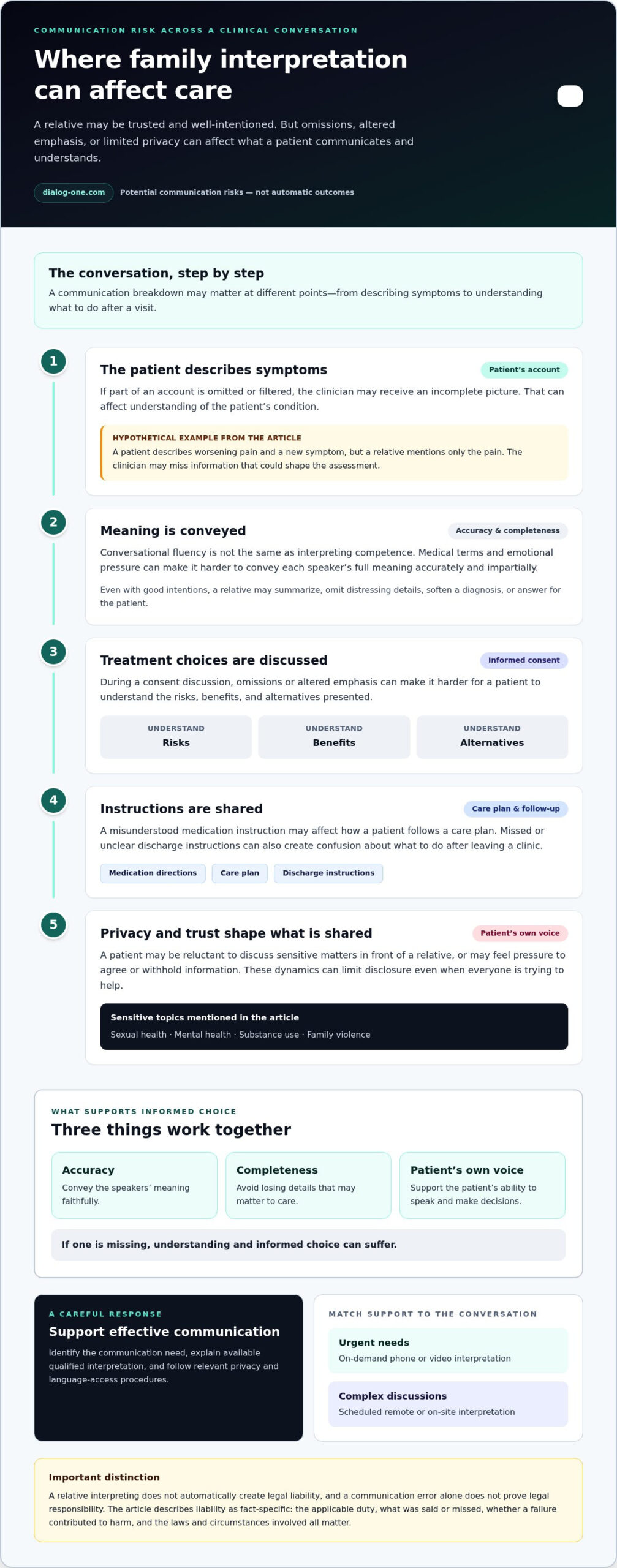
Communication can shape every step of care, from describing symptoms to understanding what to do after leaving a clinic. A relative may be trusted and well-intentioned, but family dynamics, stress, or unfamiliar medical terms can affect what gets conveyed. If the patient’s own words are filtered or key instructions are missed, clinicians may have an incomplete picture, and patients may not be able to make decisions with confidence.
Accuracy, completeness, and the patient’s own voice work together. If one is missing, understanding and informed choice can suffer.
How can interpretation errors affect clinical decisions?
An incomplete account of symptoms can alter a clinician’s understanding of a patient’s condition. A misunderstood medication instruction may affect how a patient follows a care plan. During a consent discussion, omissions or altered emphasis can make it harder for a patient to understand the risks, benefits, and alternatives presented.
Hypothetical example: A patient tries to describe worsening pain and a new symptom, but a relative mentions only the pain. The clinician may miss information that could shape the assessment. This scenario illustrates a possible communication risk, not a documented case. An error may increase risk, but it doesn’t by itself establish legal liability.
What privacy and family-dynamic concerns should teams consider?
A patient may be reluctant to discuss sexual health, mental health, substance use, family violence, or other sensitive matters in front of a relative. A family member may also have interests that differ from the patient’s, or the patient may feel pressure to agree or withhold information. These dynamics can limit disclosure even when everyone is trying to help.
Privacy obligations depend on the circumstances, including the setting, applicable rules, and the patient’s choices. HIPAA doesn’t categorically prohibit a patient-requested family interpreter. Still, staff should consider whether the patient can speak freely, explain the available qualified interpretation, and follow relevant privacy and language-access procedures.
Why take special care when a child is interpreting?
Asking a child to interpret can reverse family roles. The child may feel responsible for decisions or for communicating distressing information, while also being exposed to sensitive medical details. Children may not understand specialized terms or feel able to convey difficult messages accurately. Whenever possible, arrange qualified language support rather than placing this burden on a young family member.
Communication risks can arise at several points in a visit:
- Assessment: Symptoms, timing, or changes in condition may be left out.
- Treatment: Medication directions or care instructions may be misunderstood.
- Consent: The patient may not receive a complete explanation of choices.
- Discharge and follow-up: Warning signs, appointments, or next steps may not be clear.
These concerns show why the liability of using family members to interpret is only one part of the issue. Patient safety, privacy, and trust matter too. For urgent conversations, on-demand phone and video interpretation gives care teams access to professional language support, so a relative doesn’t have to carry the whole conversation.
What US Laws and Standards Say About Using a Relative to Interpret
There isn’t one rule that applies identically to every healthcare organization or encounter. The relevant framework may depend on the entity, its funding, the patient’s communication needs, and current federal, state, and local requirements. These distinctions matter when assessing the liability of using family members to interpret: a law, an accreditation standard, and an internal policy don’t have the same legal force.
| Framework | What it generally addresses | How to read it |
|---|---|---|
| Title VI | Prohibits national-origin discrimination by programs or activities receiving federal financial assistance. Language access may be relevant to meeting that obligation. | Applicability depends on federal funding and the circumstances. |
| ACA Section 1557 | Prohibits discrimination in covered health programs and activities on specified grounds, including national origin. The 2024 rule addresses meaningful access for people with limited English proficiency and the use of qualified interpreters. | Coverage and current enforcement must be assessed for the entity and situation. |
| ADA Title III | Requires public accommodations, including covered healthcare facilities, to provide effective communication for people with disabilities when required. | This disability-access framework is distinct from language access for people with limited English proficiency. |
| CLAS and Joint Commission | CLAS Standards guide culturally and linguistically appropriate services. Joint Commission requirements apply through its accreditation framework. | Neither should be described as a federal statute. Their scope and effect differ. |
| State law and local policy | May set additional requirements or operational procedures. | Rules vary by jurisdiction and organization. |
Which federal frameworks may be relevant in healthcare?
Title VI applies to recipients of federal financial assistance and addresses discrimination based on national origin. Section 1557 applies to covered health programs and activities, with regulations addressing meaningful access and qualified interpretation for people with limited English proficiency. For disability-related communication, ADA Title III may require appropriate auxiliary aids, which can include a qualified sign language interpreter when necessary for effective communication. The ADA and language-access rules address related but distinct needs.
The HHS National CLAS Standards are guidance, while Joint Commission standards are accreditation requirements for organizations within their scope. They can shape institutional practice without becoming statutes. For a current review, consult the applicable federal regulations, including 45 CFR § 92.201, alongside relevant agency materials.
Do patient preference and emergency exceptions change the analysis?
A patient’s request for a relative may be relevant, but it doesn’t automatically eliminate an organization’s responsibility to support effective communication. Section 1557 rules restrict relying on family members, friends, or minors, with limited circumstances that may include a life-threatening emergency when a qualified interpreter isn’t immediately available. The details matter. An emergency isn’t a blanket exception, and rules concerning adults and minors may differ. Teams should follow applicable law and policy, document the circumstances and steps taken, and avoid delaying necessary care while arranging language support.
Federal rules, agency guidance, enforcement, remedies, and state requirements can change. This overview is general information, not legal advice. Organizations should verify current requirements for their setting and jurisdiction.
Responding to Patient Requests for Family Interpreters
A patient may ask for a relative to interpret because they trust that person, feel more comfortable, or don’t know another option is available. Respond respectfully, but treat the request as a prompt to clarify communication needs and arrange appropriate language support, not as a reason to leave the patient out of the conversation. A consistent workflow helps staff balance patient preference, timely care, and organizational responsibilities.
What should staff do before relying on a relative?
Begin with the patient, not the accompanying family member. Use these steps to identify the need and support the patient’s participation:
- Identify the language and communication needs. Ask the patient which language they prefer for healthcare discussions and whether they need spoken-language or disability-related communication support. Don’t assume based on appearance, family relationships, or a brief exchange.
- Offer a qualified interpreter. Explain in plain language that a professional interpreter can help convey the conversation accurately and impartially. Ask about the patient’s preference, and arrange phone, video, or scheduled in-person interpretation as appropriate to the situation.
- Assess urgency without abandoning access. If care is urgent, follow applicable law and organizational procedures while arranging qualified support as promptly as the situation permits. An emergency may require interim communication decisions, but it isn’t a blanket reason to rely on a relative for every discussion.
- Speak directly to the patient. Address the patient in the first person, pause for interpretation, and give them time to respond. Use clear, manageable sentences and confirm understanding of key information without asking the relative to answer for them.
- Respect the patient’s role and preferences. A family member may offer emotional support, but the patient should remain central to decisions. If the patient continues to request a relative, explain the available support options and follow the organization’s policy and applicable requirements.
For a broader overview of planning language access in clinical settings, use this healthcare language access guide.
What should teams document after the decision?
Record enough detail to make the communication process clear to the next care-team member. Follow privacy rules and organizational documentation procedures, and avoid unnecessary personal details.
- Communication needs: Note the patient’s stated language preference and relevant communication requirements.
- Access efforts: Record the interpreter format arranged, attempts made, and any material timing constraints.
- Patient preference: Document the patient’s request or response to the offer of qualified interpretation, using neutral language.
- Urgent circumstances: If an interim communication choice was necessary, record the circumstances, reason, and steps taken to secure qualified support.
- Follow-up: Escalate unresolved access or safety concerns according to policy, and note how they were addressed.
Clear documentation doesn’t determine legal responsibility by itself, but it can show what the team understood, considered, and did. Since the liability of using family members to interpret depends on circumstances and applicable rules, a repeatable process is more useful than an informal decision made differently at each encounter. For immediate language support, arrange on-demand phone or video interpretation as part of the response pathway.
How Professional Interpreting Helps Reduce Communication Risk
Professional interpretation provides a structured way to support communication when a patient and care team don’t share a language. Compared with relying on a relative, a professional interpreter’s role is to convey the speakers’ messages accurately and impartially, rather than add family context or make decisions for the patient. This can keep the patient’s own words central and give staff a clearer basis for discussion.
It doesn’t eliminate every communication or legal risk. It does offer a more structured approach to a high-stakes conversation, particularly when the patient needs to describe symptoms, understand treatment choices, or discuss next steps. Match the format to the conversation:
- Accuracy: A professional interpreter focuses on conveying the exchange, including questions and clarifications, rather than relying on conversational fluency alone.
- Neutrality: A professional can help reduce the influence of family dynamics on what is shared or emphasized.
- Access: Phone and video options can support immediate communication needs, while planned conversations can use scheduled remote or on-site interpretation.
- Accountability: A defined professional role makes the communication process clearer for staff and supports consistent organizational procedures.
These safeguards don’t guarantee a particular clinical or legal outcome. They help create conditions for a more complete exchange, so teams can communicate with the patient rather than through a family member by default.
When can on-demand interpretation support timely communication?
For an unexpected conversation, on-demand phone or video interpretation connects a care team with human language support. Dialog One provides 24/7 on-demand phone and video interpretation in over 200 languages. This can be a practical option when a clinician needs to discuss an immediate concern, while still allowing the team to speak directly with the patient. Care teams should continue to assess urgency and follow their procedures.
For more detail on the video format, see the on-demand video remote interpreting guide.
When is scheduled interpretation a better fit?
Complex or planned conversations may benefit from arranging interpretation in advance. Scheduled remote and on-site options help teams plan for longer, high-context discussions, such as reviewing a care plan or explaining a procedure. Advance scheduling gives staff an opportunity to organize the conversation and share relevant context through appropriate channels. It can also support continuity in the communication process.
Choosing professional support is a practical way to address communication risk, though it doesn’t replace an organization’s responsibility to follow applicable law and policy. Explore professional interpretation services for on-demand and scheduled language support.
Make Clear Communication Part of Every Care Decision
Build a language-access process before a difficult conversation arises. When staff know how to identify communication needs, involve the patient, and arrange qualified support, they can respond consistently and help protect the patient’s ability to participate in care. Documentation and clear procedures also give teams a practical foundation for reviewing decisions and improving future encounters.
The liability of using family members to interpret isn’t determined by a single factor, and general information can’t replace advice about a specific situation. Organizations can take a constructive next step: make qualified interpretation easier to arrange and embed it into routine workflows. Dialog One brings more than 25 years of language-services experience to supporting communication in high-stakes settings.
Explore Dialog One interpretation services and identify language support that fits your team’s communication needs. With a thoughtful process and professional human support, clearer conversations are within reach.
Frequently Asked Questions
Is a healthcare provider automatically liable if a patient asks a relative to interpret?
No. A patient’s request alone doesn’t establish liability, and the liability of using family members to interpret depends on applicable duties and what happened during care. A claim may raise questions about whether the provider met communication requirements and whether a communication failure contributed to harm. The patient’s preference is relevant, but it doesn’t necessarily satisfy every legal obligation. Requirements vary by setting and jurisdiction, so organizations should follow current policy and legal guidance.
Can a family member interpret during an emergency?
Sometimes, temporarily, if the situation meets an applicable emergency exception and a qualified interpreter isn’t immediately available. Under the federal Section 1557 rule described in this article, the exception is limited to a life-threatening emergency. Staff should prioritize necessary care, seek qualified interpretation as soon as practicable, and record why interim communication was used. An urgent appointment or staffing inconvenience doesn’t automatically qualify as an emergency. Apply the governing rules and organizational procedures.
Can a patient refuse a professional interpreter and choose a family member?
A patient may express that preference, and staff should listen and explain the available options without pressure. However, a request doesn’t necessarily remove an organization’s legal responsibilities or make family interpreting appropriate for every discussion. Explain why qualified support may help, especially for decisions or instructions that require detailed understanding. Follow the rules that apply to the organization and encounter, and document the patient’s stated preference and the steps taken to support communication.
Does HIPAA prohibit a family member from interpreting for a patient?
No. HIPAA doesn’t categorically prohibit a patient-requested family member from being present or helping communicate. Whether information can be shared with a relative depends on the circumstances, including the patient’s agreement or whether the patient has an opportunity to object. HIPAA privacy obligations still apply to covered organizations and their workforce. Staff should follow privacy procedures, avoid unnecessary disclosure, and distinguish permission to share information from whether a relative is an appropriate interpreter.
Why is it risky for a child to interpret at a medical appointment?
A child may not understand clinical terms, medication directions, or the need to convey every detail, and may feel pressure to protect a parent from upsetting information. The child can also be placed in an adult decision-making role and exposed to sensitive topics. For example, a teenager may hesitate to interpret questions about family conflict or mental health. Ask the care team to arrange qualified language support so the child can participate as family, not carry responsibility for the clinical conversation.
What should a healthcare organization record when a family member interprets?
Document the patient’s preferred language, the communication support offered, the patient’s response, and efforts to obtain a qualified interpreter. If a relative interpreted, record their role and the circumstances, including any urgency that affected the decision. Note relevant timing, the information discussed, and any follow-up needed to confirm understanding with qualified support. Keep entries objective and consistent with privacy rules and organizational policy. Avoid unsupported conclusions about the patient’s comprehension.