What if the colleague who speaks both languages well isn’t the right person to interpret a consequential conversation? The risks of using bilingual staff for interpretation begin with a common assumption: conversational fluency is enough to transfer meaning accurately. When someone needs to understand information or make a decision, even a well-intentioned employee may lack the interpreting skills, impartiality, and confidentiality practices the exchange requires.
It’s understandable to turn to bilingual staff when language support is needed quickly. But asking an employee to interpret can pull them away from their role, put them under pressure, and blur the boundary between colleague and interpreter. A missed detail or unclear explanation can affect what someone understands, while sensitive conversations call for careful attention to privacy and accuracy.
This article explains where bilingual ability falls short of professional interpreting and how to recognize when an employee isn’t an appropriate substitute. You’ll learn how to assess a conversation, reduce communication risks, and protect staff capacity. We’ll also cover when on-demand phone or video interpretation can support time-sensitive conversations, and when scheduled remote or on-site interpreters may be better suited to planned, high-context meetings.
Key Takeaways
- The risks of using bilingual staff for interpretation include altered meaning, reduced neutrality, and unclear responsibility for communication.
- Assess the stakes, complexity, sensitivity, and expected length of a conversation before deciding who should interpret.
- Convenience alone isn’t a reliable measure of whether staff interpretation is appropriate for a specific interaction.
- Set clear guidelines in advance so employees know which conversations require a professional interpreter.
- Match time-sensitive conversations to on-demand phone or video interpretation, and planned, high-context meetings to scheduled remote or on-site support.
Risks of Using Bilingual Staff for Interpretation: Fluency Is Not the Same as Interpreting
A bilingual colleague is nearby, a meeting is underway, and someone needs language support. Asking that employee to interpret may seem practical. But if the conversation includes an instruction, decision, or sensitive detail, availability alone doesn’t establish that the employee is prepared to interpret accurately.
Interpretation is the transfer of spoken meaning between languages during a live exchange. The interpreter listens, processes what was said, and conveys it in another language as the conversation continues. That differs from speaking both languages socially or knowing familiar workplace terms. The risks of using bilingual staff for interpretation arise when organizations treat language ability as proof of interpreting skill and readiness for the role.
What does a bilingual employee bring to an interpreted conversation?
A bilingual employee may bring real strengths: strong language ability, familiarity with the organization, and knowledge of everyday terminology. Those qualities can help with informal exchanges, but they don’t automatically provide the skills needed to interpret accurately under pressure.
Interpreting requires listening, retaining what a speaker says, reformulating it clearly in another language, and managing turns so everyone can participate. The interpreter must convey the speaker’s complete meaning without summarizing, adding personal explanations, or quietly resolving uncertainty. For example, an employee may know the workplace meaning of a technical term but still need to preserve the speaker’s distinction between what has happened and what may happen next.
Why can a short conversation still carry high stakes?
Length doesn’t determine consequence. A brief exchange may cover instructions, a person’s options, a decision, or information they consider private. If an important qualification is omitted or a tentative statement sounds definite, participants may leave with different understandings of what was said and what happens next.
Compare a casual orientation about where to find supplies with a short conversation about a change to someone’s responsibilities. Both may use familiar language, but the second can affect decisions and follow-up. This doesn’t mean staff-assisted communication always causes harm. It means organizations should consider what could depend on the exchange, not just how long it takes or how comfortable the employee feels speaking both languages.
Interpretation also differs from written translation. Interpretation deals with spoken communication in real time, while translation works with written material and may involve drafting, editing, and review. An employee who can read a document in another language may not have the oral interpreting skills a live conversation demands. Likewise, conversational fluency doesn’t establish written translation competence.
Keep the distinction clear when assigning language tasks. Ask what the communication requires: live, complete transfer of spoken meaning, or careful work with a written document. This helps prevent organizations from treating related but separate abilities as interchangeable.
How Interpretation Risks Develop: Accuracy, Ethics, and Role Conflicts
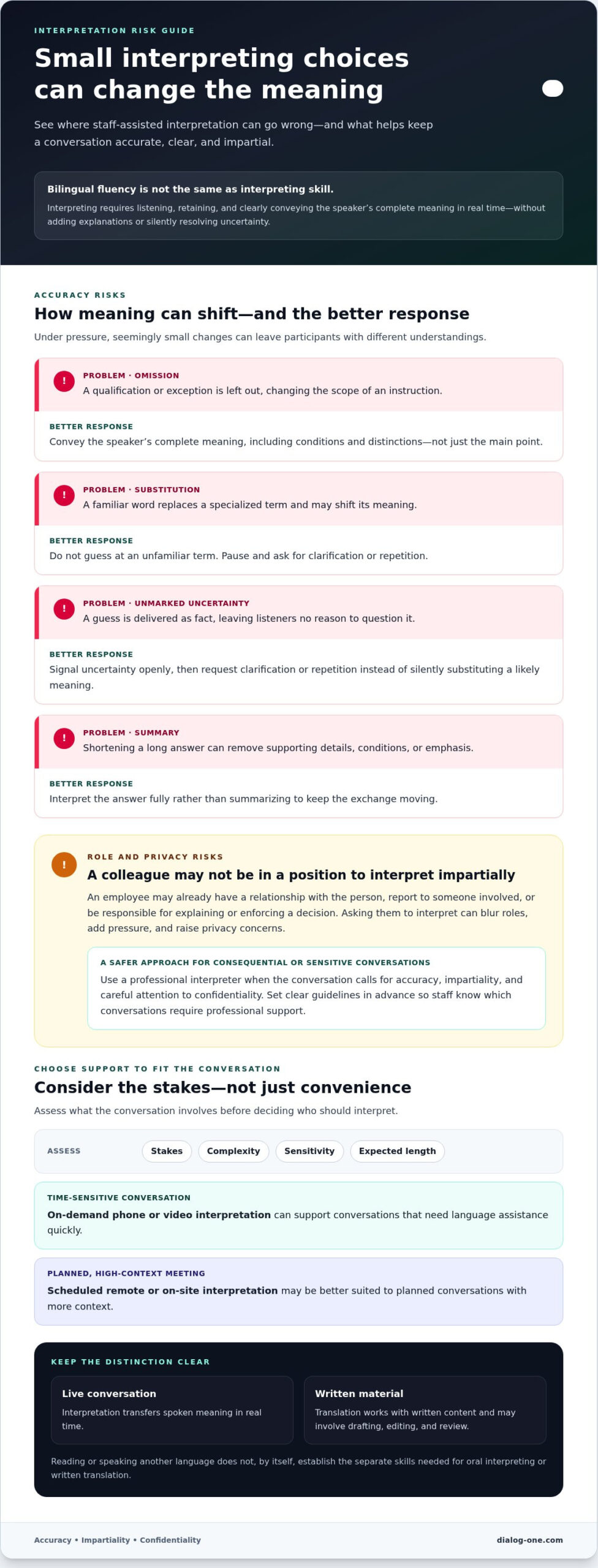
Interpretation risk can develop in small steps. A staff member misses a qualifier, chooses a familiar but imprecise word, or shortens a long answer to keep the conversation moving. Each choice may seem reasonable in the moment. Together, they can leave participants with different understandings, especially when the exchange includes unfamiliar terms, fast dialogue, or sensitive information.
An interpreting error can change not just the words exchanged, but the meaning a person relies on to understand a consequential decision or instruction.
Accuracy risks: omissions, assumptions, and specialized language
Unfamiliar terminology can be hard to interpret accurately, even for someone who speaks both languages well. Rapid turn-taking adds pressure: the interpreter must listen, process, and speak without losing details. If the employee summarizes a long response instead of conveying it fully, conditions, uncertainty, or distinctions between options may disappear.
Guessing compounds the risk. If a term is unclear, the interpreter should pause, signal the uncertainty, and ask for clarification or repetition. Silently substituting a likely meaning makes it difficult for participants to know what was uncertain.
- Omission: A qualification or exception is left out, changing the scope of an instruction.
- Substitution: A familiar word replaces a specialized term, potentially shifting its meaning.
- Unmarked uncertainty: A guess is delivered as fact, so listeners have no reason to question it.
- Summary: The main point is conveyed, but supporting details or the speaker’s emphasis are lost.
Ethical and operational risks for staff and participants
Accuracy isn’t the only concern. An employee may have an existing relationship with the person, report to someone involved, or hold a role that requires them to explain or enforce a decision. Those overlapping responsibilities can make neutrality harder to maintain. Participants may also hesitate to speak openly when the interpreter is a coworker, supervisor, or familiar face.
Privacy requires care, too. A staff member asked to interpret may not know what information should remain within the conversation or how to handle a sensitive disclosure. This is a risk to manage, not proof that every employee will mishandle information. Clear role boundaries and an appropriate interpreting arrangement help participants understand who is speaking, who is interpreting, and how information will be handled.
There is also an operational cost. Interpreting takes sustained attention, and an employee who is simultaneously responsible for regular duties may be distracted or pulled in competing directions. That can affect both the language exchange and the employee’s core work. Organizations should distinguish these foreseeable pressures from claims of guaranteed harm or automatic legal consequences.
For consequential conversations, professional interpretation can provide a clearer separation of roles. Dialog One offers on-demand phone and video interpretation for time-sensitive exchanges, as well as scheduled remote and on-site options for planned discussions.
Bilingual Staff or Professional Interpreter? Compare the Situation, Not Just Convenience
A bilingual employee may be the closest person available, but the right arrangement depends on what the conversation requires. A quick exchange about where to meet is different from a discussion in which someone must understand options, ask questions, or make a decision. The risks of using bilingual staff for interpretation increase when convenience becomes the only factor in the choice.
Fluency shows that someone can communicate in two languages; demonstrated interpreting competence shows they can transfer meaning accurately and impartially in a live exchange.
Stakes: A low-consequence logistical exchange may need only basic directions. If misunderstanding could affect a decision, instruction, or next step, use a professional interpreter.
Complexity: Familiar, straightforward information may be easier to convey than technical or specialized discussion. Complex subject matter calls for professional support.
Sensitivity: Routine coordination may involve little personal information. Private or emotionally difficult topics make confidentiality and participant comfort more important.
Required neutrality: A staff member involved in the decision, reporting relationship, or ongoing work with a participant may not be well placed to interpret impartially. Choose a professional interpreter when neutrality matters.
Conversation length: A short exchange can still be consequential. Longer conversations place greater demands on sustained attention and complete communication, so length should inform the decision but never decide it alone.
When is staff language support limited to simple communication?
For a basic logistical exchange, such as confirming a room location or directing someone to a reception area, a bilingual employee may help convey a simple message. That isn’t a universal exemption or proof that the employee is qualified to interpret. Consider what the person needs to understand and what could follow from a misunderstanding. This comparison concerns live spoken exchanges, not written document translation.
When should organizations use a professional interpreter?
Assess medical, legal, education, and sensitive workplace conversations carefully. Professional support is the stronger fit when participants need to explain circumstances, ask questions, understand choices, or make informed decisions. It also helps keep the employee’s regular role separate from the interpreting role. For healthcare-specific considerations, apply the same assessment of stakes and needs to the setting and exchange.
Convenience has a place in planning, but it shouldn’t replace a review of consequences, complexity, privacy, and neutrality. For a low-stakes exchange, basic language assistance may be sufficient. As the need for precision and participant trust increases, professional interpretation becomes the more appropriate arrangement. This gives organizations a practical way to choose support based on the conversation, not just who happens to be available.
How to Reduce Interpretation Risk: A Practical Decision Process
Organizations can reduce interpretation risk by deciding how language support will work before a meeting becomes urgent. A consistent process gives staff a clear route to follow and helps match the interpreting arrangement to the conversation. It also makes clear that a bilingual employee shouldn’t be assumed to be available or prepared to interpret simply because they speak the language.
Assess the conversation before assigning language support
Start with the purpose and likely consequences of the exchange. Consider whether it involves sensitive information, specialized terminology, instructions, rights, choices, or decisions. A routine coordination question may call for a different level of support than a conversation where someone needs to explain circumstances and understand possible next steps.
Use a threshold that staff can apply consistently. For example, your policy might require a qualified interpreter whenever a person must understand or respond to consequential information, or whenever the subject is sensitive or complex. The threshold should guide action and shouldn’t depend on who happens to be nearby.
Set staff boundaries and prepare an interpreting pathway
Make the process practical. Identify who is responsible for arranging interpretation, how staff request support during an urgent interaction, and what to do if a planned conversation changes in scope. Tell employees that language ability alone doesn’t make interpretation an assigned duty. This protects role clarity and avoids relying on an employee who may be involved in the conversation or occupied with other responsibilities.
Then document the decision. A brief record can note the interaction’s purpose, why a particular format was selected, who arranged support, and any follow-up needed. Keep the record focused on the process and avoid recording sensitive details that aren’t necessary for accountability.
- Identify the stakes. Decide what participants need to understand and what could depend on accurate communication.
- Assess complexity and sensitivity. Consider technical terms, privacy, emotional context, and whether participants need time to ask questions.
- Choose the support and format. Use phone or video interpretation for time-sensitive conversations; select scheduled remote or on-site support for planned discussions where context and coordination matter.
- Record the arrangement. Note the decision and any follow-up so the process is clear to the team.
Set these expectations in advance. A written pathway can help staff respond consistently across departments, including when the usual contact person isn’t available. It also makes the risks of using bilingual staff for interpretation easier to manage: decisions are based on the needs of the exchange rather than speed or familiarity alone.
Dialog One provides on-demand phone and video interpretation, as well as scheduled remote and on-site options. Organizations can use professional interpreter services to support urgent or planned conversations. A clear pathway can make professional interpreting support part of the response when accuracy and role clarity matter.
Professional Interpretation as a Reliable Next Step for Consequential Conversations
Once an organization identifies a conversation as complex, sensitive, or consequential, professional interpretation gives the exchange a clear support pathway. The format can match the urgency and context: phone or video interpretation for on-demand spoken communication, or scheduled remote and on-site support for planned sessions. This helps organizations respond without assigning an employee an interpreting role simply because they speak both languages.
Dialog One provides 24/7 on-demand phone and video interpreting in over 200 languages, alongside scheduled remote and on-site interpreters. Choose an arrangement based on what the interaction calls for, including how quickly support is needed and whether the meeting benefits from advance planning or in-person presence.
Choose an interpreting format that fits the interaction
Phone interpretation offers an on-demand option for spoken exchanges where participants need to communicate across languages. It can suit time-sensitive conversations when the priority is access to an interpreter without planning an in-person meeting.
Video interpretation is another on-demand option when remote visual communication is useful to the interaction. For a planned session with detailed context or coordination needs, organizations can arrange a scheduled remote interpreter or an on-site interpreter. Selecting a format around the conversation helps staff plan for its demands rather than defaulting to whichever colleague is available.
Move from uncertainty to a prepared language-access process
A prepared process turns language support from an improvised favor into a deliberate part of communication planning. Staff should know how to request an interpreter, who coordinates the arrangement, and which interactions call for professional support. This clarity matters for consequential conversations, where participants may need to explain their circumstances, ask questions, or understand what comes next.
The risks of using bilingual staff for interpretation are best addressed by matching the need to an appropriate arrangement. Professional interpreters support accurate communication and clearer role boundaries, while helping participants engage in the exchange. That distinction also protects staff capacity: employees can focus on their primary responsibilities instead of balancing them with an interpreting assignment.
Dialog One brings more than 25 years of experience to interpreting and language services. Its human-centered approach combines technology with human expertise, with phone and video options for on-demand needs and scheduled remote or on-site support for planned sessions. The aim is practical: choose a format that reflects the conversation’s urgency, setting, and level of context, without implying any arrangement can remove every communication risk.
Build a more prepared language-access process by exploring Dialog One’s interpreting services.
Make Clear Language Access Part of the Plan
Make language support a planned part of how your organization communicates. Set expectations before a consequential conversation arises, so staff know how to arrange an interpreter and participants can take part with clarity and confidence.
Recognizing the risks of using bilingual staff for interpretation isn’t about questioning an employee’s language ability. It’s about matching responsibility to the communication need, protecting staff from unclear role expectations, and giving each participant a fair opportunity to understand and be understood.
Build a process your team can use consistently, whether a conversation is urgent or scheduled in advance. Dialog One offers professional interpreting options for organizations that need language support suited to the interaction.
Explore Dialog One’s professional interpreting services to take a practical next step toward clearer communication.
Frequently Asked Questions
Is it risky to use a bilingual employee as an interpreter?
It can be risky if the employee’s language ability is treated as proof they can interpret a consequential exchange. For example, a staff member might understand the general topic but miss a distinction between a current requirement and a possible future change. Consider what participants need to understand and whether the employee can take a neutral, dedicated role. For simple coordination, the risk profile may be different.
Can a bilingual person interpret without professional training?
A bilingual person can attempt to interpret without formal preparation, but that doesn’t establish readiness for every conversation. Live interpreting calls for skills beyond speaking two languages, including accurate reformulation and handling unfamiliar phrasing. If an employee is asked to help with a limited exchange, keep the task narrow, use plain language, and pause if anything is unclear. Don’t treat that informal assistance as evidence of competence for future high-stakes assignments.
What are the main risks of using untrained staff for interpretation?
The risks of using bilingual staff for interpretation can include incomplete communication, uncertainty presented as certainty, divided attention, and discomfort for participants who know the employee personally. For example, a staff interpreter who is also responsible for explaining a workplace decision may struggle to separate neutral interpretation from their own role. These are foreseeable risks, not a prediction that every staff-assisted conversation will be inaccurate or harmful.
When should an organization use a professional interpreter instead of bilingual staff?
Use a professional interpreter when a conversation involves sensitive details, unfamiliar terminology, important instructions, or decisions a participant must understand and discuss. A planned meeting about a student’s support needs, for instance, may require participants to ask follow-up questions and consider several perspectives. Professional support is also prudent if the bilingual employee has a relationship to the decision or can’t step away from regular duties to focus on communication.
Does being bilingual qualify someone to interpret in a medical or legal conversation?
No. Being bilingual alone doesn’t establish that someone has the interpreting skills or role preparation a medical or legal conversation may require. Organizations should follow the applicable requirements and internal procedures for their setting, and assess the conversation’s subject, sensitivity, and consequences. A staff member who knows relevant terminology may still need training and authorization before taking on an interpreting role. The appropriate standard depends on the context and organization.
How can organizations reduce the risks of using bilingual staff for interpretation?
Set a written language-support policy that identifies which situations require a professional interpreter and names the staff member responsible for arranging one. Include a simple escalation route for urgent requests, plus guidance on protecting privacy and recording the support arrangement. Brief meeting participants on how to take turns and address one another directly. Review the process after unusual or difficult exchanges so teams can identify gaps and improve their response.
Is phone or video interpretation suitable for high-stakes conversations?
It can be suitable, depending on the conversation, participants, and setting. Phone interpretation supports spoken exchanges where visual cues aren’t central. Video may be useful when remote visual communication helps participants engage. Before the meeting, consider audio quality, privacy, who will join, and whether the discussion needs a planned remote or on-site arrangement. If participants can’t hear clearly or communicate comfortably, pause and adjust the format rather than pressing ahead.