What if the cost of a language gap is hiding in work your business already considers routine? The financial impact of language barriers in business can show up as delayed decisions, repeated work, stalled sales, or strained customer relationships, not just as a line item in a budget.
It’s easy to recognize a communication breakdown. It’s harder to trace its full cost. Teams may see the immediate expense of resolving a misunderstanding but miss the staff time, lost momentum, and longer-term effects that follow. Without a clear way to assess those losses, leaders can struggle to compare language-access options or judge whether an approach is working.
This guide shows where language barriers can affect revenue, productivity, risk, and customer trust, then offers a practical framework for estimating and monitoring the impact. You’ll also learn how to match communication needs to appropriate support, from on-demand or scheduled interpretation to document translation and AI transcription with optional human oversight. The goal is a defensible business decision grounded in the stakes and context of each interaction, not an unsupported promise of savings.
Key Takeaways
- Separate visible language-service expenses from less obvious losses tied to delays, rework, missed decisions, and customer friction.
- Trace each communication gap to a specific business event and measurable indicator, keeping employee impacts distinct from customer impacts.
- Use a five-step assessment to establish a baseline, estimate attributable costs, compare interventions, and review results.
- Match language-access approaches to the communication format, timing, complexity, frequency, and consequences of misunderstanding.
- Build a practical case for addressing the financial impact of language barriers in business by prioritizing high-impact moments and assigning clear ownership.
Where the Financial Impact of Language Barriers in Business Begins
A visible service expense is straightforward to record. Less visible are the costs that can follow when people don’t share enough language to understand instructions, make informed decisions, or complete work accurately. A language barrier in business is a communication gap that affects one or more of those outcomes. It can arise in employee interactions, customer conversations, operational handoffs, or important documents.
The financial impact of language barriers in business is the sum of direct costs and indirect losses that can be reasonably attributed to communication gaps. The broader economics of language examines how language interacts with economic activity. For an individual organization, the practical first step is to identify where a communication gap could affect work, then distinguish a credible cost pathway from a loss supported by evidence.
Four areas offer a practical starting point:
- Workforce: Repeated explanations, limited participation in meetings, or unclear instructions can affect employees’ time and contributions.
- Operations: Misunderstood handoffs or process steps may lead to rework, longer interactions, or delays between teams.
- Customer relationships: A customer who can’t understand information or make their needs clear may have a harder time completing a purchase or resolving an issue.
- Risk: Inaccurate understanding in a consequential exchange can contribute to errors, complaints, or additional review. The outcome depends on the situation.
Which business costs can language barriers create?
Direct costs are the extra resources an organization can observe: staff repeating an explanation, correcting an avoidable error, extending an interaction, or waiting for a task to be clarified. Indirect costs are less immediate. An employee may contribute less in a discussion, a customer may lose trust, or a sales conversation may not progress. These are plausible pathways, not proof of financial loss. To establish an impact, connect the communication event to a documented outcome, such as additional handling time or a missed transaction.
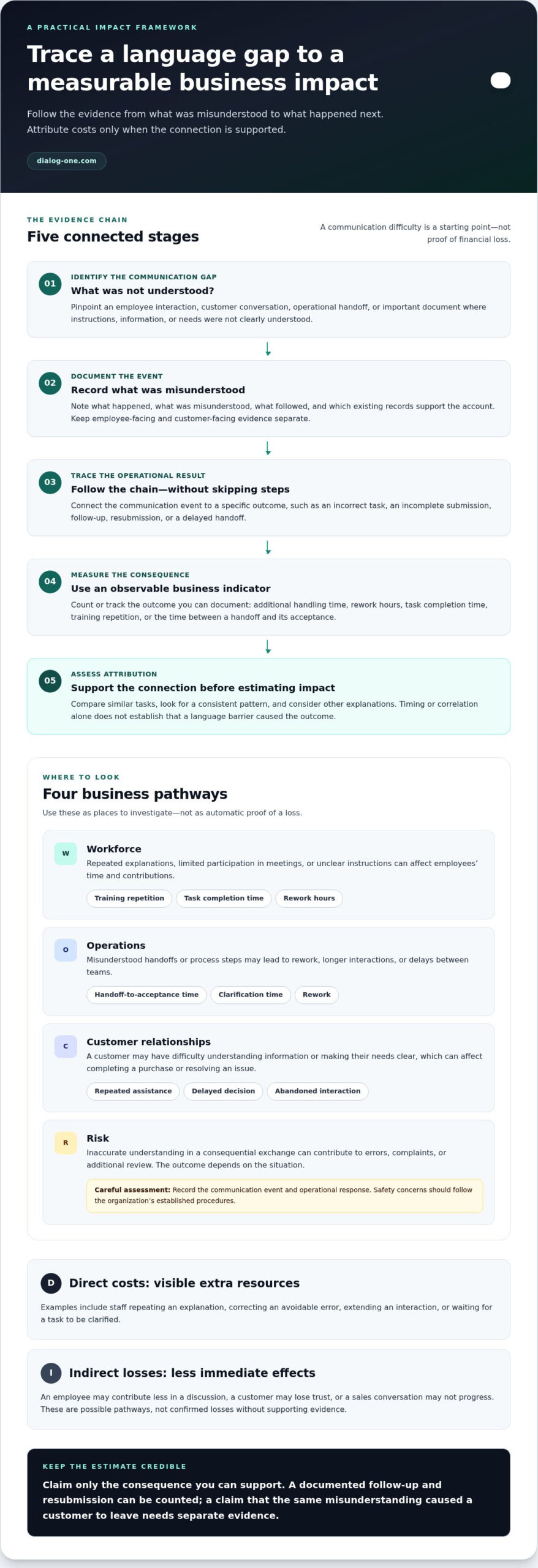
Keep the chain specific. If a form is misunderstood, for example, the immediate result may be an incomplete submission. The operational consequence might be follow-up and resubmission. Those steps can be counted and assessed. A claim that the misunderstanding also caused a customer to leave would need separate evidence. This distinction makes estimates more credible and avoids treating every communication difficulty as a confirmed loss.
Why can language-related losses stay hidden?
Records often capture the outcome, not every factor behind it. A team may log rework, a delayed task, or an employee departure without recording whether communication contributed. Small delays can also be spread across shifts, departments, and customer interactions, making their combined effect difficult to see. Look for patterns, but don’t assume they establish cause. Correlation alone can’t show that a language barrier produced the outcome.
Build a clearer picture by documenting communication-related events alongside existing operational measures. Note what was misunderstood, what happened next, and which records support the connection. This creates a disciplined starting point for measuring impact without overstating what the evidence can show.
How Language Barriers Become Financial Losses Across Business Functions
A communication gap becomes financially relevant through a chain of events, not by assumption. Trace it from the point of misunderstanding to the operational result, then identify a measure that can show the effect. The pattern differs inside the organization and across customer interactions, so assess those evidence streams separately.
Cost attribution requires linking a documented communication gap to a specific outcome and a measurable business consequence. For example, an unclear instruction might lead to a task being completed incorrectly, followed by rework. The rework hours are measurable. Whether the language gap caused them should be supported by records or a consistent pattern, not inferred from timing alone.
Workforce and operational costs of communication gaps
Employee-facing cost pathways can begin with repeated instructions or a misunderstood procedure. That may result in extra clarification, slower onboarding, incomplete work, or a delayed handoff. To assess the impact, track indicators such as training repetition, task completion time, rework hours, and the time between a handoff and its acceptance. Compare similar tasks and note other factors that could explain the difference.
Safety-related communication deserves particular care. If a worker misunderstands a process or warning, operations may pause while instructions are clarified, or a task may need review. These are possible disruptions, not proof of an incident or a legal conclusion. Record the communication event and operational response, and follow the organization’s established procedures for evaluating safety concerns.
Customer, revenue, and trust impacts
Track customer-facing evidence separately. A customer who can’t understand a product explanation, service process, or account question may abandon an interaction, delay a decision, or need repeated assistance. In banking, for instance, unclear explanations during an account-related conversation could lead a customer to postpone a decision or seek clarification. The same pathway can apply to healthcare, education, legal services, and other sectors, though the relevant outcomes differ.
Accessible communication may support customer confidence and retention, but treat that as a hypothesis to test with organizational data. Compare interaction completion, repeat contacts, unresolved inquiries, and customer feedback across relevant communication channels. A shift in these measures can signal a pattern, but it doesn’t by itself establish that language access caused it. Research on language and trust in global business offers useful context for considering how communication can shape professional relationships.
High-stakes misunderstandings may also require additional review, correction, or follow-up, increasing operational exposure. Whether they create a compliance concern depends on the organization, activity, and applicable requirements. Avoid broad legal conclusions. Document the event and seek appropriate internal review where needed.
Once a pathway is documented, organizations can consider a proportionate response. Professional interpretation can support spoken exchanges, while translation can address written materials. Dialog One provides professional interpretation and translation services to support identified communication needs.
How to Measure the Financial Impact of Language Barriers
Turn a suspected communication problem into a testable business question. A useful estimate specifies which event is being measured, what evidence supports it, and where uncertainty remains. Don’t present the financial impact of language barriers in business as a precise total if the records support only an informed estimate.
Use this five-step model to build a defensible assessment:
- Define the event. Specify the process and communication gap, such as a repeated customer interaction or a task returned for correction.
- Collect baseline data. Record how often the event occurs and its typical effect before changing the process.
- Estimate attributable costs. Use documented labor time, processing delays, or other organizational measures, and separate confirmed costs from assumptions.
- Compare interventions. Assess whether a proposed language-access approach addresses the communication format, timing, and stakes involved.
- Review results. Revisit the same measures after implementation and account for changes that could affect the comparison.
A simple starting formula is estimated impact = affected events × documented average cost per event. For example, an organization might count documented repeat contacts and multiply that count by the recorded average handling time or cost for those contacts. The result is an estimate, not proof that every event arose from a language barrier. Label observed data, assumptions, and any external benchmarks separately.
Which internal data can support a credible estimate?
Review records tied to the process being assessed, such as rework time, repeat contacts, processing delays, complaints, retention, and training records. Segment results by process, communication channel, language need, and business unit when the data supports it. Apply privacy safeguards, and don’t infer a person’s language needs from identity or demographic proxies. Use relevant information collected directly instead.
How can leaders avoid overstating the business case?
Compare a defined baseline with later results, but note changes in workload, staffing, seasonality, or process design that could also explain a shift. Choose conservative assumptions and report a range only when the underlying records support one. A credible estimate makes assumptions visible and revisable. Don’t claim a service caused savings unless the comparison and attribution method reasonably support that conclusion.
Keep the calculation tied to a defined event and review it as new evidence becomes available. This helps decision-makers compare options responsibly, refine the estimate, and identify where better communication may improve measurable business outcomes.
Comparing Language-Access Options Against the Costs They Address
The right approach depends on the communication task, how quickly support is needed, and what a misunderstanding could affect. The financial impact of language barriers in business can’t be addressed with one method alone. Training may build employee capability over time, while interpretation, translation, or transcription supports different communication needs during a specific interaction or across ongoing work.
| Option | Timing and format | Complexity and recurrence | Potential cost pathway addressed |
|---|---|---|---|
| Employee language training | Longer-term learning for spoken or written workplace communication | More relevant to recurring interactions and roles where language development is a sustained goal | May help address repeated clarification or onboarding needs over time; it isn’t an immediate solution for a consequential exchange |
| Bilingual staffing | Direct support during scheduled or routine interactions, depending on staff availability | Can fit recurring needs within a role or team; complexity depends on the subject and the employee’s language skills | May reduce delays in familiar interactions, but workload and role coverage need consideration |
| Professional interpretation | Real-time spoken conversations by phone, video, or scheduled remote or on-site support | Useful for one-time or recurring exchanges, including complex conversations where accurate understanding matters | Can address repeated explanation, stalled decisions, or unclear spoken exchanges |
| Translation | Written materials and records prepared for readers in another language | Suitable for recurring documents or one-time projects; complexity depends on content and purpose | Can help prevent confusion, follow-up, or processing delays tied to written information; certified translation applies when the task requires it |
| AI transcription and captioning | Live text access to spoken content | Can support recurring spoken-content access; suitability depends on the interaction and its stakes | May help address missed information in spoken communication, but doesn’t replace interpretation or translation for every language task |
These approaches can complement one another. A team might use translated materials alongside interpretation for a detailed discussion, or live captioning to support access to spoken content. Match the method to the task rather than assuming one tool covers every format, level of complexity, or consequence of misunderstanding.
When are interpretation and translation appropriate?
Use interpretation for a spoken exchange that requires participants to communicate in real time. On-demand phone or video interpretation can support immediate conversations, while scheduled remote or on-site interpretation can be planned for a specific meeting or setting. Translation addresses written materials and records. For a closer look at video-based support, see the on-demand video remote interpreting guide.
Where can AI transcription and human expertise fit?
AI live transcription and captioning can make spoken content available as text, but they don’t perform every task that interpretation or document translation does. Where accuracy and context carry greater consequences, optional human oversight is an important consideration. Dialog One offers AI live transcription and captioning, with optional human oversight for accuracy.
To connect a communication need with an appropriate response, explore Dialog One language services.
Build a Business Case for Language Access and Put It Into Practice
A sound business case connects a documented communication problem to a proportionate response. Start by ranking communication moments using four factors: how often they occur, the consequences of misunderstanding, who is affected, and how strong the available evidence is. A frequent, low-impact issue may call for a different response than an occasional exchange where accuracy is critical.
Use that assessment to set a baseline and define the outcome you want to improve. For example, a team might focus on reducing repeated clarification in one customer-service workflow or improving access to spoken information during a scheduled meeting. Assign an owner who can coordinate the process, collect feedback, and review the chosen measures. The goal isn’t to promise savings in advance. It’s to make a reasoned decision and test whether the response addresses the need.
How should organizations stage implementation?
Begin with one well-defined workflow or communication setting. Document the existing challenge, the people affected, and the indicators you’ll monitor. Then match the format to the task: spoken communication may call for on-demand phone or video interpretation, or scheduled remote or on-site interpretation; written information may require translation; live transcription and captioning can support access to spoken content. Dialog One provides these services, including AI live transcription and captioning with optional human oversight.
Keep the first stage focused. Make responsibilities clear, explain how the new approach fits into the workflow, and gather user feedback alongside operational measures. Review the results before extending the approach to other teams or settings. A limited, well-documented implementation helps leaders identify practical issues and refine the process before scaling it.
How can leaders assess results over time?
Track the selected indicators consistently and compare them with the original baseline. Review both usage and outcomes: is the intervention reaching the affected group, addressing the identified communication barrier, and supporting the intended business result? Note changes in workload, staffing, or process that may also influence results. User feedback can help explain what the operational measures show, but neither should be treated as proof of causation on its own.
For organizations in healthcare, the healthcare language access guide offers sector-specific context. In any industry, revisit priorities as communication needs and evidence change. This keeps the business case accountable: maintain approaches that address demonstrated needs, adjust those that fall short, and investigate new communication gaps as they emerge.
To put a measured need into practice, work with Dialog One on language-access services. Start with the communication setting, the people affected, and the outcome you want to support. That gives the conversation a clear focus and helps identify an appropriate service approach.
Make Clear Communication Part of the Plan
The financial impact of language barriers in business is easier to address when communication access is part of sound operational planning, not an afterthought. Identify one interaction where clearer communication could support better decisions, then build ownership and follow-up into the process. Keep listening to the people affected. Their experience can reveal barriers that standard performance measures may miss.
Language access requires judgment as well as the right tools. Dialog One combines human expertise with AI technology for high-stakes contexts. Interpretation, translation, and transcription can support different communication needs, helping organizations take a more deliberate and accountable approach to communicating across languages.
Explore language-access support with Dialog One and take the next step toward communication practices that serve your organization and the people it supports. Start with one clearly identified need, then build from there.
Frequently Asked Questions
How do language barriers affect business finances?
Language barriers can affect finances by adding friction to routine work and customer journeys. For example, if a supplier misunderstands a purchase order, staff may need to resolve the discrepancy before processing can continue. The financial impact of language barriers in business depends on whether such events lead to trackable consequences, such as extra handling or a delayed transaction. Review the records tied to the affected workflow before assigning a financial value.
Can language barriers reduce employee productivity?
Yes, they can make communication-dependent tasks more demanding, though the effect varies by role and situation. A new employee, for instance, might need a supervisor to repeat or demonstrate instructions before completing a task independently. Compare similar roles or onboarding groups while accounting for experience and workload. A difference in productivity can prompt further investigation, but it doesn’t establish language as the cause without evidence of the communication gap.
How can a business calculate the cost of language barriers?
Start with a specific, countable event and use internal records to estimate its documented effect. For instance, examine the additional staff time recorded for correcting a particular type of incomplete submission. Keep the calculation separate by workflow so one process doesn’t mask another. Mark each input as observed or assumed, and leave out hypothetical sales or retention losses unless your records support a defensible connection to the communication issue.
What is the difference between direct and indirect costs of language barriers?
Direct costs are tied to identifiable additional work, such as staff time spent correcting a misunderstood instruction. Indirect costs involve broader effects, such as a customer becoming less confident or an employee contributing less in a meeting. Those outcomes may be influenced by factors beyond language. Keep them in separate categories in reports, and avoid presenting an indirect effect as a financial loss unless you have evidence to support the estimate.
Can interpretation services help reduce the financial impact of language barriers?
Professional interpretation can support clearer spoken exchanges, but its effect on business outcomes depends on the setting and how the service is integrated. Before introducing it, identify which interaction needs support and what a successful exchange should enable, such as completing an intake or resolving a service question without repeated follow-up. Then review those workflow measures over time. Treat any improvement as evidence to assess, not an automatic guarantee of savings.
Is AI transcription enough to address language barriers at work?
Not by itself. Transcription and captioning present spoken content as text, while interpretation conveys meaning between languages and translation addresses written content. For example, captions may help participants follow a spoken presentation, but they don’t replace translated instructions or interpreted discussion when those are needed. Consider the language task, context, and consequences of error. Human expertise or oversight may be especially relevant when meaning depends on specialized terminology or nuance.
What business data should leaders review to identify language-related costs?
Review records that connect an event to a workflow, such as case notes, service logs, timestamps, and consistently applied issue codes. A standard field for documenting communication obstacles can make patterns easier to examine across teams. Let people identify their communication needs directly rather than inferring them from names, appearance, or other demographic proxies. Limit access to identifiable records to those who need them, and report aggregated patterns where possible.