What if an IEP meeting includes an interpreter, yet a parent still can’t follow the discussion or weigh in on decisions? The IEP meeting language requirements are about more than translating words. Federal IDEA regulations require schools to take necessary steps to help parents understand IEP proceedings, including arranging an interpreter when needed.
It’s understandable to want clear answers about what schools must provide, especially when state or district policies may add requirements. Meaningful participation depends on accurate, impartial interpretation and communication that gives families time to ask questions, share concerns, and understand the team’s decisions.
This guide explains the federal baseline and where local rules may differ. It also covers how schools can plan language support, prepare interpreters for specialized education terminology, and choose an effective approach for in-person or remote meetings. Thoughtful preparation and qualified human interpretation help make complex discussions clearer and support family participation.
Key Takeaways
- Understand how IEP meeting language requirements focus on helping parents understand and participate, not simply providing translated materials.
- Learn what IDEA says about arranging interpretation and how state or district rules may add requirements.
- Compare professional interpretation with informal or automated options, considering accuracy, impartiality, confidentiality, and specialized terminology.
- Prepare for clearer communication by coordinating language, dialect, communication mode, meeting format, and interpreter logistics in advance.
- See how scheduled on-site or remote interpretation can support planned IEP discussions, backed by Dialog One’s more than 25 years of experience and interpreting in over 200 languages.
IEP Meeting Language Requirements: What Meaningful Access Means
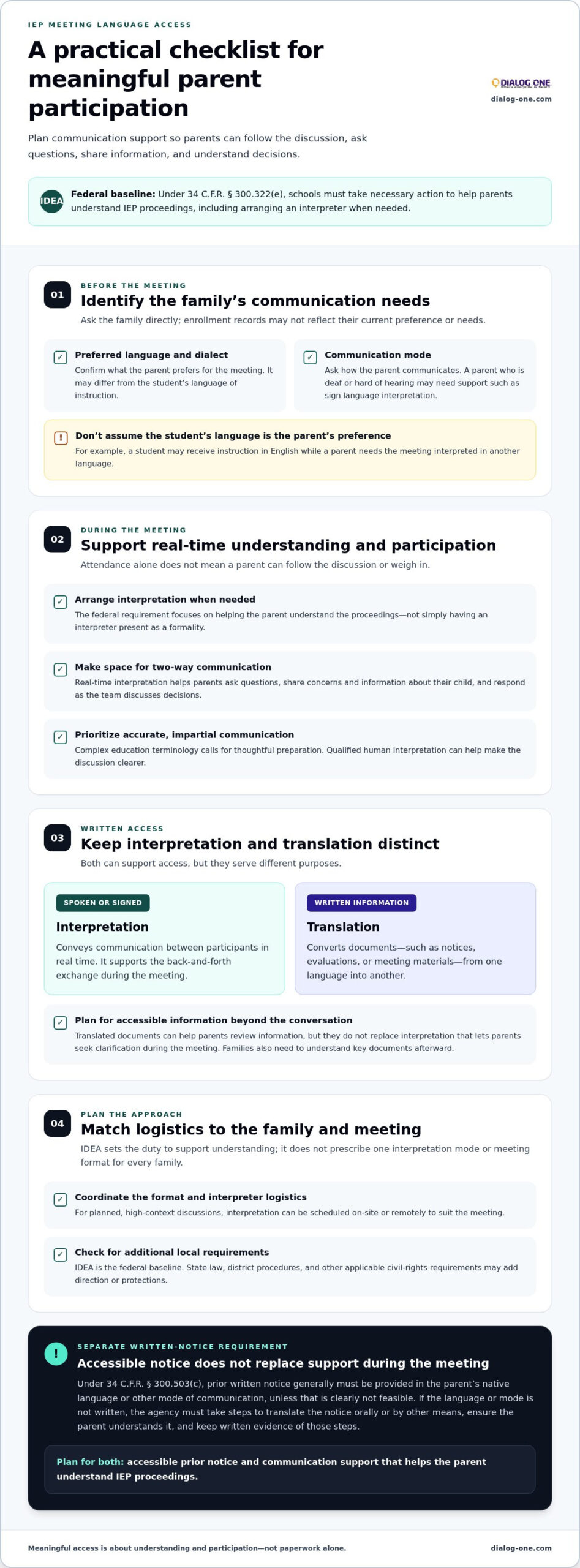
Meaningful language access is more than sending a family translated paperwork. Parents need to understand the discussion as it happens, ask questions, share information about their child, and take part in decisions. In practical terms, meaningful language access is communication support that enables a parent to understand and participate in IEP proceedings, consistent with the school’s duty under 34 C.F.R. § 300.322(e).
That distinction matters because an Individualized Education Program (IEP) brings together detailed information about a student’s educational needs and services. Federal requirements provide a baseline, while state law or district policy may add protections or procedures. Schools should consider the family’s communication needs when planning, rather than treating access as a paperwork task.
Who may need language support during an IEP meeting?
Parents whose primary or preferred language isn’t English may need spoken-language interpretation. Parents who are deaf or hard of hearing may need communication support suited to how they communicate, such as sign language interpretation. A family’s preferred language may differ from the student’s language of instruction. For example, a student receiving instruction in English may have a parent who needs the meeting interpreted in another language.
Identify needs early by asking families about their preferred language, dialect, and communication mode. Don’t assume enrollment records tell the whole story. They may not capture a parent’s current preference or the support needed to participate in a complex meeting.
Interpretation and translation serve different purposes
Interpretation conveys spoken or signed communication between participants in real time. Translation converts written information, such as notices, evaluations, or meeting documents, from one language into another. Both can support access, but they serve different purposes.
A translated evaluation may help a parent review information before the meeting. By itself, it can’t help the parent ask for clarification when the team discusses a service or explains a proposed change. Real-time interpretation supports the back-and-forth exchange that lets parents raise concerns and respond to the team. Written translations matter, too: families need to understand key documents after the meeting, not just follow the conversation while it’s happening.
What IDEA Requires for IEP Meeting Language
Federal law sets a baseline for parent understanding, but it doesn’t prescribe one interpretation format for every IEP meeting. Under IDEA’s requirement for interpreters, a public agency must take whatever action is necessary to ensure that a parent understands the proceedings of an IEP meeting. This includes arranging an interpreter for a parent who is deaf or whose native language is not English, when needed.
The focus is understanding, not simply attendance. A parent’s presence at the meeting does not, by itself, mean they can follow the discussion or participate. The school must consider what support will help the parent understand the proceedings. Depending on the family’s communication needs and the meeting, that may involve spoken-language interpretation or other communication support. The regulation establishes the duty, not a universal requirement to use a particular mode or meeting format.
The IDEA provision on parent understanding
Section 300.322(e) applies to IEP meeting proceedings. It calls for necessary action to support parent understanding, including arranging an interpreter for parents who are deaf or whose native language is not English. The current text of 34 C.F.R. § 300.322 provides the regulatory language. Schools should plan around the parent’s communication needs rather than treating an interpreter as an optional convenience.
This is the federal IDEA baseline. State law, district procedures, and other applicable civil-rights requirements may provide additional direction or protections. Schools should account for those rules alongside the family’s specific communication needs. For planned, high-context discussions, scheduled IEP meeting interpretation can be arranged on-site or remotely to suit the meeting.
Meeting interpretation is not the same as written notice
IDEA addresses written prior notice separately. Under 34 C.F.R. § 300.503(c), the notice must generally be provided in the parent’s native language or other mode of communication, unless doing so is clearly not feasible. If the parent’s language or communication mode isn’t written, the agency must take steps to translate the notice orally or by other means, ensure the parent understands it, and keep written evidence that these steps were taken.
The written-notice rule and the meeting-understanding rule address different points of access. Providing a notice in an accessible language doesn’t replace the separate need to support a parent’s understanding during IEP proceedings. Schools should plan for both: communication support during the meeting and accessible prior notice.
Qualified Interpreter or Informal Help? Compare IEP Meeting Options
The IEP meeting language requirements focus on parents understanding and participating, not simply having a bilingual person in the room. A staff member, relative, or translation tool may seem convenient, but each option has different strengths and limits. The school’s responsibility is to provide communication support that fits the family’s needs and the meeting’s complexity. Qualification rules can also vary by state or district, so don’t assume one standard applies everywhere.
Qualified professional interpreter: Supports accurate, impartial communication and can prepare for specialized education terms. This can be a strong fit for detailed discussions, sensitive topics, or meetings where parents need to ask questions and respond directly.
Bilingual staff member: May know the school’s processes and terminology. However, bilingual ability alone doesn’t establish interpreting skill, impartiality, or familiarity with interpreter ethics. A staff member may also have another role in the meeting.
Family member or friend: May offer familiarity and reassurance. Personal relationships can make it difficult to interpret sensitive information impartially, and the person may not know specialized terms or feel comfortable relaying every detail.
Automated tools: May help with basic communication or accessibility tasks. Accuracy can vary, especially with technical language, interruptions, or nuanced discussion. Don’t assume automated output can replace effective human interpretation in a consequential meeting.
Why professional interpretation can support complex IEP discussions
An interpreter relays what participants say; the interpreter doesn’t make decisions for the family or the IEP team. This role clarity helps parents communicate directly with educators instead of relying on another participant to summarize or speak on their behalf.
Preparation matters. Terms about evaluations, accommodations, services, and progress can carry specific meanings. Careful interpretation helps preserve those distinctions, while professional ethics support impartiality and appropriate confidentiality. Schools should consider interpreter qualifications and applicable local standards without assuming the same credential rules apply in every state.
A translated document can help a parent review information, but it can’t interpret live questions and answers. A bilingual attendee isn’t automatically a substitute for an interpreter, either. The key is whether the arrangement enables the parent to understand the discussion and participate meaningfully.
When remote or on-site interpretation may fit
On-site interpretation may suit meetings where in-room communication and interaction are central. Remote interpretation can connect participants who aren’t in the same location, making it a practical option for virtual meetings or dispersed teams. Consider the family’s communication preferences, meeting format, and logistics when planning. For more on the remote modality, see this on-demand video remote interpreting guide.
How to Prepare an IEP Meeting With Effective Language Support
Good interpretation starts before the meeting invite goes out. A clear plan helps families know what to expect and gives the interpreter context for accurate, two-way communication. These steps help schools put the IEP meeting language requirements into practice without leaving language access to a last-minute arrangement.
Before the meeting: identify needs and prepare
Ask each parent, in accessible and respectful language, what communication support they prefer. Don’t infer their needs from enrollment records or assume the student’s language is also the family’s preferred language. Confirm the language and dialect, whether spoken or signed communication is needed, and whether the family has preferences about the meeting format.
- Arrange appropriate support early. Select an interpreter with suitable language proficiency and relevant familiarity with education or special-education terminology. Applicable qualification standards may vary by state or district.
- Share useful context. Provide the agenda and relevant terms or acronyms in advance, following district procedures and privacy requirements. Share only the information needed to prepare, and handle student records through approved channels.
- Plan the logistics. Confirm the meeting format and how the interpreter will participate. For remote meetings, plan how participants will take turns speaking and how the family can ask for clarification.
Preparation should support the interpreter’s role without compromising confidentiality or disclosing more student information than necessary. A short list of terms, such as assessment or service names on the agenda, can help clarify specialized language without replacing the full discussion.
During and after the meeting: support two-way communication
Speak directly to the parent, not about them to the interpreter. Use manageable speaking turns and pause regularly so interpretation can keep pace. Avoid side conversations, unexplained acronyms, and long stretches of discussion without checking whether the parent has questions.
Make participation visible. Invite the parent to share observations, ask for clarification, and respond to proposals throughout the meeting, not only at the end. Before closing, summarize decisions and next steps in clear language, including who will follow up and how. Explain how written information will be provided in an accessible language or communication mode when required, and document agreed follow-up according to district procedures.
For planned IEP discussions, explore scheduled interpretation support for on-site or remote meetings.
How Dialog One Supports Language Access for IEP Meetings
Once a school understands a family’s communication needs and meeting logistics, it can arrange interpretation suited to the discussion. Dialog One provides scheduled on-site and remote interpreters for high-context conversations such as IEP meetings. With more than 25 years of language-services experience and interpreting in over 200 languages, Dialog One supports schools planning language access for families across different meeting settings.
The right arrangement depends on the participants, communication preferences, and how the meeting will be conducted. No single format suits every family or IEP team. Planning early gives the school and interpreter time to coordinate the meeting context and support clear communication, while keeping the team’s responsibilities and the interpreter’s role distinct.
Match the interpretation format to the meeting
On-site interpretation may fit meetings where in-person participation suits the setting and participants. Remote interpretation can connect a family, school team, and interpreter who are in different locations, including when the meeting is held virtually. Consider the family’s needs, meeting format, and practical logistics when selecting an approach. The aim is communication that works for participants, not a default format applied to every meeting.
Build a dependable language-access process
Share the meeting language, dialect, communication mode, format, agenda, and relevant terminology as part of early coordination. This context helps the interpreter prepare for specialized education discussions and supports accurate, impartial communication. It also gives the school an opportunity to plan how participants will take turns, ask questions, and clarify points during the meeting.
In consequential discussions, human expertise matters. An interpreter conveys what participants say so families can follow the conversation, raise concerns, and contribute information. The interpreter doesn’t decide which services a student receives or replace the IEP team’s judgment. The team remains responsible for its decisions and for ensuring that parents can understand and participate, consistent with applicable IEP meeting language requirements.
Dialog One’s scheduled interpretation services support planned IEP conversations on-site or remotely. Thoughtful coordination, accurate interpretation, and clear role boundaries can help make the meeting more accessible and accountable for everyone involved. Plan language support for an IEP meeting.
Make Meaningful Participation Part of Every IEP Meeting
Effective language access means more than inviting a parent to attend. Schools need to consider whether families can understand the discussion, ask questions, and share their perspective. The IEP meeting language requirements establish a federal baseline, while state or district rules may add further direction.
Preparation makes that access practical. Identify each family’s communication preferences early, select interpretation that fits the meeting, and give the interpreter appropriate context. During the discussion, speak directly to the parent, allow time for interpretation, and make space for questions. These steps help keep communication clear while leaving educational decisions with the IEP team.
Dialog One brings more than 25 years of language-services experience and interpreting in over 200 languages to planned, high-context meetings. Scheduled on-site and remote interpreters can support different meeting formats and participant needs. Plan language support for an IEP meeting with an approach built around clear, two-way communication. Thoughtful support helps families take part with greater understanding and confidence.
Frequently Asked Questions
Does IDEA require an interpreter at every IEP meeting?
No. IDEA doesn’t require an interpreter at every meeting regardless of need. Under 34 C.F.R. § 300.322(e), schools must take necessary steps to ensure a parent understands the IEP proceedings, including arranging an interpreter for a parent who is deaf or whose native language isn’t English when needed. The key question is whether the parent can understand and participate, not whether an interpreter is automatically present at every meeting.
Can a school use a family member to interpret an IEP meeting?
A family member may be bilingual, but that doesn’t automatically make them an effective or impartial interpreter for a detailed IEP discussion. Relatives may find it difficult to relay sensitive information or specialized terms without filtering, summarizing, or taking on an additional role. Schools remain responsible for ensuring parents can understand and participate. A qualified interpreter can support direct communication while allowing family members to participate as relatives, not as the communication channel.
Does an IEP meeting notice have to be translated into a parent’s language?
It depends on which document you mean. IDEA’s prior written notice rule, 34 C.F.R. § 300.503(c), generally requires notice in the parent’s native language or other mode of communication unless doing so is clearly not feasible. If the language or mode isn’t written, the school must take steps to communicate the notice orally or by other means and ensure the parent understands it. Meeting invitations and prior written notices serve different purposes.
Can an IEP meeting be held remotely with an interpreter?
Yes. A remote IEP meeting can include an interpreter when the arrangement supports the parent’s understanding and participation. Choose the format based on the family’s communication needs, meeting logistics, and participants’ ability to hear, see, and take turns speaking. Before the meeting, confirm how the interpreter will join and how the parent can ask questions or request clarification. Remote access is an option, not a single format required for every meeting.
Should a student interpret during their own IEP meeting?
A student shouldn’t be relied on as the interpreter for their own IEP meeting. They may have an important role in sharing their views, but interpreting can place them between their family and school team, interfere with their participation, and expose them to complex or sensitive discussion. Schools should arrange appropriate language support for the parent so the student can contribute as a student without carrying responsibility for relaying the meeting.
What should schools tell an IEP interpreter before the meeting?
Share practical context early: the meeting’s purpose, agenda, language and dialect, communication mode, format, and relevant education terminology. Provide materials or student information only as appropriate under privacy rules and district procedures. For example, a brief list of assessment or service terms on the agenda can help the interpreter prepare for specialized discussion. Also clarify logistics, such as how participants will take turns and how the interpreter will join.
Is a bilingual school employee automatically qualified to interpret an IEP meeting?
No. Speaking two languages doesn’t by itself demonstrate interpreting skill, impartiality, or familiarity with special-education terminology and interpreter ethics. A bilingual employee may also have another role in the meeting, which can complicate communication. Schools should consider applicable state or district qualification standards and whether the interpreter can accurately support the parent’s participation. The IEP meeting language requirements focus on parent understanding, not simply having a bilingual person present.